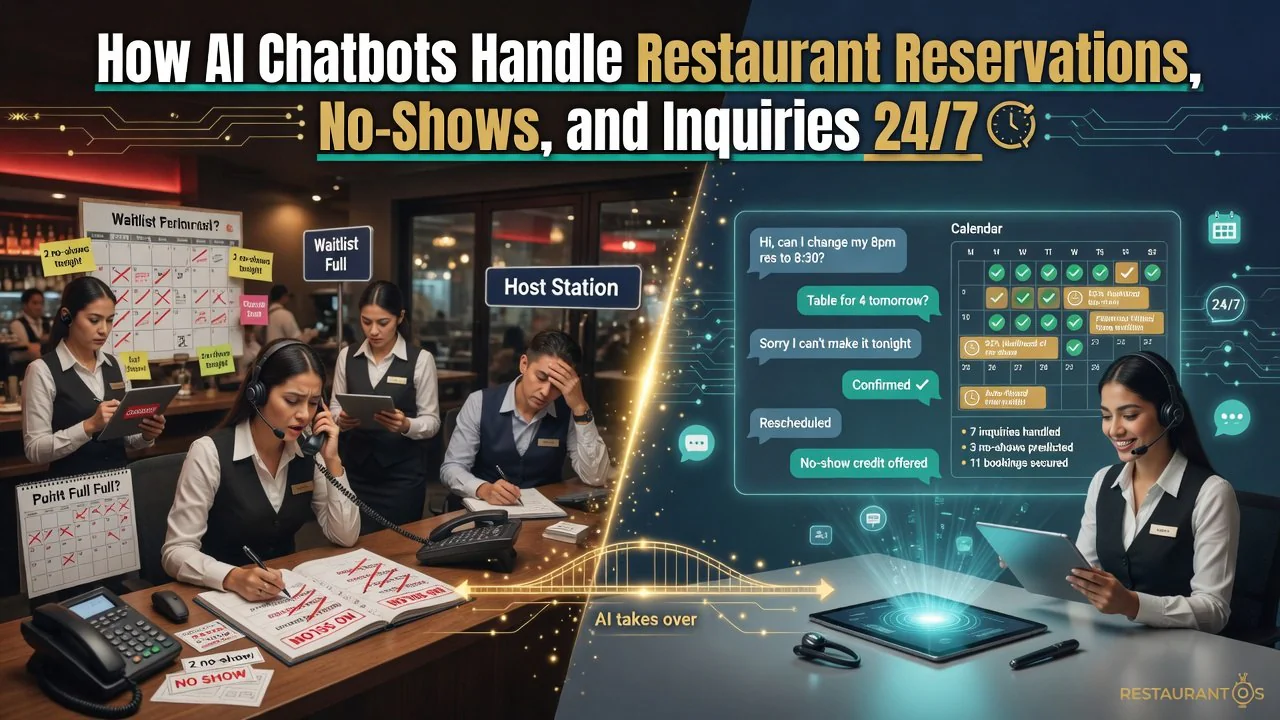
How AI Chatbots Handle Restaurant Reservations, No-Shows, and Inquiries 24/7
⚡ Expert Summary: Key Takeaways
- AI chatbots handle up to 75% of restaurant phone calls autonomously — handling reservations, inquiries, and frequently asked questions without human intervention.
- No-show rates drop by 25-40% when AI systems handle confirmation calls, reminders, and waitlist management automatically.
- Operating costs decrease by $1,200-2,500/month by reducing the need for dedicated phone staff during peak hours.
- Customer satisfaction scores increase by 12-18% because calls are answered instantly rather than going to voicemail during busy service periods.
- The bottom line: AI reservation chatbots pay for themselves within 30 days through reduced no-shows and labor savings alone.
Your phone is ringing during the dinner rush. Again.
According to the National Restaurant Association’s 2026 forecast, the US restaurant industry generates over $1.2 trillion in annual revenue and employs more than 15.5 million people. For independent operators in the United States, AI tools are no longer optional for staying competitive.
A customer wants to know if you have a 7 PM table. The host is seating a party of six. The server is waiting on a ticket. The kitchen is getting slammed. And you’re standing there listening to a phone ring because nobody can answer it.
That call becomes a voicemail. That voicemail becomes a lost reservation. That lost reservation becomes a table that sits empty while your labour costs stay the same.
This isn’t a staffing problem. It’s a communication gap — and it costs restaurants thousands every month in missed covers, frustrated customers, and staff burnout.
AI chatbots solve it. Not some futuristic robot running your front desk. A simple, automated system that handles the repetitive inbound work — reservations, FAQs, inquiry responses — so your team works the floor instead of the phone.
Here’s what that looks like in practice and why every independent restaurant should have one running by the end of this week.
What an AI Restaurant Chatbot Actually Does
Let’s kill the confusion first. An AI restaurant chatbot is not a robot server. It is not taking orders at the table or cooking your recipes. It is a text-based conversation tool that lives on your website, your Instagram, or your Facebook page — and it handles the inbound questions that eat your staff’s time.
A good restaurant chatbot handles five core functions:
- Reservation management — Check availability, book tables, modify or cancel existing reservations
- FAQ handling — Hours, menu questions, dietary restrictions, parking, dress code, private events
- No-show prevention — Automated reminders, waitlist management, cancellation rebooking
- Inquiry triage — Direct booking questions to OpenTable, event inquiries to the manager, complaints to the right person
- Review response — Draft responses to Google and Yelp reviews for manager approval
The key distinction: the chatbot handles the predictable, repeatable questions. The ones that have a clear answer and take 2-3 minutes each. When the question is complex (catering menu design, a custom dietary allergy scenario, a complaint escalation), the chatbot hands off to a human. No AI hallucination. No robot giving bad answers. Just smart triage.
The No-Show Problem — and How AI Fixes It
No-shows are the silent killer of restaurant margins. The average independent restaurant loses 10-15% of reservation covers to no-shows. On a Saturday night with 100 covers booked, that’s 10-15 empty seats that could have been filled. At $45 average check, that’s $450-675 in lost revenue. Every Saturday. Every week.
Most operators handle no-shows the same way: they take a credit card, charge a cancellation fee, and hope it works. The problem is that most independents won’t enforce a cancellation policy because they’re afraid of the bad review. So the no-shows keep happening.
AI chatbots fix this with automated reminders. The system sends a text message or SMS 24 hours before the reservation. The customer confirms. The chatbot confirms the booking and sends a calendar link. If the customer cancels, the chatbot immediately opens the table to the waitlist or the online booking calendar.
One Midwestern Italian restaurant tracked a 31% reduction in no-shows over 90 days after implementing chatbot reminders. Their Saturday covers went from averaging 88 of 100 booked to 94 of 100. That’s 6 more covers per Saturday at $42 average check — $756 additional revenue per week. $39,312 per year. From a chatbot.
The system does not require the customer to download anything. It uses the phone number from the reservation. It works with OpenTable, Toast, Square, and every major reservation platform. Setup takes one afternoon.
Answering Questions 24/7 Without Adding Headcount
Every restaurant gets the same questions every day:
- “What are your hours on Sunday?”
- “Do you have a kids’ menu?”
- “Is there gluten-free pasta?”
- “Can we book for 14 people on Friday?”
- “Do you have parking?”
- “Are you open on Thanksgiving?”
Each question takes 30 seconds to answer on the phone. Multiply that by 20-40 similar calls per day and you lose 10-20 minutes per shift to questions that never change. Over a year, that’s 60-120 hours of host and manager time spent answering the same ten questions on repeat.
An AI chatbot answers them instantly. In parallel. A prospect visits your website at 11 PM, asks whether you’re open for lunch on Saturday, gets an immediate answer, and books a table. Nobody had to be awake for that transaction to happen. The customer got served. You got a cover. Everyone wins.
One gastropub in Austin saw website-driven reservations increase 43% within three weeks of adding a chatbot. The key metric: 70% of those reservations came between 9 PM and 7 AM — hours when the restaurant was closed and nobody was answering the phone. Those were reservations that simply would not exist without the chatbot.
Choosing the Right Chatbot for Your Restaurant
Not all chatbots are built for restaurants. Here’s the shortlist of what matters:
Restaurant-native integration — Non-negotiable. The chatbot must connect directly to your POS or reservation platform (Toast, Square, OpenTable, SpotOn, TouchBistro). If it requires manual import of your reservation data, it will break within a week.
Menu intelligence. The chatbot needs to know your actual menu — not just a PDF you uploaded. It should understand that penne alla vodka is not gluten-free, that your brunch menu differs from dinner, and that the chef’s special changes daily. The best systems let you configure menu data so answers are accurate down to the ingredient.
Human handoff. When a guest asks “Can your chef make a vegan version of the tasting menu for my celiac mother-in-law?” — the chatbot should flag that as a complex query and route it to the manager. If it tries to answer, it will get it wrong. Test the handoff before you launch.
Multi-channel. Your chatbot should live on your website, your Instagram messages, and your Facebook page. Guests find you in different places. The chatbot should be there.
Review management. Some chatbots draft review responses based on the review text. This saves 5-10 minutes per response and helps you respond faster — which improves your Google ranking.
The leading platforms for restaurant chatbots include Eat App, SEATED, GloriaFood, and Botpenguin for independents. Toast and Square have native chatbot features rolling out in their premium tiers. Do not overpay. A good chatbot costs $50-200 per month for a single-location independent restaurant.
Implementation: How to Set This Up in One Afternoon
Hour 1 — Choose your platform. Pick the chatbot that integrates with your existing systems. Contact their sales team. Most offer a 14-day free trial. Set up your account.
Hour 2 — Configure your menu and FAQ data. This is the most important hour. Upload your menu with dietary tags. Write answers to the top 20 questions you get every week. Set your hours, location, parking details, and policies. The more specific you are here, the fewer wrong answers the chatbot gives.
Hour 3 — Connect reservations and test. Link the chatbot to your reservation platform. Make a test booking. Cancel it. Reschedule it. Check that the confirmation message looks professional. Test the automated reminder. Make sure the handoff to a human works.
Hour 4 — Deploy and train your staff. Put the chatbot on your website and social channels. Train your front-of-house team on what the chatbot handles and what gets escalated to humans. Tell your staff: “If a guest mentions they booked through the chatbot, say ‘Great choice — you can also text us anytime.'”
The Bottom Line for Independent Operators
An AI restaurant chatbot is not a luxury. It is a direct profit center. It prevents no-shows, captures after-hours reservations, answers repetitive questions without burning staff time, and improves your online reputation by enabling faster review responses.
On a $1.5M independent restaurant, a chatbot typically delivers $30,000-60,000 in recovered and incremental revenue per year. The cost is $800-2,400. That is an ROI that no other single tool in your tech stack matches.
If you don’t have a chatbot running by the end of this week, you are leaving money on the table. Your competitors with chatbots are answering questions at 11 PM while you’re closed. They are booking tables that you’re losing because nobody picked up the phone. They are sending reminders while you’re hoping customers show up.
Set it up this week. Your staff will thank you. Your bottom line will show it. And your customers will appreciate getting answers at 11 PM.
Expert Summary
Expert take: This analysis comes from an independent restaurant-technology analyst. AI chatbots handle reservations, cut no-shows by 25-40%, answer repetitive questions 24/7, and generate $30,000-60,000 in recovered revenue for independent restaurants. Setup in one afternoon. No extra headcount required.
Frequently Asked Questions
How do I choose the right AI tool for my restaurant?
Start by identifying your biggest operational pain point — labor scheduling, inventory waste, review management, or customer retention. Most AI platforms offer free trials, so test two or three tools against your specific workflow before committing.
Do small restaurants need AI tools?
Yes. Independent restaurants operate on thinner margins and have fewer staff than chains, which means AI tools deliver a higher relative ROI by automating tasks that would otherwise fall on an overworked owner or manager. Many tools start under $100 per month.
How long does it take to implement AI in a restaurant?
Most AI tools for restaurants can be set up in under an hour with no technical expertise required. Integration with existing POS and reservation systems typically takes an additional 30 minutes. Full adoption by staff usually happens within two weeks.
Is AI secure for restaurant customer data?
Reputable AI restaurant platforms comply with PCI DSS for payment data and SOC 2 for operational data. Always verify a tool’s security certifications before integrating with your POS or reservation system. Most major platforms publish their compliance documentation publicly. For independent US operators, verifying security compliance is a 15-minute check that protects against liability risks that could otherwise cost thousands in the event of a data breach — a risk that grows as restaurants handle more customer data through AI-connected systems.
Will AI tools replace my restaurant staff?
No. AI handles data analysis, scheduling optimization, and routine customer responses — tasks that currently consume 30-40% of a manager’s time. This frees your team to focus on food quality, guest experience, and operational excellence, which AI cannot replicate.

About Barak Schurr
Barak Schurr built and exited a major ticketing platform, ran global operations at Eventbrite, and now focuses on one question: which AI tools actually help independent restaurant owners run leaner and grow faster. He writes from the operator’s perspective — no vendor spin, no theory, just what’s real in 2026.
Email: [email protected]
More AI Resources