Get the AI Restaurant Quick-Start Guide — Free
The 5 AI tools independent US restaurant owners are using right now to cut labor costs and answer every call.
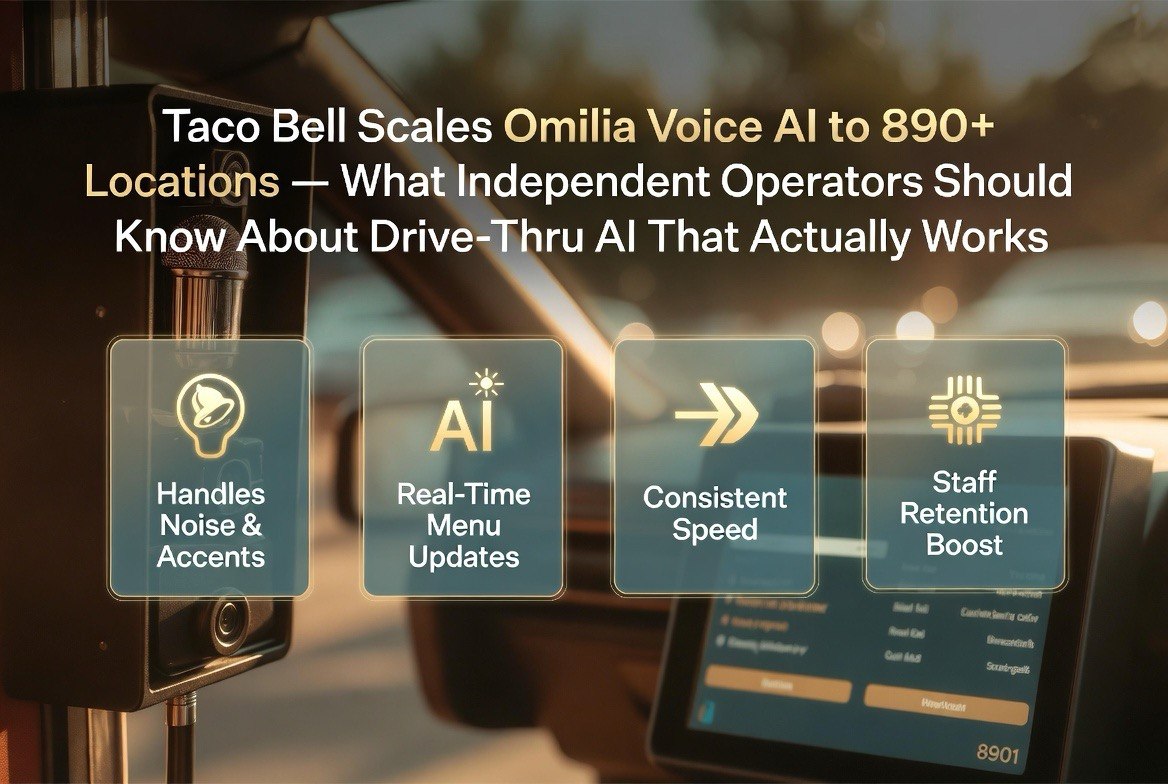
Taco Bell Scales Omilia Voice AI to 890+ Locations — What Independent Operators Should Know About Drive-Thru AI That Actually Works
⚡ Expert Summary: Taco Bell expanded its Omilia voice AI drive-thru system to over 890 US locations across 38 states as of July 2026. The system automates order-taking at the speaker, handles complex orders with modifications, filters road noise, and adapts to each location’s real-time menu — including limited-time offers and stock levels. Independent operators don’t have a Yum! budget, but the same technology is available through Omilia and competing vendors at a fraction of Taco Bell’s enterprise cost. This article breaks down what the Taco Bell rollout proves about voice AI ROI and how independent operators can apply the same principles without the corporate scale.
Taco Bell’s decision to push Omilia voice AI to nearly 900 restaurants in 38 states is not a science experiment. It is a production deployment at chain scale, and the data coming back from those locations tells independent operators exactly what works and what doesn’t in drive-thru voice AI.
The announcement, reported by Nation’s Restaurant News on July 8, 2026, confirms that Taco Bell’s partnership with Omilia — which began in 2023 with a small pilot — has moved into full-scale deployment. The technology is purpose-built for the drive-thru environment: proprietary small language models that handle noise filtering, sub-second latency, and real-time menu adaptation. It handles accent variations, modifications, slang, and complex orders without the hallucination problems that plague general-purpose AI models in noisy environments.
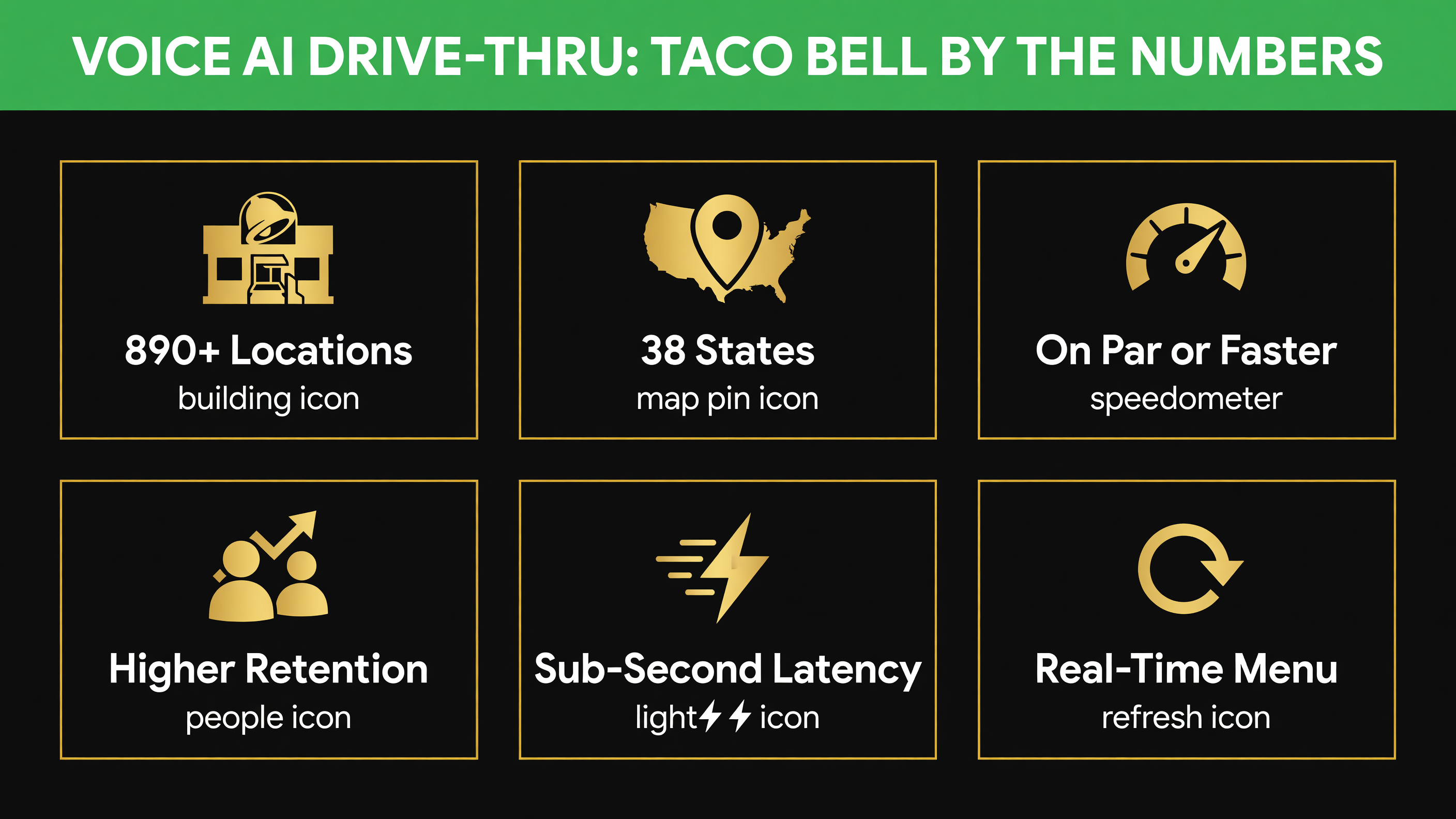
Taco Bell’s Omilia voice AI deployment covers 890+ locations across 38 states as of July 2026. Locations using voice AI report higher employee retention and on-par transaction times. Data from Nation’s Restaurant News, July 2026.
For the independent operator running one to ten locations, the immediate question is not “should I buy voice AI?” It is “what can I learn from Taco Bell’s $100 million deployment that applies to my $5,000 budget?”
The answer is more than you think.
What the Taco Bell Data Actually Proves
The most important data point from the Omilia rollout is hiding in plain sight. Taco Bell reported that locations using voice AI have higher employee retention compared to locations without it. This is not a customer experience metric. It is a labor metric.
Here is why that matters for independent operators. The restaurant industry is sitting on a turnover rate of approximately 122% annually — meaning the average restaurant replaces its entire staff every year. Every departure costs between $3,000 and $5,000 in lost sales over the subsequent three months while the position is open. If voice AI reduces the friction that causes kitchen staff to quit — specifically the stress of juggling drive-thru headsets while managing fryers and expo tickets — then the ROI on the technology is not measured in order speed. It is measured in retention dollars.
Taco Bell also reported that transaction times at voice AI-equipped drive-thrus are either on par with or faster than traditional order-taking. That is a conservative statement that actually understates the advantage. Human order-takers have variable performance based on shift timing, fatigue, and staffing levels. Voice AI maintains consistent performance at 2:00 AM during a graveyard shift, at 11:00 AM during the lunch rush, and at 7:00 PM during dinner service. The consistency alone is worth the investment.
The $18,000 Water Cup Incident and Why It Matters
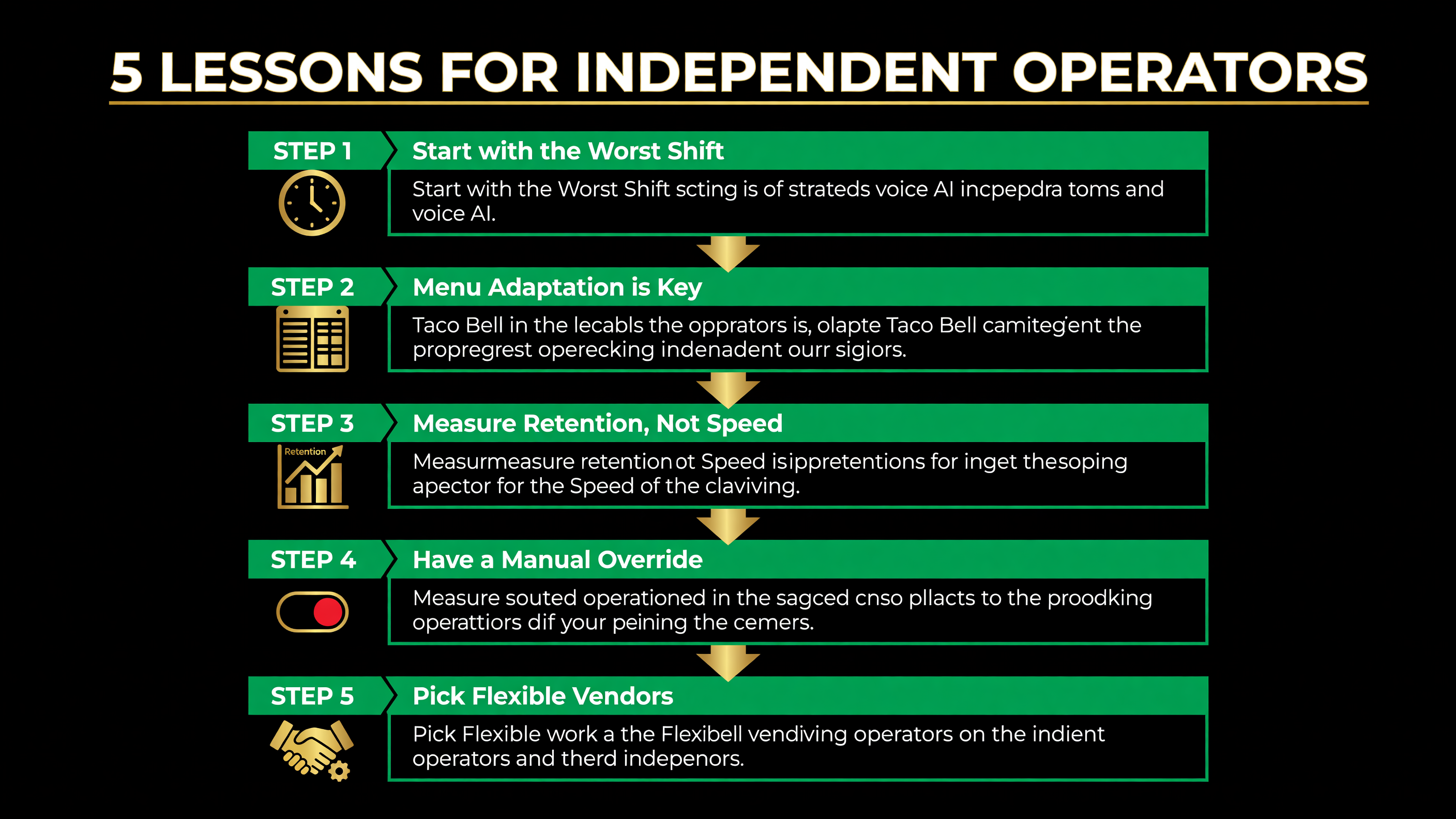
Five actionable lessons from Taco Bell’s voice AI deployment that independent operators can apply at any scale. Each step targets a specific operational risk.
No discussion of Taco Bell’s voice AI journey is complete without addressing the August 2025 incident where a customer ordered 18,000 cups of water through the system and the interaction went viral. The glitch exposed a weakness in early voice AI deployments: the system could not distinguish between a legitimate order and an adversarial interaction.
Taco Bell Global Chief Digital and Technology Officer Dane Mathews told the Wall Street Journal after the incident that the company was “thinking about where and where not to deploy the technology” — specifically that busier locations might benefit more from human order-takers.
For independent operators, this is valuable information. Voice AI in the drive-thru is not a replacement for all human interaction. It is a tool that works best when deployed strategically. A high-volume location with complex, custom orders may actually perform better with a human at the speaker during peak hours and voice AI handling the slower mid-day and late-night shifts.
The lesson is not that voice AI is fragile. The lesson is that deployment strategy matters more than the technology itself. Taco Bell scaled through this incident and continued expanding. Independent operators should expect similar bumps and build their deployment plans around phased rollout, not all-or-nothing switches.
What Independent Operators Can Steal From the Taco Bell Playbook
Taco Bell’s deployment teaches five specific lessons that apply at any scale.
Lesson 1: Start with the worst shift, not the best one. Taco Bell’s initial pilot targeted specific locations and expanded based on data. Independent operators should deploy voice AI on the shift that is hardest to staff — typically late-night or early morning — and measure the difference before expanding to peak hours. If the technology reduces stress on the one person covering the 11:00 PM to 6:00 AM window, that operator now has a retention advantage that compounds over months.
Lesson 2: Menu adaptation is the killer feature. Omilia’s system adapts to each location’s real-time menu, including limited-time offers and stock levels. An independent operator running a seasonal menu or daily specials needs voice AI that can handle menu changes without manual reprogramming. The technology exists. Do not buy a system that requires IT support to add a new menu item.
Lesson 3: Measure retention, not just speed. Taco Bell’s highest-impact metric was employee retention. Independent operators should track turnover rates at voice AI-equipped locations vs non-equipped locations before and after deployment. A 10% improvement in retention at a single location with 15 employees saves approximately $4,500 to $7,500 per year in avoided replacement costs. That alone justifies the monthly subscription for most voice AI vendors.
Lesson 4: Have a manual override plan. Taco Bell learned this the hard way. Every voice AI deployment needs a seamless handoff to a human when the system encounters an edge case. Independent operators should insist on a minimum of five seconds of interaction before escalation — enough to catch obvious issues without annoying customers.
Lesson 5: Partner with vendors that support franchise-style deployments. Omilia works with Taco Bell’s franchise network through the Byte by Yum platform. Independent operators need voice AI vendors that offer per-location pricing, self-service onboarding, and integration with their existing POS. Do not sign multi-year contracts. Month-to-month with a 30-day exit clause gives you the flexibility to switch vendors as the technology improves.
The Current Vendor Landscape for Independent Operators
Taco Bell uses Omilia, but Omilia is enterprise-focused. Independent operators have several viable alternatives that offer the same core capabilities at accessible price points.
SoundHound AI has partnered with Deliverect to integrate AI ordering agents with real-time menu data and POS systems, making phone orders flow directly into kitchen workflows. This is not drive-thru specific, but the phone ordering use case is identical in technical requirements — noise handling, accent recognition, menu adaptation — and the price point is significantly lower than Omilia’s enterprise tier.
Yelp Host has integrated voice AI with OpenTable, enabling AI-powered phone reservations that sync in real-time to OpenTable. An independent restaurant using OpenTable for reservations can add voice AI for booking management without a separate vendor relationship.
Several POS-embedded AI scheduling platforms, including Toast and Square, are adding voice ordering capabilities to their existing restaurant management suites. An operator already using Toast for POS can add voice AI as an integrated module rather than a separate system.
The key purchasing criterion is not which vendor has the best accuracy. All major vendors are within two to three percentage points of each other on standard accuracy benchmarks. The differentiator is integration depth with the operator’s existing POS, menu management system, and scheduling software.
Why Taco Bell’s Scale Actually Helps Independent Operators
Here is the counterintuitive truth: Taco Bell’s massive deployment makes voice AI better for independent operators, not worse.
Every order processed through Omilia at those 890 locations generates training data that improves the underlying model. Accent variations from different regions, complex order combinations, seasonal menu items — all of that data feeds back into the model and makes it more accurate for every deployment, including the small operator running a single drive-thru in rural Kansas.
The same dynamic applies to every major voice AI vendor. SoundHound’s partnership with chains like Panda Express and White Castle generates training data that benefits every restaurant using their platform. Enterprise-scale deployments subsidize the model improvements that make voice AI viable for independent operators.
This is the same pattern that played out with cloud computing, POS systems, and online ordering. Enterprise scale creates infrastructure that eventually becomes a commodity. Voice AI for the drive-thru is at the front end of that curve in 2026. Independent operators who adopt now will benefit from the model improvements that Taco Bell and other chains are paying to develop.
What the Numbers Look Like for a Single-Location Deployment
A realistic cost breakdown for voice AI at an independent drive-thru in 2026:
Voice AI software subscription: $300 to $800 per month per location, depending on order volume and vendor. Hardware (microphone array, speaker integration): $500 to $2,000 one-time, depending on existing drive-thru infrastructure. Integration setup with existing POS: $0 to $500 one-time, depending on whether the vendor supports the operator’s POS. Training and onboarding: Included in most subscriptions.
Total first-year cost for a single drive-thru location: approximately $4,100 to $11,600.
The payoff comes from three sources. First, labor savings: reducing the time a crew member spends on the headset during slow shifts frees that person to work the line or prep station. Second, retention improvement: if voice AI reduces turnover by even 10%, the avoided replacement costs alone cover the subscription. Third, accuracy improvements: voice AI does not miss items, does not mistype orders into the POS, and does not forget to upsell.
Independent operators serving 200 to 400 drive-thru customers per day at an average ticket of $8 to $12 should expect voice AI to pay for itself within six to twelve months of deployment based on labor savings and accuracy improvements alone, without accounting for retention benefits.
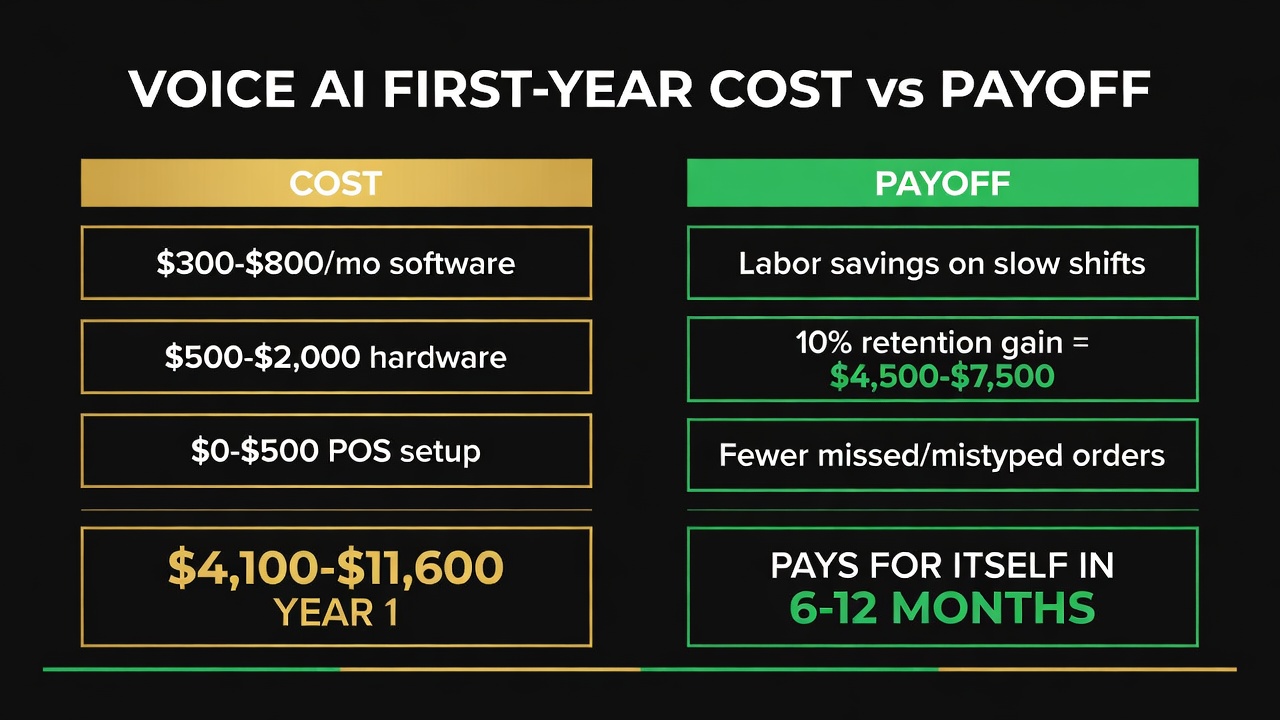
First-year cost vs. payoff for a single drive-thru adding voice AI. Software, hardware, and setup run roughly $4,100-$11,600, but labor savings and retention gains typically pay it back in 6-12 months. Figures modeled from Omilia pricing and industry labor benchmarks.
How to Start Without the Yum! Budget
The fastest path to voice AI for an independent operator requires three steps and approximately two weeks from decision to deployment.
Step one: Audit your drive-thru volume by shift. Track how many orders you process per hour between 11:00 PM and 6:00 AM, between 2:00 PM and 5:00 PM, and during lunch and dinner peaks. The slow shifts are where voice AI delivers the fastest ROI because the labor cost per order is highest.
Step two: Request demos from three vendors — SoundHound, Yelp Host, and your POS provider’s voice AI module if available. Test each system on your actual menu with your actual staff. Accuracy is table stakes. Integration depth and ease of menu management are the real differentiators.
Step three: Deploy on one shift at one location. Measure order accuracy, transaction time, and staff satisfaction for 30 days. If the data shows improvement, expand to additional shifts and locations. If the data is neutral, pause and identify whether the issue is the technology, the deployment strategy, or a mismatch between the vendor’s capabilities and your menu complexity.

About Barak Schurr
Barak Schurr built and exited a major ticketing platform, ran global operations at Eventbrite, and now focuses on one question: which AI tools actually help independent restaurant owners run leaner and grow faster. He writes from the operator’s perspective — no vendor spin, no theory, just what’s real in 2026.
Email: [email protected]
More Resources for Restaurant Operators