Get the AI Restaurant Quick-Start Guide — Free
The 5 AI tools independent US restaurant owners are using right now to cut labor costs and answer every call.
OpenAI Presence for Restaurants: What AI Phone Agents With Guardrails Mean for Independent Operators
⚡ Expert Summary: OpenAI launched Presence on July 22, 2026 — a managed enterprise platform for governed AI agents that handle phone calls, customer service, and operational workflows. While Presence is enterprise-only today, the guardrails, evaluation frameworks, and improvement loops it introduces will directly shape the AI phone agents that independent restaurants will use within 12-18 months. This article explains what Presence does, who is deploying it, and what independent US restaurant owners should do now to prepare.
OpenAI launched Presence on July 22, 2026 — an enterprise platform for deploying governed AI agents that handle real-time voice and chat conversations across phone lines, websites, and messaging apps. For independent US restaurant owners, Presence matters because it solves the problem that has kept AI agents out of restaurant operations: the inability to trust that an agent will handle a phone order, a reservation, or a customer complaint correctly without causing a disaster.
OpenAI’s own English-language phone support (1-888-GPT-0090) runs on Presence and resolves approximately 75% of inbound issues without human assistance. A Codex-powered improvement loop cut human handoffs by 15 percentage points in just 10 days. These are production metrics from millions of real customer interactions, not marketing slides.
The enterprise tier of any technology always shapes what eventually reaches small businesses. Understanding Presence today tells you what AI phone agents for restaurants will look like in 2027 and 2028 — and what independent operators should be preparing for now.
What Presence Actually Means for Restaurant Phone Handling
Presence is not a self-serve AI phone agent. It is a managed deployment platform that integrates five governance components into a single production system. For restaurants, each component maps directly to real operational requirements:
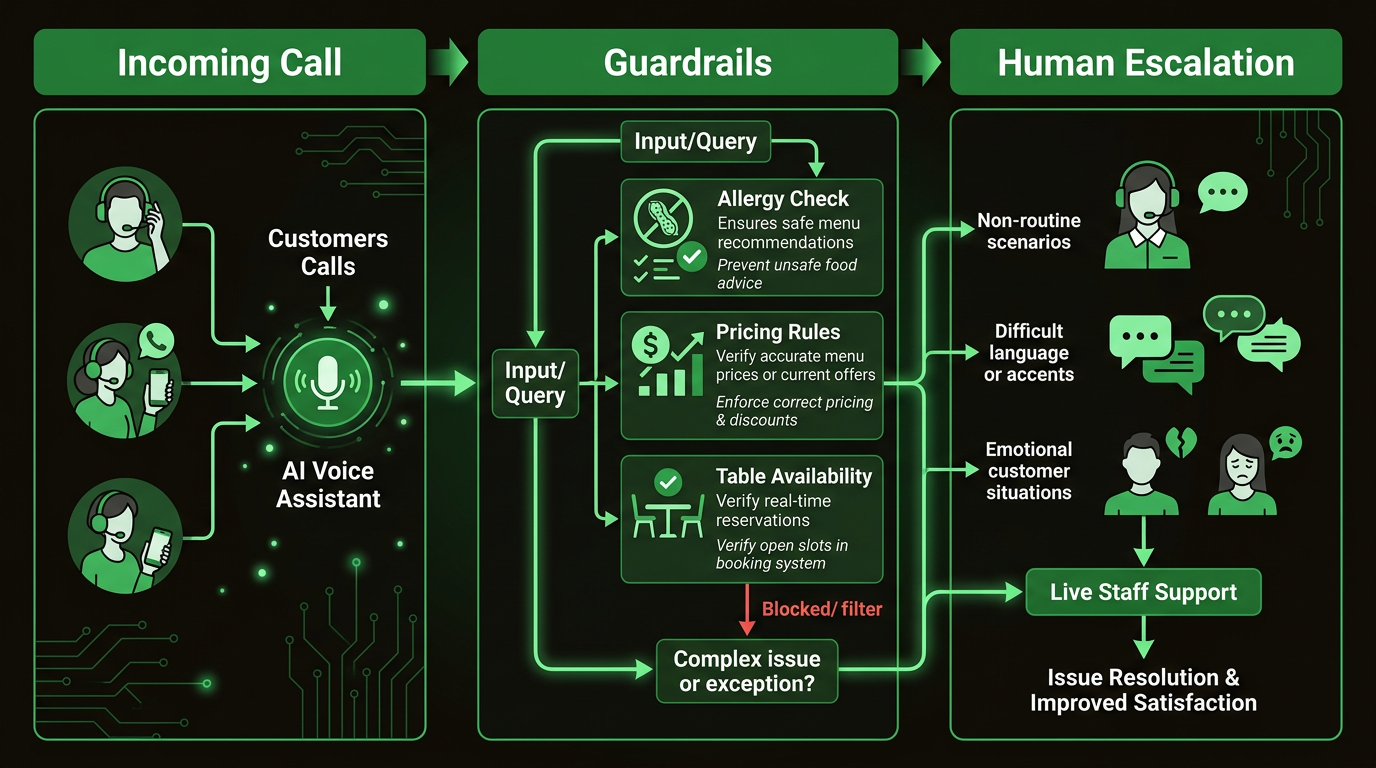
An AI guardrail system for restaurant calls enforces price accuracy, allergy warnings, and table availability before escalating complex issues to human staff. Presence builds this governance layer as a core feature rather than an afterthought.
| Presence Component | What It Does | Restaurant Equivalent |
|---|---|---|
| Policies and SOPs | Defines what the agent can do and when humans must step in | Menu items, pricing rules, reservation policies, dietary restriction handling |
| Guardrails and Permissions | Intervenes when conversations leave approved boundaries | Allergy warnings, overbooking prevention, delivery zone confirmation, price accuracy checks |
| Simulations and Evaluations | Tests agents against real scenarios before launch | Practice runs with common customer requests, difficult edge cases, and high-volume peak-hour tests |
| Codex Improvement Loop | Analyzes production calls to suggest agent improvements | Automatically learns from calls it handles well and escalations it mishandles — agents get smarter over time |
| Human Escalation | Structured handoff with full context when agent cannot proceed | Transfers frustrated customers, disputed charges, or complex custom orders to staff with complete conversation history |
How Presence Differs From Existing Restaurant AI Phone Agents
Several AI phone agents already serve the restaurant industry — Loman AI, Slang AI, Flipdish AI, and SoundHound’s restaurant offering. These agents handle reservations, take orders, answer FAQs, and integrate with POS systems. Presence does not compete with them at the restaurant level. Instead, it provides the enterprise-grade governance infrastructure that powers agents at scale.
The difference is the guardrails. Existing restaurant AI agents operate within their platform’s own guardrail system. Presence lets enterprises define their own policies, run their own simulations, and control exactly when and how agents escalate to humans. It is the difference between renting an agent with someone else’s rules and owning an agent with your own rules.
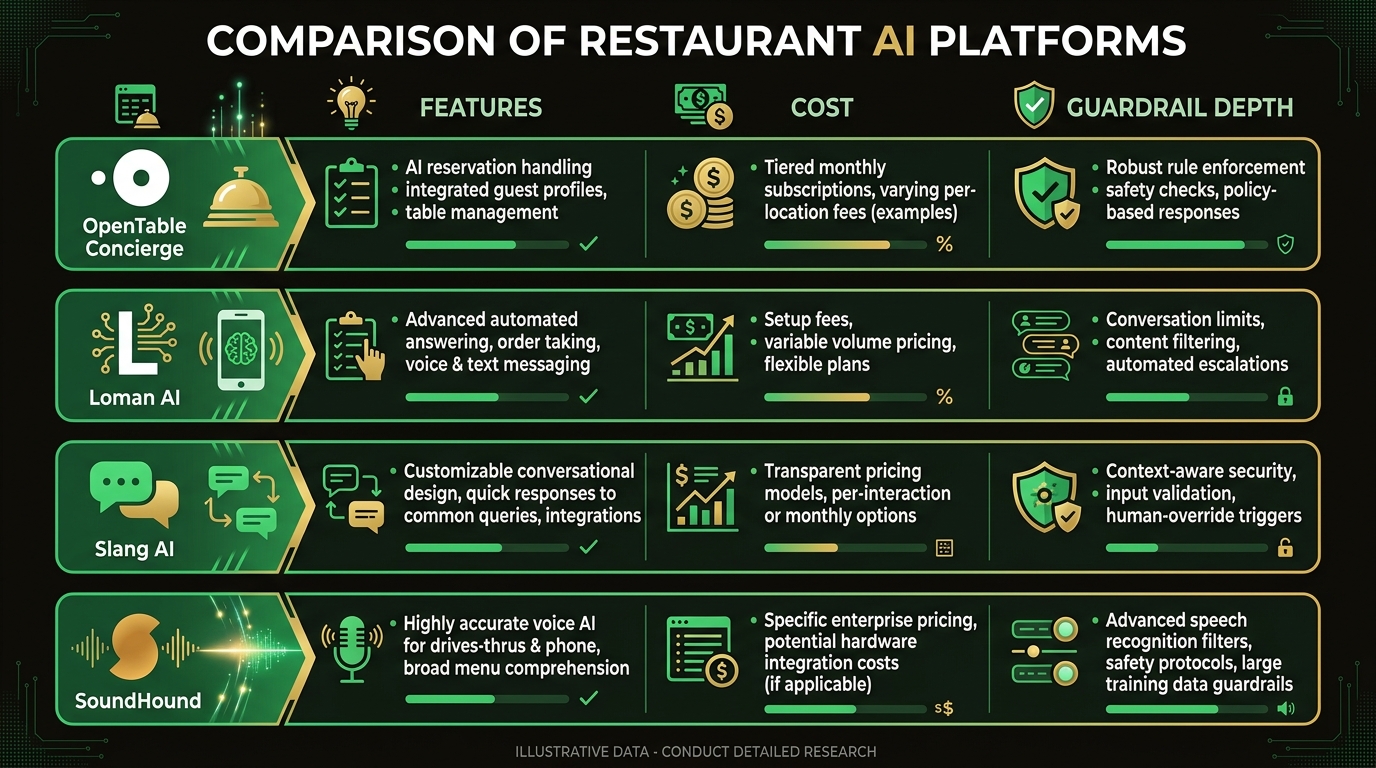
Current restaurant AI phone agents offer self-serve deployment with platform-level guardrails. Presence goes deeper with company-defined policies, simulations, and continuous improvement — but it is enterprise-only today.
What Independent Restaurant Owners Should Do Now
Presence is not available to independent restaurants. It requires an OpenAI Forward Deployed Engineer or a select systems integrator to implement. Pricing is negotiated per deployment and likely starts well above what a single-location restaurant can justify.
That does not mean Presence is irrelevant to independent operators. The governance patterns it validates — company-defined policies, pre-launch simulations, continuous improvement loops — are the features that will define the next generation of restaurant AI phone agents. Here is what the transition looks like:
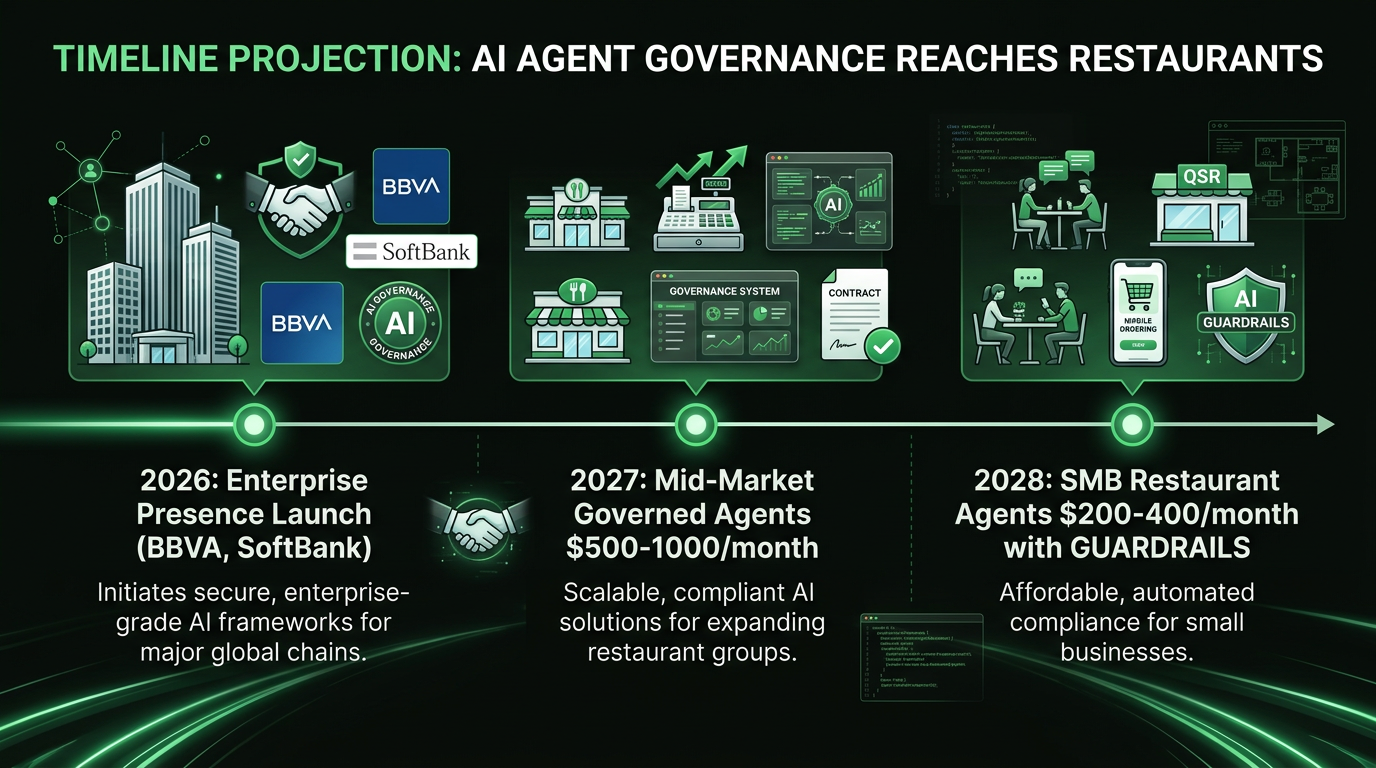
Enterprise AI governance patterns like Presence take approximately 18-24 months to reach SMB pricing tiers. Mid-market restaurant groups may see governed agents in 2027, while single-location operators can expect affordable options with meaningful guardrails by 2028.
- 2026: Presence launches at enterprise level. Large hospitality groups and chains begin evaluating governed AI agents for phone handling. Independent restaurants are not affected yet.
- 2027: Mid-market governed agents arrive at $500-1,000 per month. Regional multi-location operators can access AI phone agents with guardrails comparable to Presence. Third-party platforms like Toast, Square, and OpenTable begin integrating governed AI features.
- 2028: SMB restaurant agents reach $200-400 per month with meaningful guardrails. Independent operators gain access to AI phone agents that can handle reservations, order taking, and FAQs with built-in policy enforcement and human escalation.
What to Do in the Meantime
Independent US restaurant owners should take three practical steps over the next 12 months:
1. Document your phone policies. The businesses that get the most value from governed AI agents will be those with clear SOPs for phone handling — pricing rules, reservation policies, dietary restriction protocols, escalation triggers. If an AI agent needs written policies to follow, having those policies already exists halves the implementation time.
2. Get comfortable with existing AI phone agents. Loman AI and Slang AI offer self-serve AI phone agents that work with major POS systems today. The specific features of these agents will evolve, but the operational patterns — automated call handling, POS integration, human escalation — will remain. Running a simple test with an existing agent builds the muscle memory that will matter when governed agents arrive.
3. Watch for POS-platform integration. The fastest path to governed AI agents for independent restaurants is through Toast, Square, or OpenTable embedding governance features into their existing phone agent products. When a major POS platform announces “policy guardrails” or “custom escalation rules” for their AI phone agent, that is the inflection point. That will likely happen in 2027.
The Bottom Line for Independent Operators
OpenAI Presence is not for your restaurant today. But it is one of the most important AI developments of 2026 for the restaurant industry because it proves that governed, production-grade AI agents can handle high-stakes customer interactions at scale. The 75% resolution rate on OpenAI’s own support line is the benchmark that AI phone agents for restaurants will need to match.
The guardrails, the simulations, the evaluation graders, the continuous improvement loop — these are the features that turn AI agents from a risky experiment into a reliable operational tool. Presence proves they work at enterprise scale. The question is how quickly they reach the pricing and packaging that independent US restaurant owners can use.
Start documenting your policies now. Start testing existing AI phone agents now. When governed agents reach restaurant pricing in 2027-2028, the operators who have already done the preparation will be the ones who get the most value, the fastest.
Frequently Asked Questions
Can independent restaurants use OpenAI Presence?
No. OpenAI Presence is currently enterprise-only and requires an OpenAI Forward Deployed Engineer or select systems integrator to implement. Pricing and availability are negotiated per deployment and are not publicly available. It is not a self-serve product suitable for independent restaurant budgets.
What can an AI phone agent do for a restaurant?
AI phone agents for restaurants can answer incoming calls, take food orders, manage reservations, handle delivery requests, answer frequently asked questions, upsell menu items, process payments, and escalate complex issues to human staff. They integrate with POS systems to access real-time menu, pricing, and reservation data.
Which restaurant AI phone agents are available now?
Loman AI, Slang AI, Flipdish AI, and SoundHound offer AI phone agents for restaurants with POS integration, reservation management, and order taking. These are self-serve products with monthly subscription pricing. Presence is an enterprise platform that provides deeper governance than any of these existing solutions.
How much do AI phone agents for restaurants cost?
Existing AI phone agents for restaurants typically cost $200-1,000 per month depending on call volume, features, and integrations. Loman AI and Slang AI offer tiered pricing based on monthly call minutes. OpenAI Presence is enterprise-only with bespoke pricing significantly above these self-serve tiers.
Will OpenAI Presence replace restaurant phone agents like Loman AI?
Not directly. Presence is an enterprise platform that powers governed AI agents at scale. Existing restaurant phone agents like Loman AI and Slang AI may incorporate Presence-compatible governance features over time, but Presence itself is not positioned as a restaurant-specific product. The guardrails framework Presence validates will likely influence the next generation of restaurant AI phone agents.
When will governed AI agents reach restaurant pricing?
Industry projections suggest mid-market governed agents with custom policies and guardrails will reach the $500-1,000 per month range by 2027, with independent restaurant pricing around $200-400 per month by 2028. POS platforms like Toast and Square are expected to integrate governance features into their existing AI phone agent products starting in 2027.

About Barak Schurr
Barak Schurr built and exited a major ticketing platform, ran global operations at Eventbrite, and now focuses on one question: which AI tools actually help independent restaurant owners run leaner and grow faster. He writes from the operator’s perspective — no vendor spin, no theory, just what’s real in 2026.
Email: [email protected]
More AI Resources for Your Business