Brandoven Virtual Kitchen AI: A 24/7 Agent That Runs Your Cloud Kitchen Operations
⚡ Expert Summary: Brandoven is an AI-agent system purpose-built for virtual and cloud kitchens that autonomously handles menu design, inventory management, delivery platform listings, and dynamic pricing around the clock. Designed for operators running multiple virtual brands from a single kitchen, it aims to cut the 15-30% revenue bleed that independent operators lose to delivery platform commissions, advertising costs, and multi-platform management friction — without adding headcount or requiring a dedicated tech team.
What Brandoven Does
Brandoven is a specialized AI agent platform for the fastest-growing segment of restaurant operations: the virtual kitchen economy. These are delivery-only restaurant operations that manage multiple brands, menus, and delivery platform listings from a single physical kitchen. A single location might operate three to five virtual brands — one doing burgers, another doing tacos, another doing salads — each with a separate menu, pricing strategy, and presence on DoorDash, Uber Eats, Grubhub, and potentially regional delivery platforms.
That means the operator is managing 15-25 individual menu listings, each with its own pricing, photos, descriptions, and inventory constraints. A mistake on any one listing — wrong price, outdated photo, sold-out item still showing as available — loses money immediately.
Brandoven replaces the human manager who would need to track all those variables across all those platforms. Its AI agents handle the full operational loop autonomously.
Growth of the Virtual Kitchen Market
The virtual kitchen market has grown rapidly in the United States, driven by permanent changes in how people order food. According to industry estimates, virtual kitchens now represent approximately 15-20% of all delivery orders in major US metropolitan markets. The economics are straightforward: lower real estate costs (no prime dining room space, no expensive storefront buildout), lower staffing requirements (no servers, hosts, or bussers), and the ability to pivot menus and brands quickly based on demand patterns. A virtual kitchen can launch a new brand concept in days rather than the months it takes to open a traditional restaurant.
But the operational complexity grows faster than the revenue. A single-brand virtual kitchen with one platform connection is relatively simple to manage. Add a second brand sharing the same kitchen: now you have two menus, two sets of inventory rules, two pricing strategies, two customer bases. Add a third brand and a third delivery platform: the management overhead has tripled while revenue has not tripled proportionally because the additional brands cannibalize some orders from existing ones. This nonlinear growth in operational complexity is the core problem Brandoven addresses.
The Problem Virtual Kitchens Face
Virtual kitchens operate on razor-thin margins. The typical virtual kitchen loses 15-30% of potential revenue to three overlapping costs: delivery platform commissions (which can reach 15-30% of each order), platform advertising (paying for placement within delivery apps to stay visible), and the operational friction of managing multiple brands, menus, and platforms without dedicated staff for each.
The pricing dynamic with delivery platforms is particularly challenging for virtual kitchens. Unlike a traditional restaurant where the dining room provides a higher-margin revenue stream that subsidizes delivery operations, a virtual kitchen has only one channel: delivery. Every dollar spent on commissions and advertising comes directly out of the kitchen’s margin. There is no offsetting dine-in revenue to absorb platform costs.
This is why virtual kitchen operators need every operational efficiency they can find. A 2% improvement in menu pricing optimization or a 1% reduction in wasted inventory is not incremental — it is often the difference between profitability and break-even.
How Brandoven’s AI Agents Work
Autonomous Menu Design
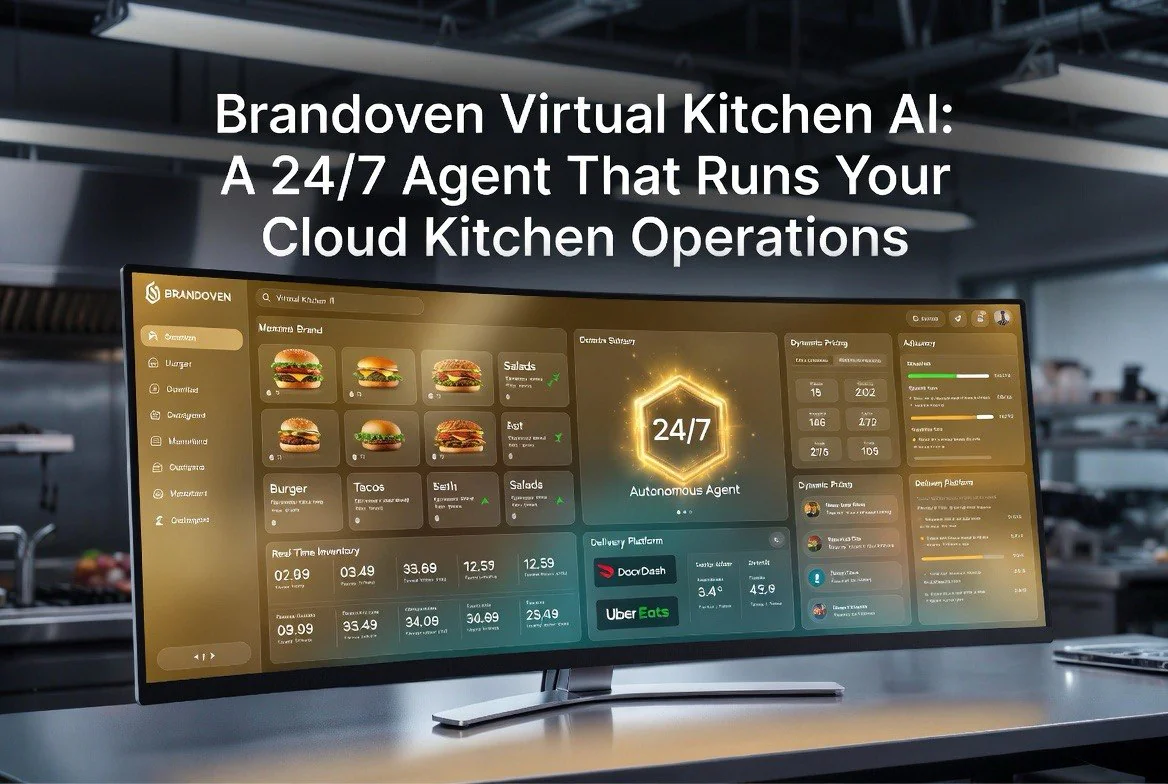
Brandoven analyzes each virtual brand’s sales data, cost of goods, margin contribution per item, and competitive pricing on each delivery platform. It does not just set prices once — it continuously adjusts menu composition and pricing based on real-time signals. Items that perform better on DoorDash versus Uber Eats get optimized placement and pricing on each platform. When ingredient costs shift — beef prices spike, avocado supply tightens — Brandoven identifies the impact on margin and suggests or implements price adjustments or substitute items.
This dynamic approach to menu management is something a human operator cannot do at scale. A human can update a menu once a week. Brandoven adjusts pricing in real time based on current cost data, competitor moves, and demand patterns.
Real-Time Inventory Management
Because multiple virtual brands share inventory from one kitchen, ingredient tracking is exponentially more complex than in a single-brand kitchen. If the taco brand uses the same ground beef as the burger brand, and both have active promotions, the kitchen could run out of beef by 7 PM without any single brand’s ordering system flagging the problem.
Brandoven tracks ingredient usage across all brands in real time. When a shared ingredient drops below a configurable threshold, the system deactivates menu items across affected brands. This prevents the kitchen from receiving orders it cannot fulfill — a catastrophe for a delivery-only operation where a cancelled order means a negative customer experience, a refund, and a lost customer who may never order again.
The system also forecasts inventory needs based on order patterns, day-of-week trends, upcoming promotions, and seasonal demand shifts. It can generate purchase orders and suggest order quantities to kitchen management.
Delivery Listing Optimization
Each delivery platform operates differently. DoorDash customers behave differently than Uber Eats customers. Commission rates, promotional mechanics, customer demographics, and pricing sensitivities vary by platform. A price that converts well on Uber Eats might kill conversion on DoorDash. A promotional placement that drives volume on DoorDash might be wasted spend on Grubhub.
Brandoven adjusts pricing, menu placement, and promotional timing per platform based on actual performance data. Items that drive profit on one platform can be loss-lead on another — Brandoven identifies these patterns and optimizes accordingly, rather than applying a one-size-fits-all pricing strategy across all platforms.
Dynamic Pricing Engine
The pricing engine adjusts based on four inputs: ingredient costs, platform commission rates, demand patterns (time of day, day of week, holiday impact), and competitor pricing in the immediate geographic area. The system can run A/B price tests across platforms and time slots to find the optimal price point for each menu item on each channel. A 50-cent price increase on a top-selling item might reduce volume by 3% but increase margin by 12% — Brandoven identifies and implements these optimizations continuously.
Who Brandoven Is For
Brandoven is not for a traditional dine-in restaurant with one menu and one delivery platform connection. It is for the growing segment of operators running virtual brands, ghost kitchens, commissary kitchens, or multi-concept delivery operations out of a single kitchen.
If you operate two or more virtual brands from one kitchen and manage listings on DoorDash, Uber Eats, and Grubhub, Brandoven likely replaces 15-25 hours of manual platform management per week. For single-brand virtual kitchen operators, the value is still substantial — the dynamic pricing and inventory features alone can save 5-10 hours per week and reduce costly errors — but the full ROI case strengthens as brand complexity increases.
The early target market is multi-concept operators with 3-5 virtual brands running on 3-5 platforms. These operators have the most to gain from automated management and the most to lose from manual errors.
What This Means for the Virtual Kitchen Industry
Brandoven represents a trend that is accelerating across the restaurant industry: AI agents that manage specific operational domains autonomously rather than AI tools that assist human managers. The distinction matters. A tool that helps a human manager update menus faster still requires human attention, human judgment, and human hours. An agent that manages menus autonomously, alerts the human only when intervention is needed, and handles routine operations without any human attention — that changes the operational structure of the business.
For virtual kitchen operators, the implications are significant. The staffing model for a virtual kitchen has always been problematic — you need management talent to handle platform management, inventory, pricing, and vendor relationships, but the margins of a virtual kitchen cannot support a large management team. AI agents that handle these domains autonomously solve the fundamental economic tension: the complexity of the operation requires management, but the margins of the operation cannot fund it. Brandoven and similar agent platforms change that equation.
Limitations and What Brandoven Does Not Cover
No current AI agent handles the complete operational loop of a virtual kitchen. Brandoven covers menu management, pricing, inventory, and platform listings — the management and administrative layer. It does not handle food preparation, packaging, order fulfillment, driver management, or customer service. Digital ordering and voice AI integrations would still need to be managed separately or through other tools.
For operators evaluating Brandoven, the key question is whether the administrative burden of multi-brand, multi-platform management justifies the cost of the platform. For single-brand operators with one or two delivery platform connections, the manual effort is manageable and may not justify an AI agent subscription. For operators with three or more brands and three or more platforms, the manual management hours escalate nonlinearly, and the case for automation becomes compelling.
How Brandoven Compares to Other Virtual Kitchen Management Tools
The virtual kitchen management software market has traditionally offered two categories. Order management platforms handle the operational layer — receiving orders from delivery platforms, routing them to the kitchen, managing fulfillment. Inventory management systems track ingredient usage and generate purchase orders. Neither category has traditionally handled menu design, pricing optimization, or platform-specific listing management — which is where the most operator time is spent and where the most money is lost through pricing errors and missed optimization opportunities.
Brandoven sits in a gap that the existing tools do not serve well. It is not an order management system or an inventory system (though it connects to both). It is a management layer above both, handling the strategic and tactical decisions — what to sell, at what price, on which platform, with what promotional support — that human operators struggle to optimize across multiple brands and platforms simultaneously.
Getting Started With Brandoven
Brandoven is in its early stages, with limited public information about pricing, trial availability, and specific integration requirements. Virtual kitchen operators interested in the platform should reach out directly or monitor updates through X/Twitter where the company has been active sharing product updates. Given the early stage of the product and the limited public deployment data, operators should plan for a pilot period with specific success metrics rather than expecting immediate enterprise-grade reliability.
FAQ
What is Brandoven Virtual Kitchen AI?
Brandoven is an AI-agent system for virtual and cloud kitchens that autonomously manages menu design, inventory, delivery platform listings, and dynamic pricing across multiple brands and channels without requiring human oversight for routine operations.
How much can Brandoven save a virtual kitchen?
Brandoven targets the 15-30% revenue bleed that virtual kitchens lose to platform commissions, advertising costs, and operational friction. Exact savings depend on the number of brands, platforms, and current management processes. Multi-concept operators with 3-5 brands on 3-5 platforms see the highest ROI.
Does Brandoven work with traditional restaurants?
Brandoven is designed for virtual and cloud kitchens running multiple brands and delivery platforms. Single traditional restaurants will benefit from the inventory and pricing features, but the full value comes from managing multi-brand, multi-platform complexity.
What delivery platforms does Brandoven support?
Brandoven supports major US delivery platforms including DoorDash, Uber Eats, and Grubhub. The system adjusts pricing, menu placement, and promotional timing per platform based on each platform’s commission structure and customer behavior patterns.
How does Brandoven handle shared inventory across brands?
Brandoven tracks ingredient usage across all virtual brands in real time. When a shared ingredient runs low, it deactivates menu items across affected brands to prevent unfillable orders. It also forecasts inventory needs and generates purchase orders based on order patterns and upcoming promotions.
Is Brandoven replacing kitchen staff?
No. Brandoven replaces management overhead — the hours spent on menu updates, pricing changes, platform management, and inventory tracking. Cooking, packaging, and delivery operations still require kitchen staff. The value is in reducing the management burden that virtual kitchen margins cannot support.

About Barak Schurr
Barak Schurr built and exited a major ticketing platform, ran global operations at Eventbrite, and now focuses on one question: which AI tools actually help independent restaurant owners run leaner and grow faster. He writes from the operator’s perspective — no vendor spin, no theory, just what’s real in 2026.
Email: [email protected]
More AI Resources