Deliverect and SoundHound AI Partner on Voice Ordering for Restaurants: What Independent Operators Need to Know
⚡ Expert Summary: Deliverect and SoundHound AI announced a partnership on July 23, 2026, integrating SoundHound’s voice AI ordering directly into Deliverect’s order and menu management system. The integration connects 550+ POS systems across 80,000 restaurant locations in 50+ countries, supporting 100+ languages. Voice orders from phone, drive-thru, kiosk, and in-car systems route straight to kitchen fulfillment without manual entry. For independent operators already using Deliverect, this turns voice into a fully automated ordering channel with no custom development required.
What the Deliverect-SoundHound Partnership Does
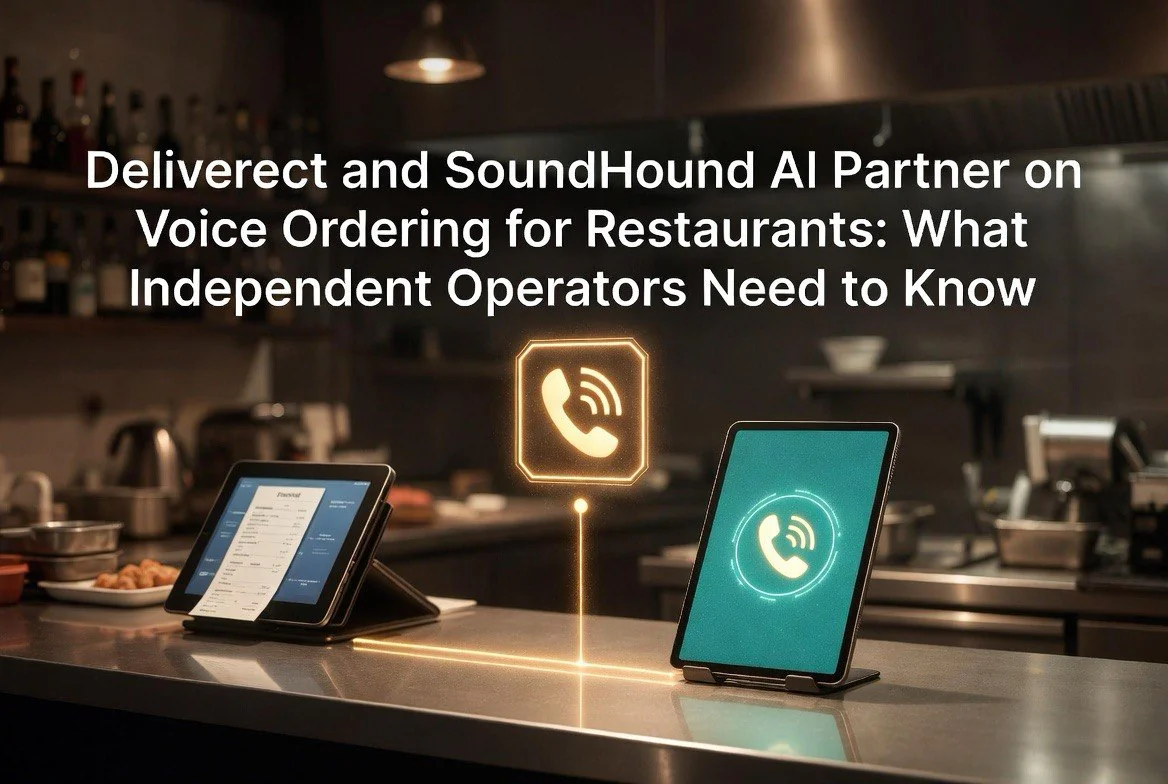
SoundHound Smart Ordering now feeds directly into Deliverect’s order and menu management platform. When a customer places a voice order — by phone, at a drive-thru, through a kiosk, or via in-car voice commerce — SoundHound’s AI agent captures the order, pulls real-time menu and location data from Deliverect, and routes it straight to the kitchen through Deliverect’s 550+ certified POS integrations.
No manual re-entry. No missed calls. No handoff errors. No staff tied to a phone during a dinner rush. The voice channel becomes as reliable and automated as a web order or a delivery platform integration.
The partnership builds on SoundHound’s existing voice commerce infrastructure, which has been deployed at chains like Chipotle and Jersey Mike’s, and brings it to Deliverect’s network, which skews heavily toward independent operators and mid-size chains.
Why Voice Ordering Has Been the Hardest Channel to Automate
Digital ordering — websites, apps, and delivery platforms — now handles 30-40% of orders at many independent restaurants. These channels are automated, reliable, and efficient. But the phone keeps ringing, and every call answered by a busy line cook or a front-of-house worker during a rush is an order at high risk of being wrong or abandoned.
The challenge has been accuracy. Early voice ordering systems struggled with accents, background noise, menu item ambiguity, and the complexity of natural language modifications. A customer saying “I’ll have the Southwest salad but no corn, extra avocado, and substitute the ranch for the cilantro lime dressing” is a simple sentence for a human but a complex parsing problem for a voice system.
SoundHound’s Dynamic Interactive Voice Response technology has advanced significantly on this front. Its agentic voice AI handles complex multi-item orders, modifications, and conditional requests with accuracy rates that match or exceed human order-takers in controlled deployments. Real-world restaurant deployments show order capture rates above 95%, compared to 60-70% for human-staffed phones during peak hours.
What Restaurants Actually Get From the Integration
24/7 Call Coverage Without Extra Staff
Every incoming call gets answered, every time, even during the 2 PM lull or the Friday night rush. The AI captures the full order, handles modifications, suggests upsells based on programmed rules, and confirms the total before sending it to the kitchen. Restaurants that previously had to let calls go to voicemail during peak hours can now capture every order opportunity.
Consistent Upselling Every Single Time
The AI agent follows programmed upselling rules on every call — no forgotten “Would you like fries with that?” on a busy Friday night when staff are stretched thin. Operators can adjust prompts, specials, and cross-sell items through the Deliverect dashboard without touching SoundHound’s configuration. A seasonal menu item can be promoted for exactly one week and then retired, with no staff training or reminder needed.
Real-Time Menu Accuracy
This is where the Deliverect integration adds unique value. Menu changes made in Deliverect propagate instantly to SoundHound’s voice agent. If an item sells out at 7:30 PM, it stops being suggested by 7:31 PM. If a new seasonal menu launches at 11 AM, the voice agent knows about it at 11 AM. No lag, no telling customers about items the kitchen cannot make, no angry callbacks from customers who ordered something that was already gone.
Staff Redeployment
Every front-of-house hour currently spent on the phone can be redirected to in-person hospitality — greeting walk-ins, checking tables, handling special requests, managing the dining room experience. For a busy independent restaurant with one person answering phones during peak hours, that is often 15-25 hours per week recovered. Over a year, that is roughly one full-time equivalent in reclaimed labor.
In the current restaurant labor environment, where staffing remains one of the top three operational challenges for independent operators nationwide, reallocating phone time to in-person service has dual benefits. It improves the customer experience in the dining room — tables are checked on more frequently, special requests get handled faster, walk-ins feel welcomed rather than ignored. And it makes front-of-house jobs more rewarding by removing the most stressful task: phone multitasking during a rush, where a single server is expected to answer a ringing phone, greet a walk-in, run food to table 7, and process a credit card payment simultaneously.
No Hardware Needed for Phone Ordering
One underappreciated aspect of this integration is the lack of new hardware requirements for the phone channel. Most standalone phone-based AI ordering solutions require routing phone lines through the provider’s telephony infrastructure — often meaning porting phone numbers, setting up SIP trunks, or installing physical hardware at the restaurant. SoundHound and Deliverect have structured this integration to work with existing phone lines through SoundHound’s cloud telephony platform, which handles call routing, AI processing, and order delivery through the Deliverect API.
For a restaurant owner already using Deliverect, the setup process is straightforward: activate the integration in the Deliverect dashboard, configure the call forwarding rules on the existing phone line, run a few test orders to verify accuracy, and go live. Drive-thru and kiosk implementations require additional hardware — directional microphones, display screens, payment terminals — but the core phone channel, which handles the majority of voice orders for most independent restaurants, works with existing infrastructure.
Scale and Reach
The integration covers 100+ languages and operates across Deliverect’s global network of 80,000 locations. For US independent operators, that means out-of-the-box English and Spanish support, with more languages available when needed for diverse customer bases.
The 550+ POS integrations mean most existing restaurant tech stacks are already compatible. The integration works through the existing Deliverect dashboard — no new software to install, no hardware to deploy, no custom development. If you already use Deliverect for order management and delivery platform integrations, enabling voice AI is a configuration change, not a new system deployment.
Real Costs and ROI for Independent Operators
While SoundHound has not published standard pricing for the Deliverect integration, the business case for automated voice ordering at independent restaurants can be estimated from public data. The average independent restaurant receives 40-80 phone calls per day during peak hours, with order capture rates of 60-70% when staffed by busy employees. That means 12-30 missed orders per day, worth an estimated $150-$400 in lost revenue daily, depending on average ticket size. Over a year, missed phone orders alone cost a typical independent restaurant $40,000-$100,000 in unrealized revenue.
At those numbers, even a premium voice ordering solution pays for itself within weeks if it captures even half of the missed calls. Add labor savings from reallocated phone time, reduced order errors (fewer comped meals and refunds), and increased average order value from consistent upselling, and the ROI case is strong for most independent operators with moderate call volumes.
How This Compares to Other Voice Ordering Options
Several voice AI ordering solutions exist, but most require restaurants to adopt the voice provider’s separate system, manage menu data independently, or integrate through a custom API build. The Deliverect-SoundHound integration eliminates those friction points for the 80,000 restaurants already on Deliverect. The menu accuracy and real-time sync are the differentiators — most standalone voice ordering systems require manual menu updates, which means they drift out of sync with actual availability within hours of any menu change.
For restaurants not on Deliverect, SoundHound still offers direct ordering solutions. But the integration with Deliverect’s real-time menu infrastructure is what makes this announcement notable for independent operators who already use the platform.
The Broader Voice AI in Restaurants Landscape
The Deliverect-SoundHound announcement is the latest and largest integration in a rapidly maturing market. Voice AI in restaurants has evolved through three phases. Phase one (2018-2023) was experimental: clunky IVR systems, limited menus, high error rates, and low adoption outside of large drive-thru chains. Phase two (2024-2025) was proof of concept: dedicated voice ordering platforms emerged, accuracy improved with large language models, and early adopters like Chipotle, White Castle, and Jersey Mike’s deployed AI voice ordering at scale in select locations.
Phase three begins now, and it is defined by platform integration. The standalone voice ordering providers that dominated phase two are being challenged by integrated solutions that embed voice ordering into the existing restaurant tech stack — order management, POS, inventory, menu management, and delivery platform integration all in one workflow. Deliverect’s network of 80,000 locations and 550+ POS integrations gives it a distribution advantage that standalone voice providers cannot match without similar platform partnerships.
For independent operators, this is good news. Platform-level integration means voice ordering is no longer a separate system to evaluate, purchase, install, and maintain. It becomes a feature of a platform you may already use or a feature you can add to an existing tech stack without disrupting current operations.
What This Means for Independent US Restaurants
The phone has been the last un-automated channel in restaurant operations. Digital ordering, delivery platforms, and self-service kiosks have all advanced significantly, but the phone — still the most common way customers order from independent restaurants — has been stuck in 1985. This integration changes that.
For operators considering voice ordering, the Deliverect-SoundHound integration removes the two biggest adoption barriers: menu management burden (handled through existing Deliverect workflows) and integration complexity (works with existing POS systems). The remaining barrier is cost — SoundHound’s voice AI pricing depends on call volume and feature set, though the partnership with Deliverect may offer bundled pricing for existing customers.
If you already use Deliverect, this integration is worth evaluating now. If you do not use Deliverect, the pricing and availability of voice AI through other channels is likely to improve within 12 months as competition in this space accelerates. The direction of travel is clear: within three years, a restaurant that does not offer automated voice ordering will be at a competitive disadvantage compared to those that do.
FAQ
What is the Deliverect and SoundHound AI partnership?
Announced July 23, 2026, the partnership integrates SoundHound voice AI ordering into Deliverect’s order and menu management system, enabling automated voice ordering across 80,000 restaurant locations and 550+ POS systems in 50+ countries.
How does voice AI ordering work for restaurants?
SoundHound’s voice AI captures orders from phone calls, drive-thrus, kiosks, or in-car systems. It pulls real-time menu and pricing data from Deliverect, confirms the order with the customer, and routes it directly to kitchen systems through Deliverect’s POS integrations — no manual entry required.
What POS systems does Deliverect integrate with?
Deliverect connects with over 550 certified POS integrations across 50+ countries. Most independent restaurant POS systems are supported out of the box, and the integration works through the existing Deliverect dashboard without new hardware.
How many languages does the voice AI support?
The integration supports over 100 languages globally. US operators get immediate English and Spanish support, with additional languages available as needed for diverse customer bases.
Can small independent restaurants use this?
Yes. Deliverect serves restaurants from small independents to multi-unit chains. The integration works through the existing Deliverect dashboard with no custom development required. Pricing depends on call volume and features.
How does this differ from standalone voice ordering systems?
The key differentiator is real-time menu sync. Standalone systems require manual menu updates that drift out of sync with actual availability. Deliverect’s integration ensures menu changes propagate instantly to the voice agent, preventing out-of-stock orders and pricing errors.

About Barak Schurr
Barak Schurr built and exited a major ticketing platform, ran global operations at Eventbrite, and now focuses on one question: which AI tools actually help independent restaurant owners run leaner and grow faster. He writes from the operator’s perspective — no vendor spin, no theory, just what’s real in 2026.
Email: [email protected]
More AI Resources