Loman AI and Toast Just Connected the Phone to Your POS — Here Is What Changes for Independent Restaurants
⚡ Expert Summary: Loman AI partnered with Toast to integrate its AI phone assistant directly with Toast’s restaurant POS system. The integration lets Loman handle incoming calls — orders, reservations, inquiries — and push the results straight into Toast’s order and reservation queues without human intervention. Restaurants using both systems can eliminate the dedicated phone-answering position and reallocate that labor to the dining room. Loman currently supports over 300 restaurant brands on Toast, processing more than 2 million calls per month across all platforms.
Every restaurant operator knows the feeling: the phone rings during the dinner rush, a host grabs it, the ticket printer fires, and now there is food waiting for a customer who has not walked in yet. The phone is a necessary tool for restaurants, but it is also the single most disruptive force on the line during peak hours.
Loman AI and Toast announced a direct integration in early July 2026 that connects Loman’s AI phone assistant to Toast’s POS and KDS (Kitchen Display System). The result is that a phone order flows from the customer’s voice into the kitchen printer without any human touching it.
What the Integration Actually Does
Before this integration, restaurants using Loman AI had the AI answer calls and take orders — but someone still had to manually enter those orders into Toast. That person was the same staff member who was already busy running the front of house or managing the dining room.
The direct integration eliminates that step. When a customer calls and orders through Loman, the order appears in Toast’s POS as if it were entered at the counter. It hits the Kitchen Display System automatically. The kitchen sees it. The order is in the system. No one touched a terminal.
The same applies to reservations. Loman can check Toast’s table availability in real time, book the reservation, and send the customer a confirmation — all during the same call. For the customer, it sounds like a knowledgeable host answered the phone. For the restaurant, it sounds like a quiet dining room where the host is actually talking to guests instead of taking down phone orders.
The Labor Math
A National Restaurant Association survey from 2025 found that restaurants with phone ordering spend an average of 8-12 hours per week on call handling per shift. That is one full day of labor per week per shift spent on a task that adds zero dining room value.
At $18/hour average wage for a host or CSR (moderate US metro, 2026), that is $144-216 per week per shift in labor costs tied to phone handling. For a restaurant with lunch and dinner shifts, double that: $288-432 per week, or roughly $15,000-22,500 per year.
Loman AI charges roughly $299/month per location for the full phone assistant, according to their pricing announced at the National Restaurant Association Show. Against a $15,000 annual cost of phone labor, that $3,588/year price tag delivers a 4:1 ROI before counting the value of fewer dropped calls, better order accuracy, and the host actually being present in the dining room.
What a Loman-Answered Call Sounds Like
The experience is closer to ordering from a well-trained human than most voice AI you have interacted with. The call flows naturally — the AI responds to interruptions, clarifies order items when the customer is ambiguous, and confirms substitutions without sounding scripted.
A typical call sounds like this:
The phone rings twice. Loman answers: “Thanks for calling Napoli’s Bistro, this is Maria — how can I help you?”
Customer: “Yeah, I’d like to place a pickup order. Can I get the grilled salmon with roasted vegetables, and a Caesar salad — extra dressing, no croutons?”
Loman: “One grilled salmon with roasted veg, got it. And the Caesar — extra dressing, no croutons. Is that a full Caesar or a side?”
Customer: “Full, please.”
Loman: “Perfect. What time are you looking to pick up?”
The AI confirms the total, takes payment if the restaurant has card-on-file enabled, sends a text confirmation, and the ticket prints in the kitchen. The entire interaction takes about 90 seconds. The customer never pressed 1 for anything. The host never left the door.
Comparing Phone AI Solutions for Restaurants
Loman is not the only phone AI in the restaurant space. Slang and SoundHound also offer restaurant voice AI, but the Toast integration is a differentiator worth examining.
Slang focuses on multilingual support and specializes in specific cuisine types. Their AI can switch between languages mid-conversation, which matters for restaurants in diverse urban markets. They integrate with Toast, Square, and Clover, but their focus on cuisine-specific menus means setup is more involved — you need to feed them your complete menu with all modifiers.
SoundHound brings voice-recognition heritage from the music space. Their restaurant AI handles drive-through ordering and can understand multiple people speaking at once (useful for car passengers debating an order). They integrate with several POS systems but their restaurant-specific features are still rolling out in 2026.
Loman differentiates on speed of deployment. The Toast integration means setup takes days, not weeks. For a restaurant already on Toast, you enable the integration in your Toast dashboard, configure your menu and hours, and the AI starts answering calls. No hardware. No new phone lines. No training staff on a new system.
Where It Falls Short
The integration handles routine orders and reservations well but struggles with edge cases. Customers who speak with heavy accents, have complicated special requests (“I want the chicken piccata but can you do it with the sauce from the veal marsala and swap the pasta for the vegetable medley from the salmon dish”), or are calling in a noisy environment still get passed to a human.
The second limitation is menu complexity. A fast-casual restaurant with 15 menu items works perfectly. A fine-dining restaurant with a rotating tasting menu, wine pairings, and daily specials requires more configuration time. The AI is only as good as the menu data it receives, and capturing every possible substitution on a 100-item menu with modifiers takes upfront work.
Third, the system requires internet reliability. If your internet goes down, so does Loman. Calls can be forwarded to a backup number, but that adds complexity most operators do not want to think about.
Who Should Use This Now
The decision to adopt Loman should be driven by call volume data, not intuition. Most Toast restaurants have call analytics available through their dashboard. A restaurant that averages two calls per lunch hour probably does not need automation. A restaurant that logs 20+ calls during dinner service with a 30%+ miss rate is leaving revenue on the table that Loman can recover instantly. The integration pays for itself in reclaimed orders within the first 30 days at those volumes.
The integration makes most sense for:
- Independent restaurants doing 50+ phone orders per day
- Quick-service and fast-casual operations with standardized menus
- Restaurants already on Toast looking for a phone solution
- Operations where the host or manager currently takes calls during peak hours
It makes less sense for:
- Fine-dining with tasting menus or heavy customization
- Restaurants doing fewer than 10-15 phone orders per day
- Operations with unreliable internet or no backup connection
- Restaurants not on Toast who would need to switch POS systems
The Phone AI Adoption Curve
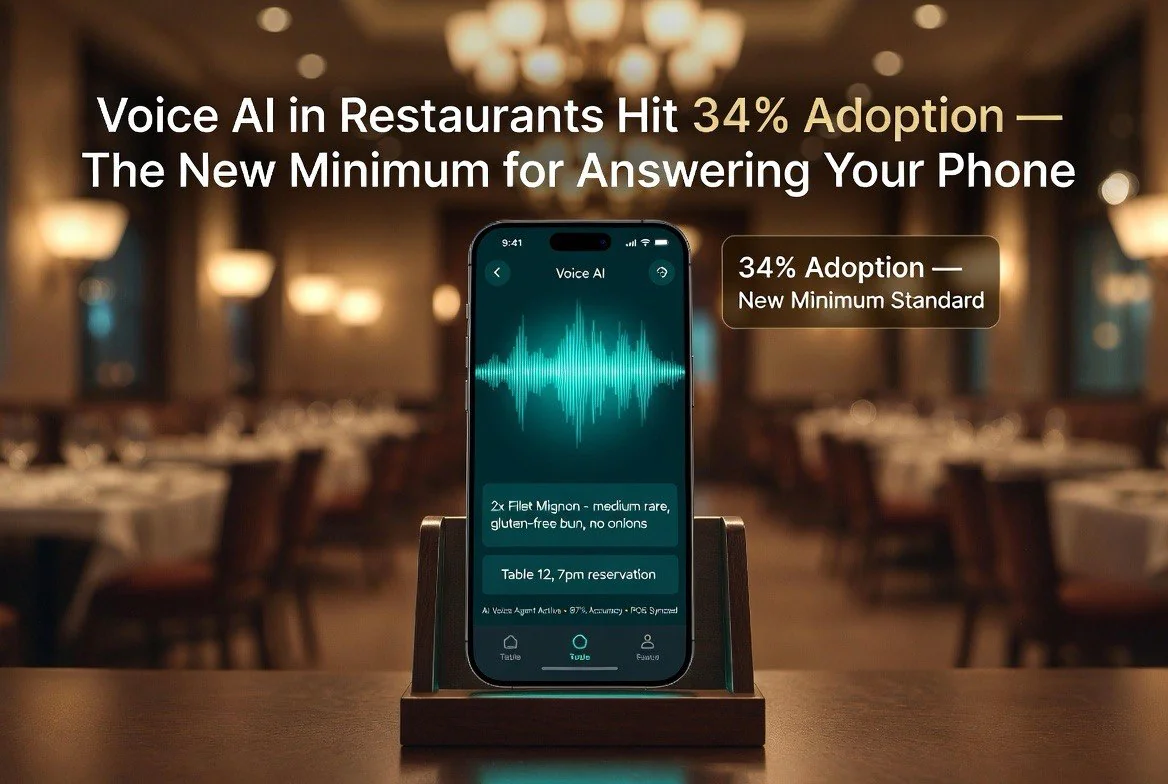
Loman’s 2 million calls per month represents meaningful scale, but industry adoption is still in the early adopter phase. A 2026 survey by Restaurant Dive found that roughly 12% of independent restaurants have adopted any form of AI phone automation. The majority still use a staffed phone line or a basic voicemail system that routes calls to a manager’s cell phone.
The barrier is not cost — at $299/month, Loman is cheaper than a single weekend shift of phone labor. The barrier is trust. Operators need to hear the AI handle their customers before they believe it works. Loman’s strategy of letting restaurants run a free trial without contract commitments has driven the bulk of their 300-brand adoption on Toast.
Once operators see the data — reduced dropped calls, faster average call handling time, fewer order errors — the decision becomes easier. The most frequently cited ROI metric in Loman’s case studies is the reduction in order errors from phone orders, which drop from an industry average of 3-5% down to under 1% with the AI taking calls consistently.
What This Means for Independent Operators
The Loman-Toast integration is part of a broader trend where AI is not replacing restaurant jobs but removing the tasks that make those jobs harder. The host who used to spend half the dinner rush on the phone can now actually seat guests, manage waitlists, and greet customers. The manager who used to enter phone orders between running food can focus on the floor.
The 2 million calls per month that Loman processes across its customer base is still a drop in the bucket compared to the estimated 400 million restaurant phone calls per month in the US alone. But the growth curve is steep — Loman expanded from 100 to 300 brands on Toast in six months. At that rate, phone AI will be the norm for independent restaurants before the end of 2027, not the exception.
Frequently Asked Questions
What is Loman AI?
Loman AI provides voice-based phone automation for restaurants. Their AI assistant answers incoming calls, takes orders, handles reservations, and integrates directly with Toast POS.
The National Restaurant Association also reports that dropped or abandoned calls cost US restaurants an estimated $160 billion annually in lost revenue. A call that rings five times without being answered is not just an annoyance — it is a customer who calls the competitor next door. Loman answers on the first or second ring every time and can handle up to six calls simultaneously. For a restaurant that regularly hits peak-hour call volumes exceeding one person’s ability to answer, that alone justifies the monthly subscription.
How does the Loman-Toast integration work?
When Loman answers a call and processes an order or reservation, the data flows directly into Toast’s POS and KDS systems without manual entry. The order prints in the kitchen automatically.
How much does Loman AI cost?
Loman AI pricing starts around $299 per month per location for the full phone assistant, including the Toast integration. Costs vary by call volume and features.
Can Loman handle complex menu modifications?
Loman handles standard modifiers and substitutions well but may pass complicated multi-item customizations to a human staff member. Menu setup and configuration determine accuracy.
Is Loman AI available for restaurants using other POS systems?
Loman works with multiple POS platforms, but the Toast integration offers the deepest connectivity, including real-time table availability, KDS integration, and menu synchronization.

About Barak Schurr
Barak Schurr built and exited a major ticketing platform, ran global operations at Eventbrite, and now focuses on one question: which AI tools actually help independent restaurant owners run leaner and grow faster. He writes from the operator’s perspective — no vendor spin, no theory, just what’s real in 2026.
Email: [email protected]
More AI Resources