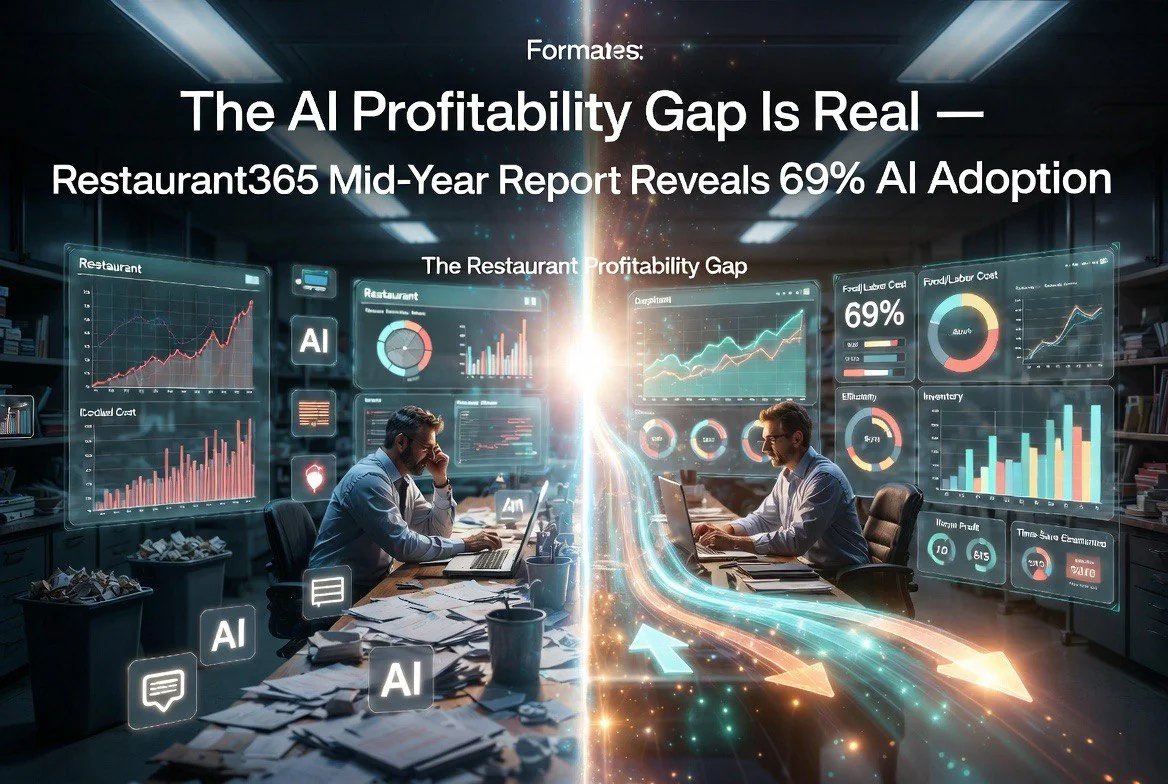
The AI Profitability Gap Is Real — Restaurant365 Mid-Year Report Reveals 69% AI Adoption
⚡ Expert Summary: Restaurant365 released its 2026 Mid-Year Report on July 16, and the headline is stark: 69% of restaurant operators are now actively using or piloting AI for back-office reporting and analytics — up from roughly 25% at the start of the year. Among AI users, 61% report reduced food costs, 62% report reduced labor costs, and 88% save time every week. The gap between AI adopters and non-adopters is widening into what Restaurant365 calls the “Restaurant Profitability Gap.”
The Data That Should Wake Up Every Operator
Restaurant365 surveyed more than 420 restaurant operators representing nearly 10,000 U.S. locations across quick-service, fast casual, casual dining, fine dining, pizza, and coffee concepts. The results paint a clear picture of an industry dividing into two camps: those using AI to gain a measurable edge, and those falling behind.
Here are the numbers that matter for operators making decisions about the second half of 2026 (Restaurant365 2026 Mid-Year Report, July 2026):
| Metric | AI Adopters | Industry Baseline |
|---|---|---|
| AI adoption rate | 69% (mid-2026) | 25% (start of 2026) |
| Reduced food costs | 61% | 87% saw food cost increases |
| Reduced labor costs | 62% | 77% saw labor cost increases |
| Save time every week | 88% | N/A |
| Cost reductions of 6%+ | Nearly 1 in 3 | N/A |
The context that makes these numbers hit harder: 87% of operators reported food cost increases in the first half of 2026, and 77% reported labor cost increases. While the broader industry is getting squeezed on both fronts, AI adopters are bucking the trend — finding ways to cut costs while their competitors struggle.
Breaking Down the “Restaurant Profitability Gap”
Restaurant365 coined a specific term for this divergence: the Restaurant Profitability Gap. It describes the measurable performance difference between operators who actively use AI for back-office functions — forecasting, scheduling, inventory management, cost control — and those who don’t.
This gap isn’t theoretical. AI adopters are pulling ahead on key P&L metrics like food cost percentage, labor cost percentage, and overall operational efficiency. They’re achieving this without relying on menu price increases, which means they’re protecting their traffic and customer satisfaction while improving margins (PRNewswire via Restaurant365, July 2026).
The Fast Casual blog covered the report with a breakdown of four specific ways AI-using operators are cutting costs and outcompeting non-adopters (FastCasual.com, July 2026). The common thread across all four: AI tools that sit on integrated operational data produce better predictions, which produce better purchasing decisions, which produce lower waste, which produce higher margins.
For a single-unit independent operator, the gap might look like 1-2% on food cost — but in an industry where margins average 3-6%, that 1-2% can be the difference between profitability and breaking even.
Which Restaurants Are Adopting AI — and Which Aren’t
The report also identifies the leading barriers for operators who haven’t adopted AI yet. Understanding these is useful because they highlight the real friction points — and many of them are solvable with the right approach:
- Data privacy and security concerns (37%) — Operators worry about where their data goes when fed into AI tools. The fix: choose platforms that process data within your existing system rather than sending it to external servers.
- Confidence in output accuracy (34%) — “Will the AI actually be right?” The fix: start with low-risk back-office applications where errors have minimal consequences, then expand as trust builds.
- Implementation cost (29%) — Upfront investment concerns. The fix: most restaurant management platforms include AI features in existing subscription pricing — no additional implementation needed.
- Uncertainty about where to start (18%) — The most straightforward fix: start with inventory management or labor scheduling, where the data is already structured and the ROI is most measurable.
The common thread is that the barriers are largely perception-based rather than technical. The infrastructure for restaurant AI is already baked into platforms many operators already use. The gap isn’t about access to technology — it’s about willingness to trust it.
Broader Industry Context: Why Now Matters
The Restaurant365 report doesn’t exist in isolation. The broader context for H2 2026 suggests the profitability gap will only widen:
Guest traffic improved significantly in the first half of the year — 49% of operators reported gains mid-year versus just 28% at the start. And 62% expect continued growth in the second half. More traffic means more revenue, but it also means more pressure on operations, inventory, and labor. Operators who can manage that pressure efficiently through AI will capture more of that growth as profit.
Labor costs are expected to stabilize somewhat — only 61% of operators expect further increases in H2, the lowest forward-looking figure in three years of Restaurant365 surveys. But recruiting and retaining staff remains the top operational challenge at 33%, with training having overtaken pay as the leading retention strategy. AI-powered scheduling that accounts for employee preferences, availability, and performance patterns can directly support retention efforts by creating fairer, more predictable schedules.
Food costs remain the wildcard. 78% of operators expect further increases in H2, though at more moderate levels than the first half. AI-driven inventory management that forecasts demand and optimizes ordering becomes not a nice-to-have but a necessity when every percentage point of waste directly hits the bottom line.
What This Means for Your Restaurant in H2 2026
The Restaurant365 Mid-Year Report makes one thing clear: the decision about whether to use AI in your restaurant is no longer theoretical. The data is in, and the early adopters have a measurable advantage. The gap between AI users and non-users will only widen as more operators implement these tools and the market becomes more competitive.
If you haven’t started: The barrier isn’t cost or complexity. Most modern restaurant management platforms include AI-powered forecasting, scheduling, and inventory optimization as standard features. Check what your current system already offers. If you’re paying for features you’re not using, start there.
If you’re testing: Focus on one back-office function where the data is clean and the ROI is measurable — inventory management is the highest-leverage starting point. Track food cost percentage before and after implementation. Report the savings to your team. Build momentum for broader adoption.
If you’re using AI actively: Push deeper. The 69% who have adopted AI for basic reporting still have room to expand into automated action agents — tools that don’t just tell you what’s happening but take action to optimize inventory, adjust labor, or flag anomalies in real time.
Four Specific Ways AI-Adopting Restaurants Cut Costs
Fast Casual published a breakdown of the Restaurant365 report that identified four specific mechanisms through which AI-using operators are pulling ahead (FastCasual.com, July 2026). These aren’t hypotheticals — they’re being deployed in real restaurants right now:
1. AI-powered demand forecasting that reduces waste. Instead of ordering based on last year’s numbers or manager intuition, AI systems analyze historical sales data, weather patterns, local events, and day-of-week trends to predict exactly how much of each ingredient you’ll need. The result: less over-ordering, fewer wasted ingredients, and lower food cost. For an independent operator spending $30,000 per month on food, a 6% reduction — which nearly a third of AI adopters report achieving — is $1,800 per month straight to the bottom line.
2. Intelligent labor scheduling that matches staffing to traffic. The same forecasting engine drives labor budgets. Instead of scheduling based on arbitrary targets, AI predicts traffic levels and recommends optimal staffing. For a full-service restaurant with 20 employees, even a 1-2% improvement in labor efficiency translates to significant annual savings — and better coverage during peak hours means faster service and higher customer satisfaction.
3. Real-time cost monitoring with anomaly detection. AI tools that sit on integrated POS and inventory data can flag anomalies in real time — price discrepancies, unusual variance between theoretical and actual food cost, or sudden spikes in specific ingredient usage. A manager gets an alert the same day, not four weeks later when the monthly P&L comes out. That speed difference is the difference between catching a problem and absorbing a loss.
4. Automated reporting that saves hours per week. 88% of AI adopters report saving time every week. For an independent operator working 60-hour weeks, even 2-3 hours saved on manual reporting is time they can spend on guest experience, staff training, or menu development. The time savings compound into better operations across the board.
What’s notable about all four applications is that none of them require replacing your existing systems. Most modern restaurant management platforms include these capabilities as built-in features or available add-ons. The question isn’t whether the technology is available — it’s whether you’re using it.
FAQ
What percentage of restaurants are using AI in 2026?
How much can AI save a restaurant on food costs?
What is the Restaurant Profitability Gap?
Why aren’t more restaurants using AI?
What restaurant AI applications deliver the best ROI?

About Barak Schurr
Barak Schurr built and exited a major ticketing platform, ran global operations at Eventbrite, and now focuses on one question: which AI tools actually help independent restaurant owners run leaner and grow faster. He writes from the operator’s perspective — no vendor spin, no theory, just what’s real in 2026.
Email: [email protected]
More AI Resources