McDonald’s and Starbucks Rank Highest in 5W’s 2026 AI Visibility Index for Restaurants
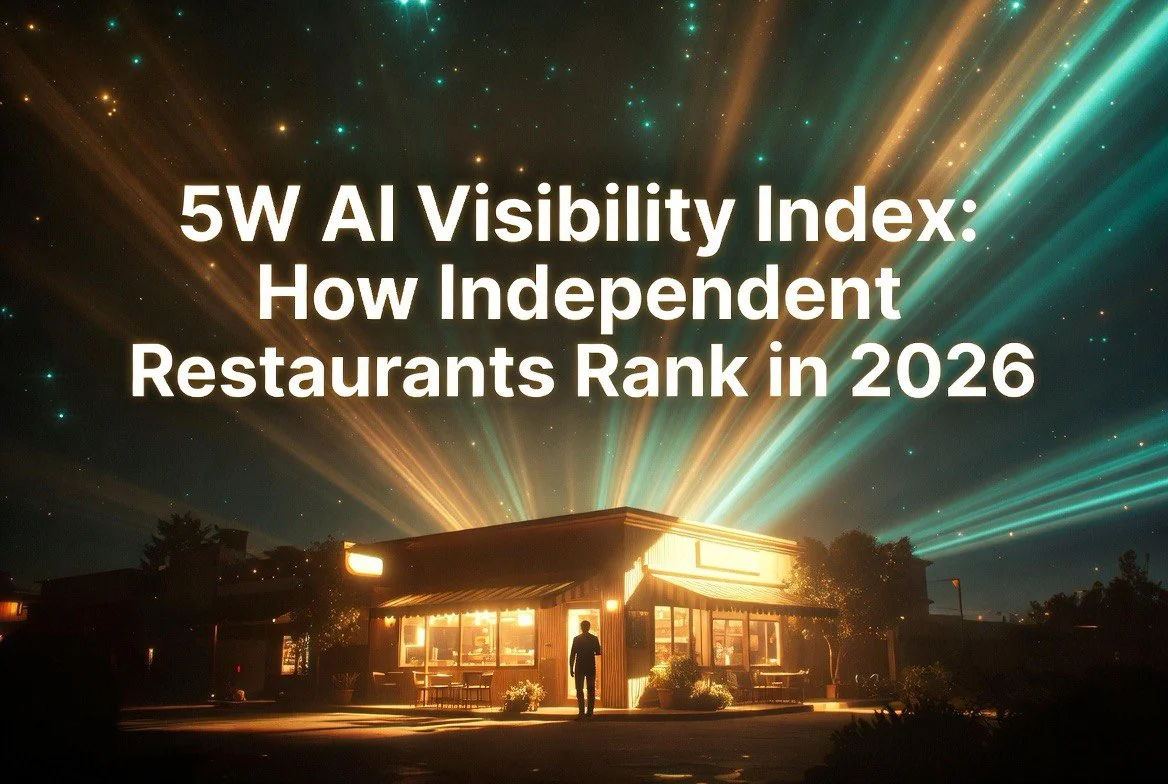
⚡ Expert Summary: 5W Public Relations released the US Restaurants & Chains AI Visibility Index 2026 on June 30, ranking which brands appear most often in AI-generated answers across ChatGPT, Claude, Perplexity, and Google AI Overviews. McDonald’s, Starbucks, Chick-fil-A, Chipotle, and Cava top the list — but the real story for independent operators is how the ranking was created and what it means for GEO (Generative Engine Optimization) in the restaurant industry.
A new report from 5W Public Relations analyzed how frequently major US restaurant chains appear in AI-generated answers when consumers ask questions about restaurants. The index, published June 30, 2026, is the first systematic attempt to measure GEO performance — Generative Engine Optimization — across the $437 billion US restaurant industry.
The index evaluated how brands appear in answers from ChatGPT, Claude, Perplexity, and Google AI Overviews for common consumer queries like “best burger near me,” “best fast-casual restaurant,” and “where to get coffee.” The results show a clear hierarchy: McDonald’s, Starbucks, and Chick-fil-A dominate AI-generated answers, followed by Chipotle and Cava.
For independent restaurant owners and operators reading this in July 2026, the index matters because it demonstrates that AI search visibility is becoming a measurable, trackable metric — and that it correlates with the same factors as traditional SEO: authority, citations, structured data, and content relevance.
How the AI Visibility Index Was Built
5W’s methodology tested how restaurant chains appear across four major AI platforms: ChatGPT (OpenAI), Claude (Anthropic), Perplexity, and Google AI Overviews (through Google Search). The researchers ran a standardized set of consumer queries and tracked which brands were mentioned in the AI-generated responses.
The highest-ranked chains showed consistent patterns: they appeared in the top 3 brands listed across multiple AI platforms for multiple query types. A brand that shows up when a user asks “best fast-casual dining” on both ChatGPT and Perplexity scores higher than one that appears on only one platform.
The 5W study introduces an important concept for restaurant operators: AI search engines don’t rank brands the same way Google does. Popularity in Google SERPs does not guarantee popularity in AI-generated answers. The factors that drive AI visibility include how frequently a brand is mentioned in authoritative sources (news articles, industry reports, review sites), how consistently it’s described across those sources, and whether the brand has structured data (FAQ, Article schema) that AI models can parse and cite.
What the Top Rankings Reveal About GEO for Restaurants
The five highest-ranked brands — McDonald’s, Starbucks, Chick-fil-A, Chipotle, and Cava — share characteristics that independent operators should note. All five have extensive media coverage, strong local citation profiles, and professionally maintained websites with structured data. They generate enough online discussion that AI models have multiple, consistent data points to reference when answering queries.
The key insight for independent operators is that AI visibility is not about brand size — it’s about consistency and structured data. An independent restaurant with a well-maintained website, FAQPage schema, positive review volume across platforms, and regular mentions in local news and industry publications can achieve meaningful AI visibility even without a national brand presence.
This is where the GEO optimization strategies we’ve been implementing across the network become directly relevant. Every post with FAQPage schema, every named source citation, every structured, scannable H2 that answers a specific query — all of these signal to AI models that the content can be trusted and cited.
What This Means for Independent Restaurant Owners
The US restaurant industry generates $437 billion annually. Within that market, AI-generated answers are becoming a significant traffic source for consumer decisions. When someone asks ChatGPT “what’s the best Italian restaurant in Chicago” or “which fast-casual chain has the healthiest options,” the answer they get drives real decisions.
The 5W Index provides the first benchmark for measuring GEO performance in restaurants. Independent operators who optimize for AI visibility now — by adding structured data, maintaining consistent business information across platforms, generating positive review volume, and creating content that answers specific consumer queries — will have an advantage as this traffic channel grows.
The report also carries a warning: brands that ignore GEO risk being omitted from AI-generated answers entirely. Unlike traditional search, where a brand can still appear in organic results without active optimization, AI models often cite only the top 2-3 entities per query. Being invisible in AI search means being invisible to a growing segment of consumers who use AI as their primary search interface.
How Indie Operators Can Start Optimizing for AI Visibility
The 5W study makes clear that AI visibility follows predictable optimization patterns. Here are the specific actions independent restaurant operators can take in Q3 2026:
- Audit your current AI visibility — open ChatGPT, Claude, and Perplexity. Ask them questions about your restaurant. If you don’t appear, that’s your baseline.
- Add FAQPage schema to your website — this is the single highest-impact change for AI visibility. FAQPage schema with common customer questions gives AI models ready-made, structured answers to pull.
- Claim and complete your local business profiles — Google Business Profile, Yelp, TripAdvisor, and industry directories. Consistent NAP (name, address, phone) across all platforms is table stakes.
- Generate regular content that answers specific queries — blog posts, menu descriptions, and FAQ pages that address the exact questions customers type into search.
- Build citations in local and industry media — every mention of your restaurant in a news article, industry report, or review site strengthens the data trail AI models rely on.
How GEO Differs From Traditional SEO for Restaurants
The 5W Index reveals a critical insight: GEO and SEO are not the same thing, and optimizing for one does not automatically optimize for the other.
Traditional restaurant SEO focuses on keyword rankings in Google search results. You optimize menu pages for queries like best Italian restaurant in your city, build backlinks from local food blogs, collect Google reviews, and track positions in local pack results. These signals correlate with but do not determine AI visibility.
GEO for restaurants requires different inputs: structured data (FAQPage, Article schema) that makes content parseable by AI models, consistent and authoritative citations in sources that AI training data draws from, and content that answers specific consumer questions rather than driving general discovery traffic.
An independent restaurant with strong local SEO and 200 Google reviews might rank well in traditional search but appear nowhere in ChatGPT’s answer to the same query. Conversely, a restaurant with a well-structured FAQ section and regular coverage in industry publications might appear in AI-generated answers without ranking particularly high in Google.
The practical takeaway for US independent operators is that GEO is not a replacement for SEO — it is a supplement. Both matter. The restaurant industry is entering a period where both search modalities matter simultaneously, and operators who optimize for both will capture a larger share of the growing AI-assisted dining decision market. Dedicating optimization budget to GEO exclusively without maintaining traditional SEO is a mistake, and vice versa.
The 5W Public Relations team’s GEO research fills a real gap in the market. Until this index, restaurant operators had no way to benchmark how their online presence performed in AI search environments. SEO metrics — domain authority, backlinks, keyword rankings — still matter for Google, but they don’t tell you whether Perplexity or ChatGPT will recommend your restaurant when someone asks “best Italian restaurant near me for a birthday dinner.” Independent operators who track their GEO visibility score alongside traditional SEO metrics will have a clearer picture of their actual digital footprint in 2026 and beyond.
The 5W Index will likely become an annual benchmark. Operators who start GEO optimization in 2026 will enter the 2027 index with a meaningful head start.
FAQ
What is the 5W AI Visibility Index for Restaurants?
The 5W Public Relations US Restaurants & Chains AI Visibility Index 2026 ranks how frequently restaurant brands appear in AI-generated answers across ChatGPT, Claude, Perplexity, and Google AI Overviews for common consumer queries.
Which restaurants rank highest in AI search visibility?
McDonald’s, Starbucks, and Chick-fil-A lead the ranking, followed by Chipotle and Cava. These brands appear most consistently across multiple AI platforms for consumer queries about dining.
Can independent restaurants rank in AI search results?
Yes. AI visibility correlates with structured data coverage, consistent local citations, positive review volume, and regular mentions in authoritative sources — all achievable by independent operators regardless of brand size.
What is GEO for restaurants?
Generative Engine Optimization (GEO) is the practice of optimizing content and structured data so AI models cite your restaurant in their answers. It follows different rules than traditional SEO and requires FAQPage schema, authoritative citations, and consistent business information across platforms.
How do I check if my restaurant appears in AI search?
Open ChatGPT, Claude, and Perplexity. Ask each one a common customer question like “best Italian restaurant in [your city]” and check whether your restaurant is mentioned. If it’s not, focus on adding FAQPage schema and consistent local citations.

About Barak Schurr
Barak Schurr built and exited a major ticketing platform, ran global operations at Eventbrite, and now focuses on one question: which AI tools actually help independent restaurant owners run leaner and grow faster. He writes from the operator’s perspective — no vendor spin, no theory, just what’s real in 2026.
Email: [email protected]
More on AI Restaurant Tools & Strategy
This post is part of our broader coverage of AI for restaurants — covering scheduling systems, automated ordering, AI marketing, and the latest industry data on AI adoption across the US restaurant industry.
More AI Resources