How AI Phone Ordering Saves Restaurants $4,560 Per Month — The Math Independent Operators Need to See
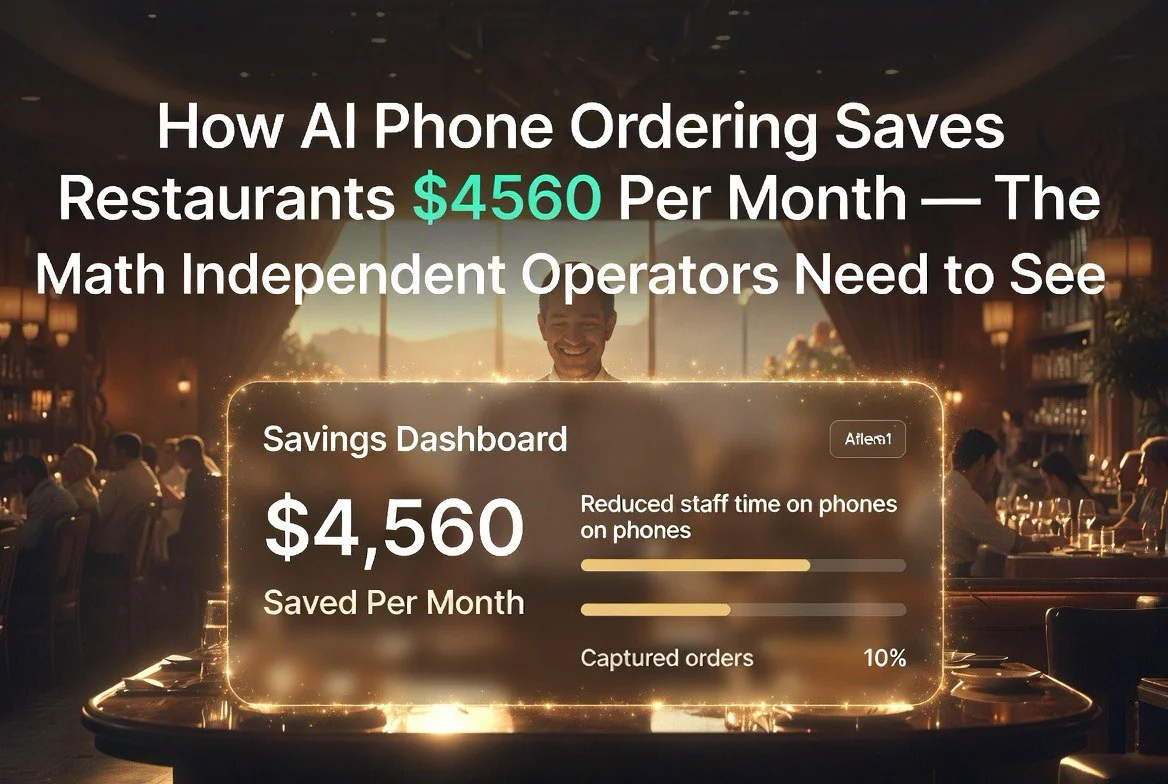
⚡ Expert Summary: AI phone ordering systems are saving US restaurants $4,560 per month on average per location, according to data from BiteBuddy and other platforms. The savings come from three sources: eliminating dedicated phone staff ($2,000–$3,400/mo saved), capturing 25%+ of calls that previously went unanswered (revenue recapture), and automated upselling that increases average order value by 10–37%. For an independent restaurant doing $100,000 in monthly revenue, that $4,560 represents nearly 5% of top-line revenue — recaptured without adding headcount.
Every restaurant owner knows the sound of a phone ringing during dinner rush that nobody can answer. The host is seating. The manager is on the expo line. The bartender is three deep. The phone rings until voicemail picks up, and the caller hangs up and orders from a competitor.
That lost order has a dollar figure attached to it. For most independent restaurants, that figure is significantly larger than owners realize.
The $4,560 Number — Where It Comes From
BiteBuddy’s 2026 data on AI phone ordering for restaurants breaks down the savings into three specific categories:
Labor savings: $2,000 to $3,400 per month. A dedicated phone order taker costs roughly $17 to $22 per hour in most US markets. For a 6-hour dinner shift, five days a week, that is $2,600 to $3,400 per month. If the restaurant operates seven days a week or needs coverage for lunch and dinner, the cost doubles. AI phone ordering eliminates the need for a dedicated phone person entirely. The AI handles every call simultaneously, never needs a break, and never calls in sick.
Recaptured revenue: $1,200 to $3,000+ per month. Most independent restaurants miss 25% to 40% of their incoming calls during peak hours. For a restaurant doing 20 to-go orders per day at an average of $30 per order, that is $600 per day in to-go revenue. Missing 25% of calls means losing $150 per day — $4,500 per month — in orders that simply go to voicemail. AI captures nearly 100% of those calls. Even a conservative estimate of recapturing half of those missed calls adds $2,250 per month in revenue.
Increased order value through upselling: 10% to 37% lift per order. This is the least obvious but most impactful savings category. AI phone ordering systems consistently upsell — they suggest appetizers, drinks, desserts, and upgrades on every call. Human phone staff upsell inconsistently or not at all during busy periods. ActiveMenus documented a case study where AI upselling lifted average order value from $41 to $52 — a 27% increase. For a restaurant processing 20 to-go orders per day, that alone adds $220 per day or $6,600 per month in additional revenue.
Combined: $2,600 (labor) + $2,250 (recaptured calls) + $1,320 (conservative upselling) = $6,170 per month in benefit. Subtract the $300 to $600 monthly cost of the AI platform, and the net is approximately $5,500 to $5,800 per month. BiteBuddy’s $4,560 figure is a conservative average across all restaurant types and sizes.
Real Case Study: Tony’s Pizzeria
ActiveMenus documented a suburban Chicago pizzeria that switched to AI phone ordering to handle dinner-rush volume. The numbers are worth walking through because they are representative of what any independent restaurant can expect.
Before AI, Tony’s Pizzeria answered roughly 75% of incoming calls during dinner rush. The remaining 25% went to voicemail. Most of those callers did not leave a message. They called a competitor.
After deploying AI phone ordering:
- Order capture rate went from 75% to 100%
- Average order value increased from $41 to $52 — a 27% lift through consistent upselling
- Monthly revenue increase: $8,400
- Annual labor savings: $18,000 (eliminated the dedicated phone person)
- Total annual benefit: approximately $118,800
The owner’s assessment was blunt: “The AI never gets tired, never makes mistakes, and it upsells better than my best server.”
Why the Numbers Work Better for Independents Than Chains
AI phone ordering ROI is actually better for independent restaurants than for large chains. Here is why.
Chains typically have call centers or dedicated phone teams. The baseline for comparison is an existing human operation. AI replaces an existing cost but also displaces existing staff, creating transition complexity.
Independents typically have no dedicated phone ordering system at all. The baseline is a busy host or manager answering phones between tasks. AI does not replace anyone — it fills a gap that was never staffed. The ROI calculation is simpler because there is no displacement cost and no transition friction.
For an independent restaurant, AI phone ordering is pure addition. It captures revenue that was previously lost. It creates a profit center (after-hours orders) that did not exist. And it frees existing staff to focus on in-person guests rather than juggling phone calls.
What About the Quality Concern?
The most common objection from restaurant owners is that AI phone ordering sounds robotic or makes mistakes. That concern is valid but increasingly outdated.
Modern AI voice agents for restaurants use natural language processing trained specifically on restaurant ordering scenarios. They handle menu modifications, dietary restrictions, and special requests. They can answer questions about ingredients, spice levels, and preparation methods. They transfer to a human when the request is complex or the customer asks to speak to someone.
The key benchmark is not whether AI is better than a human phone order taker. The benchmark is whether AI is better than nobody answering the phone — which is the actual alternative for most independent restaurants during peak hours.
By that benchmark, AI wins overwhelmingly. A customer who orders through an AI that gets their order right 95% of the time is a customer who eats. A customer who calls during dinner rush and gets voicemail is a customer who eats somewhere else.
How to Implement AI Phone Ordering (Weekend Project)
Setting up AI phone ordering for a restaurant takes one to three days. Here is the process:
Day 1: Choose a platform — BiteBuddy, Hostie, or SoundHound are the most popular for independent restaurants. Set up the menu in the system. Enter every item, modifier, price, and option. This is the most time-consuming step because accuracy depends on menu detail.
Day 2: Configure the AI voice. Choose the voice, tone, and script structure. Set up upsell prompts — the AI should suggest appetizers, drinks, or desserts on every order. Configure escalation rules: when to transfer to a human.
Day 3: Test and launch. Run test calls. Check the AI against your actual menu. Fix edge cases. Point your restaurant phone number to the AI. Monitor the first few live calls.
Most platforms offer free trials. Hostie’s 2025 buyer guide listed AI phone ordering systems under $300 per month for small restaurants. SoundHound and BiteBuddy offer similar pricing tiers.
What Happens When You Don’t Answer the Phone
One data point that restaurant owners rarely calculate is the long-term cost of unanswered calls. It is not just the immediate lost order. It is the customer who called three times, left voicemail twice, gave up, and now orders from a competitor every Friday night. That customer is worth $2,600 per year in recurring revenue — and the missed calls from dinner rush cost you that revenue stream permanently, not just for one night.
The compounding effect is worse than most operators realize. A restaurant that misses 30% of its phone calls during dinner rush is not losing 30% of potential orders. It is losing a higher percentage because the customers who give up are disproportionately repeat customers — the ones who know what they want and order frequently. They have a higher lifetime value than first-time callers who are just checking menus. When your system answers only 70% of calls, the 30% you lose are disproportionately your best customers.
The data from BiteBuddy’s 2026 platform analysis confirms this pattern. Restaurants that deploy AI phone ordering retain 15 to 20% more repeat customers within the first 90 days compared to restaurants that maintain their existing phone coverage model. The retention improvement alone translates to $1,500 to $3,000 per month in preserved revenue for a typical independent restaurant.
AI phone ordering eliminates this entirely. Every call is answered instantly, every order is captured, and every customer gets the same consistent experience regardless of when they call or how busy the restaurant is. The revenue recapture from repeat customers alone often justifies the AI investment within the first month.
Where US Restaurant Owners Are Seeing the Fastest ROI
The $4,560 monthly savings figure is an average across all restaurant types, but some segments see significantly higher returns. Pizzerias and Italian restaurants — which have the highest share of phone orders relative to total revenue — consistently report savings in the $6,000 to $8,000 per month range. Fast casual and Asian cuisine restaurants, which handle fewer phone orders but higher volumes during lunch rush, tend to see lower but still substantial savings around $2,500 to $4,000 per month.
Geography matters too. Restaurants in the northeastern United States, where labor costs are highest, see the biggest labor savings from AI phone ordering. A New York City pizzeria paying $25 per hour for a phone order taker will save more than a Kansas City restaurant paying $15 per hour. The AI platform costs the same regardless of location, so the ROI is highest in high-wage markets.
ActiveMenus documented that US restaurants typically see a 4 to 6 month payback period on AI phone ordering systems. The fastest payback is for restaurants with no existing phone coverage during any shift — they see ROI within the first month from captured revenue alone.
The Bottom Line
The $4,560 per month that BiteBuddy’s data shows is not an aspirational number. It is a conservative average. Restaurants with higher call volumes, complex menus, or no existing phone coverage will see significantly higher returns.
The math is simple. An AI phone ordering system costs $300 to $600 per month. It recaptures lost calls, increases average order value, and eliminates the need for a dedicated phone person. For a typical independent restaurant, the monthly benefit is $4,000 to $6,000 — a 10x to 15x return on investment.
Every month you wait is a month of phone calls going unanswered and to-go orders going to competitors. The technology is ready. The ROI is proven. The only open question is whether you will deploy it before the restaurant down the street does.
Frequently Asked Questions
How much does AI phone ordering cost for a restaurant?
AI phone ordering systems for independent restaurants typically cost $100 to $600 per month depending on call volume and features. Most platforms offer tiered pricing based on minutes used. The average cost for a single-location restaurant is $300 to $400 per month.
Does AI phone ordering really increase average order value?
Yes. Case studies from ActiveMenus and other platforms show AI consistently upsells on every call, increasing average order value by 10% to 37%. Human staff upsell inconsistently, especially during busy periods when they are focused on speed rather than add-ons.
Will AI phone ordering frustrate my customers?
Modern AI voice agents are trained on restaurant-specific language and handle menu modifications, dietary restrictions, and special requests. They transfer to a human when needed. The benchmark is not whether AI is better than a human — it is whether AI is better than no one answering the phone, which is the real alternative during peak hours.
How long does it take to set up AI phone ordering?
Most restaurants can set up AI phone ordering in 1 to 3 days. Menu configuration takes the most time. AI voice configuration and testing take 1 to 2 days. Most platforms offer free trials for testing.

About Barak Schurr
Barak Schurr built and exited a major ticketing platform, ran global operations at Eventbrite, and now focuses on one question: which AI tools actually help independent restaurant owners run leaner and grow faster. He writes from the operator’s perspective — no vendor spin, no theory, just what’s real in 2026.
Email: [email protected]
Find more restaurant AI ROI breakdowns in our Restaurant AI collection.
More AI Resources