26% of Restaurants Use AI Now — What the NRA 2026 Report Reveals About the Industry
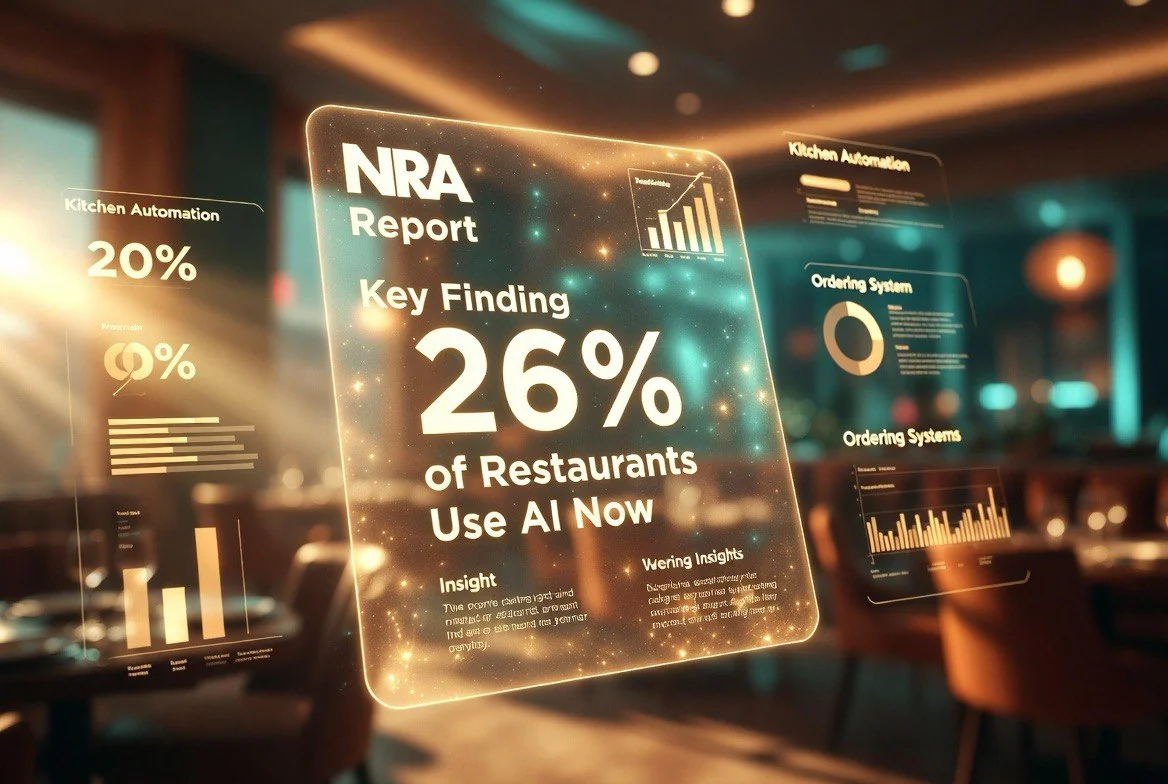
⚡ Expert Summary: The National Restaurant Association’s 2026 State of the Restaurant Industry report shows that 26% of operators now use AI in some form. Marketing leads at 19%, followed by administrative tasks at 10%, while direct food preparation and ordering applications remain low. More than half of operators plan to increase their technology investment this year, and projected industry sales hit $1.55 trillion. The numbers paint a picture of an industry that’s moving cautiously toward AI adoption — with marketing as the beachhead, not robotics or voice ordering.
The narrative around AI in restaurants tends to swing between two extremes. On one side, you have breathless coverage of robot kitchens and AI drive-thrus that suggests the fully automated restaurant is just around the corner. On the other, you have skeptical operators who’ve watched technology promises come and go for decades and aren’t convinced anything has fundamentally changed.
The NRA’s 2026 State of the Restaurant Industry report cuts through both narratives with actual data. The report, released in February 2026, surveyed thousands of operators across the United States about their technology adoption, business outlook, and strategic priorities. The results reveal an industry in transition — one that’s adopting AI selectively, not wholesale, and where the biggest gains so far are in the back office, not the kitchen.
For independent restaurant owners trying to decide how seriously to take AI, this report offers the most grounded picture available of where the industry actually stands. And for US-based operators who are tired of being told they’re falling behind because they haven’t installed a robot fry cook, the data offers something valuable: permission to be strategic rather than frantic.
The restaurant industry in the United States employs over 15 million people across more than one million locations. When a survey of that scale shows 26% AI adoption, it means the other 74% isn’t some dinosaur fringe — it’s the majority of the industry, making considered decisions about where and when to invest. The question isn’t whether AI works in restaurants. It’s which applications work well enough, for which types of operations, to justify the investment today.
The Numbers: 26% Adoption, Unevenly Distributed
The headline figure — 26% of operators using AI in some form — comes with important caveats. About 60% of operators place themselves in the “technology mainstream,” neither leading nor lagging. A smaller share considers themselves at the forefront. Most operators are somewhere in the middle: watching, learning, and adopting selectively where the return is clearest.
Adoption varies significantly by use case. Marketing is the clear leader: 19% of full-service operators and 15% of limited-service operators use AI for marketing tasks. Content generation, social media management, ad targeting, and customer segmentation are the most common applications. These are low-risk, high-ROI use cases — AI can draft a month of social media posts in minutes, A/B test ad copy, and personalize email campaigns in ways that would require a full-time marketing professional to achieve manually.
Administrative AI adoption follows at roughly 10% of operators. This covers tasks like scheduling, inventory management, accounting support, and customer communications. Again, these are back-office functions where AI can reduce labor hours without touching the customer experience directly.
What’s notably lower is direct customer-facing AI — drive-thru voice ordering, AI kiosks, robot food preparation. The NRA report found that only about 6% of operators have deployed AI for ordering or food preparation. The high-profile drive-thru AI deployments at chains like McDonald’s, Taco Bell, and Dairy Queen make up a small fraction of the industry overall. Most independent operators aren’t there yet — and based on the data, they’re not in a hurry.
What Operators Are Actually Spending On
The NRA report projects total restaurant industry sales of $1.55 trillion in 2026, with 1.3% real growth. That growth is being driven in part by technology investments, but not exclusively AI. The report identifies several categories where operators are actively investing:
A deeper look at the spending data reveals that the $1.55 trillion figure represents a return to stability after the pandemic era’s wild swings. Operators aren’t investing from a position of surplus — they’re investing because labor costs as a percentage of revenue have climbed to an average of 32-35% across the industry, and technology that can reduce that burden by even a few percentage points has a compelling ROI. The NRA survey found that more than 50% of operators plan to increase their technology investment this year specifically to address labor efficiency, not because they’re chasing innovation for its own sake.
Digital ordering and payment systems remain the top technology priority. Mobile ordering, QR code payments, and online reservation systems have become table stakes for most restaurants, not differentiators. The baseline expectation that customers can order and pay digitally is now standard across the industry, from quick service to fine dining.
Customer feedback and reputation management tools are the second largest category. With review platforms, social media, and delivery apps all generating customer data, operators are investing in systems that aggregate, analyze, and respond to feedback at scale. AI-powered sentiment analysis is one of the more practical applications here.
Back-office and operations software covers inventory management, scheduling, payroll, and accounting. These systems have existed for years, but AI is beginning to layer predictive capabilities on top of them — forecasting inventory needs based on weather and events, optimizing schedules based on traffic patterns, and flagging anomalies in cost of goods sold.
Marketing and guest engagement platforms, as noted above, are where AI has made the fastest inroads. Email automation, social media content generation, loyalty program analysis, and targeted advertising all benefit directly from AI tools that are now widely available and affordable for single-location operators.
The throughline is clear: operators are investing in technology that reduces administrative burden and improves customer communication. The flashy applications — robot chefs, fully automated drive-thrus — remain experimental at the industry-wide level. The NRA data suggests that most operators are taking a practical, cost-driven approach rather than a speculative one. They’re investing in technologies where the ROI is measurable within quarters, not years.
This is a stark contrast to the venture-capital-fueled narrative that paints AI as an inevitable, all-encompassing transformation. The actual behavior of restaurant operators, captured in the NRA’s survey data, is more conservative and more rational. They want tools that work today, not prototypes that might work tomorrow.
Why Marketing Leads: The Path of Least Resistance
Marketing AI’s dominance in restaurant adoption isn’t an accident. It reflects a practical reality that operators of all sizes face: marketing is the function where AI tools are most accessible, most proven, and least risky to deploy.
A single independent restaurant generates an enormous amount of content — daily specials, weekly promotions, seasonal menus, events, social media posts, email newsletters, online listing updates. A restaurant owner or manager might spend 5-10 hours per week on marketing tasks. AI tools like ChatGPT, Claude, and Jasper can handle the bulk of that content generation in minutes, freeing those hours for operations.
The cost is negligible relative to the labor savings. A $20/month AI tool that saves five hours of marketing work per week pays for itself in the first week. There’s no equipment to install, no staff training required, no risk of disrupting the customer experience. The operator types a prompt and gets usable output.
Contrast that with drive-thru voice AI. Implementation requires hardware installation, POS integration, staff training on fallback procedures, menu data configuration, and a willingness to absorb negative customer feedback during the transition period. The upfront cost is in the thousands, not the tens of dollars. The timeline is weeks or months, not minutes.
The NRA data suggests operators are making rational choices. They’re adopting AI where it’s easy, cheap, and low-risk — and waiting on the high-stakes applications until the technology matures and the costs come down.
What the Numbers Mean for Independent Operators
If you’re running a single location or a small group of restaurants, the NRA report offers several actionable takeaways:
You’re not behind if you’re not using AI for food preparation. Three-quarters of the industry is in the same position. The narrative that every restaurant needs AI to survive is overblown. What matters is adopting AI where it delivers measurable returns, not keeping up with a technology arms race that hasn’t materialized.
You probably should be using AI for marketing. At 19% adoption, marketing AI is already mainstream among full-service operators. If your competitors are using AI to generate social media content, personalize email campaigns, and optimize ad targeting, they’re getting more engagement for less time and money. This is the one category where adoption is becoming a competitive necessity rather than an optional upgrade.
Administrative AI is the next logical step. The 10% adoption figure for administrative AI is likely to grow quickly over the next 12-18 months. Tools that handle scheduling optimization, inventory forecasting, and customer communications are becoming more affordable and easier to implement. For an operator spending 15-20 hours per week on back-office tasks, administrative AI can free up significant time for the parts of the business that actually generate revenue.
Monitor but don’t rush on operations AI. Voice ordering, AI kiosks, and kitchen automation are still early-stage for all but the largest chains. The Taco Bell experience shows that poorly implemented operations AI can damage customer relationships. The smart play is to let the chains absorb the learning costs and enter the market once the technology has matured.
The Broader Picture: Technology as Strategy
The NRA’s broader industry forecast is cautiously optimistic. $1.55 trillion in sales, 1.3% real growth, and continued job creation suggest a healthy industry navigating genuine challenges. Labor costs, food costs, and rent are all pressuring margins, which is driving the technology investment more than any particular enthusiasm for AI.
Operators who view technology as a strategic tool — deployed selectively where it improves margins or customer experience — are the ones most likely to benefit. Operators who view technology as a replacement for the human elements of hospitality are likely to be disappointed. The data backs this up: the fastest-growing technology categories are those that support operations, not those that replace people.
The restaurant industry’s relationship with AI in 2026 can be summarized in one sentence: the easy stuff is already being adopted, and the hard stuff is still mostly experimental. The winning strategy is to focus on the easy stuff now and keep powder dry for the hard stuff when it’s ready.
FAQs About Restaurant AI Adoption in 2026
What percentage of restaurants use AI in 2026?
26% of restaurant operators report using AI-related tools, according to the National Restaurant Association’s 2026 State of the Restaurant Industry report.
What are restaurants using AI for most?
Marketing leads at 19% adoption, followed by administrative tasks at 10%. Direct ordering and food preparation AI adoption remains low at approximately 6%.
Are most restaurant operators adopting technology rapidly?
No. About 60% of operators describe themselves as in the “technology mainstream” — neither leading nor lagging. Most are adopting selectively where returns are clearest.
What are the projected restaurant industry sales for 2026?
The NRA projects $1.55 trillion in total industry sales, representing 1.3% real growth over the previous year.
Should independent operators invest in AI now?
Yes, for marketing and administrative uses where ROI is clear and implementation risk is low. Operations AI like voice ordering and kitchen automation remain early-stage for most independent operators.

About Barak Schurr
Barak Schurr built and exited a major ticketing platform, ran global operations at Eventbrite, and now focuses on one question: which AI tools actually help independent restaurant owners run leaner and grow faster. He writes from the operator’s perspective — no vendor spin, no theory, just what’s real in 2026.
Email: [email protected]
More AI Resources