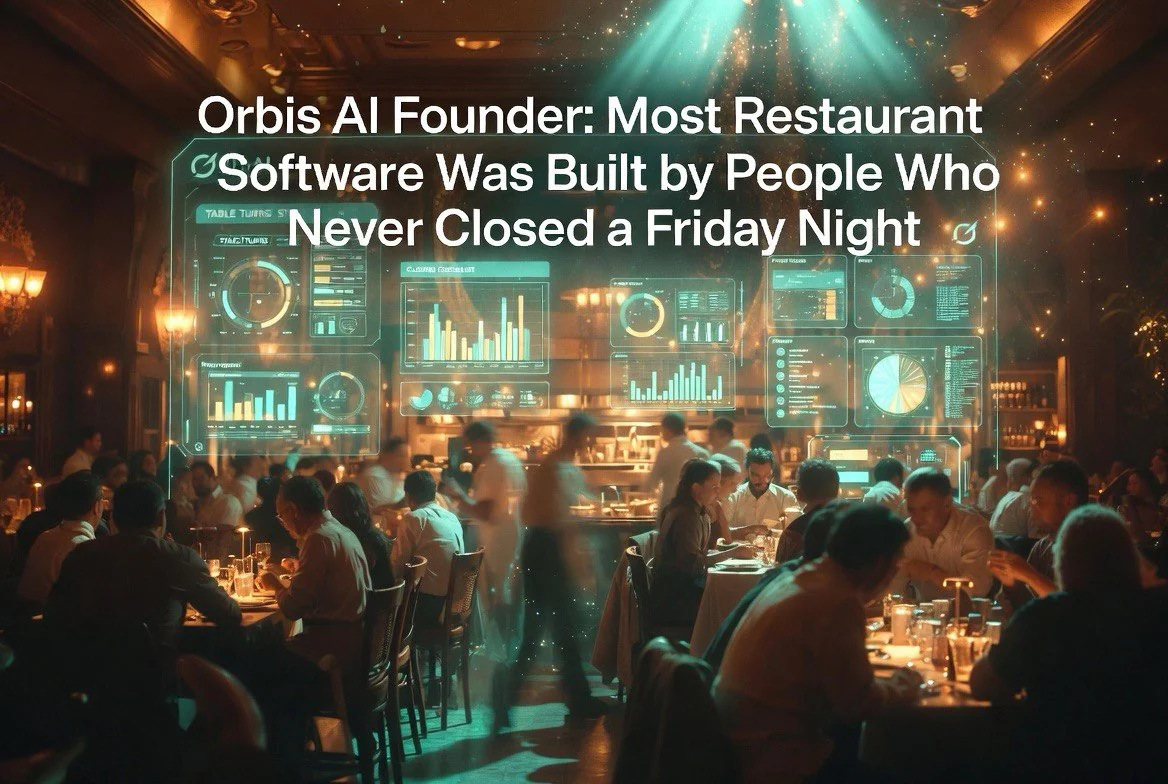
Orbis AI Founder: Most Restaurant Software Was Built by People Who Never Closed a Friday Night
⚡ Expert Summary: Orbis AI founder Temo Benidze made a blunt observation in a Restaurant Dive opinion piece: most restaurant software is built by people who have never worked a Friday night service. The gap between what operators need and what most AI vendors sell is enormous — and it explains why so many restaurant tech investments fail to deliver. For independent owners across the United States, this perspective cuts through the noise and points to what actually matters in restaurant AI: tools that give back time, not more dashboards to check.
Let’s be honest. Most restaurant software is bad.
It’s not bad because the code doesn’t work. It’s bad because it was designed by people who think a restaurant operates like a spreadsheet. They’ve never been in the weeds on a Saturday night. They’ve never cleaned a grease trap or calmed down a table whose order came out wrong. They’ve never closed with a dishwasher who didn’t show up.
Temo Benidze, founder of Orbis AI, said exactly this in a June Restaurant Dive opinion piece. His company builds AI for restaurant operations, and he’s willing to say the quiet part out loud: most technology vendors don’t understand how restaurants actually work, and it shows in the products they ship.
But here’s what makes Benidze’s argument different from another “tech doesn’t understand restaurants” rant. He’s not arguing that restaurant operators should avoid technology. He’s arguing that restaurant technology needs to be rebuilt from the ground up by people who understand the floor, not by engineers who have only ever seen a restaurant from the customer side of the counter.
This distinction matters because it changes how you evaluate tools. If you walk into every vendor demo assuming the product was designed by someone who has never worked a dinner rush, you will ask better questions. You’ll skip the polished dashboards and demand the workflows that actually save time during service. Benidze is essentially giving operators permission to be the skeptics they already are at heart.
What Benidze Gets Right
The core of Benidze’s argument is that restaurant technology should give operators back time, not generate more data they don’t have capacity to act on.
Think about the typical tech stack in an independent restaurant today. You’ve got a POS that generates reports. An inventory system that generates alerts. A scheduling platform that generates recommendations. An analytics dashboard that generates charts. And at the end of the night, the owner still has to synthesize all of this across five different logins to figure out what to do differently tomorrow.
The AI these vendors sell doesn’t solve the problem — it adds to it. Instead of one dashboard, you now have six. Instead of one set of reports to review, you have AI-generated insights layered on top. The operator still spends their limited off-hours doing data synthesis work instead of running their business.
Benidze’s point is that AI should be the layer that does the synthesis for you. Not an additional tool. The connector that sits between your existing systems, extracts the signal, and tells you exactly what needs to change — in plain language, not chart form.
This is the gap most restaurant AI vendors miss. They build for the corporate ops team at a 500-location chain. They don’t build for the owner-operator who wears 14 hats and needs technology that works like a sous chef — taking direction, executing reliably, and reporting outcomes.
What Real Restaurant AI Looks Like
If you strip away the startup jargon and the pitch deck language, what independent restaurants actually need from AI is remarkably simple. Three things:
1. AI that predicts before you know to ask. The best restaurant AI doesn’t wait for you to notice a problem. It tells you that based on weather, day of week, and local events, you should prep 25% more chicken wings this weekend. It flags that a delivery pattern changed and your vendor invoice is 12% higher than last month before you notice on the P&L. The value is in the heads-up, not the analysis.
2. AI that connects your tools. Most independent restaurants run on legacy POS systems, manual inventory counts, and paper schedules. The AI layer should bridge these systems without requiring a $50,000 integration project. If your POS reports cover but your inventory shows waste in chicken, the AI should flag the correlation without a human having to cross-reference spreadsheets.
3. AI that tells you what to do, not what’s happening. This is the biggest difference between enterprise AI and restaurant AI. Enterprise dashboards serve data. Restaurant AI should serve decisions. “Your labour is 32% of sales” is data. “You’re overstaffed on Tuesday lunch by two people based on last month’s covers” is a decision. The shift from information to action is what makes restaurant AI actually useful on the floor.
The “Closed a Friday Night” Test
Benidze’s argument introduces a useful framework that every operator can apply when evaluating technology vendors. Call it the “Closed a Friday Night” test.
Ask yourself: does this technology vendor understand what it’s like to run service when everything goes wrong? When the expo line is backed up, the POS is lagging, three call-outs hit the schedule, and a 40-top walks in without a reservation — does this system make that situation better or worse?
Most restaurant tech fails the test. AI tools that require data entry, additional screen time, or complex configuration are the opposite of helpful in a busy service. The best technology in a restaurant is the technology you don’t notice — the inventory system that automatically reorders before you run out, the scheduling AI that creates the right shift coverage without manager input, the predictive system that adjusts prep levels based on real booking data.
When you call your food vendor to order more product, you don’t want an AI tool that requires you to log in, run a report, analyze three metrics, and produce a purchase order before you can pick up the phone. You want the system to have ordered it automatically based on usage patterns and forecasted covers.
The Data That Independent Operators Actually Need
One of Benidze’s most practical points is about data overload. Most operators don’t need more data. They need less — but the right data, surfaced at the right time.
Orbis AI’s approach is instructive. Instead of building a dashboard with 47 metrics, they focus on the handful of decisions an operator makes every day: how much food to prep, how many staff to schedule, what to price on the menu, and where to cut costs this week. Every data point that doesn’t feed one of those decisions is noise.
For an independent operator in the United States, that’s refreshing. You don’t need to become a data analyst to benefit from restaurant AI. You need a tool that understands your operation well enough to tell you the three things that need to change today — and leave the other 40 metrics alone.
How Most Vendors Get It Wrong — And How To Spot It
Benidze’s critique of restaurant software vendors cuts deep because most operators have felt this pain but never had the language to articulate it. When a technology vendor pitches a new AI tool, the operator sits through a polished demo, sees impressive numbers on a dashboard, and signs up — only to discover six months later that the tool added 10 minutes of daily data entry while saving three minutes of theoretical efficiency.
The problem isn’t malicious. It’s structural. Most restaurant AI vendors come from enterprise SaaS backgrounds. They’ve built tools for operations teams at large companies that have dedicated staff to manage technology. They designed for a user who has time to configure dashboards, set up alerts, and fine-tune reporting parameters. That user doesn’t exist in an independent restaurant.
The user in an independent restaurant is the owner, who also manages front of house, covers the bar when the bartender calls out, unclogs the ice machine, and handles the vendor call about the compressor that just died in the walk-in. That person needs technology that works on day one with zero configuration. They don’t have the time or inclination to become an AI power user.
When you evaluate restaurant AI, look for products designed for this specific workflow. If the demo requires more than five minutes of setup explanation, it’s built for the wrong user. If the pricing page assumes you have a dedicated IT person, it is also built for the wrong user. The products that work in independent restaurants are the ones designed by people who have stood in front of a hot line and realized there has to be a better way. That is the distinction Benidze is making, and it is worth paying attention to.
Ask the vendor who on their team has worked in a restaurant. Not “who has consulted for restaurants.” Who has actually run a shift, closed a register at 2 AM, or dealt with a health inspector walk-in? If the answer is nobody, the product was designed from theory, not practice.
Demand a trial that includes a live service period. A demo showing perfect conditions is useless. Run the tool during a Thursday lunch rush and a Saturday dinner service. If it doesn’t perform when it matters most, it doesn’t perform.
Choose tools that reduce screen time, not increase it. Every additional login and dashboard is a tax on your limited time. The right restaurant AI reduces the number of places you have to check to run your business. If a new tool requires more attention than the tool it replaces, it is not an upgrade. The reality is that most current restaurant AI tools add friction instead of removing it. The ones built by people who understand the floor are the exceptions, not the rule. Find those and ignore the rest.
FAQ
Who founded Orbis AI?
Orbis AI was founded by Temo Benidze. He wrote a widely discussed opinion piece for Restaurant Dive arguing that most restaurant software is built by people who have never worked in actual restaurant operations.
What is the “Closed a Friday Night” test for restaurant tech?
A framework for evaluating restaurant technology: does this tool help or hurt when service is chaotic? If a product requires additional data entry or complex configuration during peak hours, it fails the test. Good restaurant tech is invisible during service.
How is Orbis AI different from other restaurant AI tools?
Orbis focuses on giving operators back time by reducing the number of systems they need to check. Instead of building another dashboard, they aim to synthesize data across existing tools and surface only the decisions that need attention.
What should restaurant owners ask when evaluating AI vendors?
Ask whether anyone on the vendor’s team has worked restaurant operations, demand a trial that includes live service periods, and choose tools that reduce screen time rather than increasing it.

About Barak Schurr
Barak Schurr built and exited a major ticketing platform, ran global operations at Eventbrite, and now focuses on one question: which AI tools actually help independent restaurant owners run leaner and grow faster. He writes from the operator’s perspective — no vendor spin, no theory, just what’s real in 2026.
Email: [email protected]
More AI Resources