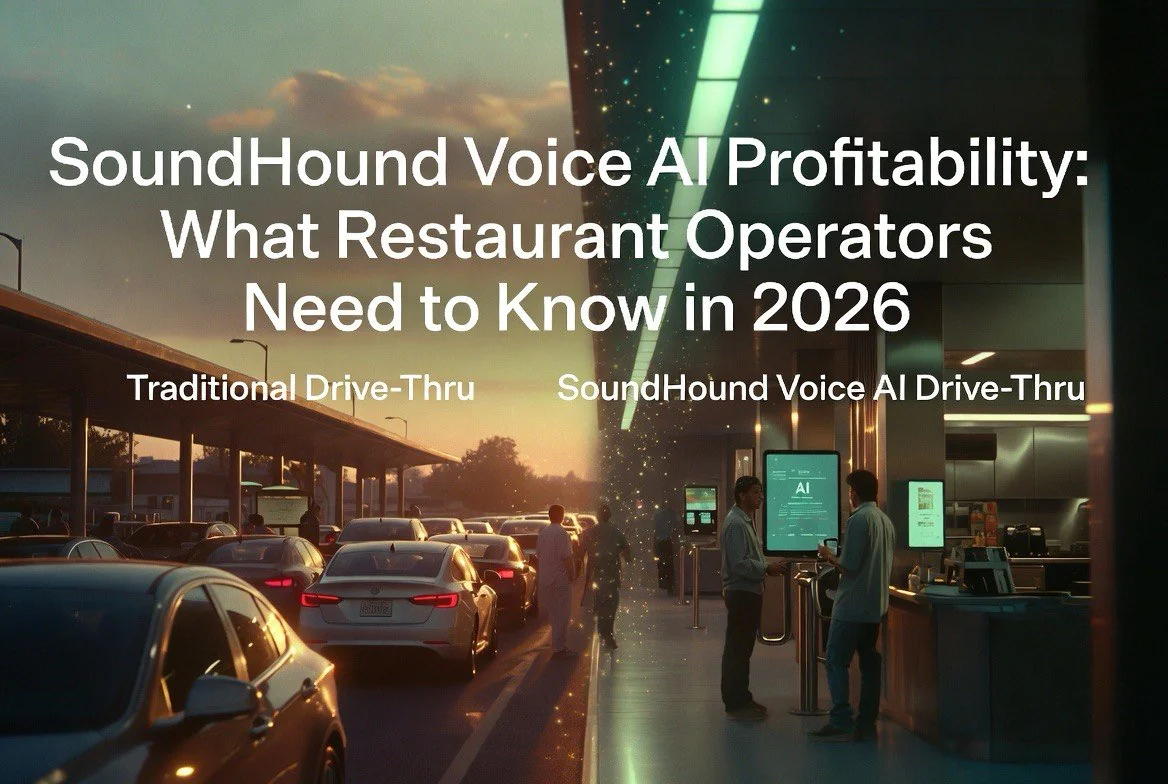
SoundHound Voice AI Profitability: What Restaurant Operators Need to Know in 2026
⚡ Expert Summary: SoundHound AI ($SOUN) is projecting profitability in 2026, driven by restaurant voice AI adoption across phone ordering, drive-thru automation, and POS integration. With a 53% five-year revenue compound annual growth rate and a speech-to-meaning accuracy advantage over Big Tech alternatives, SoundHound is positioning itself as the leading restaurant voice AI platform at a moment when the technology is moving from experimental to essential.
Voice AI for restaurants has had a reputation problem. Too many pilots. Too many press releases about testing. Too few real deployments with measurable results.
That narrative is shifting. And SoundHound AI is the best signal of the change.
SoundHound ($SOUN) is projecting profitability in 2026. Not “targeting” or “expecting to reach.” The company is telling investors that the business is crossing into sustainable positive earnings, driven primarily by its restaurant voice AI business.
For independent restaurant owners in the United States, this matters more than SoundHound’s stock price. A profitable voice AI vendor means the technology is not a speculative experiment. It means there is a real market, real deployments, and real ROI that restaurant operators are paying for consistently enough to make the vendor profitable.
When the company selling you the technology is profitable, you are not a beta tester. You are a customer buying a proven product.
The Numbers Behind SoundHound’s Profitability Projection
SoundHound reported a 53% five-year revenue compound annual growth rate through 2025, driven primarily by its restaurant and automotive voice AI divisions. The restaurant segment grew faster than automotive in 2025 and is projected to accelerate in 2026 as more US quick-service and fast-casual chains deploy voice AI at scale.
The company’s shift toward profitability is notable because it has not required massive cost cutting or restructuring. Revenue growth has outpaced expense growth for six consecutive quarters. The path to profitability runs through customer adoption, not austerity.
SoundHound’s “speech-to-meaning” technology, which the company claims achieves higher accuracy than Big Tech alternatives (Google Assistant, Amazon Alexa, Apple Siri) in restaurant-specific contexts, has been the differentiator. Restaurant voice AI needs to handle noisy environments, diverse accents, and complex menu modifications. SoundHound built its technology specifically for these conditions rather than adapting a general-purpose voice assistant.
Privacy protections are another selling point. SoundHound has positioned its technology as more privacy-conscious than Google or Amazon alternatives, which process voice data through their broader ecosystems. For restaurants concerned about customer data usage and potential liability, this differentiation matters.
What SoundHound Voice AI Actually Does for Restaurants
SoundHound’s restaurant voice AI platform covers three primary use cases, each at a different stage of market maturity.
Phone Ordering
The most mature segment. SoundHound’s voice AI answers inbound restaurant phone calls, takes orders conversationally, and routes them to the POS/kitchen display. The system handles multiple languages, remembers customer preferences, and can process complex orders with modifications. Deployment is typically 2-4 weeks, and the system integrates with Toast, Square, and Oracle POS systems. This is the primary driver of SoundHound’s restaurant revenue today.
Drive-Thru Automation
The fastest-growing segment. SoundHound’s drive-thru AI takes orders at the speaker, handles payment, and coordinates with the kitchen display. The key advantage over competitor systems is accuracy in noisy environments — engine noise, road noise, passenger conversations — where general-purpose voice assistants frequently fail. Multiple US quick-service chains are currently in deployment or pilot, with full-chain rollouts expected in the second half of 2026.
In-Store Voice Ordering
The emerging segment. Kiosk-based and counter-based voice ordering allows customers to place orders by speaking to a screen rather than tapping through menus. SoundHound is piloting this with select partners, and industry analysis suggests broader availability in 2027. For independent operators, this is the least immediately relevant segment but signals where the technology is heading.
Why Restaurant Voice AI Is Hitting an Inflection Point
SoundHound’s profitability projection is a symptom of a broader market shift. Several factors have converged to push restaurant voice AI from pilot phase to production.
Labor cost pressure. Minimum wage increases in 18 US states in 2026 have pushed the effective cost of a phone-ordering employee to $18-25 per hour including taxes and benefits, depending on location. A voice AI system costs roughly $1,500-3,000 per month for an operation handling 100-300 daily calls, which is equivalent to 1.5-2 full-time employees at a fraction of the cost.
Customer acceptance. Consumers are now comfortable interacting with AI voice systems for routine tasks. The same customers who use Siri, Google Assistant, and Alexa at home do not resist AI restaurant ordering the way they would have five years ago. The National Restaurant Association’s 2026 Consumer Survey found that 58% of US adults would be comfortable ordering from a restaurant using voice AI, up from 32% in 2023.
Integration maturity. Restaurant POS systems have standardized their API access over the past three years. Toast, Square, Oracle, Clover, and Lightspeed all offer well-documented integration paths for voice AI vendors. Integration that required custom development in 2023 is now a standard configuration in 2026.
Accuracy thresholds crossed. Voice AI accuracy for restaurant ordering has crossed 95% in controlled environments and 90% in noisy environments, according to SoundHound’s published benchmarks. At those accuracy levels, the AI can handle the majority of calls independently, with human escalation reserved for edge cases. The financial model works.
Competitive Landscape: SoundHound vs. the Alternatives
SoundHound is not the only restaurant voice AI vendor, and independent operators should understand where it fits in the competitive landscape before making a decision.
Presto Voice AI focuses primarily on drive-thru automation for fast-food chains. Presto recently deployed at Dairy Queen franchise locations across the United States. For drive-thru-focused operations, Presto is a strong competitor. For phone ordering, Presto is less established than SoundHound.
Ghost AI Systems targets independent restaurants specifically, with a focus on replacing delivery platforms. Ghost AI’s pricing is lower ($1,500-3,000/month vs. SoundHound’s $1,500-2,500/month starting range), and the company emphasizes speed of deployment (72 hours claimed). SoundHound offers broader feature depth but at potentially higher integration cost.
ChefCall and VoxOrder serve the lower end of the market with simpler systems at $499-1,500/month. These are viable options for single-location independents with straightforward ordering needs. They lack SoundHound’s accuracy in noisy environments and drive-thru capability but cost significantly less.
Big Tech alternatives (Google Cloud Contact Center AI, Amazon Lex) exist but require significant custom development. For most independent operators, the startup cost and technical complexity rule these out as practical options.
For a mid-market independent restaurant or small group generating $1-3 million annually, SoundHound sits in the premium tier of restaurant voice AI, competing on accuracy and feature breadth rather than price. The question is whether the accuracy premium translates to enough additional order capture to justify the cost difference versus lower-priced alternatives.
What This Means for Independent Operators
For independent restaurants, SoundHound’s trajectory signals two things.
First, the technology is ready for prime time at the independent level, not just at large chains. While SoundHound’s initial restaurant deployments were with multi-unit chains like KFC, Dairy Queen, and Taco Bell, the company has been expanding its independent restaurant offerings through POS-integrated partners and simpler deployment models. The cost structure for a single-location independent restaurant is roughly $1,500-2,500 per month, which must be measured against the $20,000-40,000 many independents pay monthly in delivery platform commissions.
Second, the window for early adopter advantage is closing. When a company the size of SoundHound projects profitability based on restaurant voice AI revenue, it means the technology has crossed the chasm. The operators who deploy in 2026 will capture the savings and competitive advantage while late adopters play catch-up in 2027-2028.
What to Watch for Before Deploying
SoundHound is a strong platform, but independent operators should evaluate specific deployment factors before committing.
Voice complexity. SoundHound’s claimed accuracy advantage matters most for restaurants with heavy drive-thru traffic, diverse customer accents, or complex menu structures. For a simple counter-service operation with a straightforward menu, the accuracy differences between vendors may not justify a premium price.
Integration cost. SoundHound’s independent restaurant pricing starts at $1,500/month, but integration and setup costs vary. Some POS integrations are plug-and-play. Others require middleware or custom work. Get a written scope of work before signing.
Contract terms. As SoundHound moves toward profitability, the company may shift from acquisition pricing (discounted to win market share) to value-based pricing (priced to maximize margin). Operators who lock in multi-year contracts in 2026 may benefit from pricing that later customers cannot get.
Support model. Independent restaurants need responsive support. Confirm whether SoundHound provides US-based technical support for independent operators or routes smaller accounts through a partner network. Response time for a down system is the difference between taking orders and losing a Friday night service.
The Automation Roadmap Beyond Voice
SoundHound’s profitability signals a broader shift in restaurant automation. If voice AI for ordering is crossing into sustainable commercial viability, the same technology stack can extend to other restaurant operations.
SoundHound is already developing adjacent capabilities: AI-driven upsell suggestions during phone and drive-thru orders, automated customer satisfaction surveys after delivery, and predictive ordering based on historical call patterns. These are not speculative R&D projects. They are production-adjacent features that leverage the same voice AI infrastructure that SoundHound has already built and proven.
For independent operators considering a voice AI deployment in 2026, the decision should factor in the broader automation trajectory. A vendor that is profitable, growing, and extending its product line will be a more reliable long-term partner than a startup that may not survive the next funding cycle. SoundHound’s profitability projection effectively de-risks the vendor choice — not the only factor, but a meaningful one in an industry where restaurant technology vendors have a high failure rate.
Frequently Asked Questions
Is SoundHound voice AI available for single-location independent restaurants?
Yes, but availability varies by POS integration. SoundHound works with Toast, Square, and Oracle POS systems. Independent operators on other POS platforms may need to verify compatibility before deployment.
How does SoundHound compare to Presto Voice AI or other competitors?
SoundHound differentiates on speech-to-meaning accuracy in noisy environments and privacy protections. Presto Voice AI (recently deployed at Dairy Queen franchise locations) focuses on drive-thru ordering specifically. For phone ordering, SoundHound and Ghost AI Systems are the strongest options for independent operators. The best choice depends on POS compatibility and specific use case.
Does SoundHound charge per call or per month?
SoundHound typically charges a monthly subscription fee based on expected call volume, with overage charges for higher-than-expected usage. Independent operators should negotiate a flat monthly rate with a reasonable volume cap to avoid surprise charges during busy periods.
Can SoundHound handle languages other than English?
Yes. SoundHound supports multiple languages for phone ordering, including Spanish, which is critical for US restaurants serving diverse customer bases. The system can also handle bilingual interactions within a single call.
How long does deployment take for an independent restaurant?
Typical deployment time is 2-4 weeks including POS integration, menu training, shadow mode, and live deployment. Some POS integrations (Toast) are faster than others.

About Barak Schurr
Barak Schurr built and exited a major ticketing platform, ran global operations at Eventbrite, and now focuses on one question: which AI tools actually help independent restaurant owners run leaner and grow faster. He writes from the operator’s perspective — no vendor spin, no theory, just what’s real in 2026.
Email: [email protected]
More AI Resources