Square vs Toast AI Menu Optimization: Which POS Wins for Small Restaurants in 2026?
u26a1 Expert Summary: Square and Toast are both launching AI-powered menu optimization tools in mid-2026, but they approach the problem differently. Square uses its data advantage across millions of businesses to offer simple, affordable menu insights. Toast leverages deep restaurant-specific features with xtraCHEF for ingredient-level profitability analysis. For independent restaurant owners, the choice between them depends on whether you want a simple AI assistant or a full operations intelligence platform.
The AI Menu Race Is On
Point of sale platforms have quietly become some of the most powerful data engines in the restaurant industry. Every transaction, every ticket modifier, every time-of-day sales pattern is a data point. In 2026, both Square and Toast are finally turning that data into actionable AI for menu optimization u2014 but they’re starting from very different positions.
Square processes payments for millions of businesses across every vertical, giving it a broader data set but less restaurant-specific depth. Toast processes exclusively for restaurants, giving it a narrower but far more relevant view of menu performance, food costs, and operational efficiency.
For an independent restaurant owner in the United States, the question isn’t whether AI menu optimization matters u2014 it does. According to a Restaurant Dive study from early 2026, only about 7% of restaurants currently use AI specifically for menu management, but the early adopters are seeing measurable margin improvements through data-driven pricing and dish performance analysis.
The question is which platform’s approach fits your operation.
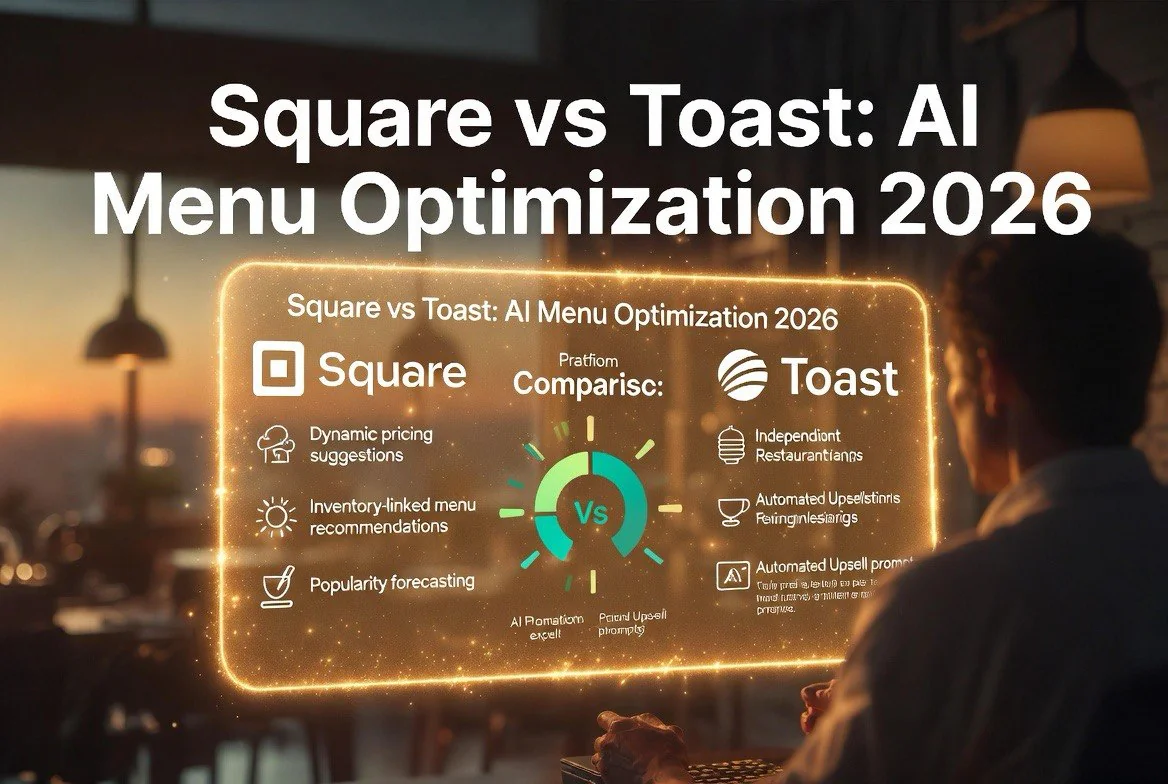
Square’s AI Menu Tools
Square for Restaurants launched updated AI menu features in mid-2026 as part of its Plus and Premium plans. The tools focus on three areas:
Performance scoring. Square’s AI analyzes each menu item across sales volume, profit margin, time-of-day popularity, and customer ratings. Items get scored and ranked, with clear recommendations for which dishes to promote, discount, or remove.
Dynamic pricing suggestions. Based on demand patterns, ingredient cost changes, and competitor benchmarking, Square suggests price adjustments in real time. The system flags items that are underperforming relative to similar items in similar restaurants.
Allergen and dietary auto-tagging. Square uses computer vision and natural language processing to automatically tag menu items with dietary attributes u2014 gluten-free, vegan, nut-free u2014 based on ingredient lists and preparation methods. This reduces manual data entry and improves accuracy for increasingly important dietary transparency.
Square’s pricing for these features is straightforward. The Plus plan at $49/month per location includes basic menu analytics. The Premium plan at $149/month per location adds the AI-driven scoring, pricing suggestions, and auto-tagging. For a single-location independent restaurant, that’s a $1,200-1,800 annual investment for AI menu intelligence.
Toast’s AI Menu Tools
Toast’s approach is more operationally integrated, thanks to its acquisition and development of xtraCHEF for recipe costing and menu profitability analysis. Toast’s AI menu toolkit includes:
Menu intelligence dashboard. Toast aggregates sales data, ingredient costs, prep time, and customer feedback into a single view of each menu item’s true profitability. Not just what sells, but what actually makes money after food cost, labor, and waste are factored in.
Demand forecasting. Using historical sales data, weather patterns, and local event calendars, Toast predicts demand for each menu item with per-day, per-meal accuracy. This feeds into inventory ordering and staffing recommendations.
Check trend analysis. Toast’s AI identifies patterns in what customers order together u2014 which combinations drive higher check averages, which pairings are being missed, and where upselling opportunities exist.
Toast’s AI features are included in the “Build Your Own” tier, which starts around $110 per month and scales with add-ons. For a restaurant already on Toast, the AI tools don’t require additional subscriptions. The tradeoff is Toast’s higher base cost u2014 the Point of Sale plan starts at $69/month, and the hardware costs are higher than Square’s.
Side-by-Side Comparison
| Feature | Square | Toast |
|---|---|---|
| Starting price for AI | $49/month (Plus), $149/month (Premium for full AI) | $69-110/month (AI features included) |
| Menu item scoring | AI-driven profit/volume/rating scores | Full cost-of-goods analysis via xtraCHEF |
| Dynamic pricing | Real-time suggestions based on demand patterns | Forecast-driven pricing with demand prediction |
| Allergen auto-tagging | Computer vision + NLP from menu data | Manual + recipe-based via xtraCHEF |
| Inventory integration | Basic stock tracking | Deep integration with recipe costing + ordering |
| Best for | New/small restaurants, budget-conscious ops | Full-service, multi-location, operations-focused |
| Processing fees | 2.5-2.6% in-person (varies by plan) | 2.49-3.09% in-person (varies by plan) |
| Hardware cost | $59 reader to $899 terminal | Subscription-based terminals (higher cost) |
Which Should an Independent Restaurant Choose?
The answer depends on what kind of restaurant you run and what you need from menu optimization.
For a new or small independent restaurant (under $500k annual revenue): Square is the smarter choice. The entry price is hard to beat u2014 Square’s free plan gives you basic POS and menu management, and the $49/month Plus plan adds meaningful menu analytics. The AI features on the Premium plan at $149/month are worth it only if you’re actively using the pricing and scoring tools to make menu decisions.
The main tradeoff is depth. Square’s AI tools are designed for broad applicability across many business types. A coffee shop and a full-service Italian restaurant get the same basic toolset. The insights are useful but not operationally specific.
For an established independent (over $500k annual revenue, 10+ employees): Toast’s higher cost is justified by the operational integration. xtraCHEF’s recipe-level costing means the AI can tell you not just how an item sells, but whether it actually makes money after ingredients, prep labor, and waste. The demand forecasting ties directly into inventory ordering, reducing both waste and stockouts.
If you’re running specials or seasonal menus, Toast’s ingredient-level data helps you price them accurately from day one instead of guessing and adjusting later. The AI doesn’t just suggest better prices u2014 it tells you what each item costs to produce at the ingredient level.
For multi-location operators: Toast’s edge widens. Centralized menu management with per-location AI insights, combined with consistent tooling across all locations, makes Toast the practical choice. Square can handle multi-location, but the menu features are less operationally integrated.
The AI Menu Third-Party Option
For restaurants that want AI menu optimization without switching POS systems, standalone tools like MenuPriceOptimizer, Checkmate, and Loman.ai connect to either Square or Toast and add AI-driven menu analysis on top of existing POS data. These typically cost $15-100 per month per location and integrate via the POS’s API.
This approach is worth considering if you’re happy with your current POS but want the AI layer. However, the native Square and Toast versions are deeper and better integrated, since they access data that third-party tools can’t reach through the limited API surface.
The Bottom Line
AI menu optimization is no longer a futuristic concept u2014 it’s a feature you can get today on either Square or Toast for roughly $50-150 per month. For a restaurant that wants to maximize margins through data-driven pricing and dish performance analysis, it’s a small investment with measurable returns.
Square wins on price and simplicity. Toast wins on depth and operational integration. If you’re running a single-location quick-service or fast-casual operation, Square’s AI tools are more than sufficient. If you’re running a full-service restaurant with complex menu engineering needs, Toast’s xtraCHEF integration makes its higher cost a worthwhile investment.
Frequently Asked Questions
Can I get AI menu optimization without switching POS systems?
Yes. Third-party tools like Checkmate and Loman.ai connect to both Square and Toast via API and add AI menu analysis.
Does Square’s AI menu tool work for coffee shops too?
Yes. Square’s AI menu features are designed for broad applicability across food service businesses, including coffee shops, bakeries, and fast-casual.
Is Toast’s menu AI included in the base plan?
The more advanced AI features (xtraCHEF integration, demand forecasting) are available in the Build Your Own tier, not the basic Point of Sale plan.
How accurate are the AI pricing suggestions?
Both platforms report that restaurants using AI-driven pricing suggestions see 3-8% margin improvements within 90 days of implementation, according to the companies’ published case studies.
Does either platform support inventory integration for menu costing?
Toast’s integration is deeper, with xtraCHEF providing ingredient-level recipe costing. Square offers basic stock tracking but not ingredient-level menu profitability.
Can I run AI menu tools across multiple locations?
Yes. Both Square and Toast support multi-location management with per-location AI insights.

About Barak Schurr
Barak Schurr built and exited a major ticketing platform, ran global operations at Eventbrite, and now focuses on one question: which AI tools actually help independent restaurant owners run leaner and grow faster. He writes from the operator’s perspective — no vendor spin, no theory, just what’s real in 2026.
Email: [email protected]
More AI Resources