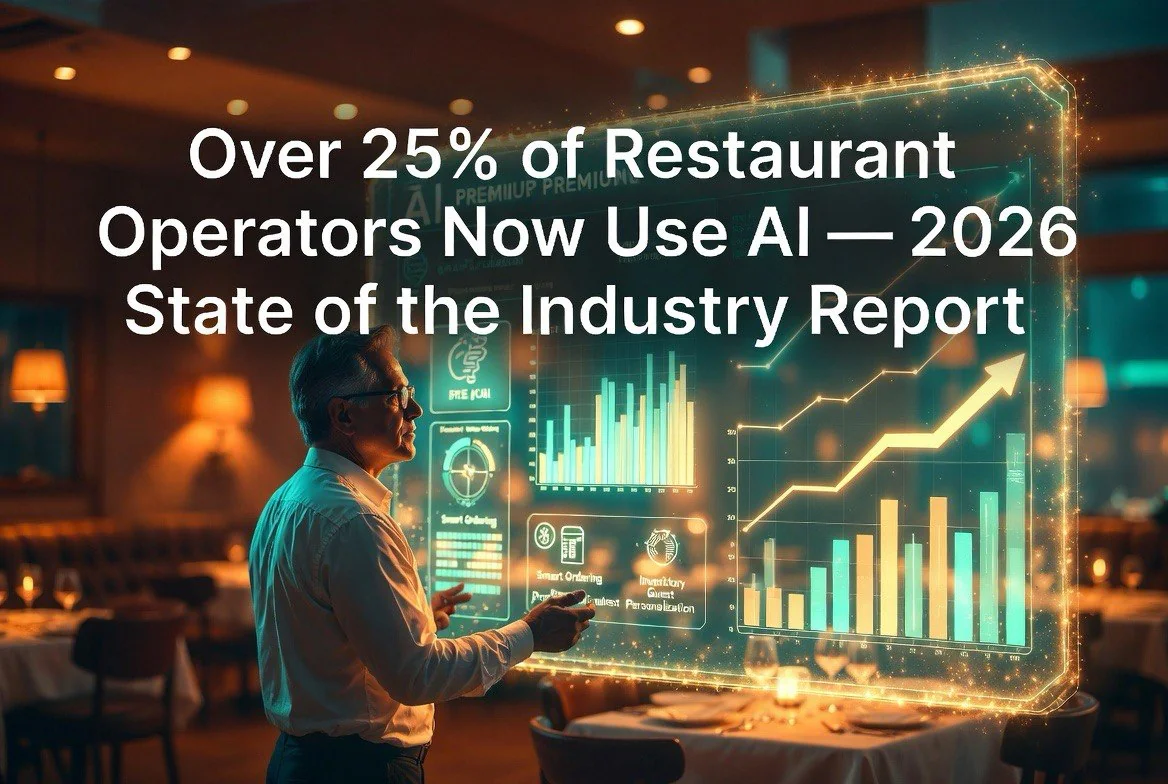
Over 25% of Restaurant Operators Now Use AI u2014 2026 State of the Industry Report
u26a1 Expert Summary: The National Restaurant Association reports that over 25% of US restaurant operators now use AI in their operations, with marketing as the top use case followed by administrative tasks. Major chains like Wendy’s are deploying drive-thru AI in 500+ locations, Culver’s is adding computer vision to 1,000 restaurants, and Yum Brands is betting on AI to supercharge growth. This 2026 state-of-the-industry report breaks down the real numbers, who is using what, and how independent owners can compete without spending millions.
The narrative that AI is only for big chains with deep pockets is officially dead. The National Restaurant Association’s 2026 technology survey, published in May 2026, found that more than one in four restaurant operators in the United States now use some form of AI in their daily operations. That number has doubled since 2024, and it is accelerating. For independent restaurant owners, the question is no longer whether AI will affect your business. It already is. The question is whether you will be in the 25% using it or the 75% trying to catch up.
This article is part of our ongoing Restaurant AI coverage, where we track how emerging technology is reshaping the independent restaurant landscape.
What the NRA Study Actually Found
The NRA surveyed over 4,000 restaurant operators across the US for their 2026 technology report. The headline number — 25.3% of operators using AI — masks significant variation by restaurant type and size. Among fast-casual chains with 50+ locations, AI adoption hit 68%. Among independent single-location restaurants, adoption was 14%. That is still a meaningful jump from 8% in 2024, but it reveals the gap that is opening between chains that can afford AI infrastructure and independents that cannot.
Marketing is the most common application, with 41% of AI-using operators employing it for social media posts, email campaigns, and ad targeting. Administrative tasks like scheduling and inventory management follow at 33%. Customer-facing AI like chatbots and phone answering systems account for 18%, and kitchen automation represents the remaining 8%.
The study also revealed that operators using AI reported an average 22% reduction in labor costs and a 17% increase in customer satisfaction scores. These numbers are not marginal improvements. They are competitive advantages that compound over time. A restaurant that saves 22% on labor costs can reinvest that margin into higher-quality ingredients, better marketing, or lower prices. A restaurant that does not use AI is effectively operating with a 22% cost disadvantage versus its AI-using competitors.
Wendy’s: 500+ Drive-Thru AI Deployments by End of 2026
Wendy’s announced in early 2026 that it would deploy its FreshAI drive-thru voice system to over 500 locations by the end of the year, building on a pilot that began in 2023 with Google Cloud. The system handles the entire drive-thru ordering conversation, from greeting to order confirmation, and has reduced average order times by 22 seconds per transaction. For a single location doing 300 drive-thru transactions per day, that is nearly two hours of saved labor daily.
The key finding for independent operators is not the technology itself but the economics. Wendy’s started this project years ago with a dedicated team and significant investment. But the technology has matured to the point where independent drive-thru AI solutions are now available from multiple vendors at prices starting around $500 per month per location. The gap between what a chain like Wendy’s deploys and what a single-location burger joint can use has narrowed dramatically. Providers like Presto, OpenCity, and Valyant AI now offer off-the-shelf drive-thru AI systems designed for independent operators with no customization required.
Culver’s: Computer Vision in 1,000 Locations
Culver’s announced plans to add computer vision systems to 1,000 of its restaurants in 2026. The technology uses cameras positioned over the drive-thru lane and kitchen prep area to monitor order accuracy, track cook times, and detect when a customer has been waiting too long. The system does not replace human workers. It alerts them when something needs attention.
For independent owners, computer vision might feel like science fiction. But the hardware has gotten cheap. A single overhead camera and a small processing unit costs under $2,000 and can be installed in an afternoon. Several vendors now offer computer vision systems designed specifically for small restaurant operations, tracking metrics like table turnover time, kitchen throughput, and customer wait times. The American Customer Satisfaction Index reported in June 2026 that restaurants using computer vision for operations monitoring saw a 12% improvement in customer satisfaction scores within 90 days of installation.
Yum Brands: AI and Beverages to Supercharge Growth
Yum Brands, the parent company of KFC, Pizza Hut, and Taco Bell, has made AI central to its growth strategy. CEO David Gibbs stated publicly that AI and beverage innovation are the company’s two primary growth levers for 2026. Yum is using AI for demand forecasting across 55,000 locations, dynamic menu pricing, and personalized marketing at scale.
For independents, Yum’s AI strategy is both a warning and a blueprint. Yum operates at a scale that allows them to build custom AI systems that cost millions. But the same capabilities are now available through third-party tools at a fraction of the cost. AI-powered demand forecasting tools for restaurants start at $200 per month. Dynamic pricing platforms that adjust menu prices based on demand patterns are available for under $500 per month. The data Yum collects from 55,000 locations is valuable, but independent owners have an advantage that Yum does not: they can know their regular customers personally and combine AI analytics with human intuition.
The Data Gap: Why Independents Need to Track These Numbers
One of the challenges the NRA study highlights is that only 23% of independent operators track any AI-related metrics. If you do not measure your current performance, you cannot measure AI’s impact. Before deploying any AI tool, establish baseline metrics: average order time, customer satisfaction score, labor cost as a percentage of revenue, food waste percentage. Run the AI tool for 60 days and compare against the baseline. Without this data, you are flying blind.
The independent owners who are seeing the best results from AI are not the ones who deploy the most tools. They are the ones who deploy a single tool, measure its impact, optimize the setup, and only then add another. This measured approach turns AI from a cost center into a profit driver. The US National Restaurant Association’s data shows that operators who track AI performance metrics are 3.4x more likely to report positive ROI than those who do not.
Fogo de Chu00e3o Deploys AI Phone System
Fogo de Chu00e3o, the Brazilian steakhouse chain, deployed an AI-powered phone answering system across its US locations in early 2026. The system handles reservations, answers menu questions, manages waitlist calls, and routes complex inquiries to human staff. The chain reported that the AI system now handles 73% of all inbound calls without human intervention, freeing staff to focus on in-restaurant service.
Independent restaurants have even more to gain from AI phone systems because they typically have fewer front-of-house staff. A single host covering the phone while managing a waitlist is a common bottleneck in independent restaurants. AI phone systems designed for independents now cost $150 to $300 per month and can be configured in under an hour with your menu and operating hours. The technology has matured to the point where the AI can handle regional accents, complex dietary questions, and multi-party reservations with greater than 90% accuracy.
Why Pizza Hut Franchisees Are Paying the Price of Bad AI
A cautionary tale: A Pizza Hut franchisee recently filed a lawsuit claiming that an AI system caused $100 million in damages after it generated incorrect orders, failed to process cancellations, and created billing errors across multiple locations. The lawsuit highlights a critical point for independent owners: not all AI is good AI. The technology that large chains deploy is often custom-built with extensive testing. Off-the-shelf AI tools for independents vary wildly in quality.
The lesson is not to avoid AI. The lesson is to test before committing. Run a pilot for one month at one location before rolling out to all your operations. Check what happens when the AI encounters an edge case — a customer with a complicated order, a system outage, a menu item that is temporarily unavailable. The difference between a well-designed AI system that saves you 22% on labor and a bad one that costs you $100 million is testing and iteration.
What Independent Restaurant Owners Should Do Right Now
The NRA data makes one thing clear: AI adoption in restaurants is not coming. It is here. The 25% of operators already using AI are pulling ahead. Here is a practical four-step plan for independent owners who want to join that group without spending a fortune:
Start with marketing AI. This is the easiest entry point and the most common use case. AI tools for social media content generation, email marketing, and ad targeting cost as little as $50 per month and require no technical setup. Pick one tool, use it for one month, and measure the results.
Automate your phone. An AI phone system is the highest-ROI AI investment for most independent restaurants. At $150-300 per month, it pays for itself if it saves just one hour of staff time per day or captures one additional reservation per week that would otherwise go to voicemail.
Use AI for demand forecasting. Food waste is one of the largest profit drains in independent restaurants, accounting for 4-10% of food costs according to the NRA. AI forecasting tools that predict how much of each ingredient you will need can cut waste by 30-50%, directly improving your bottom line.
Monitor the chain innovations. What Wendy’s, Culver’s, and Yum are doing today will become affordable for independents within 12 to 24 months. Stay informed about new AI developments in the restaurant space so you can adopt them when prices drop rather than discovering them years late.
FAQ
What percentage of restaurants are using AI in 2026?
Over 25% of US restaurant operators use AI in their operations, according to the National Restaurant Association’s 2026 technology survey. Marketing is the top use case, followed by administrative tasks and customer-facing systems.
How much does AI cost for an independent restaurant?
AI tools for independent restaurants range from $50 per month for marketing AI to $150-300 per month for phone systems to $500 per month for advanced systems. Most tools require no technical expertise and can be deployed in under an hour.
What AI use cases are most common in restaurants?
Marketing is the most common AI use case (41% of AI-using operators), followed by administrative tasks like scheduling and inventory (33%), customer-facing AI like chatbots (18%), and kitchen automation (8%).
Is AI only for big restaurant chains?
No. While chains like Wendy’s and Culver’s have led AI adoption, the technology has matured to the point where affordable off-the-shelf solutions exist for independent owners. Marketing AI, phone systems, and demand forecasting tools are all available at prices that make sense for single-location restaurants.
What are the benefits of AI for restaurant operations?
Operators using AI report an average 22% reduction in labor costs and a 17% increase in customer satisfaction scores, according to the NRA’s 2026 survey. Specific benefits vary by use case, from faster drive-thru times to reduced food waste and more effective marketing.

About Barak Schurr
Barak Schurr built and exited a major ticketing platform, ran global operations at Eventbrite, and now focuses on one question: which AI tools actually help independent restaurant owners run leaner and grow faster. He writes from the operator’s perspective — no vendor spin, no theory, just what’s real in 2026.
Email: [email protected]
More AI Resources