Get the AI Restaurant Quick-Start Guide — Free
The 5 AI tools independent US restaurant owners are using right now to cut labor costs and answer every call.
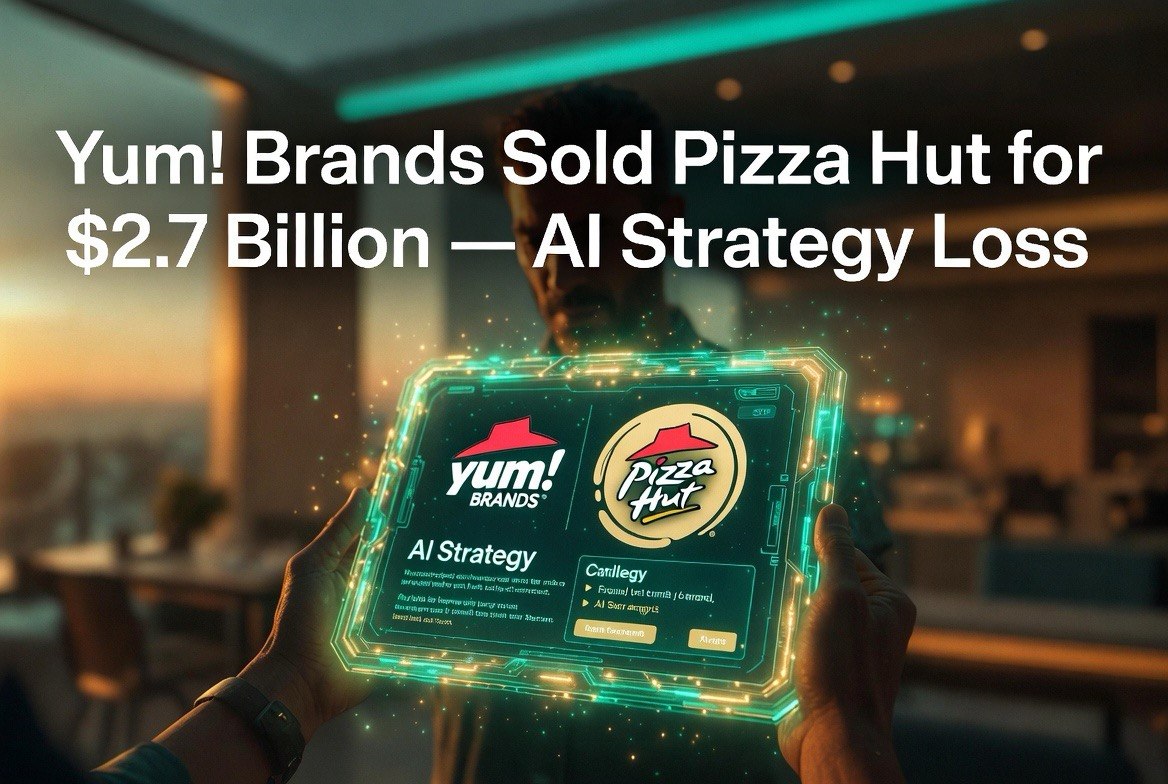
Yum Brands Sold Pizza Hut for $2.7 Billion — Here Is What the AI Strategy Loss Means for Independent Operators
⚡ Expert Summary: Yum Brands sold Pizza Hut for $2.7 billion on June 16, 2026 — splitting the chain between LongRange Capital ($1.5B for non-China markets) and Yum China Holdings ($1.2B). The sale takes Pizza Hut private after 10 consecutive quarters of same-store sales declines. For independent operators, the big story isn’t the sale itself — it’s what happens to Yum’s AI-driven technology strategy that Pizza Hut was supposed to benefit from. The sale severs Pizza Hut from the Byte platform, Yum’s proprietary AI tech stack that powers Taco Bell and KFC. Independent restaurants should watch closely: the Byte platform is Yum’s competitive AI weapon, and without it, the newly independent Pizza Hut will need to rebuild its tech infrastructure from scratch.
The Biggest Restaurant Sale of 2026 — and Why It Matters Beyond the Headlines
On June 16, Yum Brands announced it would sell Pizza Hut in two separate transactions totaling $2.7 billion. LongRange Capital is acquiring the international business (excluding China) for $1.5 billion, while Yum China Holdings is purchasing the China operations for $1.2 billion. Both deals are expected to close in Q3 2026.
The headline numbers are dramatic. Pizza Hut’s same-store sales have declined for 10 consecutive quarters. The brand closed approximately 250 underperforming U.S. locations in February 2026 — about 4% of its domestic footprint. Over the past decade, Pizza Hut has shuttered roughly 1,500 net U.S. locations. Its market share fell from 16.9% in 2015 to 12.1% in 2025. During that same period, Domino’s grew from 14.2% to 23.4%, becoming the undisputed category leader.
But here’s what the financial press coverage misses: Yum Brands has spent the last three years building one of the most sophisticated AI-driven restaurant technology platforms in the industry. That platform — called Byte — powers digital ordering, AI-driven supply chain forecasting, dynamic menu pricing, and automated kitchen routing across KFC and Taco Bell. And Pizza Hut is about to lose access to it.
What Is Byte? Yum’s AI Platform That Pizza Hut Is Leaving Behind
Byte is Yum Brands’ proprietary restaurant management platform that integrates point-of-sale, kitchen display systems, inventory management, and customer data into a single AI-powered layer. Yum has invested over $500 million in Byte since 2023, and the platform currently processes transactions across roughly 55,000 restaurant locations worldwide.
The key capabilities Byte provides include:
AI-driven demand forecasting: Byte uses machine learning models trained on years of transaction data to predict daily sales volume by hour across every store location. KFC and Taco Bell franchisees report that Byte’s forecasts hit within 5% of actual sales 90% of the time, according to Yum’s 2025 investor day presentation. This level of accuracy allows operators to optimize food prep volume, reduce waste, and schedule labor more precisely.
Dynamic menu optimization: Byte automatically adjusts digital menu boards based on inventory levels, time of day, and regional preferences. If a store runs out of a key ingredient at 2 PM, Byte removes items containing that ingredient from the digital menu within minutes — no manager intervention required. Taco Bell has used this capability to reduce stockout-related revenue loss by an estimated 12%.
Automated kitchen routing: Byte’s kitchen display system intelligently routes orders to the optimal cooking station based on current load. If the make line is backed up, Byte automatically redistributes orders to underutilized stations. This dynamic routing has reduced average ticket times at KFC by roughly 45 seconds per order.
Integrated labor scheduling: Byte’s AI labor module generates shift schedules based on predicted sales volume, historical coverage patterns, and individual employee availability. It also handles tip pooling calculations and overtime alerts automatically.
The acquisition announcement specified that Yum will continue to provide Byte to Pizza Hut during a transition period, and Yum’s press release noted that Pizza Hut would continue to use Byte’s technology platform — “for a period of time.” That’s the key phrase. The transition support is temporary. Once it expires, Pizza Hut will need its own technology stack, from scratch.
What This Means for Independent Operators
The Pizza Hut sale creates a rare moment of clarity in restaurant technology. Here’s what independent operators should take away:
1. The large chains recognize that proprietary AI platforms are a competitive moat. Yum’s willingness to sell Pizza Hut while keeping KFC and Taco Bell confirms something important: the company believes its AI technology advantage is worth more than a billion-dollar pizza chain that can’t execute. Yum’s leadership concluded that the turnaround effort required to fix Pizza Hut’s operations would distract from what the company does best — running KFC and Taco Bell, powered by Byte. For independent operators, this confirms that AI-driven operations are a competitive advantage, not a cost center. The largest restaurant companies in the world are betting their core brands on custom AI platforms. The gap between chain-level AI capabilities and independent restaurant tech is widening, not narrowing.
2. Pizza Hut’s tech rebuild is a case study in how hard restaurant AI actually is. Building a platform like Byte requires years of transaction data, thousands of integration points, and continuous model training. Pizza Hut will need to either acquire or build an equivalent system. That process will take 18-36 months minimum, and during that gap, Pizza Hut will be operating with substantially less operational AI capability than its competitors. For independent operators still running pen-and-paper ordering or basic POS systems, the lesson is clear: the AI gap compounds. Every month you delay adopting operational AI, the data deficit grows. The restaurants that start collecting AI-ready data now — digital orders, prep times, waste tracking — will have a massive advantage within two years.
3. The Byte platform model is not available to independents — but alternatives are emerging. Byte is proprietary to Yum. Independent operators cannot license it. But the technological components that make Byte work — machine learning demand forecasting, dynamic menu boards, automated scheduling — are becoming available through third-party platforms. Systems like Crunchtime, Upserve, and specialized AI restaurant platforms offer pieces of the same technology stack. The competitive question for independent operators is: are you assembling the pieces now, or waiting until your competitors have a three-year data advantage?
4. Pizza Hut’s decline holds specific AI-related lessons. Pizza Hut’s market share loss to Domino’s is partly a technology story. Domino’s has invested heavily in AI throughout its operations — from the AnyWare ordering platform to its GPS delivery tracking to its autonomous delivery vehicle program. Domino’s technology infrastructure gives it operational advantages that compound over time: more data enables better forecasts, better forecasts enable lower waste, lower waste enables better pricing, better pricing drives more orders. Pizza Hut, despite being part of a larger company with more resources, fell behind on this technology cycle. The lesson for independent restaurants is that technology investment in restaurants operates on a compounding curve, not a linear one. The earlier you start, the faster the advantages accumulate.
What Happens to Restaurant AI Investment After the Sale
The sale reframes how the industry should think about restaurant technology adoption. Yum’s decision is a tacit admission that fixing Pizza Hut structurally requires more management attention than the chain’s revenue contribution justifies. That’s a cold business calculation, but it reveals something important about restaurant AI: the technology is becoming too strategic to be shared across different brand strategies. Taco Bell and KFC benefit from Byte because their operations are similar enough that the same forecasting models work across both. Pizza Hut’s operations — dominated by delivery and carryout with a significantly different kitchen workflow — couldn’t leverage Byte the same way.
This suggests that as restaurant AI matures, technology platforms will become more brand-specific, not more generic. Independent operators who buy off-the-shelf restaurant management software may find it increasingly outpaced by competitors using customized AI systems tuned to their specific operational profile.
“The sale process could drag on for several quarters, if not longer, and likely acts as a distraction for at least the next year,” BTIG analyst Peter Saleh wrote in a research note in December 2025. That distraction extends beyond Pizza Hut’s management. It affects every supplier, technology vendor, and franchisee connected to the chain. The ripples will take 18-24 months to fully settle.
What Independent Operators Should Do Now
The Pizza Hut sale is a signal, not an immediate threat. But it signals clearly that the restaurant industry’s AI transformation is accelerating, not slowing down. Here are three actions independent operators can take:
Audit your technology stack. Do you know what data your POS system is collecting? Can you export granular sales data by hour and menu item? If not, your technology is not AI-ready. The foundation of operational AI is structured, accessible transaction data. Without it, no AI tool can help you.
Compare your AI adoption to your direct competitors. If a pizza chain in your market uses AI demand forecasting and you’re still doing manual prep counts, the efficiency gap will grow every quarter. You don’t need a $500 million platform — but you do need a plan to adopt the components that matter most for your operation.
Watch Pizza Hut’s tech rebuild. The newly independent Pizza Hut will need to make public technology decisions in the coming months. Will they acquire a technology company? Build their own platform? License from a third party? Each decision will tell you something about the direction of restaurant technology. Independent operators should pay attention to which vendors Pizza Hut chooses — those are the same vendors that may soon be targeting the mid-market.
The Bottom Line for Independent Operators
When Yum Brands decided to sell Pizza Hut, it made a calculation that the turnaround required to fix operations across 6,300 U.S. locations was not worth the distraction from its core AI-powered brands. That calculation is a direct statement about the strategic importance of restaurant technology infrastructure.
The sale price — $2.7 billion for a brand with 18,000 locations worldwide — reflects the market’s assessment of Pizza Hut’s diminished competitive position. Domino’s, with roughly 20,000 locations, has a market capitalization over $14 billion. The gap between those valuations is partly a technology gap.
For independent operators, the message is unmistakable: AI-driven operations are no longer a future possibility. They are the current competitive baseline. The brands investing in AI are pulling away. The brands that aren’t are being sold.
The $2.7 billion sale of Pizza Hut isn’t just a financial story. It’s a technology story that every restaurant owner should study. The biggest lesson isn’t about pizza market share. It’s about what happens when a brand falls behind on AI — and how hard it is to catch up.
Frequently Asked Questions
What is the Byte platform and why does it matter?
Byte is Yum Brands’ proprietary AI-powered restaurant management platform. It handles demand forecasting, dynamic menu boards, automated kitchen routing, and labor scheduling across roughly 55,000 KFC and Taco Bell locations. Yum has invested over $500 million in Byte since 2023.
Will Pizza Hut lose access to Yum’s AI technology?
Yes, eventually. Yum will provide transitional Byte platform support after the sale closes, but the press release specifies continued access “for a period of time.” Once the transition period ends, Pizza Hut will need its own technology infrastructure.
How much did Yum Brands sell Pizza Hut for?
Yum Brands sold Pizza Hut for $2.7 billion in two separate transactions. LongRange Capital purchased the international business (excluding China) for $1.5 billion. Yum China Holdings acquired the China operations for $1.2 billion.
Why did Yum Brands decide to sell Pizza Hut?
Pizza Hut’s same-store sales declined for 10 consecutive quarters. Its market share fell from 16.9% in 2015 to 12.1% in 2025. Yum’s CEO stated that turning around the chain might be best executed outside of Yum’s ownership. The chain’s U.S. operations account for 40% of its sales, making it difficult to offset domestic problems through international growth.
What does the Pizza Hut sale mean for independent restaurant operators?
The sale confirms that large chains view proprietary AI platforms as a competitive advantage. It also demonstrates how hard it is to catch up when you fall behind on restaurant technology adoption. Independent operators should audit their data readiness and begin adopting operational AI tools now, before the technology gap widens further.

About Barak Schurr
Barak Schurr built and exited a major ticketing platform, ran global operations at Eventbrite, and now focuses on one question: which AI tools actually help independent restaurant owners run leaner and grow faster. He writes from the operator’s perspective — no vendor spin, no theory, just what’s real in 2026.
Email: [email protected]