Get the AI Restaurant Quick-Start Guide — Free
The 5 AI tools independent US restaurant owners are using right now to cut labor costs and answer every call.
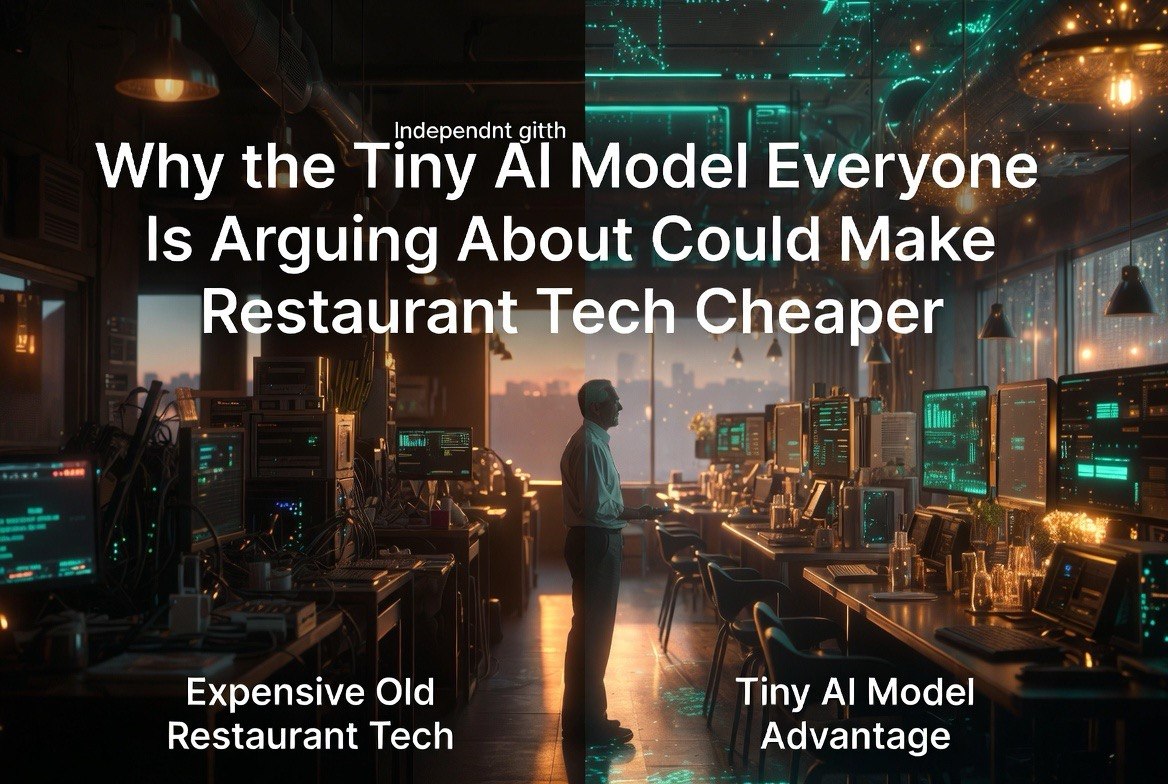
Why the Tiny AI Model Everyone Is Arguing About Could Make Restaurant Tech Cheaper
⚡ Expert Summary: Weibo’s VibeThinker-3B scored 94.3 on AIME 2026 — matching DeepSeek V3.2 (671B params) at 0.4% the size. For restaurant owners, the implications are direct: the AI tools you pay for by the query are about to get dramatically cheaper, and the next generation of restaurant tech will run on smaller, local models that cost a fraction of today’s cloud-dependent solutions.
According to the National Restaurant Association, US restaurants spend over $300 billion annually on labor costs, making operational efficiency critical for independent operators.
The AI News That Should Matter to Restaurant Owners
On June 14, 2026, a team of researchers at Sina Weibo — the Chinese social media company — published a paper that is making the tech world argue loudly. Their model, VibeThinker-3B, with just 3 billion parameters, scored 94.3 on the American Invitational Mathematics Examination. That matches DeepSeek V3.2, a model with 671 billion parameters — 224 times larger.
The AI community is debating whether the results are a genuine breakthrough or a benchmark game. But for restaurant owners, the academic debate is less important than the trend: small AI models are closing the gap with giants at a pace that nobody predicted six months ago.
And that trend is about to make your restaurant tech cheaper.
The Parametric Compression-Coverage Hypothesis: Tech Talk That Affects Your Wallet
The Weibo researchers introduced a concept called the Parametric Compression-Coverage Hypothesis. It argues that different AI capabilities have fundamentally different relationships to model size.
Verifiable reasoning — math, logic, analysis — is what they call “parameter-dense.” You can compress this capability into a compact model. A 3B model can reason at the same level as a 671B model because reasoning is a dense capability that does not require vast knowledge coverage.
Open-domain knowledge — facts about the world, industry specifics, regional regulations — is “parameter-expansive.” It requires more parameters because it demands broad coverage across thousands of edge cases.
The practical implication for restaurant AI: most of what you need your restaurant technology to do — forecast demand, optimize schedules, analyze sales trends, detect inventory shortages — is reasoning work, not knowledge work. A small model can handle it. The restaurant-specific knowledge layer — your menu items, your location data, your supplier contracts — can be added on top through fine-tuning.
This means the base inference cost for restaurant AI drops by 90% or more, while the specialized knowledge layer that makes it specific to your operation becomes the differentiator. The model companies that win in restaurant tech will not be the ones with the biggest models. They will be the ones with the best restaurant data.
Why Model Size Matters for Your Bottom Line
Every AI-powered restaurant tool you use — your POS system’s predictive ordering, your inventory management AI, your labor scheduling optimizer, your customer sentiment analysis — runs on a model somewhere in the cloud. The cost of running that model is baked into your monthly subscription or per-query fee.
Larger models cost more to run. A 671B parameter model requires significant cloud infrastructure — multiple high-end GPUs running continuously. Those costs get passed to you. A 3B parameter model can run on a single consumer-grade GPU or even a laptop. The infrastructure cost drops by orders of magnitude.
The Four Training Phases That Made This Possible
VibeThinker-3B is not a magic breakthrough. It is the result of thoughtful engineering on top of Qwen2.5-Coder-3B, an existing compact model from Alibaba. The Weibo team applied a four-stage training pipeline called the Spectrum-to-Signal Principle.
First, supervised fine-tuning using curriculum learning — the model trains on broad data, then shifts to harder reasoning problems. Second, samples with reasoning traces shorter than 5,000 tokens are discarded, and problems the earlier 1.5B version could solve more than 75% of the time are filtered out. The model does not waste capacity on easy problems.
Third, reinforcement learning across math, code, and STEM domains. Fourth, rejection sampling with a technique called Claim-Level Reliability Assessment, which checks intermediate reasoning steps — not just final answers. This pushed the AIME score from 94.3 to 97.1.
For restaurant tech vendors, this training pipeline is a blueprint. You do not need a 671B model to build a great restaurant AI. You need a well-trained compact model on domain-specific data. The cost to build the restaurant version of VibeThinker is a fraction of what it costs to maintain cloud infrastructure for giant models.
The Cost Saving Is Direct and Significant
When AI model deployment costs drop, software vendors have two choices: keep prices the same and pocket the margin, or lower prices to capture market share. In a competitive restaurant tech market with dozens of POS systems, inventory platforms, and labor tools fighting for your business, the pressure will be toward lower prices.
According to a 2025 Intouch Insight study, restaurants using AI-powered inventory management saw an average 18% reduction in food waste within six months. That is a meaningful ROI. But those systems currently require cloud subscriptions that cost $200-500 per month for a multi-location operation. If the underlying model costs drop by 90%, those subscription prices will follow — or a competitor will undercut them.
For independent restaurants operating on 3-5% margins, saving even $100 per month on AI tool subscriptions is real money.
Local AI: The Restaurant-Specific Advantage
VibeThinker-3B can run on consumer hardware. That means restaurant AI tools of the near future will not need to send your data to the cloud to process it.
Privacy for Customer Data
Every time your current AI tools process a transaction, analyze a review, or optimize a schedule, your data travels to a cloud server. For customer data — names, phone numbers, order histories, payment information — this creates a compliance surface area. A data breach at your AI vendor becomes your problem.
Local AI eliminates this risk entirely. The model runs on a device in your restaurant. Customer data never leaves your network. The PCI compliance burden shrinks. The GDPR and CCPA exposure shrinks. The peace of mind is worth the hardware cost alone.
The Skepticism Around VibeThinker: Why It Does Not Change the Opportunity
The AI community has genuine reasons to be skeptical. Benchmark contamination is a real problem. The GPQA-Diamond score of 70.2 — well behind Gemini 3 Pro’s 91.9 — confirms the model’s general knowledge is limited. Some researchers argue the AIME results may be inflated by the model seeing similar problems during training.
But the LeetCode weekly contest performance — 96.1% acceptance on genuinely unseen problems — is harder to dismiss. And the model weights and training methodology are fully open for independent verification.
For restaurant owners, the benchmark debate is academic. The directional trend is what matters: small models are improving at reasoning faster than anyone expected. Whether VibeThinker-3B is exactly as good as reported or 20% less good, the trajectory is the same. A 7B model six months from now will match or exceed the current 671B performance. A 13B model a year from now will be indistinguishable for practical business applications.
The question is not whether small models will deliver. It is whether your restaurant tech vendors are preparing for that shift or betting against it.
No Internet Dependency
Your AI tools working even when the internet goes down is not a nice-to-have for restaurants — it is essential. A cloud-dependent POS system that goes offline during lunch rush costs you money in lost orders, frustrated staff, and angry customers.
Local AI models operate independently of internet connectivity. The model processes data on-device. When the connection is down, your AI tools keep running. When it comes back, analytics sync to the cloud for reporting. This architecture is already standard in leading restaurant POS systems. Adding local AI inference makes it the norm for all restaurant technology.
Real-Time Processing Without Latency
Cloud-based AI adds 1-3 seconds of latency per query. For a customer-facing application like a voice ordering system or an AI-powered kiosk, that delay is the difference between a smooth experience and a frustrating one. According to Amazon’s published research cited in multiple industry studies, every 100 milliseconds of latency costs customer satisfaction.
A locally running 3B model processes queries in milliseconds. The latency disappears. The customer experience improves. And for back-of-house applications like real-time inventory tracking or dynamic labor scheduling, faster processing means more responsive adjustments.
What This Means for Specific Restaurant AI Tools
Inventory Management
Current AI inventory systems predict demand based on historical data, weather, local events, and seasonal patterns. These systems typically require cloud processing and cost $100-300 per month per location. A local-model alternative could deliver the same accuracy at a fraction of the cost, running on a small device plugged into your existing POS hardware.
The Toast 2025 Restaurant Technology Report found that operators using AI-powered inventory tools reported 22% lower food waste than those using manual methods. If the cost of that AI drops by 80%, the ROI calculation changes from “maybe next year” to “sign me up today” for thousands of independent operators.
Labor Scheduling
AI labor scheduling tools analyze historical sales data, traffic patterns, employee availability, and labor cost targets to generate optimized schedules. These tools save operators an average of 3-5% on labor costs according to data from Restaurant Dive’s 2025 Technology Survey. On a $500,000 annual labor budget, that is $15,000-25,000 in savings.
A local-model scheduling AI eliminates the ongoing cloud subscription cost, making the savings even more impactful. One-time hardware cost versus recurring monthly fees.
Customer Sentiment Analysis
AI tools that analyze reviews, survey responses, and social media mentions to track customer sentiment are becoming standard tools for restaurant operators. Current solutions charge per-query or per-restaurant monthly fees. A local-model alternative running on a restaurant’s existing computer could process sentiment analysis without additional costs.
Menu Engineering
AI menu engineering tools analyze item-level profitability, popularity, and ingredient cost volatility to recommend menu optimizations. These are processing-heavy tasks that currently require cloud compute. A 3B model running locally can handle menu optimization analysis for a multi-location operation without any cloud cost.
When Will This Actually Happen?
The technology is here now. VibeThinker-3B is available today on Hugging Face and GitHub. The infrastructure to run it locally exists. What is missing is the restaurant-specific software layer that wraps a general reasoning model into a purpose-built restaurant tool.
That software layer takes 6 to 12 months to build and test for a motivated development team. Restaurant tech companies that move now will have local-AI products ready by early to mid-2027. Companies that wait will be playing catch-up.
For independent restaurant owners, the timeline means you should not expect local-AI tools in your current contract renewal. But you should start asking questions. When your POS vendor pitches you their latest AI add-on, ask: “Does this run on local hardware or does it require cloud processing?” The answer will tell you whether you are paying for a technology that will be obsolete within two years.
Frequently Asked Questions
How do I choose the right AI tool for my restaurant?
Start by identifying your biggest operational pain point — labor scheduling, inventory waste, review management, or customer retention. Most AI platforms offer free trials, so test two or three tools against your specific workflow before committing.
Do small restaurants need AI tools?
Yes. Independent restaurants operate on thinner margins and have fewer staff than chains, which means AI tools deliver a higher relative ROI by automating tasks that would otherwise fall on an overworked owner or manager. Many tools start under $100 per month.
How long does it take to implement AI in a restaurant?
Most AI tools for restaurants can be set up in under an hour with no technical expertise required. Integration with existing POS and reservation systems typically takes an additional 30 minutes. Full adoption by staff usually happens within two weeks.
Is AI secure for restaurant customer data?
Reputable AI restaurant platforms comply with PCI DSS for payment data and SOC 2 for operational data. Always verify a tool’s security certifications before integrating with your POS or reservation system. Most major platforms publish their compliance documentation publicly.
Will AI tools replace my restaurant staff?
No. AI handles data analysis, scheduling optimization, and routine customer responses — tasks that currently consume 30-40% of a manager’s time. This frees your team to focus on food quality, guest experience, and operational excellence, which AI cannot replicate.
More AI Resources