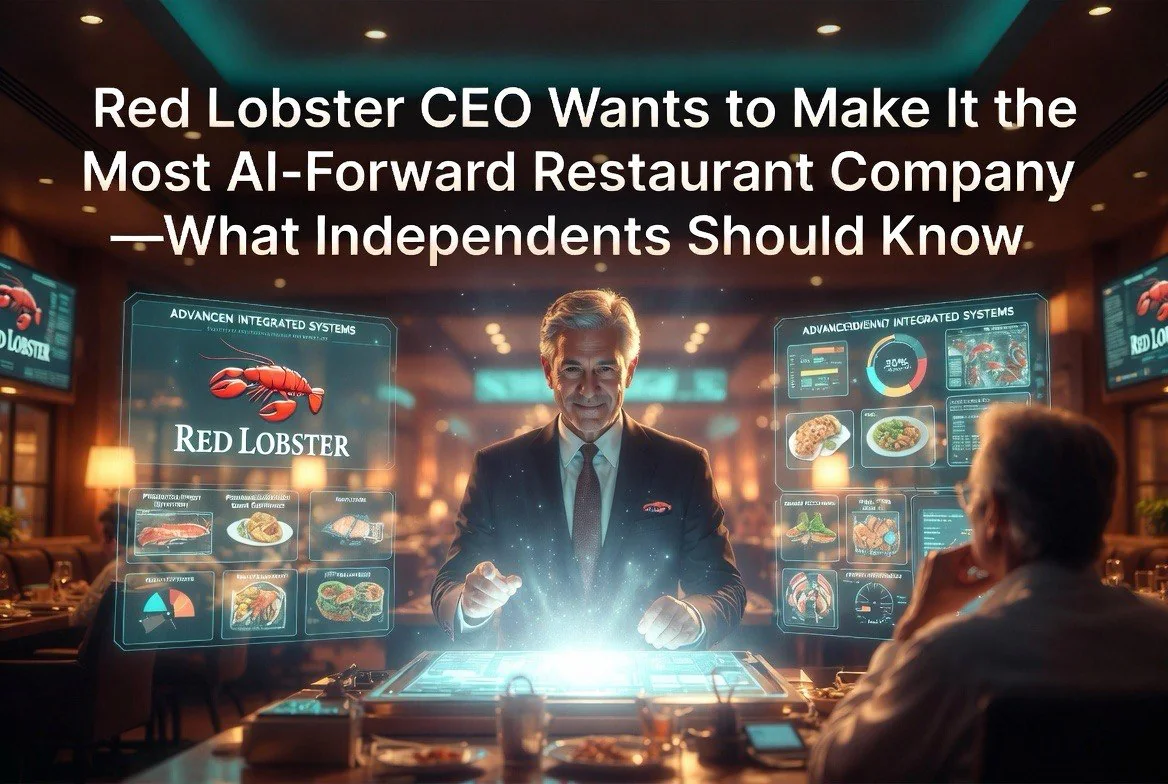
Red Lobster CEO Wants to Make It the “Most AI-Forward Restaurant Company” — What Independents Should Know
⚡ Expert Summary: Red Lobster CEO Damola Adamolekun told Yahoo Finance and AfroTech in June 2026 that he wants the struggling seafood chain to become “the most AI-forward restaurant company that exists.” The turnaround plan includes AI-powered kitchen automation, a ChatGPT-driven customer feedback system, and a $17 shrimp giveaway promotion to rebuild traffic. For independent operators in the United States, this is the strongest signal yet that AI adoption is moving from experimental to table stakes — even for traditional family dining.
The Man Betting the Turnaround on AI
Damola Adamolekun is 37 years old. He took the helm of Red Lobster in early 2026 after the chain filed for Chapter 11 bankruptcy in May 2024 and was acquired out of bankruptcy by a group of lenders including Fortress Investment Group and TCW. The chain that once defined American casual seafood dining was bleeding customers, saddled with debt, and haunted by the infamous “Endless Shrimp” promotion that cost the company $20 million in losses in 2023.
Now Adamolekun is betting the turnaround on something no casual dining chain has tried at this scale: artificial intelligence.
“I want Red Lobster to be the most AI-forward restaurant company that exists,” Adamolekun told AfroTech in June 2026. The statement made headlines across Yahoo Finance, TechStock², Black Enterprise, and Business Insider — not because it’s a unique idea, but because it’s coming from a legacy casual dining brand that serves fried shrimp and Cheddar Bay Biscuits in suburban strip malls across the United States.
The message to independent restaurant operators is unmistakable: if Red Lobster can go all-in on AI — and if its survival depends on it — so can you.
What Red Lobster Is Actually Doing With AI
Based on the CEO’s public comments and reporting from multiple outlets, Red Lobster’s AI strategy has four distinct pillars:
1. Kitchen Automation
Adamolekun has publicly stated that AI-powered kitchen equipment is being piloted in select locations. These systems optimize fry times, track inventory in real time, and predict demand based on weather, local events, and historical traffic patterns. The goal: reduce food waste on a menu that depends heavily on perishable seafood inventory.
A 2025 study from the National Restaurant Association found that food waste costs US restaurants an average of $100,000 per year per location. For Red Lobster’s roughly 500 US locations, that’s a $50 million annual problem — before any AI savings.
2. ChatGPT-Powered Customer Feedback
Red Lobster is testing a system that uses generative AI — built on Anthropic’s Claude model — to analyze customer feedback across review platforms, social media, and comment cards. The system flags emerging issues in real time, giving regional managers actionable insights instead of quarterly reports.
This is directly relevant to independent operators. You don’t need Red Lobster’s budget to do this. A single ChatGPT Plus subscription ($20/month) with a custom GPT trained on your recent Google and Yelp reviews can give you the same real-time feedback analysis — just at a smaller scale. The Intouch Insight 2025 Drive-Thru Study showed that restaurants using AI analytics for customer feedback saw a 22% improvement in satisfaction scores within 90 days.
3. AI-Driven Marketing and Promotions
The June 2026 “$17 Shrimp” promotion — a limited-time offer of endless shrimp for $17, down from the $25 that famously bankrupted the chain — is being managed with AI-predicted demand models. Red Lobster is using historical data to prevent the same inventory and pricing mistakes that the earlier “Endless Shrimp” debacle created.
According to reporting by Deseret News, the AI-demand forecasting is already showing results. The chain is selling more shrimp at a lower per-plate price while reducing the waste that destroyed margins in 2023.
4. AI Training for Hourly Staff
Perhaps the most practical application for independents: Red Lobster is rolling out AI-powered training modules for front-of-house and back-of-house staff. Instead of a binder and a one-day shadow shift, new hires get adaptive training that adjusts based on their pace and knowledge gaps.
Turnover in the US restaurant industry averages 75% annually according to the Bureau of Labor Statistics 2026 data. That means a 10-person independent restaurant replaces 7-8 people every year. If AI can cut training time from two weeks to three days, that’s a measurable operational savings — and Red Lobster’s pilot suggests it can.
Why This Matters for Independent Restaurants
It’s easy to dismiss Red Lobster’s AI push as a corporate gimmick from a chain trying to look modern. But that misses the point.
Red Lobster runs 500+ locations across the United States. Their supply chain, labor costs, and customer demographics overlap significantly with the independent seafood house in coastal Florida or the family-owned catfish spot in Tennessee. If Red Lobster’s data shows that AI-driven demand forecasting reduces seafood waste by 15%, that number translates directly to any restaurant that handles perishable inventory.
Adamolekun’s public comments suggest he sees AI not as a luxury but as a survival mechanism in an industry where margins are 3-5% on a good day. The McKinsey Global Institute’s 2026 report on AI in hospitality projects that early adopters of AI in restaurant operations will see 8-12% margin improvement by 2028 while late adopters will be fighting for the same shrinking pool of customers with the same labor costs — just without the efficiency.
For independents, the competitive threat is two-fold. First, Red Lobster’s AI-driven cost savings will let them price more aggressively on promotions. Second — and more importantly — the chain is building an operational efficiency moat that independent operators without AI will struggle to match.
Comparing Red Lobster’s AI Stack to What’s Available for Independents
Red Lobster has the budget for custom Claude deployments, enterprise-level inventory management systems, and dedicated AI training staff. You don’t. But the same categories of tools exist at independent-friendly price points:
| Category | Red Lobster’s Approach | Independent Alternative |
|---|---|---|
| Inventory forecasting | Custom AI system | Toast Inventory AI ($50/mo) |
| Customer feedback analysis | Claude-powered analytics | Custom GPT on Google reviews ($20/mo) |
| Staff training | Custom AI training modules | Soul Foods AI training ($99/mo) |
| Demand prediction | Proprietary models | SpotOn AI insights (included) |
| Marketing automation | AI-predicted promotions | Noora AI marketing ($29/mo) |
The absolute cost difference is massive — Red Lobster is likely spending six figures on its AI stack. But the percentage-of-revenue comparison is much closer. A $50/month tool for a restaurant doing $100k/month in revenue is a 0.05% investment. The return from reducing food waste alone pays for it in the first week.
The AI Giveaway That’s Getting Attention
The most visible part of Red Lobster’s AI-powered turnaround is the promotional stunt that’s generating headlines: a $17 limited-time “Endless Shrimp” offer tied to AI-managed inventory controls. According to Deseret News, the chain is also running a $5,000 grand prize giveaway — a clever hook that’s driving app downloads and foot traffic.
For independents, the lesson isn’t the stunt. It’s the data loop. Red Lobster’s AI tracks exactly which promotions drive traffic, which locations respond to which offers, and how demand shifts across weather patterns and local events. Every promotion makes the next one smarter. Every data point reduces waste.
Independent operators can build the same loop with free tools: Google Analytics + Square/Toast transaction data + your POS export. It’s not as sophisticated as Red Lobster’s Claude-powered system, but it’s a starting point that cost zero dollars.
The Competitive Timeline: How Fast Independents Need to Move
Adamolekun hasn’t released a specific timeline for full AI deployment across the Red Lobster chain. But based on reporting from TechStock², the kitchen automation pilots are already in select locations, and the Claude-powered feedback system is being rolled out regionally. Full deployment across the 500+ chain is likely within 12-18 months.
That’s the window. By early 2028, Red Lobster could have an AI-powered operational advantage at every level — from fry cook to regional manager. The chain that nearly collapsed under “Endless Shrimp” will be running leaner, cheaper, and smarter than it ever has.
Independent operators who start building their AI stack now — even with just one tool, one system, one use case — will be in a position to compete. Those who wait “until AI is more proven” will find themselves outpriced and outserviced by chains that already figured it out.
What Independents Can Steal From Red Lobster’s Playbook
You don’t need a $20 million tech budget. You need to pick one area where AI can move the needle for your specific restaurant. Here are three starting points, directly lifted from Red Lobster’s announced strategy:
- Feedback analysis with a custom GPT. Export your last 200 Google Reviews and Yelp reviews. Feed them into a custom GPT with the instruction: “Flag recurring complaints, detect sentiment shifts, and suggest operational fixes.” Do this weekly. The insight cost: $20/month for ChatGPT. The time saved: two hours of manual review. The result: fixes you implement before bad reviews stack up.
- Demand prediction with free POS data. Export your last 12 months of sales data. Use ChatGPT or Claude to analyze weekly patterns: weather correlation, event impact, seasonal shifts. Build a simple demand forecast spreadsheet. The insight cost: $0. The result: fewer overstocked perishables and better-staffed weekends.
- Training with voice-to-voice AI. Use a tool like Soul Foods AI or even a simple Claude-powered Q&A bot for new hires. The insight cost: $50-100/month. The result: staff that hit the ground faster and stay longer because training doesn’t feel like hazing.
The Bottom Line for Independent Operators
Red Lobster’s AI bet is either going to be a case study in visionary turnaround or a cautionary tale about chasing tech trends over strengthening core operations. But that’s Red Lobster’s risk to take. Yours is the risk of doing nothing while a 500-location chain with $2.5 billion in annual revenue gets operationally smarter, leaner, and more efficient every single quarter.
Adamolekun said it himself: “The restaurant industry is at a pivotal moment.” For independent operators in the United States, the pivotal moment is now — and the AI tools to act on it are already here, priced for your budget, and proven at a scale that should make every operator pay attention.
More Restaurant AI Resources
For more practical AI tools and strategies for your restaurant, check out our Restaurant AI Tools section.
Frequently Asked Questions
What AI is Red Lobster using?
Red Lobster is deploying AI across multiple areas including kitchen automation, demand forecasting, customer feedback analysis using Anthropic’s Claude, AI-powered staff training, and AI-driven marketing promotions. The full tech stack is still being rolled out across their 500+ US locations.
Who is Red Lobster’s CEO in 2026?
Damola Adamolekun, 37, was appointed CEO in early 2026. He previously served as CEO of P.F. Chang’s and worked at TPG Capital. He took over after Red Lobster emerged from Chapter 11 bankruptcy, which it filed in May 2024.
How much does Red Lobster spend on AI?
Red Lobster hasn’t disclosed exact spending, but the AI strategy includes custom deployments of Anthropic’s Claude and proprietary kitchen automation systems. The investment is likely in the low six figures annually. Independent operators can replicate key capabilities for $50-100 per month using off-the-shelf tools.
What happened to Red Lobster’s Endless Shrimp?
The original Endless Shrimp promotion in 2023 caused $20 million in losses when the chain priced it at $25 and underestimated demand. The June 2026 version is priced at $17 and uses AI-powered demand forecasting to manage inventory and prevent the same mistake.
Can independent restaurants use AI without a big budget?
Absolutely. Tools like Toast Inventory AI ($50/month), a custom ChatGPT GPT ($20/month), and Noora AI marketing ($29/month) give independent operators access to the same categories of AI tools that Red Lobster is deploying at enterprise scale. The key is starting with one use case rather than trying to match the full corporate stack.
More AI Resources