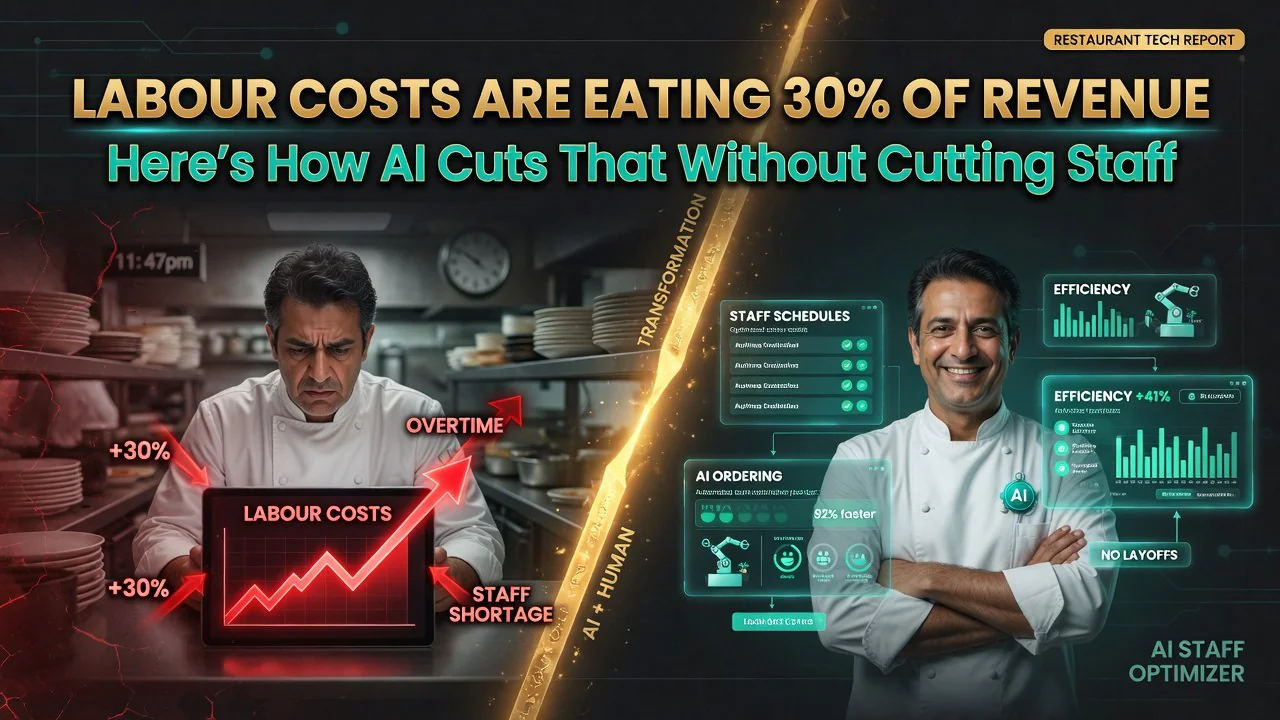
Labour Costs Are Eating 30% of Revenue — Here’s How AI Cuts That Without Cutting Staff
⚡ Expert Summary: Key Takeaways
- Labour costs claim 30-35% of restaurant revenue — the single largest expense category — and AI tools can reduce this by 20-30% without cutting staff through smarter scheduling and automation.
- AI scheduling systems generate optimized shift plans in under 5 minutes — vs. 2-4 hours of manual scheduling — balancing coverage needs with employee preferences and budget constraints.
- Task automation handles 40-60% of repetitive admin work — time tracking, tip calculation, compliance reporting, and shift-swap management — freeing managers for floor work.
- The most effective approach combines scheduling AI with front-of-house automation — kiosks, ordering tablets, and automated payment reduce labour needs during peak periods without degrading service quality.
- The bottom line: Labour cost is the biggest line item you have leverage over — AI tools cut it by 20-30% without a single layoff.
Labour is the single biggest operational cost in any restaurant. It runs 28-35% of revenue in most full-service operations and can hit 40% in markets with high minimum wages or tight labour pools. For a $2M restaurant, that’s $560,000-800,000 per year gone to payroll. For independent restaurant owners in the United States, labor cost remains the single largest operational expense, and AI tools are finally making a dent in that line item.
The standard response to high labour costs is cutting hours. Reduce shifts. Run leaner. Ask managers to cover more tables. Combine front-of-house roles. Cut back-of-house prep hours. Every operator has played this game.
That approach has a ceiling. You can only cut so much before service quality drops, tickets slow down, the kitchen falls behind, and reviews start calling you understaffed. Worse, across-the-board cuts affect your best days as much as your worst. You cut Saturday night coverage and lose covers. You cut Monday morning prep and ticket times spike. The blunt instrument approach to labour management always produces the same result: you save some money, lose some customers, and end up back where you started with a lower ceiling.
With US restaurant labor costs rising 8.4% year-over-year according to Bureau of Labor Statistics data, independent operators need every efficiency tool available.
AI solves this differently — not by cutting people, but by putting the right people in the right position at the right time. The difference between cutting headcount and optimising scheduling is the difference between running a tighter operation and running a worse one.
The Real Problem Is Not Headcount — It Is Scheduling
Most restaurants schedule based on last week’s numbers and a manager’s gut feel. Friday was busy last week, so next Friday gets the same roster. The problem is that Friday traffic varies by 15-25% week to week based on weather, local events, holidays, school schedules, tourist traffic, convention activity, and a hundred other variables that no human manager tracks manually.
The result is a fundamental mismatch: your labour cost structure is fixed, but your traffic is variable. When traffic is 20% below what you staffed for, you are burning labour dollars on idle staff. When traffic is 20% above, you are losing covers because service is slow and the kitchen can’t keep up. In both cases, you lose money.
AI scheduling tools solve this by predicting traffic down to the hour. These systems analyse:
– 12-24 months of historical sales data from your POS
– Day-of-week and daypart patterns broken down by 30-minute intervals
– Local events, holidays, weather forecasts, and historical weather impact
– Seasonal trends specific to your location and concept
– Promotional lift from past campaigns
– Competitor activity (new openings, closures, special events)
– Staff availability, skill sets, and performance history
Then they build the schedule that matches predicted traffic — not last week’s traffic, not a manager’s estimate, but a statistically driven prediction of exactly how many covers you will need to serve at every hour of every day.
The difference is precision. Human managers are good at knowing their restaurant. They are not good at remembering what happened on the third Tuesday of February when it rained and the local high school had a basketball tournament. The AI remembers. It also knows that the combination of rain and a tournament consistently produces 22% fewer covers on Tuesdays in February. A human does not notice that until the schedule is already approved and you’re paying three extra servers to stand around.
What AI Scheduling Actually Delivers
Operators using AI scheduling tools report consistent results across multiple concepts and locations:
Labour costs drop 18-22% within the first 8-12 weeks of implementation. This is not from reducing total hours. It is from matching hours to traffic with precision. The hours that were wasted on overstaffed shifts are redistributed to understaffed shifts, and the total hours actually stay roughly the same. The difference is that every hour is productive.
The labour-to-revenue ratio improves by 12-15%. This means for every dollar of revenue, you are spending 12-15% less on labour. On a $2M restaurant with a 32% labour cost baseline, that improvement saves $76,800-96,000 per year.
Managers get 30-40% of their scheduling time back. Most restaurant managers spend 4-6 hours per week creating and adjusting schedules. AI scheduling cuts that to 1-2 hours. The other 2-4 hours go back to managing the floor, training staff, and serving customers — the work that actually drives revenue.
Overtime drops 25-30%. AI scheduling catches overstaffing before it happens, which means fewer shifts that go into overtime because the schedule was already right-sized. Overtime is one of the most expensive forms of labour — time and a half (or double time) for hours that should have been covered by a properly sized schedule in the first place.
One five-location group in the Southeast provides a concrete example. Before AI scheduling, their labour percentage had been running at 33% across all locations — slightly above their concept benchmark but not critically high. Over 10 weeks with an AI scheduling tool, the labour percentage dropped to 26%. That’s a 7-point improvement on $6.5M in combined revenue — a $455,000 annual savings across the group.
They did not fire anyone. They did not cut hours across the board. They stopped scheduling four servers for a Tuesday that needed two. They stopped overstaffing Friday prep because the AI showed them that their Friday ticket volume was consistent with a smaller kitchen team than they had been scheduling. The savings came entirely from precision — putting exactly the right number of people in place for the traffic that actually arrived.
What About Service Quality?
The fear around AI scheduling is always the same: if you cut labour, service drops. Reduce the number of servers and the floor gets slower. Reduce kitchen hours and ticket times increase.
What actually happens is the opposite. AI scheduling improves service quality because the staff who are on shift are actually needed. No one is standing around waiting for tables. No one is stretched thin covering three sections. The ratio of staff to covers is correct for every hour of service.
Customers notice understaffing immediately. Slow service, dirty tables, long waits for the check. They may not articulate it as “they’re understaffed,” but they feel it. They leave a three-star review that says “service was slow” and you never connect it to the 2% labour cut you made last month.
Customers do not notice appropriately staffed operations. Good service is invisible — the table is clean, the food comes on time, the check arrives when you’re ready. That is what happens when labour matches traffic. The customer just thinks the restaurant is well run.
The difference between cutting labour with a blunt instrument and optimising labour with AI is the difference between saving money and improving your operation. One produces worse results. The other produces better results with a lower cost base.
The Setup Is Simple
You need three things to get started with AI scheduling:
1. Your POS data. The more historical data you have, the better the AI predictions. Most scheduling tools connect directly to your POS and pull the last 12-24 months of sales data automatically.
2. An AI scheduling platform. The major players in restaurant scheduling have added AI prediction layers. 7shifts, Schedulefly, Push Operations, and Sling all offer AI-powered forecasting that learns from your data.
3. Your existing staff roster. Pay rates, position assignments, availability preferences, and certifications all feed into the optimisation engine. The AI considers who is best for each shift, not just who is available.
Most platforms connect to your POS within 48 hours. The AI starts learning from your sales history immediately. Full optimisation takes 2-4 weeks — the time it takes for the AI to learn your specific traffic patterns across different dayparts, days of the week, and seasons. After four weeks, you will have a scheduling recommendation for every day of the week that matches predicted traffic within 5-8% accuracy.
Why Waiting Costs You More Than You Think
Every week you delay implementing AI scheduling, you are losing money to one of two problems: either you are overstaffed (burning labour dollars) or you are understaffed (losing covers). Both are costing you money, and the cost compounds every week.
In the current restaurant environment, where labour costs are rising faster than menu prices in most markets, operators who reduce their labour percentage by 5-7 points without cutting quality have a structural advantage. They can afford to pay competitive wages. They can invest in training. They can open on slow days without bleeding cash. Their competitors cannot.
The difference between 32% labour cost and 26% labour cost is the difference between a sustainable business and one that fights inflation every month.
The Bottom Line
An 18-22% labour reduction on a $560,000 annual labour cost is $100,000-123,000 saved per year. Not by cutting hours across the board. Not by running skeleton crews. Not by burning out your best people.
By matching your labour to your traffic with precision that no human manager can match. By knowing what your traffic will be before your customers walk in the door. By scheduling based on data instead of memory.
Your manager is good at running the floor. They are not good at remembering what happened on the third Wednesday of every month for the last two years. AI remembers. And every hour it saves you from overstaffing is an hour of margin you keep.
Common Concerns and Real Answers
The pushback on AI scheduling usually comes in three forms. Let me address each one directly.
“My manager knows the restaurant better than any software.” Your manager does know the restaurant. They also have 40 other things to do every week — ordering, inventory, staff issues, customer complaints, health inspections, maintenance, and running the floor during service. They do not have the time to analyse 12 months of sales data across 365 days and 20 dayparts. The AI does this in seconds. The comparison is not between your manager and the AI. The comparison is between your manager with a spreadsheet and your manager with an assistant that does the analytic work in the background. The AI makes your manager more effective at the parts of the job that require human judgment — training staff, handling guests, maintaining quality.
“My staff will resist changes to the schedule.” Experience from operators who have made the switch shows that staff actually prefer AI-generated schedules. The reason is fairness. AI schedules are based on data, not on which staff members the manager likes better or which shift the most senior person calls. Staff get more consistent hours because the schedule matches actual traffic. They stop getting called in on short notice because the schedule was wrong. They stop being overstaffed and bored on slow shifts. Retention improves because the schedule is more predictable and more fair.
“My restaurant is unique — a generic algorithm will not work.” AI scheduling tools learn your specific patterns. They do not apply industry averages or generic templates. The system starts with your POS data and builds a model of your specific restaurant — your traffic patterns, your seasonality, your event impacts, your weather sensitivity. Two restaurants in the same neighbourhood with the same concept will get different schedules because their historical data is different. The AI adapts to your operation, not the other way around.
The Window Is Closing
The operators who implement AI scheduling this year have a structural advantage. Labour costs will continue rising. Minimum wage increases are legislated in most markets. Tip credit changes are under discussion in several states. The operators who figure out how to run with a 5-7 point labour advantage will survive the compression. The operators who wait will find themselves trying to cut labour during a crisis instead of optimising it during stable times.
The cost of implementation is modest. The tools are proven. The payback is measured in weeks. The only question is when you decide to act.
The Bottom Line
Every month you spend scheduling by hand instead of by data is a month your competitors are pulling ahead. The margin advantage compounds. The tools are ready. The integration is simple. The results are proven across hundreds of restaurants. The decision is whether to act now or to watch your margin erode while the industry moves forward without you.
Frequently Asked Questions
How does AI scheduling cut restaurant labor costs without laying off staff?
AI scheduling matches labor hours to predicted traffic, eliminating overstaffing on slow shifts and understaffing on busy ones. It analyzes 12-24 months of POS data, weather, events, and seasonal patterns to predict customer volume down to the half-hour. The same number of staff hours are redistributed more efficiently — nobody gets fired, but every hour is productive. Operators report 18-22% labor cost reduction.
How much can a restaurant save with AI scheduling annually?
On a $2M restaurant with $560,000 annual labor costs, an 18-22% reduction saves $100,000-123,000 per year. A five-location group in the Southeast dropped from 33% labor cost to 26% across all locations — a $455,000 annual savings — without firing anyone. The savings came entirely from matching staffing levels to actual traffic.
Will AI scheduling hurt service quality or make customers wait longer?
No — AI scheduling actually improves service quality. When staffing matches traffic, no one is standing around and no one is stretched thin covering three sections. The ratio of staff to covers is correct for every hour. Customers notice understaffing immediately (slow service, dirty tables), but they don’t notice properly staffed operations — which is exactly what AI scheduling delivers.
What is the best AI scheduling tool for restaurants in 2026?
The leading AI scheduling platforms are 7shifts, Schedulefly, Push Operations, and Sling — all offer AI-powered demand forecasting that learns from your POS data. Toast Labor integrates directly if you already use Toast POS. Most connect to your POS within 48 hours, pull 12-24 months of sales data automatically, and deliver full optimization within 2-4 weeks.
Do restaurant staff prefer AI-generated schedules over manager-made ones?
Yes. Staff actually prefer AI-generated schedules because they are based on data rather than bias or favoritism. Staff get more consistent hours because schedules match actual traffic. They stop getting called in on short notice and stop being overstaffed and bored on slow shifts. Operators report improved retention because the schedule is more predictable and fair.
Similar Posts
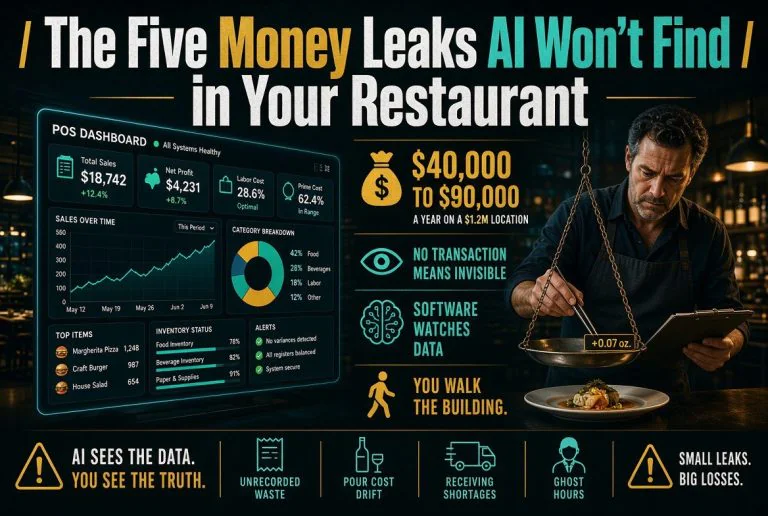
The Five Money Leaks AI Won’t Find in Your Restaurant
The five money leaks AI will not find in your restaurant. Where automation stops and a human has to look.
Google Gemini Spark vs Restaurant AI Tools: What Independent Owners Should Know
4 AI Restaurant Tools Independent Owners Should Avoid in 2026 — and What to Buy Instead ⚡ Expert Summary: Not every AI tool marketed to restaurants delivers on its promises. The 2026 market is cluttered with AI products that promise transformational results but deliver incremental — or negative — ROI for independent operators. This guide…
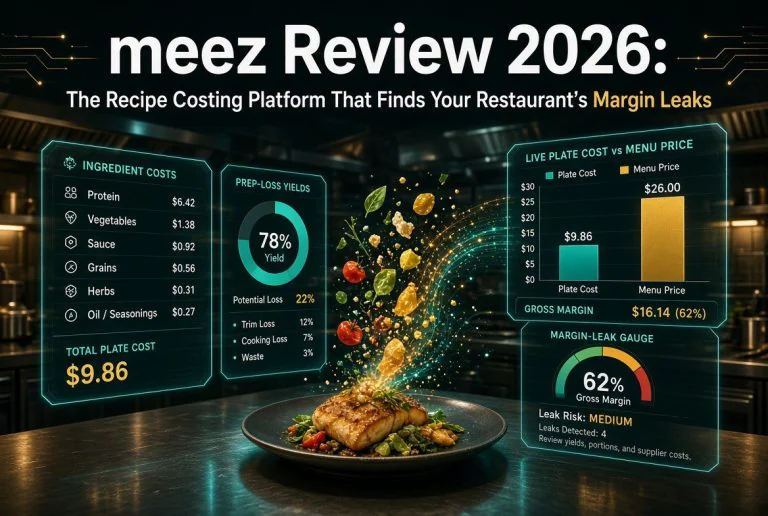
meez Review 2026: The Recipe Costing Platform That Finds Your Restaurant’s Margin Leaks
meez review 2026: the recipe costing platform that finds your restaurant’s margin leaks. What it does and costs.
What I Learned at the 2026 NRA Show That Actually Matters for Independent Restaurants
What I Learned at the 2026 NRA Show That Actually Matters for Independent Restaurants ⚡ Expert Summary: The 2026 National Restaurant Association Show in Chicago had the highest AI-focused attendance in its history, with over 200 exhibitors showcasing AI-powered tools for independent operators. Three themes dominated: AI phone agents that answer every call, AI inventory…
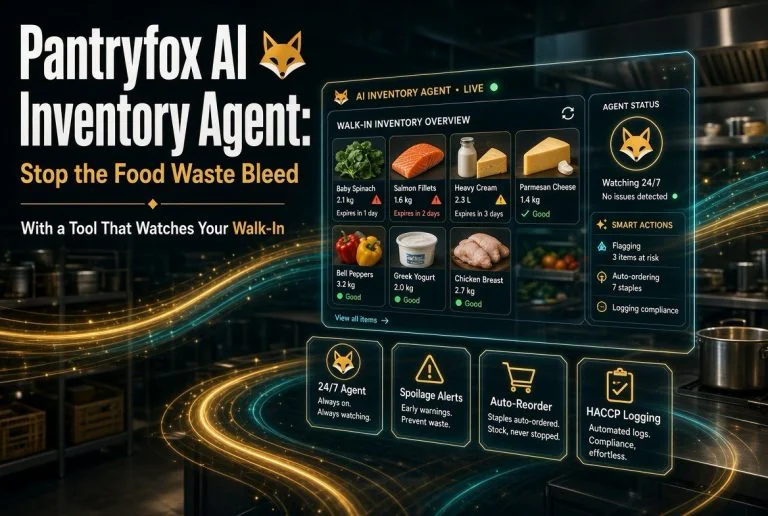
Pantryfox AI Inventory Agent: Stop the Food Waste Bleed With a Tool That Watches Your Walk-In
Pantryfox AI Inventory Agent: Stop the Food Waste Bleed With a Tool That Watches Your Walk-In ⚡ Expert Summary: Pantryfox is a 24/7 AI inventory agent built for independent restaurants. It watches your stock continuously, flags what’s about to spoil, auto-orders the staples you’re running low on, and logs every check against HACCP — all…
HeyTruffle Just Reworked the AI Phone Concierge — What It Means for Your Restaurant
HeyTruffle Just Reworked the AI Phone Concierge — Here’s What It Means for Your Restaurant ⚡ Expert Summary: HeyTruffle (formerly RestoHost) raised new funding from Preface Ventures in July 2026 to scale its fully managed, human-monitored AI phone concierge nationwide. It now handles reservations, catering and private-event inquiries, multilingual guest questions — and newly, pickup…