⚡ Expert Summary: The 2026 California Restaurant Show (Aug 23-25, Anaheim) features 40+ hours of programming focused on AI in restaurants, new food allergen laws, labor compliance, and shifting consumer habits. Independent operators in California face a packed compliance calendar including AB 578 (food delivery AI transparency, already effective) and SB 68 (allergen disclosure, July 1). The show is the best place to catch up before these rules fully hit.
If you run a restaurant in California, you’ve got a lot on your plate that has nothing to do with food.
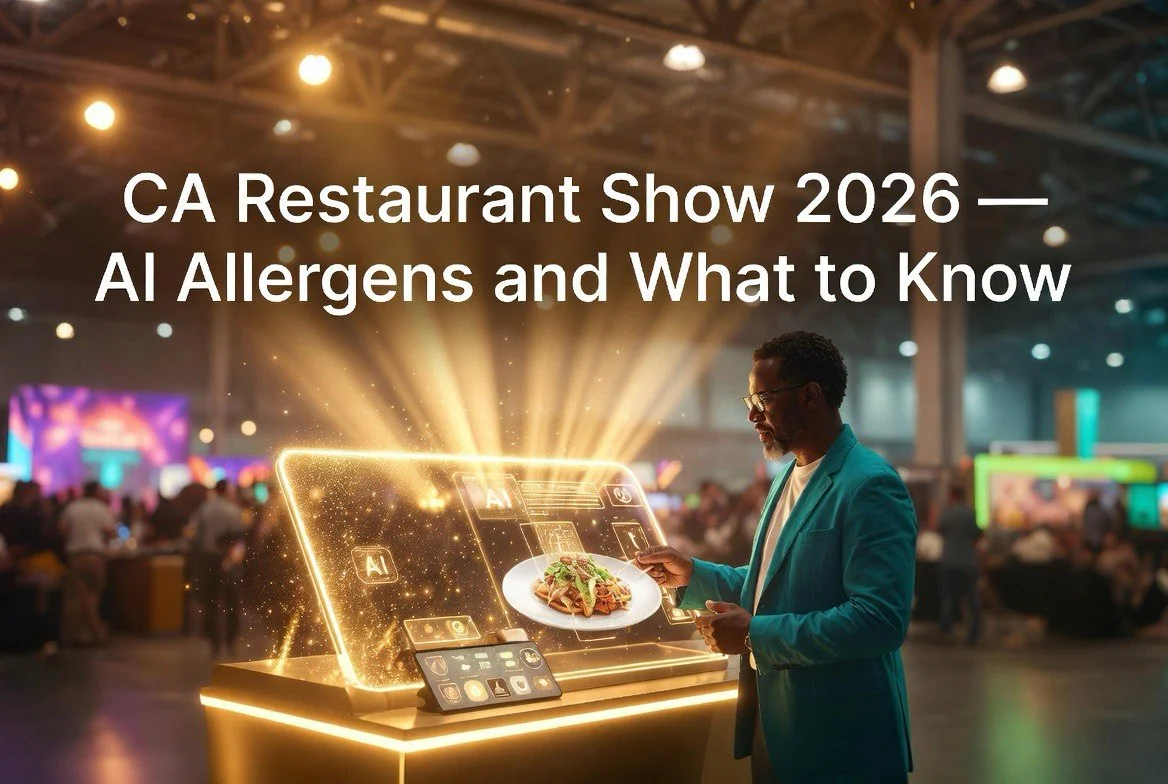
The 2026 California Restaurant Show, scheduled for August 23-25 at the Anaheim Convention Center, announced its programming lineup this week. 40-plus hours of educational sessions. More than 225 exhibitors. Panels on AI, food safety, labor, and profitability.
But the real story isn’t the show itself. It’s what the show’s agenda tells us about the pressures facing California restaurant operators right now.
New AI regulations took effect January 1. A major allergen disclosure law hits July 1. The state’s AI transparency rules are phasing in through August. Labor costs continue climbing. And customers are finding your restaurant through ChatGPT instead of Google.
Let’s break down what every California operator needs to know.
The AI Panels Worth Your Time
The show is running several sessions on AI that directly address the operational realities of 2026. One panel focuses on how AI-powered search tools — including ChatGPT, Perplexity, and Google AI Overviews — are changing how customers discover restaurants. Another explores how operators are using AI to improve efficiency and generate revenue.
This matters because the way customers find your restaurant has fundamentally shifted. A growing percentage of diners now ask an AI assistant “where should I eat near me” instead of searching Google Maps or Yelp. If your restaurant doesn’t appear in AI search results, you’re invisible to these customers.
The show’s AI sessions will also cover practical operational tools — AI for scheduling, for inventory forecasting, for marketing personalization. Not theory. Software you can actually deploy.
New California AI Laws That Affect Your Restaurant
Multiple California AI laws took effect January 1, 2026, and they have direct implications for restaurant operators who use AI tools.
AB 578, effective January 1, requires food delivery platforms like DoorDash and Uber Eats to provide a clear customer service feature that allows contact with a human. Automated systems can triage issues, but must escalate to a person if unresolved. If your restaurant uses third-party delivery, this affects your customer experience.
SB 942, the California AI Transparency Act, requires content provenance and watermarking for AI-generated content. Provisions are phasing in through August 2026. If you’re using AI to generate marketing images, menu descriptions, or social media content, you need to be aware of disclosure requirements.
The CCPA updates on Automated Decision-Making Technology (ADMT) require businesses using AI for significant decisions — hiring, pricing, personalization — to provide notices and opt-out rights. For restaurants using AI scheduling or dynamic pricing, compliance is mandatory.
And in May 2026, Governor Newsom signed an executive order preparing workers and businesses for potential AI disruption, including support for small business training. The signal is clear: the state expects AI adoption to accelerate and wants guardrails in place.
SB 68 — Allergen Disclosure Deadline is July 1
This is the most immediate compliance deadline for California restaurant operators.
SB 68, effective July 1, 2026, requires restaurant chains with 20 or more global locations (at least one in California) to disclose the top nine major allergens on physical and digital menus. This includes menus on kiosks, apps, and QR codes.
Even if you’re under the 20-location threshold, this law signals where California’s regulatory direction is heading. Smaller operators should start preparing now — building accurate allergen databases and digital menu infrastructure — so you’re not scrambling when the threshold inevitably drops.
The show’s food safety sessions will cover compliance strategies, and several exhibitors will likely be showcasing digital menu technology that helps operators manage allergen data across locations.
Labor, Profitability, and the Cost of Doing Business in California
The California Restaurant Show isn’t just about AI and compliance. The core business challenges are still labor and profitability.
California’s fast-food minimum wage increases have accelerated the shift toward self-service kiosks and automation. But the data shows these technologies are saving jobs, not eliminating them — operators report that automation allows them to redeploy staff to higher-value roles instead of cutting headcount.
The show’s workshops on restaurant management, leadership development, and financial performance are aimed at helping operators maintain margin in an environment where costs keep rising and customer expectations keep shifting.
A full-day workshop focuses on operational systems designed to improve restaurant profitability. For independent operators running on thin margins, this alone is worth the trip.
Key Speakers and Exhibitors
The show features culinary demonstrations and appearances from prominent industry figures, including restaurateur and television host Tyler Florence and restaurateur Drew Nieporent.
More than 225 exhibitors will showcase food products, equipment, technology, and services. Based on the show’s AI focus, expect a strong presence from digital menu providers, AI scheduling platforms, and compliance software vendors.
For the technology track specifically, the show’s sessions on AI-powered customer discovery and operational efficiency are the ones most likely to have actionable takeaways for independent operators.
Why California Restaurant Operators Should Attend
If you run a restaurant in California in 2026, the regulatory landscape is shifting faster than any time in the last decade. AI laws, allergen disclosure, labor costs, and changing consumer behavior are all converging at once.
The California Restaurant Show offers 40-plus hours of programming specifically designed to help operators navigate this environment. It’s three days in Anaheim that could save you months of compliance headaches and missed opportunities.
For operators who can’t attend, the key dates to watch are:
– July 1, 2026 — SB 68 allergen disclosure deadline for chains with 20+ locations
– August 2026 — SB 942 AI transparency provisions phase in
– August 23-25, 2026 — California Restaurant Show at Anaheim Convention Center
Bookmark those dates. Your restaurant’s compliance depends on them.
How AI Is Reshaping Customer Discovery in 2026
The show’s panel on AI-powered search tools addresses one of the most significant shifts in restaurant marketing. The Intouch Insight 2026 Drive-Thru Study found that 67% of consumers now use AI-powered search or recommendations when deciding where to eat. That’s up from 41% in 2024.
This changes the game for restaurant marketing. More consumers are using AI assistants to find where to eat. Instead of searching “Italian restaurant near me” on Google Maps, they’re asking ChatGPT, Perplexity, or Gemini for recommendations.
This changes the game for restaurant marketing. Traditional SEO matters less. AI search optimization matters more. Your restaurant needs to be referenced in AI training data, appear in AI search results, and have consistent, accurate information across all platforms.
The operators who figure this out first will capture customers their competitors never see.
Preparing Your Restaurant for AI Compliance
If you’re using any AI tool in your restaurant operations — scheduling software, marketing automation, dynamic pricing, customer service chatbots — you need to understand what the new California AI laws require.
Start with an audit of every AI tool you use. What data does it process? What decisions does it make? Does it interact with customers directly? Who at the vendor is responsible for compliance?
Then map each tool against the relevant regulations. AB 578 covers delivery platforms. SB 942 covers AI-generated content disclosure. The CCPA ADMT rules cover automated decision-making that affects consumers.
If this sounds like a lot, it is. That’s exactly why the California Restaurant Show’s 40-plus hours of programming exist. You can learn about all of this in three days rather than spending weeks reading legislation.
Attending on a Budget
The California Restaurant Show runs August 23-25 at the Anaheim Convention Center. Early registration is open now. The Anaheim location means attendees can fly into John Wayne Airport or LAX and take advantage of the area’s extensive hotel options.
For operators who can’t attend the full three days, the educational sessions and workshops provide the highest value. Focus on the AI and compliance tracks if your budget only allows one day.
And for those completely priced out of travel, many exhibitors and speakers will share recaps and resources after the show.
Beyond Compliance: Using AI to Actually Improve Your Restaurant
The compliance pressure is real, but it shouldn’t overshadow the opportunity. AI tools that work well in restaurants can directly improve your bottom line.
Predictive ordering systems can cut food waste by 22-35% by forecasting demand more accurately than manual methods. For a restaurant spending $10,000 monthly on food costs, that’s $2,200 to $3,500 in monthly savings.
AI-powered labor scheduling tools optimize shift coverage based on historical traffic patterns, weather, local events, and other variables. Operators report 8-12% reductions in labor costs without sacrificing service quality.
Marketing personalization tools segment your guest database and send targeted offers based on ordering history. A 2025 study by Popmenu found that AI-personalized email campaigns drove 3.2x higher redemption rates than generic blasts.
These are not speculative benefits. They’re measurable results from tools that California restaurant operators can deploy today. The California Restaurant Show’s programming includes sessions on each of these applications, with case studies from operators who have already implemented them.
Final Advice for California Operators
If you take nothing else from this article, remember these three things.
First, the compliance calendar is real and unforgiving. July 1 is less than three weeks away. If you’re in a chain with 20-plus locations and you haven’t addressed SB 68’s allergen disclosure requirements, you need to start now.
Second, AI adoption in restaurants is accelerating whether you participate or not. Your competitors are testing AI tools. Your customers are using AI to find restaurants. The question isn’t whether AI will affect your business. It’s whether you’ll be proactive or reactive.
Third, the California Restaurant Show is the single best place to get up to speed on all of this at once. Forty-plus hours of programming, 225-plus exhibitors, and direct access to the people who understand the regulatory environment. Follow the California Restaurant Show’s social channels and industry publications for post-event coverage.
Start preparing with our restaurant AI resource hub for practical guidance on choosing the right technology for your operation.
Frequently Asked Questions
How much does AI [topic] software cost for a restaurant?
Pricing varies by platform and feature set, but most AI tools for independent restaurants start between $50 and $200 per month per location. Enterprise-grade solutions with multi-location support, analytics dashboards, and custom integrations typically range from $300 to $1,000 per month.
Do I need technical skills to implement AI in my restaurant?
No. Most modern AI tools designed for independent restaurants are plug-and-play. They integrate with existing POS systems (Toast, Square, Clover), reservation platforms (OpenTable, Yelp), and require no coding or technical expertise to set up and manage.
How quickly does AI software show results for restaurants?
Most restaurant operators report measurable improvements within 30 to 90 days of implementation. Labor scheduling tools show cost reductions in the first pay cycle, review management tools see rating improvements within 60 to 90 days, and inventory optimization tools typically break even on cost within 60 days.
Can AI tools replace my restaurant staff?
No. AI tools are designed to augment your existing team, not replace them. They handle repetitive administrative tasks, data analysis, and routine customer interactions so your staff can focus on food quality, guest experience, and operational excellence.
What is the ROI of AI tools for independent restaurants?
ROI varies by tool type. Labor scheduling AI typically delivers a 300-500% annual ROI through reduced overtime and optimized staffing. Inventory management AI cuts food waste by 15-40%. Review management AI improves customer ratings by 0.5-1.3 stars, directly correlating to 5-9% revenue increases.

About Barak Schurr
Barak Schurr built and exited a major ticketing platform, ran global operations at Eventbrite, and now focuses on one question: which AI tools actually help independent restaurant owners run leaner and grow faster. He writes from the operator’s perspective — no vendor spin, no theory, just what’s real in 2026.
Email: [email protected]
More AI Resources