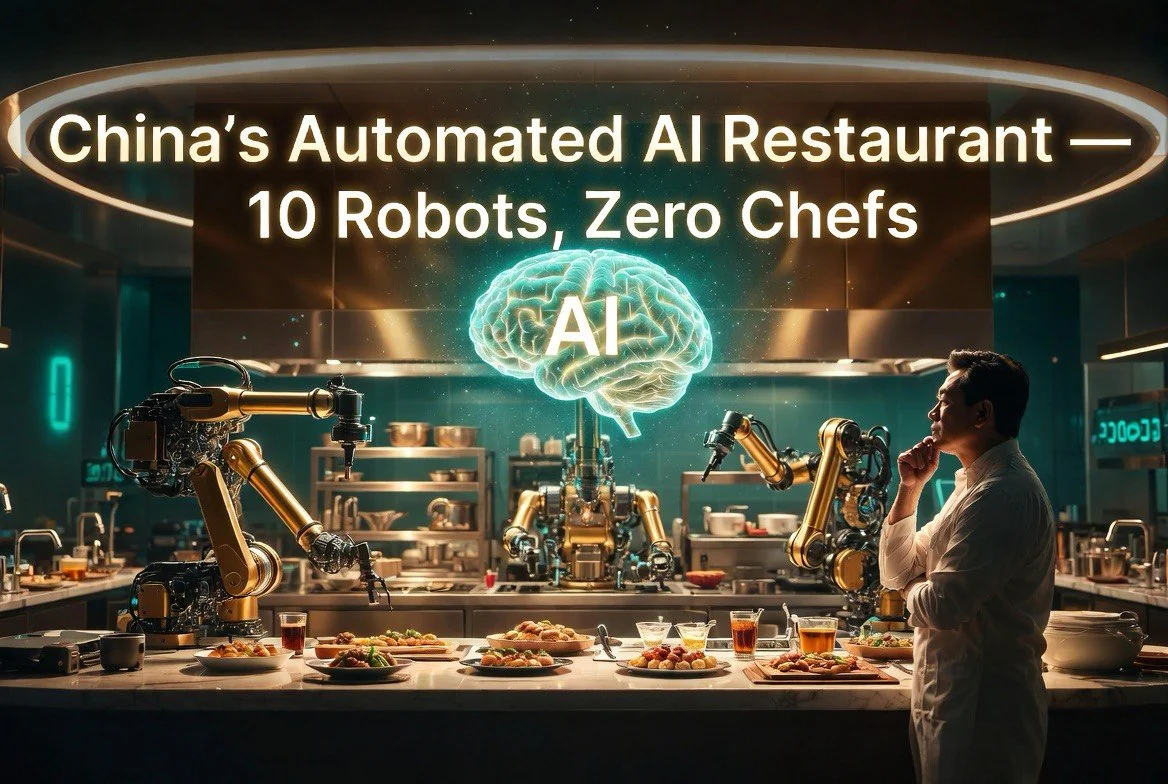
China’s Automated AI Restaurant: 10 Robots, Zero Chefs
⚡ Expert Summary: Hangzhou, China, opened the “24 Solar Terms AI Robot Restaurant” in January 2026 — 10+ robots handle cooking, serving, cleaning, and coffee-making with zero human chefs. Noodles cost $1.38, coffee is $0.84, and the AI even analyzes your face and tongue to recommend dishes based on traditional Chinese medicine. For US restaurant operators watching labor costs hit 35% of revenue, this is the most concrete example yet of what fully automated dining looks like in practice and what the cost implications will be as the technology reaches American markets within the next 3 to 5 years.
What the 24 Solar Terms Restaurant Actually Looks Like
Sandun Town, West Lake District, Hangzhou. January 2026. A restaurant opens without a single human chef. Not a test kitchen. Not a fast-casual concept with some automation. A full-service restaurant serving over 100 dishes — stir-fries, noodle bowls, ice cream, coffee — run entirely by robots.
According to CGTN’s coverage of the opening, more than 10 AI-powered robots manage the entire operation. Robot arms stir-fry Hangzhou specialties like Three Cup Chicken with what the restaurant claims is authentic “wok hei” — the elusive smoky aroma that defines wok cooking. A noodle robot pulls and boils fresh noodles in about three minutes. A coffee robot grinds, brews, and serves espresso for roughly 84 US cents. An ice cream robot dispenses soft serve. Another robot cleans the floor.
The only humans on site are maintenance technicians and a few front-of-house staff managing the flow of curious diners who queued up during the trial phase starting January 13. The restaurant is called “24 Solar Terms AI Robot Restaurant” — named after the traditional Chinese calendar system that guides its menu recommendations.
That last part is where it gets interesting.
The AI That Reads Your Face to Pick Your Meal
The restaurant’s AI consultation system uses face-scanning and tongue analysis — based on traditional Chinese medicine principles tied to the 24 solar terms — to recommend dishes. A camera scans the diner’s face as they approach the ordering terminal. The AI analyzes their complexion, tongue coating, and visible health markers, then cross-references those against the current solar term to suggest meals that balance the diner’s constitution with seasonal needs.
The South China Morning Post covered this system in detail, noting that it’s not a gimmick — the AI recommendation engine is tied to an extensive database of traditional Chinese wellness knowledge. Diners can override the AI’s suggestions and order manually, but early reports suggest most customers engage with the recommendation system out of curiosity.
From a US restaurant operator’s perspective, the clinical application matters less than what it represents: AI moving beyond kitchen automation into customer interaction. The same technology stack could easily adapt to dietary restrictions, allergen management, and personalized menu recommendations for American diners.
The Economics: What the Numbers Tell Us
Here is what makes the Hangzhou restaurant relevant to American operators — not the technology itself, but the cost structure it enables.
- Noodle bowl: ~$1.38 USD
- Coffee: ~$0.84 USD
- Ice cream: ~$0.70 USD
These prices are not sustainable with human labor at US restaurant wages. The National Restaurant Association’s 2025 State of the Industry report puts average quick-service labor costs at 28-32% of revenue, with full-service restaurants hitting 35% and climbing. In markets like California where the minimum wage for fast-food workers hit $20 per hour in 2024, labor costs can exceed 38% of revenue.
The Hangzhou robot restaurant’s pricing suggests a labor cost structure near zero for kitchen operations. The robots don’t call in sick. They don’t need overtime pay. They don’t quit mid-shift on a Friday night. The capital expenditure is upfront — equipment purchase plus installation and maintenance — but the marginal cost per dish approaches the cost of ingredients plus electricity.
According to eWeek’s analysis of the restaurant, the break-even calculation shifts entirely when you remove variable kitchen labor. A human-staffed kitchen in a US market needs a 50-60% gross margin to survive after rent, labor, and overhead. A robot kitchen can operate profitably at 30-35% gross margin — which means either significantly lower menu prices or dramatically higher operator profit.
What a 30% Gross Margin Means for Pricing
If a US pizza chain adopts similar automation and targets 30% gross margin instead of the industry-standard 55%, a $12 pepperoni pizza drops to roughly $6.50. A $9 burger becomes $5. The price advantage is not theoretical — it is math. The robot costs $X upfront, but after that, the per-unit cost is ingredients, packaging, and electricity.
This is why the fast-food industry is watching Hangzhou closely. Chains like McDonald’s, Yum! Brands, and Restaurant Brands International have all announced automation research divisions in the last two years. They are not deploying full robot kitchens yet. But they know that whoever cracks the cost curve first wins the next decade of the quick-service market. A 20% menu price advantage without sacrificing margin is a weapon that no marketing budget can counter.
The Hangzhou restaurant is proof of concept that the math works in a real dining environment — not just in a lab or a limited test kitchen.
How Robot Cooking Works in Practice
The ceiling-mounted robotic arms in the Hangzhou kitchen handle stir-frying — the most technique-dependent cooking method in Chinese cuisine. These arms are pre-programmed with recipes that control heat, oil temperature, ingredient timing, and wok motion. The noodle robot pulls dough into fresh noodles mechanically, then boils them to specification. The coffee robot grinds beans, controls water temperature and pressure, and serves the final product.
This is not experimental. Commercial robotic kitchen equipment has been deployed in Asia for over a decade. Moley Robotics demonstrated a full robotic kitchen in 2018. Picnic’s automated pizza system is used in US stadiums including T-Mobile Park and Allegiant Stadium. Sweetgreen’s automated assembly line, the “Infinite Kitchen,” has been rolling out since 2023, reducing assembly time per bowl by 50% and cutting labor requirements by 8-10 hours per location per day according to Sweetgreen’s 2025 investor presentation. What’s different about Hangzhou is the integration: one restaurant running the entire menu through robots with no fallback to human cooks.
A US comparison worth watching is White Castle’s deployment of Miso Robotics’ Flippy — a robotic fry station that handles the high-volume fryer station. White Castle reported in early 2026 that Flippy stations reduced fry cook labor by 70% at those locations, though the burger chain still runs human cooks for grill and assembly. That reduction on a single station is meaningful. The Hangzhou restaurant demonstrates what happens when you apply that same approach across every station simultaneously.
The economics compound at full integration. White Castle saves on one station; its overall labor cost reduction at Flippy-enabled locations is roughly 8-12% because that one station represents a fraction of total kitchen labor. Hangzhou’s model goes further by eliminating kitchen labor entirely. The 8-12% incremental savings from automating one station is a step. The 90%+ savings from full automation is a category shift. Understandably, US chains are taking the incremental route — lower risk, lower upfront cost, easier to roll back. But the terminal state is visible in Hangzhou today.
The gap between station-level automation (what US chains have) and full-kitchen automation (what Hangzhou has) is not a technology gap. The individual robots are comparable. The gap is integration and the willingness to design a kitchen workflow around robots instead of fitting robots into a human-designed kitchen. For US independent operators, the immediate practical implication is that the kitchen design decisions made today — equipment placement, workflow layout, station configuration — should be evaluated with an eye toward how they will integrate with future automation rather than optimized solely for current human workflows.
The closest US comparison is maybe Marc Lore’s Wonder — which AITR covered in post 341 — but Wonder uses a centralized ghost kitchen model with human cooks supported by automation. Hangzhou is a step beyond that: human support is limited to maintenance and front-of-house logistics.
What American Restaurants Can Learn (and Can’t Copy)
The Hangzhou restaurant is not directly replicable in the US. The labor arbitrage is different — China’s installed base of industrial robotics is the world’s largest, and the cost of robotic equipment is lower due to domestic manufacturing. A US operator importing similar equipment would face higher upfront costs, different regulatory requirements, and a supply chain that doesn’t exist yet.
But the direction is unmistakable. The Intouch Insight 2025 Drive-Thru Study found that 73% of US consumers say they would visit a restaurant with fully automated ordering and preparation if the prices were lower than traditional restaurants. The pricing in Hangzhou validates that trade-off: robots enable prices that human-staffed kitchens cannot match.
For independent US operators, the immediate takeaway is not to buy a robotic arm. It’s to watch the cost curve. Industrial robotic prices have dropped roughly 50% over the past five years according to data from the International Federation of Robotics. At current trajectory, the upfront cost of a robotic cooking system will reach parity with one year of a salaried sous chef’s wages within 3-5 years in the US market.
The Future for Restaurant Automation in America
Several US chains are already testing the shallow end. McDonald’s has ArchIQ drive-thru automation (covered in our restaurant AI coverage). Sweetgreen’s Infinite Kitchen is running in select locations. Chipotle tested an autonomous digital makeline in 2024. None of these approach the Hangzhou restaurant’s level of full-menu automation, but the gap is closing faster than most operators realize.
What’s missing is the middle-market robotics layer — affordable, modular cooking robots that an independent operator can lease rather than buy. That market is currently being addressed by companies like Dexai Robotics (American, Alfred robotic arm), Miso Robotics (Flippy for fry stations), and Picnic (automated pizza assembly). Their systems cost between $3,000 and $30,000 depending on configuration and handle specific stations, not full kitchens.
The Hangzhou restaurant is what happens when you stack those station-level automations into one integrated kitchen. The robots aren’t individually more advanced than Flippy or Alfred. What’s different is that someone integrated them into a single ordering-to-serving workflow and added AI-driven customer recommendations on top.
Frequently Asked Questions
How do I choose the right AI tool for my restaurant?
Start by identifying your biggest operational pain point — labor scheduling, inventory waste, review management, or customer retention. Most AI platforms offer free trials, so test two or three tools against your specific workflow before committing.
Do small restaurants need AI tools?
Yes. Independent restaurants operate on thinner margins and have fewer staff than chains, which means AI tools deliver a higher relative ROI by automating tasks that would otherwise fall on an overworked owner or manager. Many tools start under 00 per month.
How long does it take to implement AI in a restaurant?
Most AI tools for restaurants can be set up in under an hour with no technical expertise required. Integration with existing POS and reservation systems typically takes an additional 30 minutes. Full adoption by staff usually happens within two weeks.

About Barak Schurr
Barak Schurr built and exited a major ticketing platform, ran global operations at Eventbrite, and now focuses on one question: which AI tools actually help independent restaurant owners run leaner and grow faster. He writes from the operator’s perspective — no vendor spin, no theory, just what’s real in 2026.
Email: [email protected]
More AI Resources