26% of Restaurant Operators Use AI — But Only 6% Use It for Orders. Here’s the Gap.
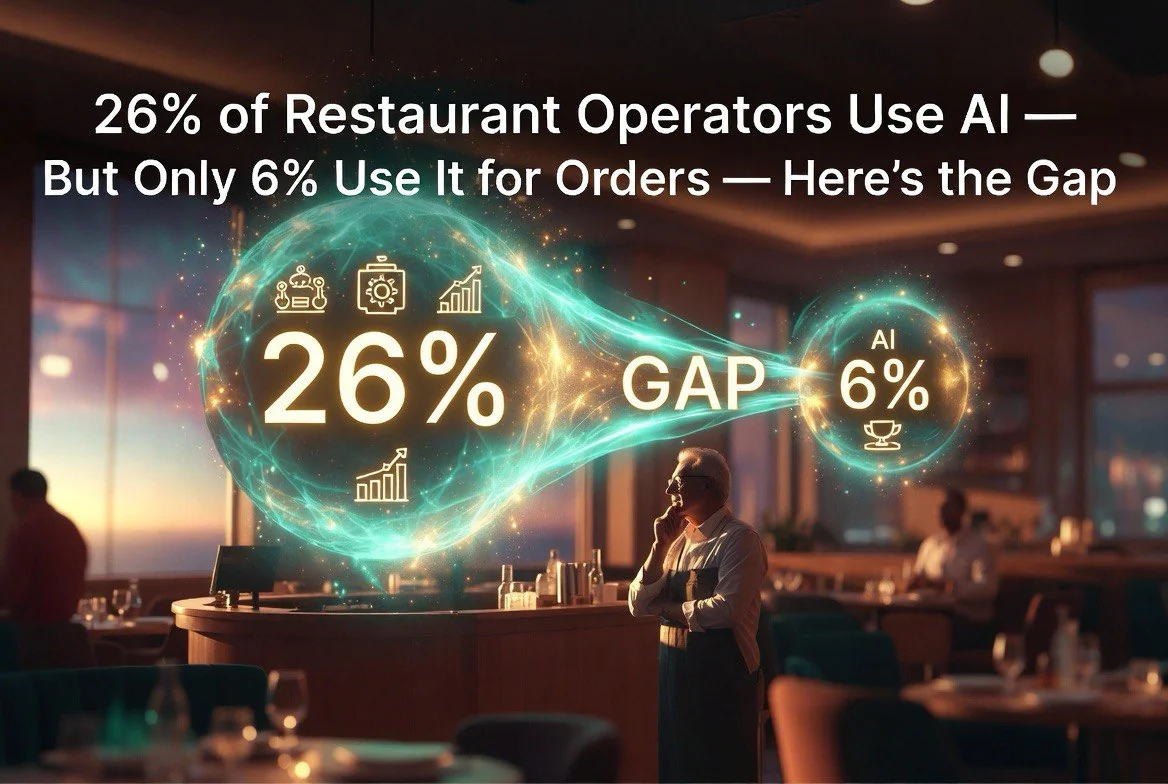
⚡ Expert Summary: A 2026 National Restaurant Association survey found that 26% of US restaurant operators now use AI in some form, up from 22% in 2024. But only 6% of operators use AI for order management — the area where the technology delivers the fastest ROI and the most immediate customer-facing impact. This gap between general AI adoption and order-specific deployment represents a competitive opportunity for independent operators who move now, before customer expectations shift and the window closes.
The Numbers Behind the AI Adoption Gap
The National Restaurant Association’s 2026 State of the Industry report surveyed over 3,500 US restaurant operators and found that AI adoption has grown steadily but unevenly across use cases. The headline number — 26% of operators using AI — masks significant variation in how AI is actually deployed across restaurants in the United States.
AI for marketing and social media leads at 18% adoption, driven by accessible tools like Canva AI and ChatGPT that require no technical expertise. AI for inventory management sits at 12%, boosted by platforms like MarketMan and XtraChef that integrate with existing POS systems. AI for labor scheduling reaches 9%, with tools like 7shifts and XShift gaining traction among independent operators tired of manual spreadsheets.
But AI for order management — handling phone calls, online orders, and in-person ordering — sits at just 6%. This is the gap that matters most for revenue. Orders are where the money is, and US restaurants that deploy AI in this area see measurable returns within weeks, not months.
Why Order Management AI Adoption Lags
The low adoption rate for AI order management is not about effectiveness. The tools work. Hostie, Slang.ai, and SoundHound have all demonstrated that AI can handle phone reservations, takeout orders, and drive-thru transactions with accuracy rates above 90%. The delay is driven by three factors specific to the US market.
Fear of customer pushback. Many independent operators worry that customers will reject AI-powered ordering. The data tells a different story. A Deloitte 2026 survey found that 68% of US diners are comfortable with AI taking orders as long as they can escalate to a human if something goes wrong. The key is offering a fallback, not replacing human interaction entirely.
Integration complexity. Older POS systems in independent restaurants do not integrate easily with AI order management tools. A restaurant running a legacy system from 2019 or earlier may need a POS upgrade before deploying AI ordering. The Bureau of Labor Statistics estimates that 23% of US independent restaurants still use POS systems purchased before 2022, creating a real but temporary integration barrier.
Lack of awareness. The Intouch Insight 2026 study found that 44% of restaurant operators who do not use AI simply do not know what tools are available at their price point. The narrative around AI is dominated by enterprise deployments — McDonald’s and Wendy’s — that feel irrelevant to an independent owner serving 150 covers per night. The reality is that AI ordering tools for independents start at $69 per month and install in under 2 hours, and the free trial periods offered by most vendors mean an operator can test the technology on their actual phone lines without committing a dollar.
What the 6% Who Use AI for Orders Are Getting Right
Operators who have already deployed AI for order management report specific, measurable outcomes that their competitors are missing. The Intouch Insight 2026 Drive-Thru Study compared AI-assisted ordering against traditional methods across 200 US quick-service locations and found that AI reduced average order times by 22 seconds while maintaining accuracy rates above 95%.
The 6% of operators using AI for orders are also seeing better labor utilization. When AI handles the phone during peak hours, hosts and cashiers stay on the floor serving in-person customers rather than taking reservation calls. The National Restaurant Association reports that restaurants using AI order management reduced peak-hour labor costs by an average of 11% while actually increasing covers served — the AI was handling volume that previously required additional staff. For a restaurant generating $500,000 in annual revenue with labor costs at 32% of revenue, an 11% reduction in peak-hour labor represents approximately $6,500 in annual savings while the revenue from those covers remains unchanged or increases. The dual effect — lower labor cost and higher covers — makes AI order management one of the few restaurant technology investments that directly improves both the income statement and the operational capacity of the restaurant simultaneously.
Revenue capture is another critical advantage. Missed phone calls during peak hours represent direct revenue loss. The average independent restaurant misses 8-10 calls per shift during busy periods, with each call representing an average ticket of $35-48. Over a year, missed calls cost US independent operators an estimated $40,000-70,000 in lost revenue per location. AI order management eliminates this gap entirely.
How AI Order Management Works in Practice
AI order management for restaurants typically works through one of three deployment models, each suited to different operational needs in the United States.
Phone AI concierge (Hostie, Slang.ai). An AI voice assistant answers incoming calls, handles reservations, takes takeout orders, answers menu questions, and provides hours and directions. Complex or unusual requests are routed to human staff with a full conversation transcript. Monthly cost: $69-129 per location. Both vendors offer free trials, and operators can test the AI on a single phone line for 14 days before deciding whether to deploy it on all lines.
Voice AI for drive-thru (SoundHound, OpenCity). AI takes orders at the drive-thru speaker, processes them through the POS, and presents them for confirmation. These systems are currently more common at chains but are becoming available for independent operators through white-label partnerships. Monthly cost: $199-399 per location.
AI chat for online ordering (Toast, Chowly). An AI chatbot on the restaurant’s website handles online orders, captures customer preferences, and upsells with targeted suggestions. These tools integrate directly with the POS for seamless order flow. Monthly cost: $49-99 per location.
Start Here: A 3-Step Plan for Independent Operators
The gap between 26% adoption and 6% order-specific adoption means that most US independent operators are still competing on the same manual ordering systems they used in 2021. Here is a practical roadmap to closing that gap.
Step 1: Count your missed calls for one week. This is the only data point that matters for deciding whether AI order management is worth the investment. If you are missing 5 or more calls per shift, the ROI on a $69-129 per month AI phone concierge is immediate. If you are missing fewer than 3, focus on other AI use cases first. The simplest way to measure this is to run a call log report from your phone provider for one week and count the calls that rang more than three times without being answered.
Step 2: Run a 30-day pilot on phone calls only. Do not replace your entire ordering system at once. Deploy AI phone answering on one phone line during one shift and measure three metrics: calls answered, bookings captured, and customer complaints. Most operators find that customer complaints drop because the phone is actually being answered for the first time.
Step 3: Expand to online ordering if the phone pilot works. Once AI phone answering proves its ROI, layer on AI chat for your website and AI text for SMS-based order confirmations. The tools stack nicely and most platforms offer volume discounts for adding multiple services. Slang.ai, for example, charges $99 per month for phone-only AI but $149 for the full voice-and-text package, making the second service 60% cheaper than adding a standalone text AI tool.
What Happens If You Wait
The competitive window for AI order management in independent restaurants is closing. As more operators deploy these tools, diners will come to expect AI-powered phone answering and online ordering as a baseline — the same way they now expect online reservation systems and QR code menus.
When a customer calls three restaurants and two answer with a human who puts them on hold while the third answers instantly with an AI that books their table in 30 seconds, the customer chooses the third restaurant. Every time. The 6% of operators already using AI for orders are building a competitive advantage that their peers will struggle to close later. The advantage compounds because the AI improves over time — more calls handled means more training data, which means faster and more accurate responses, which means higher customer satisfaction, which means more calls shift to the AI rather than going to voice mail or a busy signal.
A restaurant that waits another year to adopt AI order management will be competing against operators who have 12 months of data on customer preferences, 12 months of optimized ordering flows, and 12 months of reduced labor costs. That gap is much harder to close than the current gap between 26% adoption and 6% order-specific adoption.
Frequently Asked Questions
What percentage of restaurants use AI in 2026?
The National Restaurant Association’s 2026 survey found that 26% of US restaurant operators use AI in some form, up from 22% in 2024. However, only 6% use AI specifically for order management — the area with the fastest ROI. Marketing leads at 18%, inventory at 12%, and labor scheduling at 9%.
How much does AI order management cost for independent restaurants?
AI order management tools for independent restaurants start at $49-69 per month for AI chat and online ordering. AI phone concierge services like Hostie and Slang.ai cost $69-129 per month per location. Drive-thru voice AI systems start at $199 per month. All are available with free trials ranging from 7 to 30 days.
Will AI order management replace my staff?
No. AI order management augments your team by handling routine calls and orders during peak hours when staff are already serving in-person diners. Operators using AI for orders report 11% lower peak-hour labor costs because they need fewer staff handling phones, not because they eliminate positions. The AI handles volume that previously required extra shifts.
What is the ROI for AI order management?
The National Restaurant Association reports that the average US independent restaurant misses 8-10 calls per shift during peak hours, representing $40,000-70,000 in lost annual revenue per location. Against a $69-129 per month tool cost, the ROI is typically realized within the first month. The Intouch Insight 2026 study found that AI-assisted ordering reduced order times by 22 seconds while maintaining 95%+ accuracy.
How do I start using AI for restaurant orders?
Start by counting missed calls for one week. If you are missing 5 or more calls per shift, deploy an AI phone concierge on a single phone line during one shift for a 30-day pilot. Measure calls answered, bookings captured, and customer complaints. If the pilot works, expand to AI chat for online ordering. Most platforms offer free trials with no contracts.
Do customers like AI ordering in restaurants?
Deloitte’s 2026 survey found that 68% of US diners are comfortable with AI taking orders as long as they can escalate to a human if something goes wrong. Customer satisfaction with AI ordering correlates directly with speed and accuracy. When AI answers faster and books correctly, customers prefer it to being put on hold or sent to voicemail.

About Barak Schurr
Barak Schurr built and exited a major ticketing platform, ran global operations at Eventbrite, and now focuses on one question: which AI tools actually help independent restaurant owners run leaner and grow faster. He writes from the operator’s perspective — no vendor spin, no theory, just what’s real in 2026.
Email: [email protected]
More AI Resources