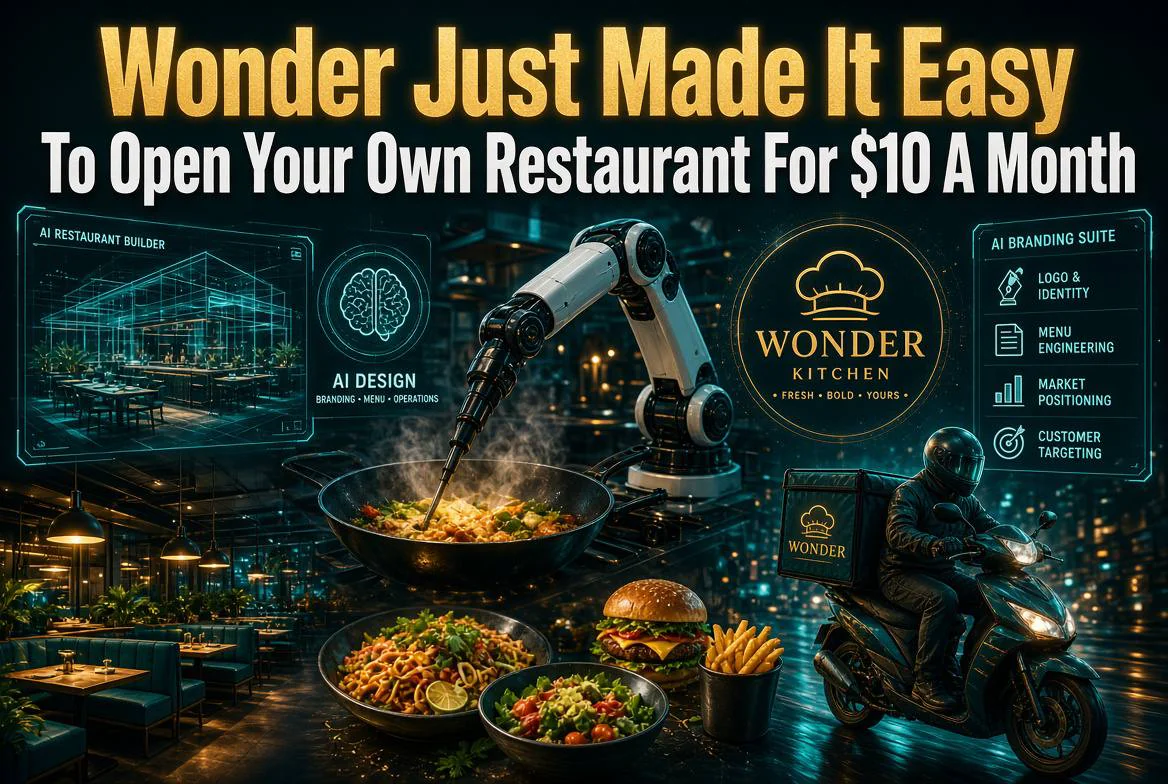
Wonder Just Made It Easy To Open Your Own Restaurant For $10 A Month
⚡ Expert Summary: Wonder Create hands anyone $10 a month and an AI chat box and gives them back a restaurant brand – cooked by a robot, delivered by the company that also owns the app you order from. Marc Lore is right that creativity should beat capital. But the delivery app has quietly stopped being a directory of restaurants and become a shop window for whoever can afford a prompt, on the one platform that writes its own listing rules. Meanwhile DoorDash and Uber Eats forbid AI-generated food photos, Deliveroo banned them outright in October, and 77% of delivery customers already can’t tell a virtual brand from a real restaurant. You aren’t being asked to trust the food. You’re being asked to trust the photo.
Marc Lore has a sentence he likes to use about restaurants, and it is a good sentence: creativity, not capital, should determine who gets to own a restaurant. On Wednesday his company did something about it. Wonder launched Create, a tool that turns a typed idea into a complete restaurant brand – name, logo, food photography, menu, recipe, prices – for as little as $10 a month per location.
You do not need a lease. You do not need a kitchen, a hood, a walk-in, a dishwasher, a line cook, or a single conversation with a health inspector. You need an idea and ten dollars. Wonder does the rest: it cooks the food in a robotic assembly line, delivers it, and lists it on Grubhub and Seamless – which Wonder also owns.
That last part is the whole story, and almost nobody covering the launch has said it out loud.
What Wonder Create Actually Does
The mechanics are simple enough to explain to a line cook in thirty seconds. According to Nation’s Restaurant News, a creator logs into the Wonder Create platform, types an idea for a restaurant into the LLM chat box, and the system returns an entire ghost kitchen brand. Name, branding, logo, menu, pricing – generated.
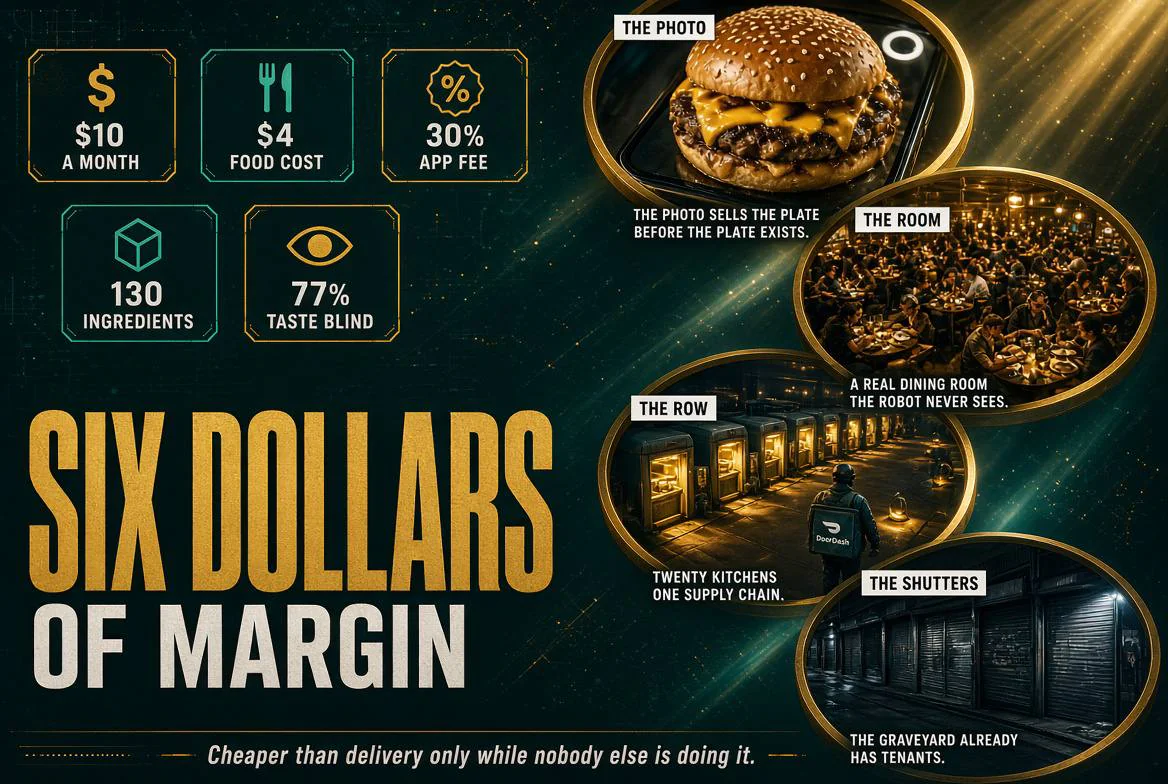
Inc. put it more bluntly: “The platform AI tools will develop the name, logo, concept, photography, and product descriptions.” Read that list again. Photography. The picture of the food you are about to buy is generated, not shot.
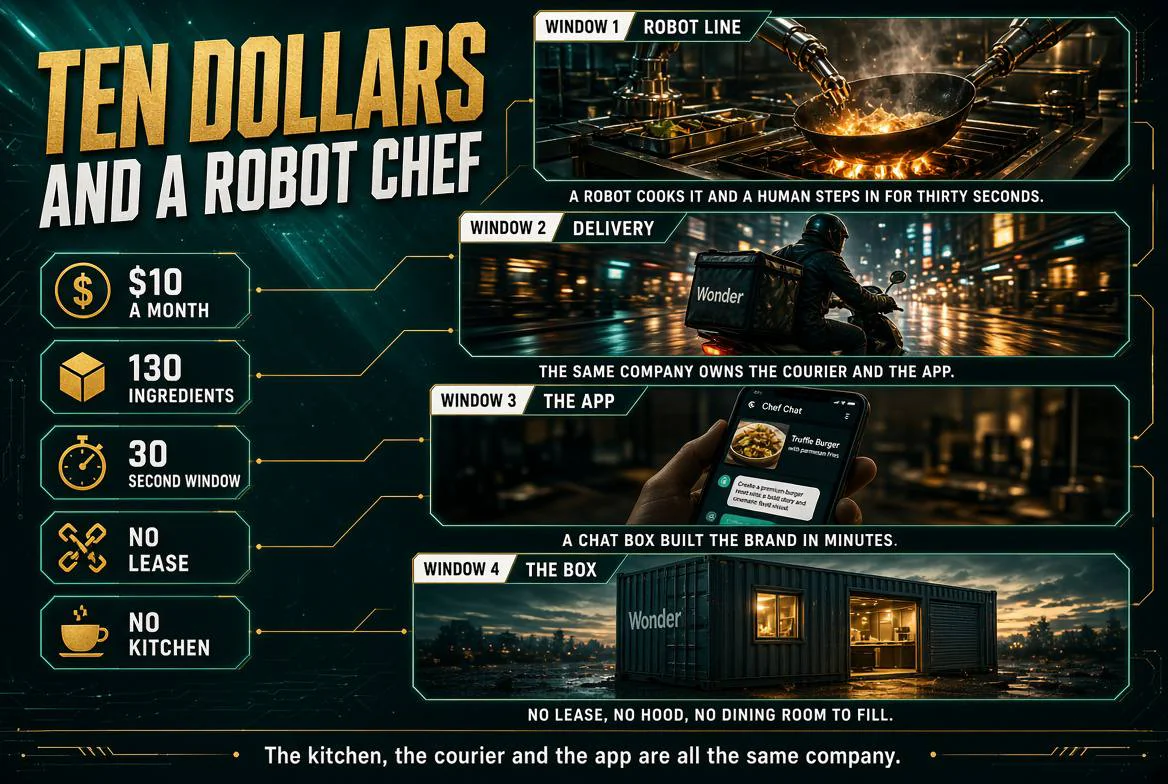
Everything is constrained to what the machine can actually make. Wonder’s Infinite Makeline stocks 130 ingredients and assembles bowls from them. The line evolved from Spyce, the robotic kitchen Wonder bought from Sweetgreen for $186.4 million. Lore’s own description of the manufacturing is almost giddy: “Full autonomy with the exception of the lid and tape – and eventually we will solve that as well. So maybe 30 seconds of human intervention. Otherwise it is fully autonomous from restaurant creation to delivery to your front lawn.”
Thirty seconds of human contact per order. That is the labour model.
The Price Is $10 a Month. The Business Model Isn’t.
The $10 figure has already been mangled in the coverage, so be precise: it is as little as $10 a month per location. NRN: “Creators pay a monthly subscription fee (as little as $10 a month per location) to host their restaurant on the Wonder, Grubhub, and Seamless apps, and can then begin making money back on every item ordered.”
Per location. That is the tell. This is not a subscription product priced to earn back its cost through subscriptions. Ten dollars a month does not pay for an AI image model, a menu generator, a recipe engine, sourcing, cooking, packaging, and delivery. It does not pay for the robot. It is a customer-acquisition fee.
Wonder’s real revenue comes from the food. The creator owns the brand and sets the price, subject to a minimum, and takes a revenue share. Wonder keeps the transaction, the customer relationship, and every physical step in between. Chain Store Age describes it plainly: “Wonder handles the full food service process including sourcing, cooking, delivery and pick-up.”
What Wonder gets for ten dollars a month is a supply of brands that each bring their own audience. The $10 is not the business. The $10 is the door.
| What you bring | What Wonder brings | Who holds it |
|---|---|---|
| The idea, the name, the brand, the menu concept | 130-ingredient robotic line, sourcing, cooking, packaging | Creator owns the brand; Wonder owns the machine |
| A $10/month per-location subscription | Delivery and pickup logistics, driver network | Wonder |
| The audience you already have | Listing space on Wonder, Grubhub and Seamless | Wonder – it owns all three |
| Nothing physical | Health permits, inspections, allergen compliance | Wonder, as the licensed operator of the kitchen |
| Your name on the label | The food, the photo, the rails, the customer data | Winner keeps the relationship |
The Photo Is the Product
Here is where the food business and the software business collide.
Every major delivery platform has spent the last three years trying to stop AI-generated food images from reaching customers. DoorDash and Uber Eats require real photography of real dishes and prohibit generated images. Deliveroo went further in October 2026 and banned generative AI food images outright. The stated reason is consistent across all of them: a customer ordering from a photo needs the photo to be true.
Wonder Create generates food photography for listings. On its own apps.
Nobody has to break a rule here. Wonder is not a restaurant uploading a fake picture to somebody else’s marketplace. Wonder owns the marketplace. The listing rules that have been written to protect customers from fabricated food on Grubhub and Seamless are written by the same company that is now manufacturing the food images that fill them. That is not a loophole. It is vertical integration.
The consequence lands on the customer, in the only place a customer can check: the picture. When you order from a delivery app you are buying a photograph, a price, and a promise. If the photograph is a generated image and the brand is a generated name, two of those three things were produced by software in the last few seconds, and the third was set by the person who prompted it.
77% of Customers Can’t Tell the Difference – and Nobody Has to Tell Them
Circana’s 2024 research found that only 23% of delivery app users could correctly identify a virtual brand. Which means 77% believed they were ordering from a standalone restaurant.
That number was measured before anyone could generate a brand identity from a sentence. It was measured in a world where a virtual brand was at least run by an operator who had thought about the food. The gap between what a customer thinks they are buying and what they are actually buying has been widening for years, and Wonder Create does not create it. It industrialises it.
And no US state requires disclosure. Zero. There is no federal rule, no state statute, no platform mandate that a listing tells you the restaurant does not exist as a physical place you could walk into. The nearest thing to a protection is a naming convention – Wonder’s existing concepts carry a “by Wonder” suffix on the big platforms, and Wonder’s own app separates “Made at Wonder” from outside restaurants. But as of this writing, no reporter has published a live screenshot of how a Wonder Create storefront is badged on Grubhub or Seamless. The disclosure question, at launch, is unanswered.
So the honest version of the customer experience is this: you are on a delivery app, you tap a restaurant you have never heard of, the food photography is generated, and the brand was invented by a model. Nothing in the interface tells you any of that. You find out by reading an article like this one, or you never find out at all.
Cheaper Than DoorDash – for Now
There is a genuinely good argument for Wonder Create, and it is on price.
Wonder runs $0 delivery fees, no minimums, and no marketplace mark-ups on its own app. A typical order comes out $5 to $14 cheaper than the same basket on DoorDash or Uber Eats, where delivery fees run $1.99 to $5.99 and a service fee of roughly 15% is standard. For an independent operator being bled by 30% commission, that spread is not a rounding error. It is the difference between a viable margin and a closed dining room.
That is the real pitch, and it is not the pitch Wonder is leading with. The pitch is creativity. The economics are about who owns the customer. If you want the broader picture of how AI is rearranging restaurant operations rather than just the delivery layer, that is where this thread continues.
| Factor | Opening a restaurant the normal way | Opening one with Wonder Create |
|---|---|---|
| Upfront capital | Build-out, equipment, permits, deposits – typically six figures | As little as $10 a month per location |
| Time to first order | Months | After a waitlist and a content screening |
| Who cooks | You and your staff | A robotic line, roughly 30 seconds of human contact per order |
| Who holds the health permit | You | Wonder, as the licensed kitchen operator |
| Who owns the customer | You, unless delivery apps take it | Wonder, on apps Wonder also owns |
| Menu flexibility | Anything you can source and cook | Whatever the 130 ingredients allow |
| What you actually own | The restaurant | The brand |
The Barrier Was Never Only Money
Lore’s sentence is right about the problem. Opening a restaurant in America is expensive and slow, and the people who can afford it are frequently not the people with the best ideas about food. Anything that lowers that wall deserves a fair hearing, and the launch partners show the range: Jim Gaffigan, Andy Cohen, Gary Vaynerchuk, Ally Love, Chef Marc Murphy, Hannah Bronfman, Jesser, Livvy Dunne, Topper Guild, plus Netflix, the Girl Scouts of the USA, and MLB Players Inc.
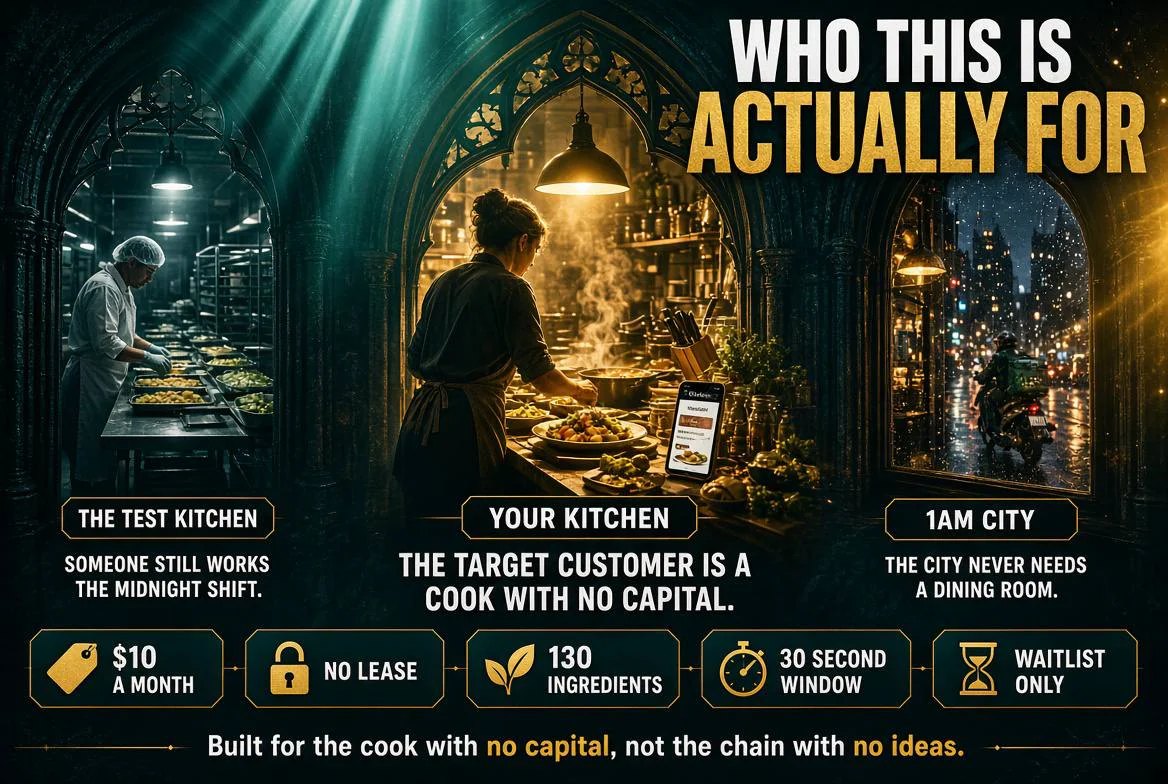
Chopt Creative Salad Co is testing new dishes through it. That is the most interesting name on the list, because a chain using a $10-a-month prompt tool as an R&D lab is a genuinely new behaviour. No test kitchen, no limited-time menu rollout, no lease – just a brand you can stand up, sell, and kill in a week based on real orders.
But the barrier-lowering is narrower than it sounds. What Wonder Create removes is the money wall. What it does not remove is the audience wall. A restaurant with no customers fails whether it took $400,000 and nine months to open or $10 and an afternoon. The people who will succeed on this platform are overwhelmingly people who already have distribution – a comedian, an athlete, an influencer, a chain with a mailing list. They are not home cooks with a good idea. They are the already-visible.
The old wall was capital. The new wall is reach. It is cheaper, and it is not necessarily fairer.
The Ghost Kitchen Graveyard Already Has Tenants
It would be naive to treat this as the first attempt at the idea. The US ghost kitchen market was worth about $2.9 billion in 2025, and IBISWorld recorded revenue down 5.2% in 2024, with negative growth stretching back to 2020. Uber Eats purged roughly 8,000 virtual storefronts in 2023 to clear out low-quality listings. Reef and Kitchen United both retreated from the space. MrBeast sued Virtual Dining Concepts after his name was attached to food he could not stand behind.
The graveyard tenants all died of the same disease: a brand with no kitchen is a brand with nobody accountable for the food. Wonder’s advantage is that it owns the kitchen. Its risk is that it now owns the food for brands it did not design, made from a fixed list of 130 ingredients, sold to customers who cannot see the difference.
And there is a structural question nobody has answered yet, because Wonder filed confidentially for an IPO in early November and its S-1 is not public. If hundreds of creators flood one storefront, what happens to the customer experience? How many near-identical bowls from the same 130 ingredients can one kitchen list before a customer notices? DoorDash already requires roughly 50% menu differentiation per address. Wonder owns its own platform, so it writes its own answer.
Who This Is Actually For
If you run an independent restaurant: this is not your replacement, and it is barely your competitor. It is a competitor for the delivery slot at 8pm on a Friday – the same customer, the same $22, a different kitchen. The thing worth stealing from Wonder is not the robot. It is the $0 delivery fee and the no-mark-up pricing, because that is the part of Wonder’s model that would actually fix your P&L. Everything else about Create is a supply of cheap listings that will make your category look noisier.
If you have an audience and a food idea: this is the cheapest product test in the history of food. Ten dollars a month for a brand, a kitchen, and a listing. But understand the trade you are making. You are renting the machine, the rails, the delivery network, and the customer relationship in exchange for a brand you own outright and a price you set. If Wonder’s platform economics change – and platforms always change their economics once they have supply – you own a name and nothing else.
If you are a customer: you are now ordering from a system where the photograph, the name, and the menu may all have been generated in the seconds before you opened the app, on a platform whose owner sets the disclosure rules. You are not being lied to. You are being shown a very good picture of something nobody has to describe to you accurately.
Frequently Asked Questions
How much does Wonder Create cost?
As little as $10 a month per location, according to Nation’s Restaurant News. That covers hosting your brand on the Wonder, Grubhub and Seamless apps. You then earn a revenue share on every item ordered, with Wonder setting a minimum price. The $10 is a subscription to the platform, not the price of the food.
Do you need a kitchen or a food licence to use Wonder Create?
No. Wonder handles sourcing, cooking, delivery and pickup, and as the licensed operator of the physical kitchen it holds the health permits and inspections. You bring the brand and the idea. Note that this also means the food safety responsibility sits with Wonder, not with you – and the creator terms covering indemnity were not publicly available at launch.
Is the food photography on Wonder Create real?
No. Inc. reported that the platform’s AI tools generate the name, logo, concept, photography and product descriptions. The images are generated, not shot. This is notable because DoorDash and Uber Eats prohibit AI-generated food images and Deliveroo banned them outright in October 2026 – but Wonder generates them for listings on Grubhub and Seamless, which Wonder owns.
Can customers tell a Wonder Create restaurant is AI-generated?
Probably not. Circana found only 23% of delivery app users could correctly identify a virtual brand, meaning 77% believed they were ordering from a standalone restaurant. No US state requires disclosure that a listing is a virtual brand, and at launch no reporter had published how a Wonder Create storefront is labelled on Grubhub or Seamless.
Is Wonder Create available to the public yet?
Not fully. Wonder launched Create in Manhattan on 18 November 2026 with select brands and creators, and is taking names for a public waitlist. All Create restaurants are subject to content screening before they launch, which means Wonder decides which prompts become restaurants.
How is this different from other ghost kitchen brands?
The kitchen. Earlier virtual brand models left the cooking to third parties, which is how a market worth $2.9 billion ended up shrinking 5.2% in 2024 and why Uber Eats purged around 8,000 storefronts in 2023. Wonder owns the robotic line, the delivery network and the ordering apps, so it can guarantee the food in a way a brand licensing arrangement cannot – and it can set the listing rules at the same time.

About Barak Schurr
Barak Schurr built and exited a major ticketing platform, ran global operations at Eventbrite, and now focuses on one question: which AI tools actually help independent restaurant owners run leaner and grow faster. He writes from the operator’s perspective — no vendor spin, no theory, just what’s real in 2026.
Email: [email protected]
More Resources for Restaurant Operators