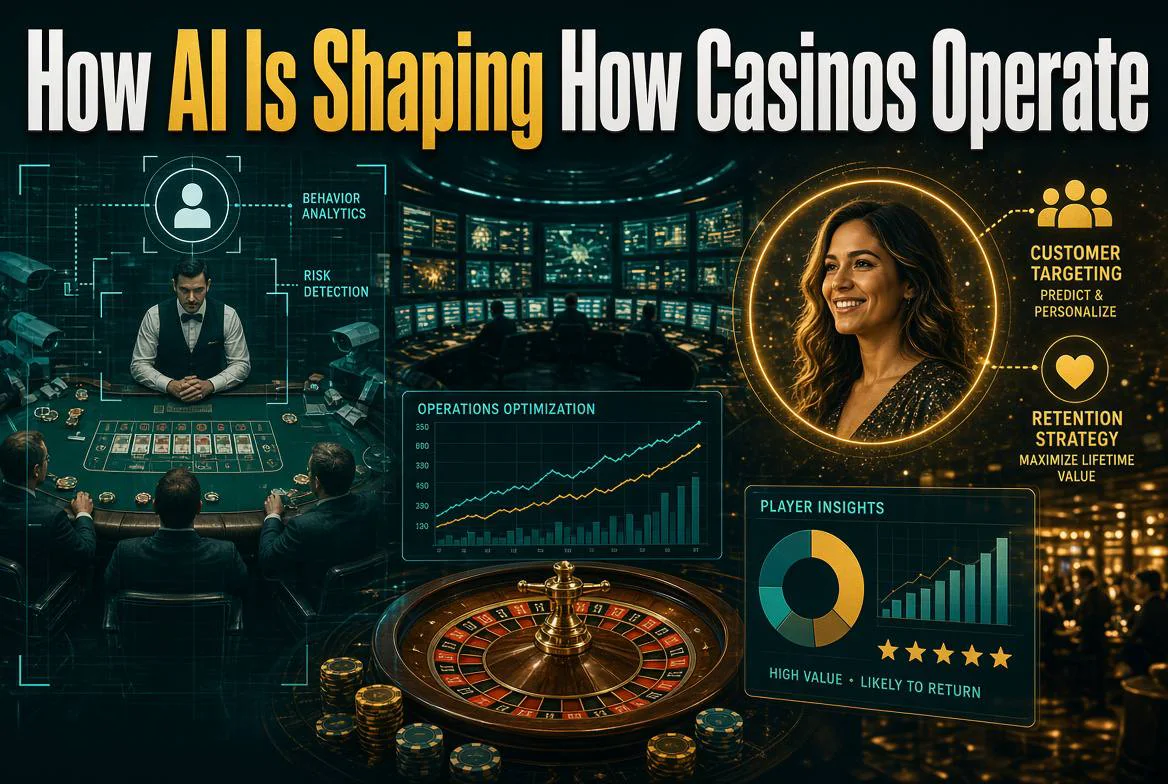
How AI Is Shaping How Casinos Operate
⚡ Expert Summary: The American casino floor runs on two AI systems now, and they are pointed in opposite directions. One watches the dealer: at Resorts World Las Vegas, vision AI reviews table games for errors and every false alarm hands a surveillance operator a seven-second clip to check — on a system the vendor says is right about 40% of the time when it is first switched on. The other watches the customer: the same class of model produces what EagleSight’s chief executive calls “perfect player ratings,” so marketing knows exactly which players to reinvest in. The pitch was fraud detection. The product is knowing who to keep. Meanwhile the operators who own these floors are answering a New York Times finding that one of them used machine learning to target losing bettors, and a federal bill that would write AI restrictions into law.
Every casino in America already has the cameras. That is the part people miss when they imagine the industry being rebuilt by software. The eye in the ceiling has been there for decades — above the pit, above the cage, above the slot aisles, recording everything and mostly waiting for something bad to happen.
What changed in 2026 is that the footage finally got read.
At the Global Gaming Expo in Las Vegas at the end of September, the people who watch those screens for a living described what happens when a machine starts watching with them. The answers were specific, the numbers were small, and the enthusiasm was real. So was the cost.
The Floor Already Had the Cameras
There is a version of the casino-AI story that sounds like every other enterprise-AI story: pilot programme, vendor demo, a chief executive saying “we are exploring”. That is not what happened here. What happened is that the single most instrumented physical space in American business — a room with a camera above every table and a regulatory obligation to record everything — finally got something that can read its own footage.
The pitch sold at trade shows is fraud detection. The thing actually being bought is a continuous audit of every human on the property, dealer and customer alike. Those are two different products, and confusing them is why the industry’s public defence keeps missing the question regulators are now asking.
This is a look at what the machines are doing on the floor right now, what they cost, who is selling them, and why the same technology that catches a dealer’s mistake can also decide which customer gets a host and which gets an offer. Both functions run on the same data. Only one of them is disclosed to the player.
What the AI Is Actually Looking At
Vision AI is not a new camera system. It is a layer that runs a property’s existing video through AI agents that watch for dealer errors and cheating players, monitoring many streams at once and flagging anything that deserves a human’s attention.
EagleSight.ai, founded in 2024, started putting its technology into casinos this year and now sells to 12 properties nationwide, according to chief executive Trevor Outman. The reason it exists is staffing, and Outman said so plainly: experienced surveillance staff can spot mistakes accurately, but there are not enough of them to watch every table at once.
At Resorts World Las Vegas, the system already pays for itself in a narrow way. Zachary Koep, the property’s director of surveillance, said AI surveillance is catching hundreds of thousands of dollars in mistakes on table games, and is also identifying cheating and analyzing player behavior. He called it a boon.
“It’s amazing how many things you’re not aware of,” Koep said.

The Seven Seconds That Explain the Whole Deployment
Here is the sentence that reorganizes the story.
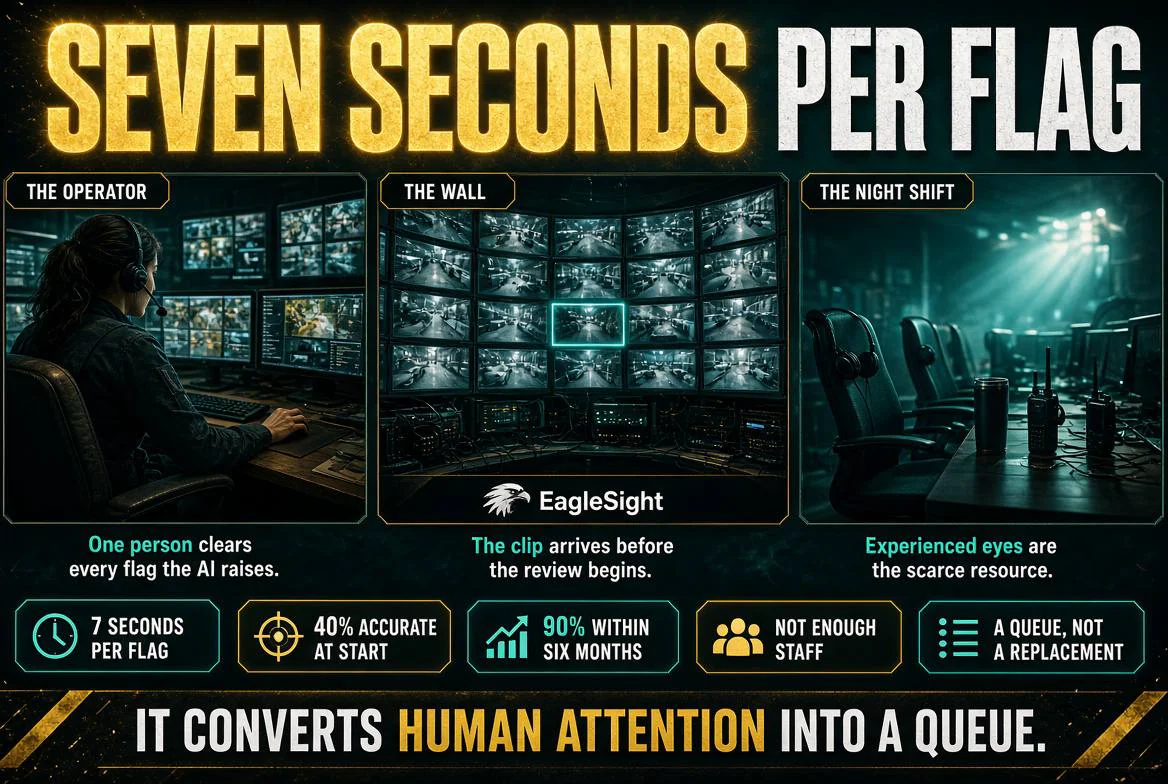
When the AI spots a possible mistake at a table in the high-limit room, a surveillance operator receives a seven-second clip to review. If it turns out to be a false positive — a machine guessing wrong about a human being — the operator has still spent the time.
“My operators literally lose seven seconds of their lives,” Koep said.
That is not a complaint about the software being useless. It is a description of exactly what the software does: it converts the casino’s expensive human attention into a queue. The queue is shorter than watching every table, which is the point. But it is a queue, and somebody has to clear it.
Outman is candid about the accuracy curve, which is the other half of the same story. The technology is accurate about 40% of the time when it is first introduced at a property, depending on the quality and consistency of the video. Within six months of learning that property’s floor, accuracy hits 90%.
“It will never be perfect,” Outman said. “I don’t think a perfect world exists.”
So for the first half-year of any deployment, the machine is wrong more often than it is right, and a human clears every one of those errors at seven seconds apiece. The casino is not buying certainty. It is buying a filter that gets better.
Why It Only Covers the High-Limit Room
The technology is expensive. That single fact explains the shape of the rollout more than any technical limitation.
Resorts World uses AI surveillance only on its high-limit tables, Koep confirmed. Outman said that kind of strategic deployment is typical across the industry because of cost, and EagleSight declined to disclose its pricing.
So the machine watches the money. Not the whole floor, not the $15 blackjack table, not the slot aisles where the volume actually lives. The high-limit room, where a dealer error or a cheat is measured in thousands rather than tens.
That is a rational deployment and it is also a revealing one. The AI’s job is to protect margin, and margin is concentrated in a small number of players in a small number of rooms. Everywhere else, the economics do not clear the bar yet.
Outman’s ambition is the reverse of that: making the technology cheap enough that AI agents eventually monitor every table and produce business intelligence across the broader floor. That is the direction. It is not the current state.
The Business Intelligence Is the Real Product
The fraud detection is the story the casino tells. The customer data is the story the casino is buying.
Once the machine is watching, it is not only catching mistakes. It is rating players continuously, and rating them accurately in a way the industry has struggled with for years.
“You get perfect player ratings,” Outman said. “Marketing knows exactly what players to reinvest into, to what degree.”
Gaming consultant Debi Nutton explained the gap this closes. Casinos audit players, but it is genuinely hard to distinguish a player who knows the game and plays well from one who plays fast and badly. Both look active. Only one is worth reinvesting in.
“The ability to really know your customer like you do a slot customer, it would really improve our auditing tremendously,” Nutton said. “And our customer retention because we may not be investing in the customers the way we think we should.”
Read those two quotes together and the machinery is visible. The camera watches the dealer to protect the house. The same camera watches the player to decide who gets a host, a suite, a comp, an offer. One system, two audits, and only one of them is a cost.
What Each Major Operator Is Doing
The big players are not running the same play, and their public positions are unusually far apart for a single industry on a single question.
| Operator | AI focus | Public position | Exposure |
|---|---|---|---|
| Resorts World Las Vegas | Table surveillance, high-limit only | Calls it a boon; catches hundreds of thousands in errors | Seven seconds of operator time per false flag; too expensive for the full floor |
| MGM Resorts International | Customer auditing and responsible-gaming identification | “We’ve all been doing a form of this for a very long time” | $100–110M lost when one cyberattack took the whole network down |
| Caesars Entertainment | Data automation, player experience, loyalty targeting | “Not in our interest… nor is it possible to build your business on problem gambling” | Named most likely to profit from AI loyalty targeting by Jefferies |
| DraftKings | Promotion targeting | Denies targeting customers by their losses | Subject of a New York Times finding; now under state and federal scrutiny |
| Light & Wonder | AI features inside gaming systems | De-leveraging is the prime objective | Debt 3.4x cash flow; systems sales down 16%; buybacks deprioritised |
MGM chief executive Bill Hornbuckle made the industry’s broadest defence during the G2E chief executive panel, and he did not hedge it. Automation has been used to audit customers for decades, he said, and it now simply allows casinos to do so at a larger scale.
“We’ve all been doing a form of this for a very long time,” Hornbuckle said, “and by the way, so is Amazon and everybody else.”
He also argued the technology promotes responsible gaming by identifying problem gamblers, whom casinos then contact and assist.
Caesars chief executive Tom Reeg took a different line, and it was the more interesting one because it was a statement of business logic rather than a defence.
“It’s not in our interest to try to build, nor is it possible to build your business on problem gambling,” Reeg said.
That is true as far as it goes. A player who is destroyed is a player who stops playing, and every operator knows it. But “not our business model” is not the same as “not what the model can do,” and that gap is precisely where the regulators have now walked.
The Pushback, and What It Is Made Of
The most damaging allegation in the industry is not about surveillance at all. It is about targeting.
A New York Times investigation published on September 19, 2026, reported that DraftKings used artificial intelligence to target promotions at likely losing gamblers. DraftKings denies it, saying it does not target customers based on their losses.
ProPublica then tested the guardrails directly. A reporter who deliberately bet like a problem gambler was given VIP status, and the app’s design and promotions encouraged more betting even after that reporter opted into responsible-gaming tools meant to slow users down.
The consequence was immediate and it was structural: state and federal officials launched inquiries and demanded information, and one proposal would limit when companies like DraftKings can pitch users to bet more.
Note what the accusation actually is. Nobody claims the machine made anybody gamble. The claim is that the machine found the people most likely to keep going and put the offer in front of them. That is a marketing function, performed with a precision that human list-building never reached, and it is the reason AI in this industry is a policy question rather than a technology one.
| Question | What the industry says | What the record shows |
|---|---|---|
| Do you target losers? | DraftKings denies targeting customers by their losses | A New York Times investigation found machine learning aimed at likely losing bettors; ProPublica found a problem-gambling profile given VIP status |
| Is this new? | MGM: automation has audited customers for decades at larger scale | True on audits. New on speed, scale and the promotional offer attached to the audit |
| Can the machine be trusted? | EagleSight: accuracy hits 90% within six months | Also 40% at introduction, and every wrong guess costs an operator seven seconds |
| Who is watching it? | IGSA: nine best practices, called living documents | No published price from any vendor, no published savings from any operator, no federal law yet |
The Regulators Have Started Writing Rules
The International Gaming Standards Association released “Ethical Use of Artificial Intelligence,” the first in a series of best-practices documents and the first from one of its non-technical committees. It contains nine best practices for the ethical use of AI in gaming.
The detail that matters is who wrote it. The IGSA Regulatory Committee, composed exclusively of representatives from regulatory authorities, had input, and the membership voted to approve the result.
“The EAI Committee has completed work on our very first release of a set of best practices, which is a new document form for us,” said IGSA president Mark Pace, describing a framework intended to help regulators oversee AI use in the industry.
The documents are described as living documents, to be added to as committees produce more work. That phrase is doing a lot of load-bearing. It is an admission that the rules are being written while the deployments run.
In Washington, Representative Paul Tonko is fine-tuning the SAFE Bet Act, federal legislation aimed at deceptive marketing tactics, artificial intelligence and fiscal safeguards in legal sports betting.
“We put a framework out, now we are wordsmithing it,” Tonko said. “We are networking with folks to make certain we get it exactly as we intended.”
What the Suppliers Are Selling, and What It Costs Them
The vendor layer tells a story that rhymes with everything else happening in AI right now: the companies selling efficiency are the ones under the most pressure to deliver it.
Koin’s head of AI and data strategy, Hemash Bhatti, describes contextual segmentation of everything a customer says — the unstructured data inside guest-service and support conversations, which he says holds a wealth of knowledge. Adoption is companywide, from data teams to developers to marketing.
“There’s no silver bullet to use it to solve everything we need for our customers,” Bhatti said. “It can definitely be something that can help build efficiencies. It’s only as good as the requirements and the strategy around it.”
Quick Custom Intelligence’s co-founder and chief technology officer, Andrew Cardno, is more direct about the payoff. Half its technology stack now runs internally on large language models, handling customer engagement support, communications, response processes and summarization.
The result: more than 50 resorts added as clients over the last year, without a proportionally larger team.
“We’re using ChatGPT to allow us to support and handle that larger volume of customer partners without having to engage a much larger team,” Cardno said. “For us internally, it’s a scaling thing.”
Then there is Light & Wonder, the supplier with the balance sheet to worry about. On its second-quarter call, chief financial officer Oliver Chow laid out the plan to reduce debt to three times cash flow by mid-2027, down from 10.5 times in 2020 and 3.4 times at present, with investment grade as the goal. Stock buybacks become a lower priority for the rest of 2026. Gaming systems sales were down 16% on a hard comparison.
The company selling AI-enabled gaming floor systems is de-leveraging, not expanding. That is not a contradiction. It is the same story as the operator floor: the technology is real, and the money around it is tight.
The Skeptic in the Room
Not everyone at these conferences is selling. Jennifer Golbeck, director of the University of Maryland’s social-intelligence lab, told an AGS GameON audience in Reno exactly what she thought of the technology the industry is buying.
“Artificial intelligence is really dumb,” Golbeck said. “It tries very hard to approximate what people do, but it doesn’t understand anything about what it’s doing.”
She argued the doomsday framing is a distraction from something more mundane and more real: the data gathering already normal everywhere, including in casinos. Her examples ran from a 15-year-old girl receiving maternity and diaper advertisements weeks before she told her parents she was pregnant, to a pharmacy reminder based on a dog’s prescription record, to a European football league that tracked fans’ phones to find bars showing games without a licence and then switched on the microphone to check.
“We’re all tracked without our knowledge all the time,” she said.
She was also blunt about the failure mode that matters most for a business running on numbers: AI “is definitely not good for facts.” Asked for a summary of a published paper about the casino industry, it cited a source that did not exist.
Put that next to a surveillance system that is wrong about 60% of the time when it is first installed, and the seven seconds stop looking like an inconvenience. They look like the price of a machine that confidently guesses.

What the Analysts Think This Is Worth
Wall Street has already picked its side, and its reasoning is worth reading closely because it says something about which AI the industry actually values.
Jefferies analyst David Katz wrote that gaming operators are likely to expand AI to support customer acquisition, engagement and retention “through more targeted and personalized promotional offers at greater speed and scale.” Operators with the most extensive loyalty ecosystems, Caesars named directly, appear best positioned to capture incremental value and defend, if not modestly expand, share versus later adopters.
That is the targeting side, not the surveillance side. Nobody on the analyst call is modelling the seven-second clip. They are modelling the offer.
J.P. Morgan’s Dan Politzer added a line that cuts the other way and should be read by every operator investing here: among the reasons to be tactically bullish on U.S. gaming operators, he listed that “experiential offerings are insulated from AI.”
Sit with that for a second. The bull case for casinos includes the idea that what they sell cannot be automated. Which means the industry is spending money to automate the parts of itself that are not the product — the watching, the auditing, the reporting — while the thing people actually pay for, a night out with a dealer and a crowd, stays human.
Where This Goes Next
Three things will decide whether AI in casinos stays a back-office story or becomes a public one.
First, cost. Every operator watching Resorts World is waiting for the price of full-floor coverage to fall. Outman’s stated goal is a system cheap enough to cover every table and produce business intelligence across the whole floor. The moment that happens, the seven-second queue stops being a high-limit curiosity and becomes an operational line item at hundreds of properties.
Second, the targeting question. The surveillance system and the marketing system are learning from the same player data. The industry’s defence is that it is not in its interest to build a business on problem gambling. The regulator’s question is whether interest is the right test.
Third, the rules. IGSA has nine principles and calls them living documents. Congress has a bill being wordsmithed. Both are attempts to govern a technology whose vendors have not disclosed their pricing and whose operators have not disclosed their savings.
What is not in dispute is the direction. The casino floor has been instrumented for forty years — the cameras were always there. What arrived in 2026 is the interpreter. It is fast, it is cheap relative to a human watching a wall of monitors, and it is wrong often enough that a person still has to check its work.
That person, for now, is the business model. Seven seconds at a time.
Frequently Asked Questions
Do casinos really use AI to watch table games?
Yes. Vision AI systems run a property’s existing camera footage through AI agents that watch for dealer errors and cheating players, monitoring multiple streams at once and flagging what needs a human review. EagleSight.ai sells this to 12 properties nationwide, and Resorts World Las Vegas uses it in its high-limit room.
How accurate is AI table surveillance?
EagleSight chief executive Trevor Outman says it is accurate about 40% of the time when first introduced at a property, depending on video quality, and reaches about 90% within six months. Those figures are the vendor’s own and have not been independently audited.
Why don’t casinos put AI on every table?
Cost. Resorts World uses AI surveillance only on high-limit tables, where a single dealer error is worth far more than the system’s price. Outman says that targeted deployment is typical across the industry and that the company is working to make full-floor coverage affordable.
Did a casino use AI to target problem gamblers?
A New York Times investigation in September 2026 reported that DraftKings used artificial intelligence to target promotions at likely losing gamblers. DraftKings denies it, saying it does not target customers based on their losses. State and federal officials have since launched inquiries.
What does the casino industry say in its defence?
MGM chief executive Bill Hornbuckle argues automation has been used to audit customers for decades and now simply works at larger scale, and that the technology helps identify problem gamblers for outreach. Caesars chief executive Tom Reeg says it is not in the industry’s interest, or possible, to build a business on problem gambling.
Are there rules governing AI in casinos?
The International Gaming Standards Association published nine best practices for the ethical use of AI, drafted with input from a committee of regulators. In Congress, Representative Paul Tonko is preparing the SAFE Bet Act, which would address artificial intelligence alongside deceptive marketing and fiscal safeguards in sports betting.
Does AI surveillance actually save casinos money?
Resorts World’s director of surveillance, Zachary Koep, says the system catches hundreds of thousands of dollars in mistakes on table games. That figure is the property’s own and has not been independently verified, and no casino has disclosed what the system costs or its return on investment.
What is the biggest risk of AI in gaming?
Two candidates. One is targeting: using machine learning to find and cultivate the customers most likely to lose. The other is infrastructure: MGM lost an estimated $100–110 million in a cyberattack that took down its casino, hotel, ATM and wifi systems together because the network was not segmented.

About Barak Schurr
Barak Schurr built and exited a major ticketing platform, ran global operations at Eventbrite, and now focuses on one question: which AI tools actually help independent restaurant owners run leaner and grow faster. He writes from the operator’s perspective — no vendor spin, no theory, just what’s real in 2026.
Email: [email protected]
More Resources for Restaurant Operators