How to Choose an AI POS System for Your Independent Restaurant in 2026
Picking a POS system used to be straightforward. You chose between the one your friend used and the one with the cheaper processing rate. That was it. The decision had nothing to do with how you ran your restaurant because POS systems were just payment terminals with a register screen attached.
That era is over. In 2026, your POS system determines your restaurant’s AI capabilities, which means it determines your ability to compete on margin, labor efficiency, and customer experience.
The Four Contenders
The POS market for independent restaurants has consolidated into four major options, each with distinct AI capabilities and pricing models. There is no universal best choice. The right system depends on the specific needs of your operation.
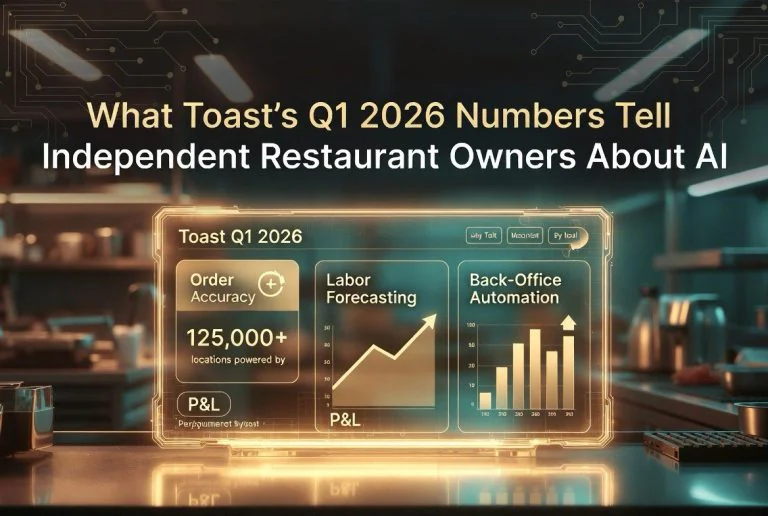
Toast is the market leader with 171,000 locations and growing. Its AI features include Toast IQ, which provides conversational data queries, predictive sales forecasting, and automated labor scheduling recommendations. Toast also launched a unified drive-thru AI system in 2026, expanding beyond its core dine-in and takeout market. Pricing is among the highest of the four options, with processing rates starting around 2.49 percent plus 15 cents per transaction and monthly software fees of $50 to $165 per location depending on features. Total cost for a typical independent restaurant runs $400 to $800 per month.
SpotOn is the most aggressive AI innovator in 2026. Its Profit AI system, launched in June 2026, generates proactive profit recommendations by analyzing POS data, accounting integrations, and operational metrics. SpotOn also offers a full suite of AI tools for marketing, loyalty, and scheduling. Pricing is competitive with Toast, with processing rates around 2.39 percent plus 10 cents per transaction and monthly fees of $40 to $120 per location. SpotOn positions itself as the more restaurant-specific alternative to Square, with stronger customer support and industry-specific features.
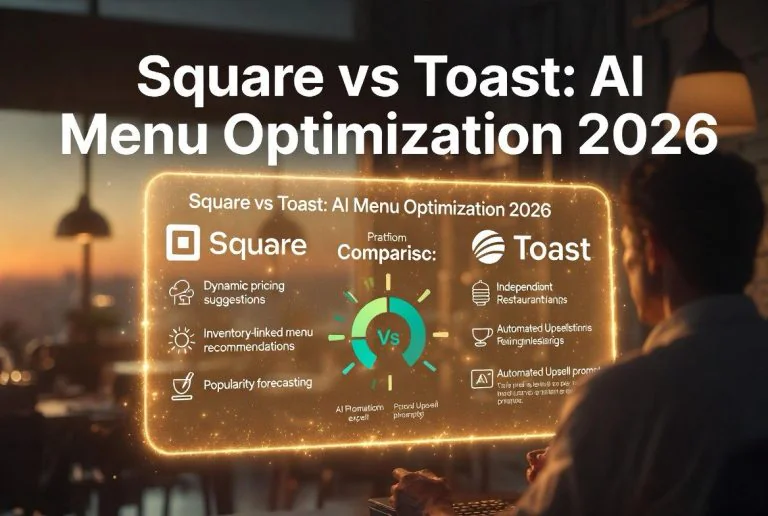
Square for Restaurants is the simplest and cheapest option. Its AI features include built-in pricing optimization, demand forecasting, and basic marketing automation. Square lacks the depth of restaurant-specific AI features that Toast and SpotOn offer, particularly in kitchen operations and inventory management. For a very small operation — a coffee shop, food truck, or limited-menu fast-casual concept — the simplicity advantage outweighs the missing features. Pricing is the lowest of the four, with processing rates at 2.29 percent plus 10 cents per transaction and no mandatory monthly software fee. Total monthly cost runs $200 to $400 per month for a typical independent restaurant.
Clover is the hardware-first option. Its terminals and handheld devices are excellent, and its software ecosystem supports restaurant features through third-party apps. The AI tools are less baked into the system than Toast or SpotOn, requiring additional apps and integrations to match their AI capabilities. Clover’s pricing is comparable to Toast, with processing rates around 2.49 percent plus 10 cents per transaction and monthly fees of $15 to $125 depending on plan and hardware lease.
AI Features That Actually Matter in 2026
Not all AI features are created equal. Before the NRA Show 2026, many restaurant tech executives warned operators to look past marketing and evaluate AI tools for real operational value. Here is what matters and what does not.
AI features worth paying for: Predictive sales forecasting that adjusts labor scheduling automatically, food cost analysis that identifies specific menu items or suppliers driving margin erosion, inventory optimization that reduces waste without manual counting, and customer data analysis that generates actionable suggestions for increasing average check size without aggressive upselling.
AI features that are mostly marketing: AI-generated marketing emails that sound generic, chatbots that cannot handle complex reservation scenarios, dashboards that show insights without specific recommendations, and voice AI that cannot handle your restaurant’s specific menu and policies out of the box.
The operators getting real value from AI POS features are using them for labor and food cost management. Those are the two biggest expense categories for independent restaurants, and they are where AI has the most data to work with. Marketing and customer engagement features are nice to have, but they do not move the needle on profitability the way labor optimization and food cost reduction do.
Total Cost Comparison Across the Four Options
Monthly cost for an independent restaurant processing $40,000 in credit card sales with a single location:
Toast: approximately $650 to $1,100 per month including software fees, processing costs, and hardware lease. The higher end includes Toast IQ and advanced AI features.
SpotOn: approximately $550 to $950 per month including software, processing, and AI tools. Profit AI is in beta but expected to add $50 to $150 per month at general availability.
Square for Restaurants: approximately $300 to $500 per month including processing and optional premium features. AI tools are included in the standard subscription.
Clover: approximately $500 to $900 per month including processing, software, and hardware lease. AI features require additional third-party apps at extra cost.
The five-year cost difference between the cheapest and most expensive option for a restaurant processing $40,000 monthly is approximately $24,000. That difference matters, but it is small compared to the cost of choosing a system without the AI features you need. A system that helps you reduce food cost by 3 percent on $200,000 annual food spend saves $6,000 per year. The wrong system saves nothing.
Which POS System Fits Your Restaurant Type
Full-service restaurants with 50 to 150 seats: Toast or SpotOn are the clear choices. Both offer table management, modified menu handling, and kitchen display system integration that full-service operations need. Toast has a deeper ecosystem for reservations and waitlist management. SpotOn has stronger profit analysis tools. Either will serve you well.
Fast-casual and quick-service: Toast leads in this category with its drive-thru AI and kiosk integrations. Square is a strong alternative for simpler fast-casual concepts without complex menu modifications or drive-thru operations.
Coffee shops, bakeries, and limited-menu concepts: Square is the practical choice. The simplicity advantage outweighs the missing restaurant-specific features. You do not need a kitchen display system or advanced menu management when your menu fits on one board above the counter.
Multi-location independent groups: SpotOn or Toast, with the decision coming down to which AI features matter more for your specific operations. Multi-location operators benefit significantly from centralized AI analysis across locations, which both platforms support.
The Implementation Decision Nobody Talks About
Switching POS systems is a three-week disruption no matter which platform you choose. Staff need retraining, menu data needs re-entry, and there will be a week of slower service while everyone adjusts. The operators who switch successfully treat the transition like opening a new restaurant for three weeks.
The common mistake is underestimating the data migration. Your menu with modifiers, prices, and categories is the core of your POS configuration. Every platform handles this differently, and every migration requires manual verification. Budget a full weekend for menu reconfiguration and another two days for testing before going live.
Training is the second underestimated cost. Toast offers the most comprehensive training resources for staff. Square the least. If your team is not tech-savvy, factor the training time into your switch decision.
Hidden Costs That Change the Math
The advertised pricing for POS systems never tells the full story. Independent operators who have been through a POS switch identify several hidden costs that can change the five-year cost projection by thousands.
Hardware replacement cycles. POS terminals last three to four years before they need replacement. Toast and Clover require proprietary hardware. SpotOn and Square support a mix of proprietary and standard iPad-based setups. The iPad-based options are cheaper to replace when hardware needs upgrading.
Integration costs for existing tools. If you use third-party tools for online ordering, loyalty, accounting, or inventory management, switching POS systems may require new integrations. Some integrations are included in the monthly fee. Others require additional monthly subscriptions ranging from $20 to $100 per tool.
Early termination fees. Most POS contracts run three to five years with early termination fees of $500 to $2,000. If you switch before your contract ends, that fee adds to the total cost of the new system.
Training and productivity loss. The three-week transition period includes slower service, more errors, and lower table turns. For a restaurant doing $40,000 monthly revenue, that productivity loss typically costs $1,500 to $3,000. Plan for it and set expectations with your team.
Operators who account for all of these costs before choosing a system make better decisions than those who compare only monthly fees and processing rates.
What the Next 12 Months Will Bring
The POS AI landscape is evolving rapidly. Here are three developments that will shape the market through mid-2027.
AI labor scheduling will become standard. Every major POS platform will offer AI-powered labor scheduling within 12 months. The differentiation will shift from who has the feature to whose algorithm produces better results for specific restaurant types.
Voice AI ordering will expand beyond drive-thru. Toast’s drive-thru AI proves the technology works. The next wave will bring voice AI to counter service, bar ordering, and phone orders. SpotOn and Square are both expected to announce voice AI features before the end of 2026.
Cross-platform AI analysis will emerge. Independent operators running multiple tools across different vendors will benefit from AI that can analyze data across platforms. This is the hardest technical challenge in the space because it requires data sharing between competitors. It is also the feature with the highest potential value for operators who do not want to consolidate everything onto one platform.
The operators who will benefit most from these developments are those who choose a platform now with the AI foundation to support future features. Switching POS systems is hard. Switching again in 18 months because your platform fell behind on AI would be a costly mistake.
Making the Final Decision
If you are evaluating POS systems in 2026, here is the decision framework that accounts for both current needs and future AI capabilities.
Start by identifying your highest-cost operational problem. If labor is your biggest pain point, prioritize platforms with the strongest AI scheduling tools. If food cost is your leak, prioritize platforms with the best inventory AI. If customer acquisition is your challenge, prioritize platforms with AI marketing tools.
Then eliminate the platforms that do not match your restaurant type. A full-service restaurant should not use Square. A food truck does not need Toast. The AI features are irrelevant if the platform does not support your basic operations.
Then compare total five-year cost including hardware, software, processing, integrations, and the one-time switching cost. The cheapest monthly option is not always the cheapest over five years when processing rate differences compound.
Then evaluate the AI roadmap. What features are coming in the next 12 months? Which platform is investing in the AI capabilities you will need next? The platform that fits your current needs but is stagnant on AI is a worse choice than the platform with a slight cost disadvantage but an aggressive AI roadmap.
The right POS system for your independent restaurant in 2026 is the one that solves your biggest operational problem today and has the AI roadmap to solve your next problem before it becomes a crisis. Price matters. Features matter. But the trajectory of the platform matters most.
Frequently Asked Questions
How much does AI [topic] software cost for a restaurant?
Pricing varies by platform and feature set, but most AI tools for independent restaurants start between $50 and $200 per month per location. Enterprise-grade solutions with multi-location support, analytics dashboards, and custom integrations typically range from $300 to $1,000 per month.
Do I need technical skills to implement AI in my restaurant?
No. Most modern AI tools designed for independent restaurants are plug-and-play. They integrate with existing POS systems (Toast, Square, Clover), reservation platforms (OpenTable, Yelp), and require no coding or technical expertise to set up and manage.
How quickly does AI software show results for restaurants?
Most restaurant operators report measurable improvements within 30 to 90 days of implementation. Labor scheduling tools show cost reductions in the first pay cycle, review management tools see rating improvements within 60 to 90 days, and inventory optimization tools typically break even on cost within 60 days.
Can AI tools replace my restaurant staff?
No. AI tools are designed to augment your existing team, not replace them. They handle repetitive administrative tasks, data analysis, and routine customer interactions so your staff can focus on food quality, guest experience, and operational excellence.
What is the ROI of AI tools for independent restaurants?
ROI varies by tool type. Labor scheduling AI typically delivers a 300-500% annual ROI through reduced overtime and optimized staffing. Inventory management AI cuts food waste by 15-40%. Review management AI improves customer ratings by 0.5-1.3 stars, directly correlating to 5-9% revenue increases.
More AI Resources