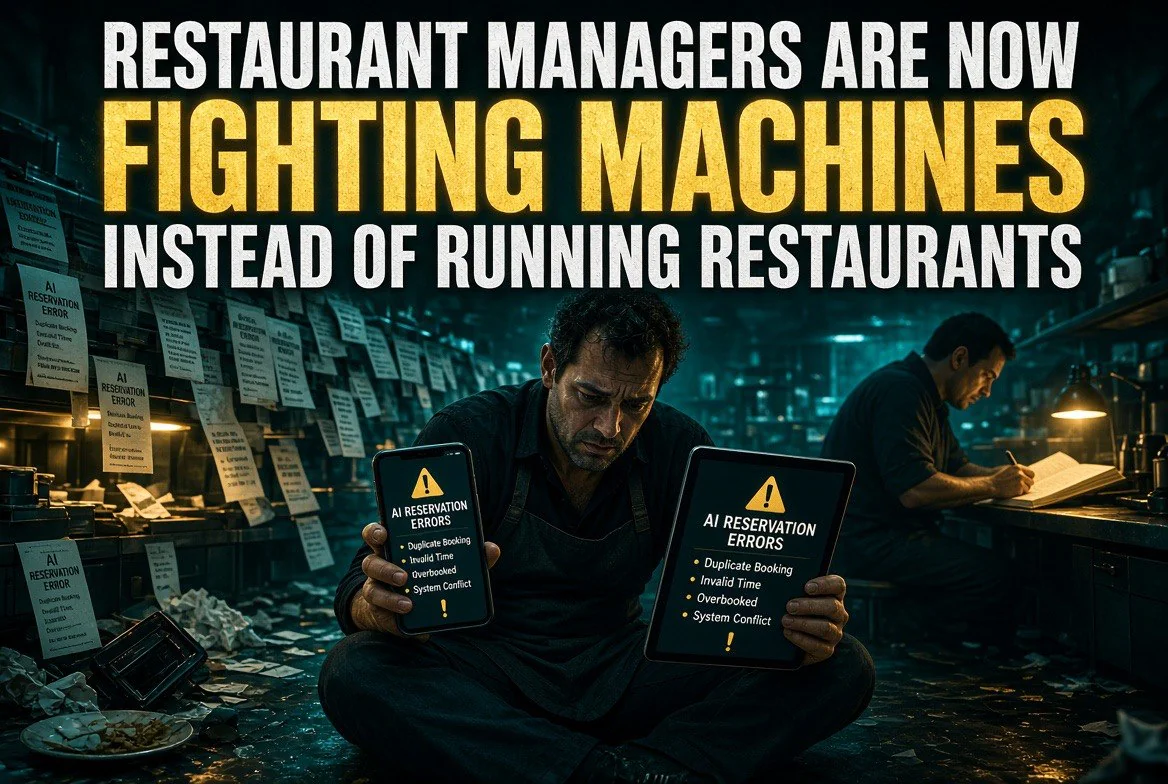
Restaurant Managers Are Now Fighting Machines Instead of Running Restaurants
⚡ Expert Summary: Your shift is being eaten by software that was sold to you as help. AI-written complaints arrive in identical seven-paragraph form, reservation bots take the tables before a real diner can tap, and the guide telling you which automation to buy was written by Toast and published as an article with Toast’s own product named inside it. Meanwhile the industry’s own survey says 3.2% of operators have implemented AI companywide and 48.8% name cost as the top obstacle. The automation is not being implemented. It is being marketed, at volume, to people who have a Friday service to run. The honest operators are quietly going back to a Sharpie and paper — and on the evidence, they are not being stupid.
Two things are happening to restaurant managers at the same time, and neither of them is the AI pitch.
The first is that the machines are in the way. Not running the restaurant — in the way. Fake complaints that arrive in near-identical paragraphs. Reservation scripts that strip the book before a human can book. Vendor content that reads like reporting and is actually an advertisement.
The second is the pitch itself. Every vendor says you are already behind. Every deck shows you the operators who are killing it with automation. Every trade article on the internet tells you the same five things to look for in a restaurant AI platform, and the article is sponsored by a restaurant AI platform.
Then you look at the actual numbers and find out almost nobody has done any of it. Not because they are lazy. Because they are running restaurants.
First: The Complaints Are Not Real
In San Francisco, an executive at a restaurant group described a pattern that every GM reading this will recognise instantly. As reported by Jay Barmann at SFist on 10 November, the complaints arriving through the regular channels had become impossible to tell apart. The executive, who is not named in the piece, described the arc of one: the guest would like to file a formal complaint, then a seven-paragraph email about how they had to wait for a table.
The line that matters is the short one: “They all sound the same.”
That is not a customer service problem. That is a volume problem. Somebody has figured out that a long, formally structured, mildly aggrieved email gets a comp, a call-back, or at minimum a rise out of a manager on a busy night. So they generate them, in bulk, in the voice of a customer who does not exist.
You cannot win this by being more responsive. Responsiveness is the exploit. Your front-of-house manager’s evening is now a triage queue for text written by a machine that feels nothing about the wait it is describing.
Worth stating plainly: the source is one anonymous executive at one group, reported by SFist this week. That is thin, and it is honest to say so. But it is not the only place the pattern shows up, and every operator who has read it has said the same thing — that they have had these emails.
Second: The Bots Are Eating Your Book
The reservation problem is better documented and it is worse, because it costs you covers directly.
Diners in that same reporting described the experience from the other side of the book. One said that “within two seconds, everything was gone.” Another was blunter: “I just don’t believe that every reservation booked in the 15 seconds before me was actually booked by the same human.”
Those are diner comments, not manager comments, and it is worth being precise about that. But read them as an operator and the mechanics are obvious. When a booking window opens and the inventory disappears faster than a human hand can move, the inventory did not go to humans. It went to whoever built the faster hand.
The tools exist, they are cheap, and they have a plausible story behind them — a heroic table-hunter who secures you the impossible reservation for a fee. Your side of that transaction is a full book at 8pm that never turns into covers, no-shows you cannot attribute, and regulars who gave up and stopped trying.
You pay for the bot twice. Once in the empty seat that was booked by nobody, and once in the regular who decided your restaurant is impossible to get into and stopped attempting.
Third: The Article Telling You What to Buy Was Written by a Vendor
This is the part that should make operators genuinely angry, and it involves a document you may have already read.
On 10 November, Restaurant Dive published a piece carrying the byline Tessa Zuluaga with a slugged sponsorship marker and a sponsor label above the fold. It is a guide to choosing restaurant AI tools. It was authored by Toast, and Toast’s own product is named inside it.
The sentences are remarkable because of what they assume you will not notice. On usage: “In Toast’s 2026 Restaurant AI Report, sales and revenue were the top topics operators raised in Toast IQ, accounting for 30% of all user-initiated threads.” On social proof: Jialin Chen, Store Manager at Nan Xiang Soup Dumplings in Pittsburgh, is quoted saying “In our experience, other AI tools can only provide generic advice, whereas Toast IQ provides analysis based on our actual sales, menu and operations.”
And then the detail that quietly reclassifies the whole piece: “Toast IQ is included in all plans… The Toast IQ Grow marketing solution (separate subscription required).”
Read the structure of that. The report about Toast’s usage is a report about Toast’s customers using Toast. It is a survey of people already inside the tent, presented to you as evidence about the market. The operator testimonial compares Toast to unnamed “other AI tools.” The product is included in all plans, except the part that does the marketing, which is not.
None of that is illegal. All of it is the thing you would flag in a menu if a supplier tried it — the “market price” that is set by the only person who knows the market.
The Numbers That Contradict Every Vendor Deck
Here is where the marketing and the reality part company. The National Restaurant Association released operator survey findings on 5 November. This is the industry’s own trade body asking its own members what they are actually doing, and the answers are brutal for anyone selling automation.
| What the survey found | What it means on a Tuesday night |
|---|---|
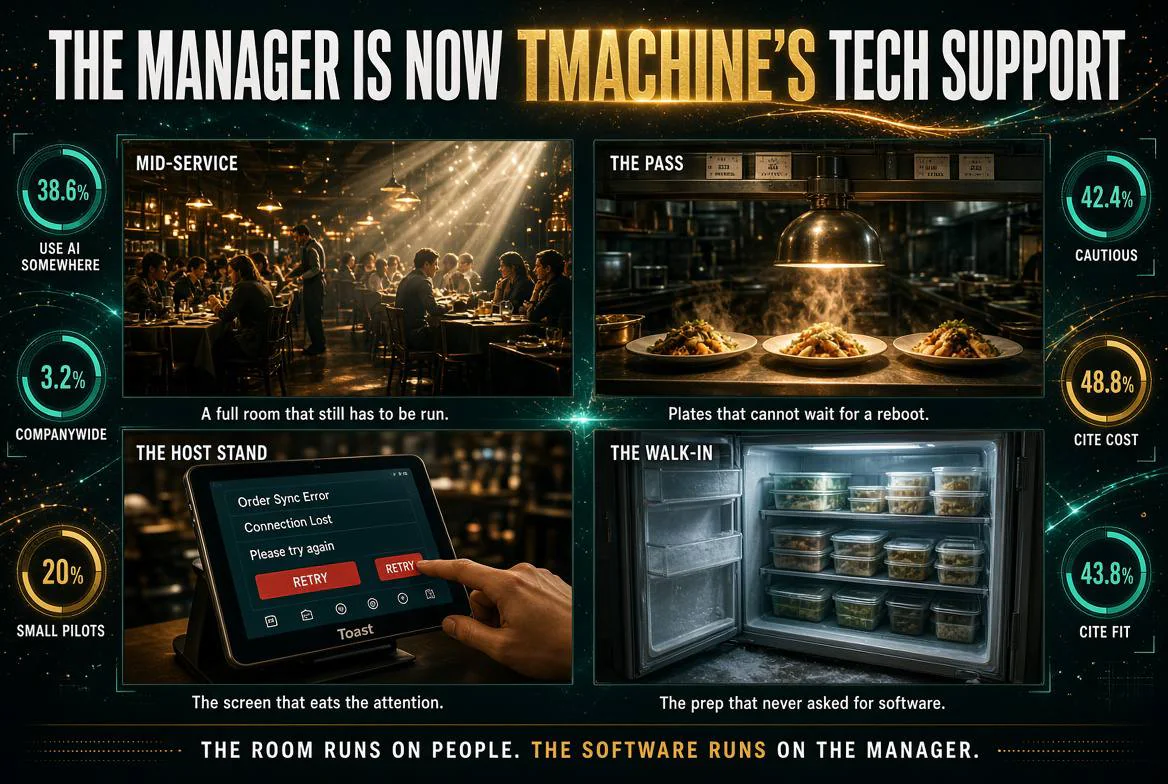
| 3.2% have implemented AI companywide | Roughly three in a hundred. The transformation everyone describes has barely started |
| 20% are running small pilots | The pilot is not the rollout. Most of those pilots will be quietly switched off |
| 38.6% use some AI tools | Using a tool somewhere is not running a restaurant on it |
| 42.4% describe themselves as cautious, 26.2% as excited | The cautious outnumber the excited nearly two to one |
| 48.8% name cost as the top obstacle | Labour is the constraint, not curiosity. Nothing here is free |
| Business fit 43.8%, workforce 41.3%, integration 38.8% | The next three obstacles are all the same obstacle: it does not fit our restaurant |
One honest caveat: the release did not publish a sample size. It describes a survey of operators nationwide and nothing more specific. Do not let anyone — including a vendor — quote it as if it were a census.
But the direction of the finding does not depend on the sample. Under four in a hundred at companywide level, nearly half blocked on cost, and the second-biggest obstacle being “business fit” — that is not an industry mid-transformation. That is an industry still deciding whether the whole category is worth the disruption.
The Operator Who Went Back to a Sharpie
The clearest voice on this came from Vancouver, and it was not a manager complaining about software. It was a manager refusing to participate in the pitch at all.
CBC reported on 9 November, in a piece by Akshay Kulkarni, on Kevin Thach of NaMi Vietnamese Cafe. Thach was clear: “We will NOT use AI to promote our business … we’re going old school and using a Sharpie and paper!”
Then he explained why, and the reason is the whole argument in one sentence: “Someone had to make that food behind the counter… there’s effort that gets put into it as well.”
And on AI-generated food imagery specifically: “How can you let that be displayed as your own food? … I never find it all too appealing or appetizing.”
That is not a technophobe. That is an operator who worked out that the thing being sold to him — cheap, fast, generated promotion — costs him the one asset a restaurant builds over ten years and cannot replace: the fact that what you see is what you get.
Note that this piece is thin on operators. SFist gave us one anonymous executive. CBC gave us one named chef. The NRA survey gave us percentages without a sample size. That is the actual state of the public record on this story, and it is worth being honest about rather than dressing it up with voices that do not exist.
Where the Automation Actually Works
Because it does work, in the right place, and pretending otherwise would be as dishonest as the sponsored guide.
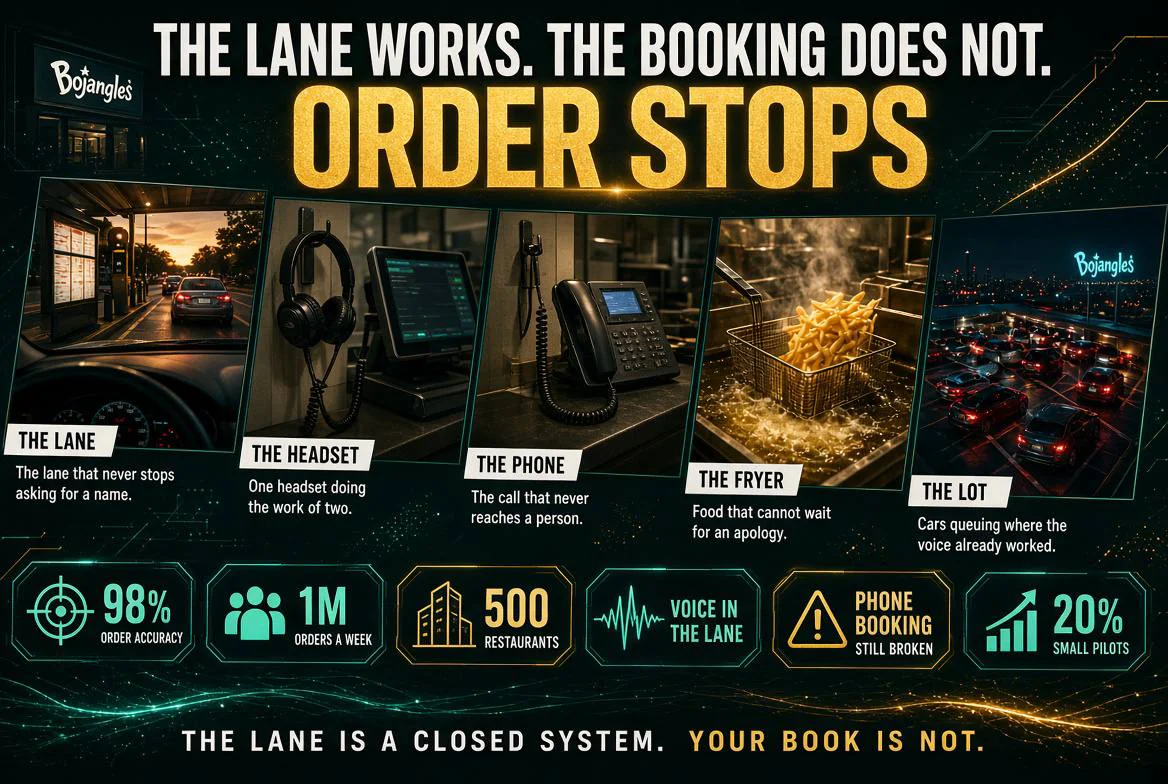
The strongest documented case this quarter is Bojangles with Hi Auto: roughly one million orders a week across about 500 restaurants at reported 98% accuracy, as covered by Aneurin Canham-Clyne at Restaurant Dive on 22 October. That is not this week, and the date matters — this is a mature deployment, not a current launch. But it is real, and it is the shape of a deployment that works.
Look at what it is: one narrow job, drive-thru order taking, at enormous volume, measured against a single hard number — order accuracy. Not a platform. Not a transformation. One task with a scoreboard.
That contrast is the honest map of the category. The automation that works is narrow, measurable and boring. The automation being marketed is broad, unmeasurable and expensive, and it is marketed to the 96.8% who have not yet implemented anything.
What This Costs You, and What to Do About It
| The machine problem | The move that actually helps | Who pays if you do nothing |
|---|---|---|
| Identical seven-paragraph complaints | Stop rewarding length. Comp from the reservation record, not from the essay | The manager on the floor, every busy night |
| Bots stripping the book in seconds | Deposits on peak slots, phone-only for the prime times, and watch the pattern by hand for two weeks | The regular who stopped trying to book |
| Vendor-authored “how to choose” guides | Read the byline and the sponsor label before the five tips. If the vendor wrote it, it is a menu | Your margin, on a subscription you did not price |
| The pressure to be “already using AI” | Buy one narrow job with a scoreboard. Not a platform. Not a suite | The labour hours the platform quietly adds back |
| The subscription creep after the pilot | Ask what the separate subscription costs before you sign the plan that “includes” it | Every month after the pilot quietly becomes permanent |
On pricing, be careful with the numbers. Toast IQ is stated as included in all plans, with the Grow marketing solution on a separate subscription. Comparable vendor packages sit in a broad range — SpotOn’s Profit Assist and Marketing Assist have been quoted in the roughly $40 to $150 per month band depending on location count — but that comes from vendor pricing pages and should be treated as a starting point for negotiation, not a market rate.
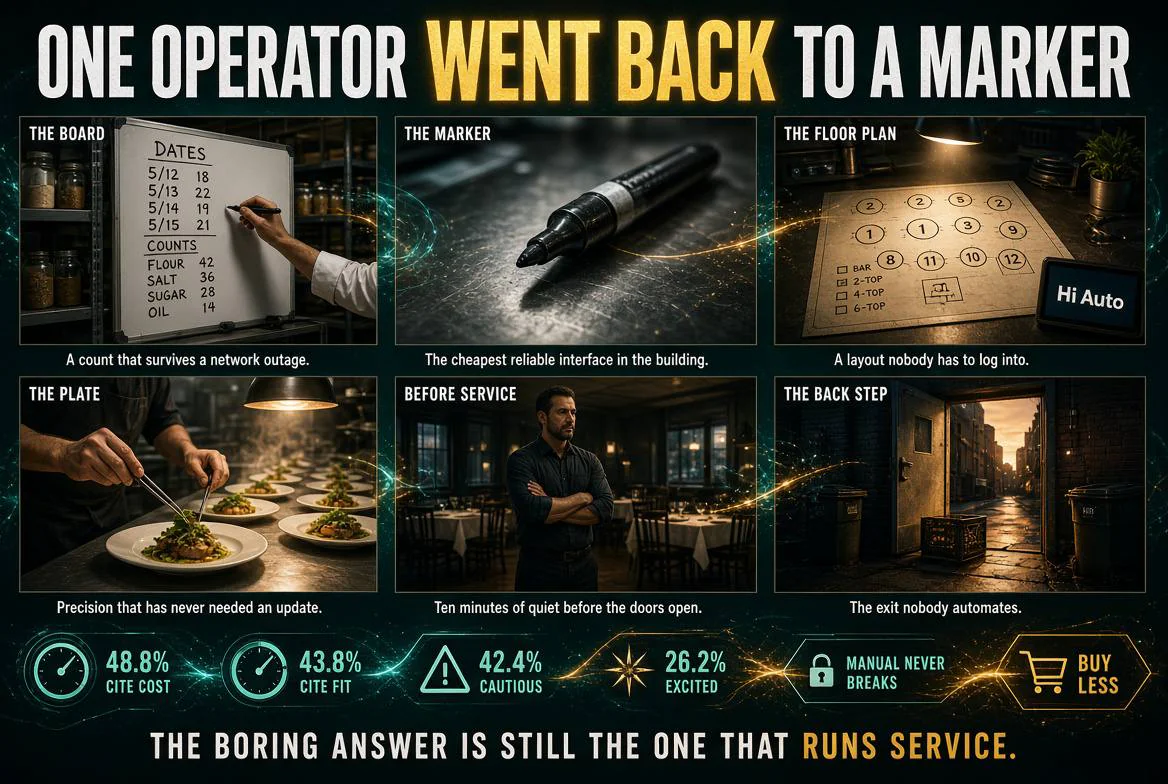
The discipline that saves money here is the same discipline that saves money on food cost. Buy the item, not the programme. Measure the thing you bought. Cancel it if the scoreboard does not move.
The Part Nobody Sells You
Every vendor deck has the same missing slide. It is the one showing what the manager’s evening looks like after the platform is installed.
The pitch assumes the time saved goes back to the operator. In practice, a new system takes the hours it takes to learn, the hours it takes to clean up when it gets something wrong, and the hours it takes to argue with a support queue while a service is running. That cost is real, it is unpaid, and it is never in the deck.
The operators surviving this period are doing something simpler than a transformation. They are protecting the parts of the business that cannot be automated — the food, the room, the regulars — and buying automation only where it carries a number they can check.
Kevin Thach is not behind. He has done the arithmetic and declined the deal. Three point two percent of the industry has done the full rollout. The gap between those two facts and the volume of the marketing is the actual story of restaurant AI in 2026.
Frequently Asked Questions
Is AI actually being used in restaurants, or is it all marketing?
Both, at different levels. The National Restaurant Association’s November findings put companywide implementation at 3.2%, with 20% running small pilots and 38.6% using some tools somewhere. The marketing volume is far ahead of the adoption reality.
Should I ignore every trade article about restaurant tech?
No, but read the byline and the sponsor label first. The 10 November Restaurant Dive guide to choosing restaurant AI tools was authored by Toast and names Toast IQ inside it, with a separate subscription flagged for the marketing product. Treat vendor-authored guides as menus, not reviews.
How do I stop AI-written complaints costing me comps?
Stop paying for length. Verify against the reservation record rather than the quality of the grievance, and treat structurally similar long complaints as a pattern to log rather than a guest to satisfy.
Are reservation bots really taking my tables?
Diners report peak inventory disappearing within seconds of opening, with at least one saying plainly they do not believe every booking in the preceding 15 seconds was made by a human. If your prime slots vanish instantly and turn into no-shows, the inventory is not reaching real guests.
What kind of restaurant AI does actually work?
The narrow kind with a scoreboard. Bojangles and Hi Auto at roughly one million drive-thru orders a week across about 500 restaurants, reported at 98% accuracy, is a single task measured against one hard number. That is what a working deployment looks like.
What is the real cost blocker for independent operators?
Cost is named by 48.8% of operators as the top obstacle and business fit by 43.8%. The subscription itself is only part of it. The bigger cost is the unpaid time to learn, fix and maintain a system during service.
Should I just go back to paper?
For the things paper does better, yes. A Sharpie on a chalkboard still beats a generated food image that misrepresents the plate. The judgement is which job the automation genuinely wins, not whether you are for or against AI.

About Barak Schurr
Barak Schurr built and exited a major ticketing platform, ran global operations at Eventbrite, and now focuses on one question: which AI tools actually help independent restaurant owners run leaner and grow faster. He writes from the operator’s perspective — no vendor spin, no theory, just what’s real in 2026.
Email: [email protected]
More Resources for Restaurant Operators