The Labor Department Just Handed Your AI Scheduler a Legal Loophole
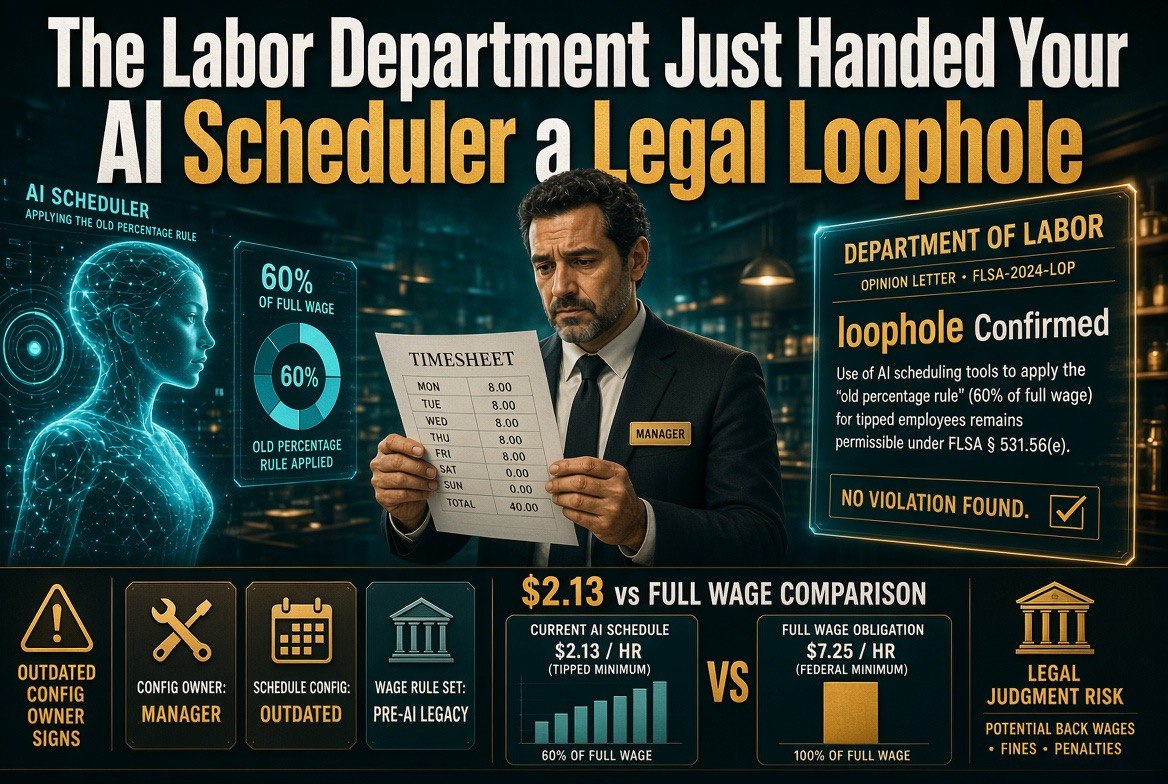
⚡ Expert Summary: On October 20, 2026, the U.S. Department of Labor withdrew three opinion letters from 1979, 1980 and 1985 covering tip credits for employees who work both tipped and nontipped jobs. It confirmed it will focus on whether duties relate to the tipped occupation, without a percentage-based limit on time spent on related nontipped work. The 80/20 rule is dead at the federal level. The federal tipped minimum remains $2.13 an hour. Workers in dual-job roles may be paid that rate only for time spent performing tipped work. Everything else requires at least full minimum wage. The bottom line: an AI scheduler now decides which hours count as tipped time, and the rule defining that line just changed. If your software was built against the old 80/20 standard, it is classifying your payroll using a regulation that no longer exists — and you sign the timesheet.
There is a version of this story where nothing bad happens. The Department of Labor removes three moldy opinion letters from the Carter and Reagan years, states plainly that they had the potential to be misread, and says it will write a fresh proposal with a public comment period. Nobody is fined. Nobody loses a job. The agency tidies its own paperwork.
And there is the version where your scheduling software is still calculating payroll against a rule a federal appeals court vacated two years ago, and you are the one who signs the timesheet.
Both versions are true. Only one of them shows up in your labor cost line.
What the Labor Department Actually Did
On October 20, 2026, the DOL announced it would rescind three decades-old opinion letters — published in 1979, 1980 and 1985 — addressing how the Fair Labor Standards Act applies to tipped employees who perform “dual job” roles. The agency said the documents no longer reflect its interpretation of federal law, and specifically that they had the potential to be misread.
The background matters, because this is the third time the rule has moved in eight years and each move has been in the opposite direction.
For decades, the DOL applied the 80/20 rule: if duties related to a tipped occupation took up more than 20% of an employee’s working time, the employer could not take a tip credit for those duties. The first Trump administration moved to drop it with a 2018 opinion letter, then a 2020 final rule that intended to scrap the standard entirely. That rule said employers could take a tip credit for related nontipped duties as long as they were performed contemporaneously with, or within a reasonable time immediately before or after, tip-producing activities.
The Biden administration reversed it and reinstated the 80/20 regulation. Then the Fifth U.S. Circuit Court of Appeals vacated that rule in 2024, holding it inconsistent with the FLSA’s text.
Now the DOL has withdrawn the old letters that the Biden-era rule leaned on, and says it will focus on whether a tipped employee performs duties related to their tipped occupation — without imposing any percentage-based limit on time spent doing related nontipped work. A new proposal is in process, with comments to come once published.
Here is the practical translation for a restaurant owner who does not want to read a field assistance bulletin: the percentage test that many scheduling tools were built around no longer exists at the federal level. What replaces it is a judgment about whether the work is related to the tipped occupation — which is exactly the kind of judgment software is worst at.
Where the AI Scheduler Enters the Story
Most independent restaurants do not employ a wage-and-hour specialist. They employ a general manager with eleven other jobs who uses a scheduling platform that came bundled with the POS.
That platform makes a classification decision every time it builds a schedule. When it books a server for a four-hour shift, it is assigning those hours to a tipped role. When it books the same server for two hours of prep before open — rolling cutlery, folding napkins, restocking — it is deciding whether those hours are tipped time or not. Under the old 80/20 framework, there was a percentage threshold that at least gave the software a rule to check against.
Remove the threshold and what remains is a question: is this duty related to the tipped occupation? A human can reason about it. So can a good lawyer. A scheduler that was configured in 2023 against a percentage test is not reasoning about anything. It is applying a rule that no longer governs, to hours you are legally responsible for.
And the stakes are not abstract. Employees in dual-job roles may be paid the federal tipped minimum of $2.13 an hour only for time they spend performing tipped work. For all other hours, they must be paid at least the full applicable minimum wage. State minimums are higher, and many are dramatically higher. In a state at $15 an hour, the gap between tipped and full minimum is $12.87 per hour, per person, per misclassified hour.
| Period | Federal Rule on Nontipped Time | What a Scheduler Must Decide |
|---|---|---|
| Pre-2018 | 80/20 rule — tip credit lost above 20% related nontipped time | A percentage, measurable in software |
| 2020–2021 | No percentage cap; duties allowed if contemporaneous with tipped work | Timing relative to tipped activity |
| 2021–2024 | 80/20 reinstated by Biden-era final rule | Back to a percentage |
| 2024 onward | Fifth Circuit vacated the rule — no percentage standard in effect | Nothing codified to check against |
| October 2026 | Old opinion letters withdrawn; relatedness test, no percentage limit | A judgment call, not a calculation |
Look at that last column. A scheduler can be programmed to count a percentage. It cannot be programmed to make a relatedness judgment, because the judgment is legal, not mathematical. So most systems will do one of two things: keep applying the dead percentage quietly because it is still in the config, or default to whatever the vendor hardcoded years ago and never revisited.
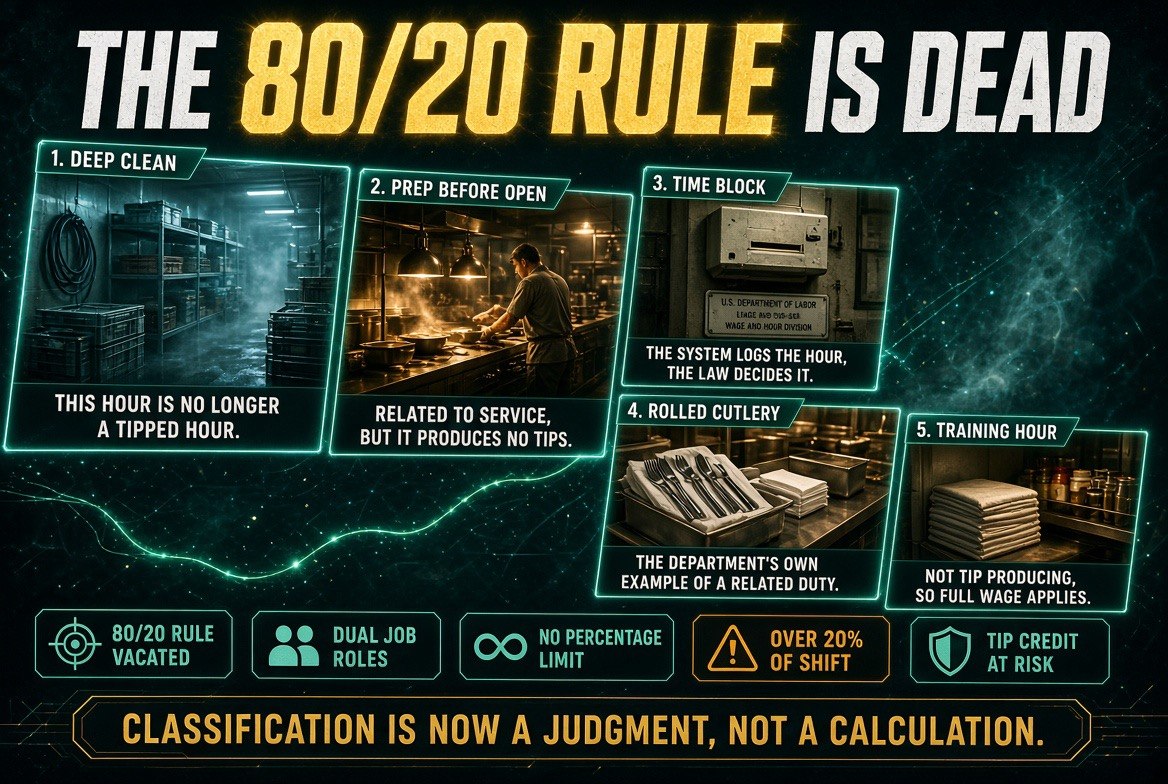
The percentage test is gone, so these duties no longer have a number to check against. Each of them now requires at least full minimum wage.
The Loophole Is Not Malice. It Is Momentum.
I want to be precise about where the loophole comes from, because the lazy version of this article blames a federal agency for being generous to employers.
The DOL’s stated reasoning is coherent. The Fifth Circuit held that the Biden-era rule was inconsistent with the FLSA’s text. The old opinion letters were cited as part of the justification for reviving 80/20. If the rule fell and its supporting letters had the potential to be misread, withdrawing them is housekeeping, not deregulation.
But a rule can be legally sound and operationally dangerous at the same time. The gap between what the law now says and what your payroll software was configured to believe is where wage claims live. And that gap does not close when the DOL publishes a bulletin. It closes when somebody updates the software, or when somebody audits the timesheet.
That is the actual loophole: not a legal permission, but a maintenance gap. The regulation moved three times in eight years. Software integration cycles do not run that fast. Every restaurant running a scheduler built, configured, or sold during the 80/20 years is potentially classifying hours under a rule that is no longer in force, and nobody is required to tell them.
The federal tipped minimum has been $2.13 an hour since 1991. Three decades of technological change have run on top of a number that has not moved. Whatever your scheduler decides, it is deciding against a legal floor that predates the smartphone.
What This Looks Like in an Actual Restaurant
Concrete example, and I am choosing a boring one on purpose because boring is how wage claims start.
A server is scheduled 4:00 p.m. to 10:00 p.m. Doors open at 5:00. From 4:00 to 5:00 they roll cutlery, fold napkins, fill condiments, and wipe down tables. Those are duties related to a tipped occupation, performed right before service, but they produce no tips. Under the old 80/20 test, a manager had a percentage to check: if that hour was under 20% of the shift, the tip credit held. Most systems handled this by simply not counting prep separately — the whole shift was one tipped block.
Now there is no percentage. The question is whether the duties are related to the tipped occupation. The DOL’s own example — a waitress cleaning and setting tables or making coffee — suggests related duties can stay in the tipped occupation. So in many cases nothing changes, and the same payroll passes.
But consider the same server assigned an hour of deep-cleaning the walk-in, or restocking the liquor cage, or training a new hire. Those duties are further from the tipped occupation. Under a relatedness test, a plaintiff’s attorney gets to argue about where the line sits, and the honest answer is that reasonable people could disagree — which is exactly what a court case is.
Multiply that ambiguity across a staff of thirty, over two years of back-pay exposure, in a state with a $15 minimum, and the arithmetic stops being theoretical. The scheduler made the same call every week without documenting why. You signed every timesheet.
| Task Assigned to Tipped Staff | Distance From Tipped Work | Documentation You Want |
|---|---|---|
| Rolling cutlery, folding napkins before service | Close — DOL’s own example of related duty | Time block logged separately |
| Making coffee, setting tables | Close — explicitly listed by DOL | No action needed beyond schedule record |
| Deep-cleaning walk-in, restocking storage | Farther — arguable under relatedness | Separate duty code, full minimum rate |
| Training a new hire | Farther — not tip-producing | Paid at full minimum, documented |
| Anything with no tip attached and no paper trail | Where claims are built | Your only defense is the record |
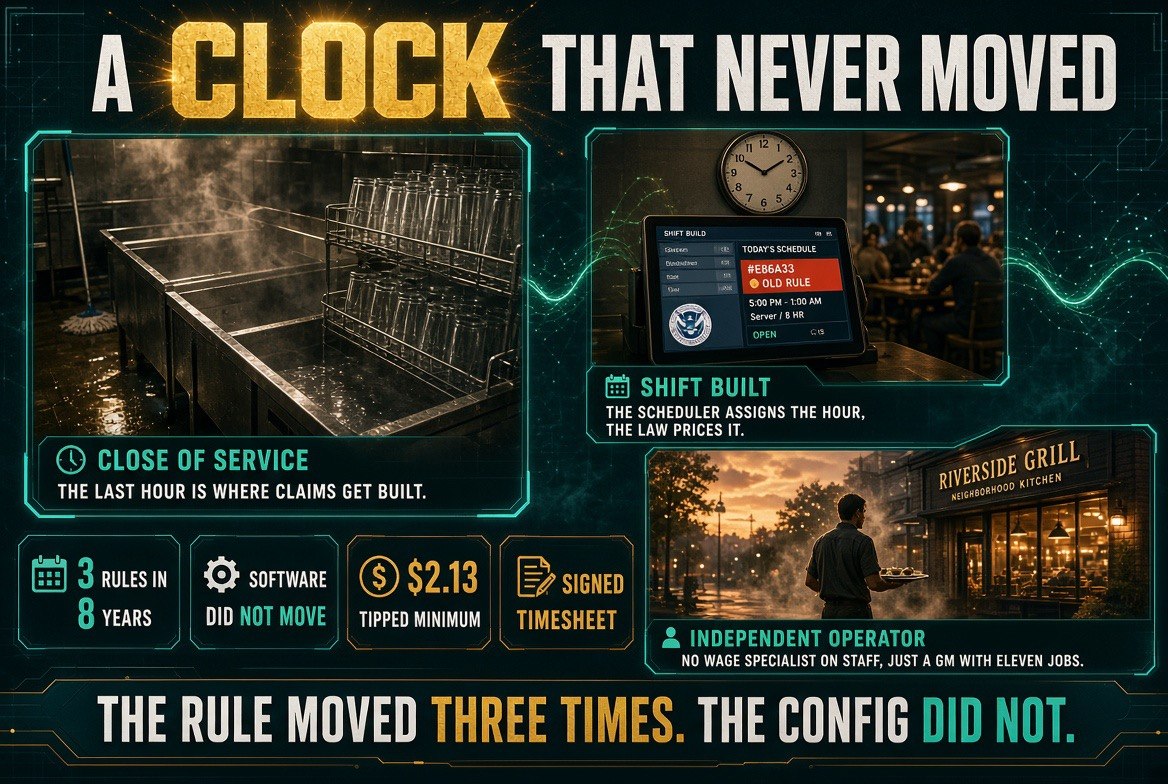
The federal tipped minimum has held at $2.13 since 1991. The rule above it changed three times in eight years; the software underneath it did not move at all.
What to Do Before the New Proposal Lands
The DOL has confirmed it is drafting a new proposal and will take comments. That means the rule will move again. Whatever you configure today should be built to survive another change, which means it should not depend on a percentage that has now been created and destroyed twice.
Ask your scheduling vendor one direct question. Not “are you FLSA compliant” — everyone says yes. Ask: in our current configuration, how does the system classify nontipped duty time, and what rule is that based on? If the answer references the 80/20 test, you have your problem in writing.
Stop letting the scheduler be the only record. The system makes a classification and forgets why it made it. A one-line note per shift — what duty, what rate, who approved it — takes seconds and is the document you will want if a claim arrives two years from now.
Separate far-from-tipped duties into their own codes and pay them at full minimum. Deep cleaning, storage restocking, and training are the tasks most likely to be argued about. Paying them at full minimum costs less than arguing about them later, and it removes the entire question for those hours.
Check your state before your software. Several states never adopted the federal framework and have their own dual-job and tip-pool rules that are stricter. A scheduler configured for the federal standard is not compliant in those states, and the federal change does not loosen state law.
Treat the comment period as your one free shot. When the new proposal publishes, small operators can submit comments. Few do. The people who show up to those proceedings are the vendors and the trade associations, and their interests are not identical to yours.
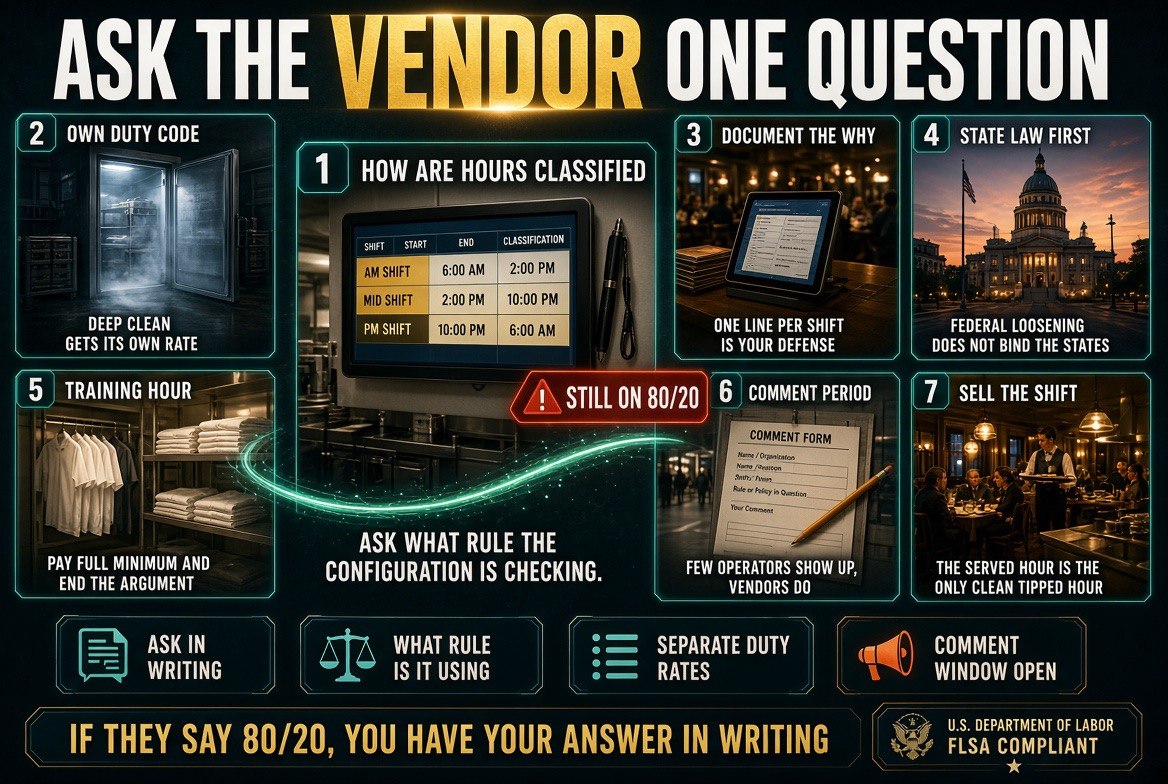
Seven checks that fit in one conversation with your vendor. The first answer to write down is which rule the configuration is actually using.
The Real Question
The story you will read elsewhere is that the Labor Department made it easier to pay tipped workers $2.13 an hour. That framing is not quite right, and the accurate version is more useful to you.
What the DOL did was remove a percentage test that had already been vacated by a federal appeals court, and replace it with a relatedness standard. For many restaurants, most shifts will look the same as before. For some, at the margins — a slow Tuesday, a training hour, a deep clean — the classification is now a legal judgment rather than an arithmetic one.
The loophole is not in the statute. It is in the lag between a rule that changed and software that did not. An AI scheduler is very good at optimizing labor against a rule it was told. It has no opinion about whether that rule still exists.
Which leaves the accountability exactly where it started: with the person who signs the timesheet. The federal tipped minimum is $2.13 an hour, it has not changed since 1991, and no algorithm is going to take the fall for getting it wrong.
Frequently Asked Questions
What did the Labor Department change on October 20, 2026?
The DOL withdrew three opinion letters from 1979, 1980 and 1985 on tip credits for employees in dual-job roles, stating they no longer reflect its interpretation of federal law. It said it will focus on whether duties relate to the tipped occupation without imposing a percentage-based limit on related nontipped time.
Is the 80/20 rule still in effect?
Not at the federal level. The Fifth U.S. Circuit Court of Appeals vacated the Biden-era rule that reinstated 80/20 in 2024, and the DOL has now withdrawn the older opinion letters that supported it. Some states have their own percentage or dual-job rules that still apply.
How much must a tipped worker be paid?
The federal tipped minimum wage is $2.13 an hour, but it applies only to hours spent performing tipped work. Employees in dual-job roles must be paid at least the full applicable minimum wage for all other hours, and many states set a higher tipped minimum than the federal figure.
Does an AI scheduler create wage-and-hour liability?
The software classifies hours as tipped or nontipped and applies rates accordingly. If it was configured against a rule that has since been vacated, it may classify time incorrectly. The employer remains responsible for the payroll, so the liability sits with the restaurant, not the vendor.
What should I ask my scheduling software vendor?
Ask how the system classifies nontipped duty time in your specific configuration, and what legal rule that classification is based on. If the answer references the 80/20 percentage test, the configuration predates the current federal position and needs review.
Will the rule change again?
Yes. The DOL confirmed it has begun a new proposal on tip credits for dual-job workers and will accept comments once it is published. The standard has changed three times since 2018, so any configuration should avoid depending on a specific percentage.

About Barak Schurr
Barak Schurr built and exited a major ticketing platform, ran global operations at Eventbrite, and now focuses on one question: which AI tools actually help independent restaurant owners run leaner and grow faster. He writes from the operator’s perspective — no vendor spin, no theory, just what’s real in 2026.
Email: [email protected]
More Resources for Restaurant Operators