98% Accuracy Means 20,000 Wrong Orders a Week
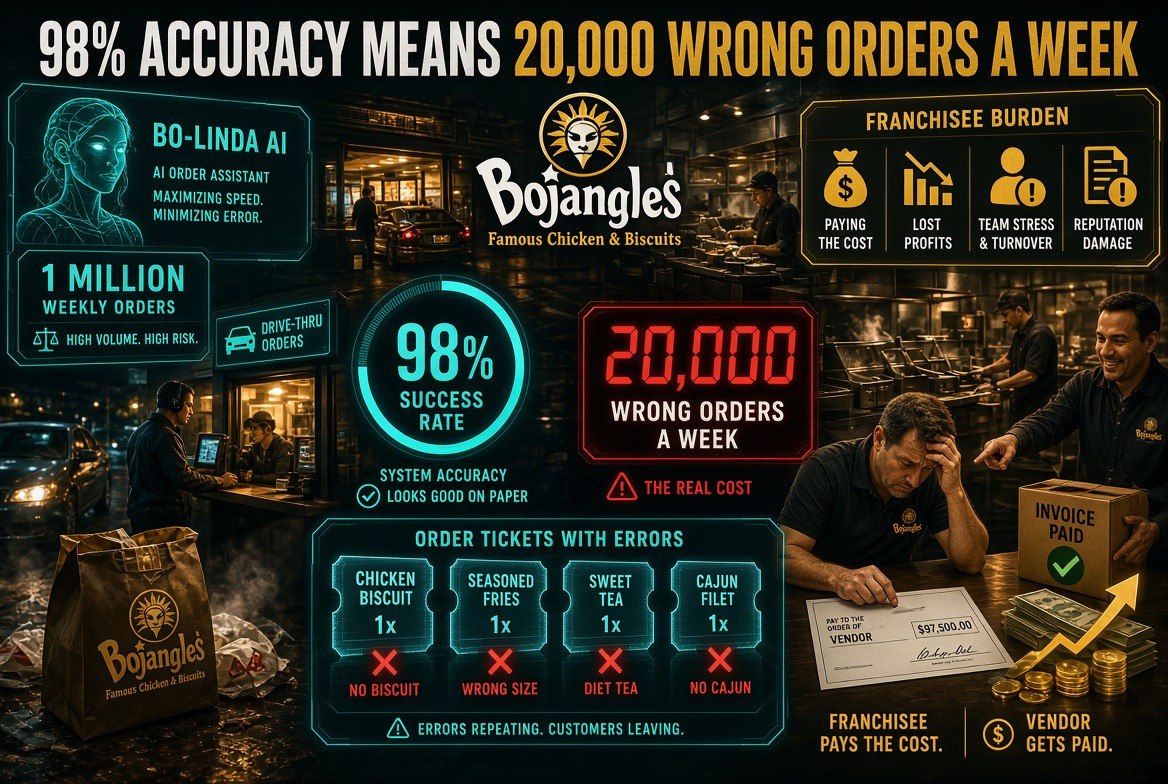
⚡ Expert Summary: Bojangles told investors, reporters and its own franchisees that its AI drive-thru, Bo-Linda, processes more than 1 million orders a week at “a 98%, or better, success rate.” Run the arithmetic: 2% of one million is 20,000 orders a week. Nobody in the announcement defined what “success” means, who audits it, or what happens on the other two percent — the remake, the refund, the walk-away. The vendor gets paid on the number. The franchisee eats the errors.
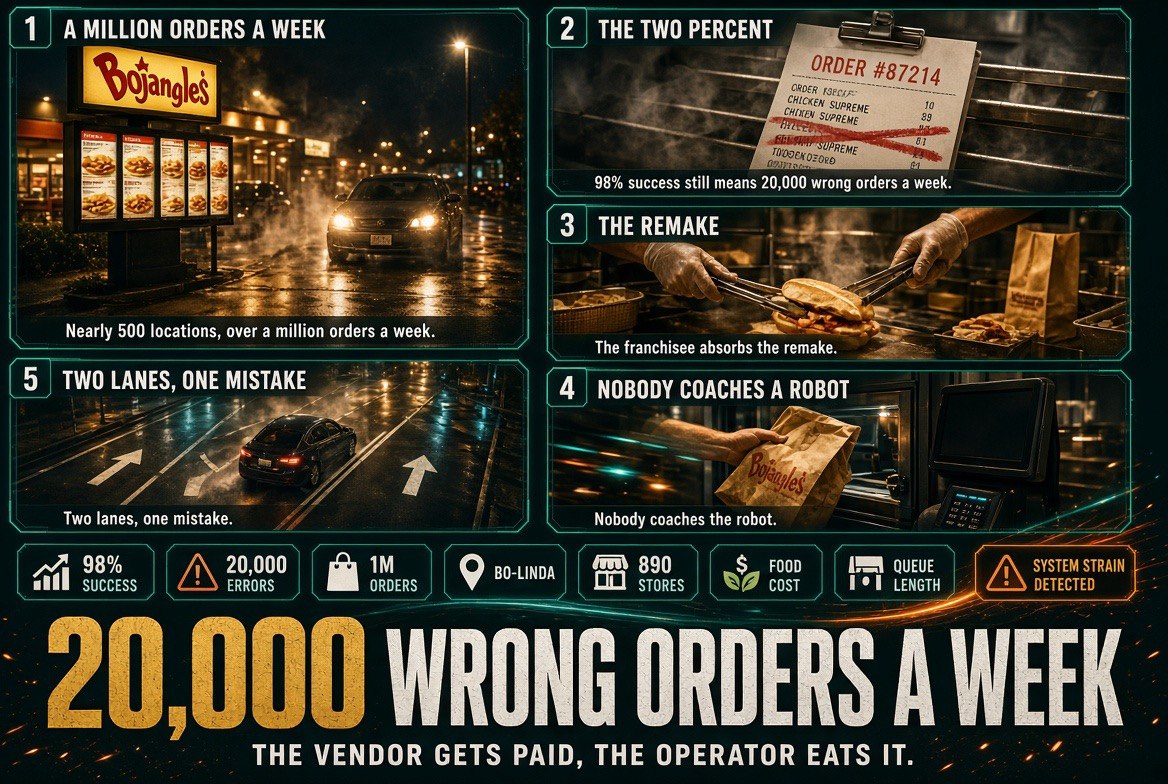
One million orders a week at 98% accuracy. That is the sentence Bojangles put in front of the restaurant industry on Thursday, and it is the sentence every franchisee in the system will repeat at their next operators’ meeting.
Now do the napkin math. Two percent of one million is 20,000. Twenty thousand orders a week, roughly 2,857 a day, that the system got wrong by its own definition.
That number does not appear in the announcement. Not once.
The Number, As It Was Actually Given
Richard Del Valle, Bojangles’ CIO and chief of staff, gave the figure in the press release: “Bo-Linda now processes more than a million orders a week across our system at a 98%, or better, success rate. This has given us the confidence to continue and expand Bo-Linda.”
Hi Auto and Bojangles have worked together since 2024, when they launched the drive-thru AI tool they are now expanding. The new multi-year extension adds 100 more locations by mid-2027, which would put Bo-Linda in roughly two-thirds of the chain’s 890 restaurants.
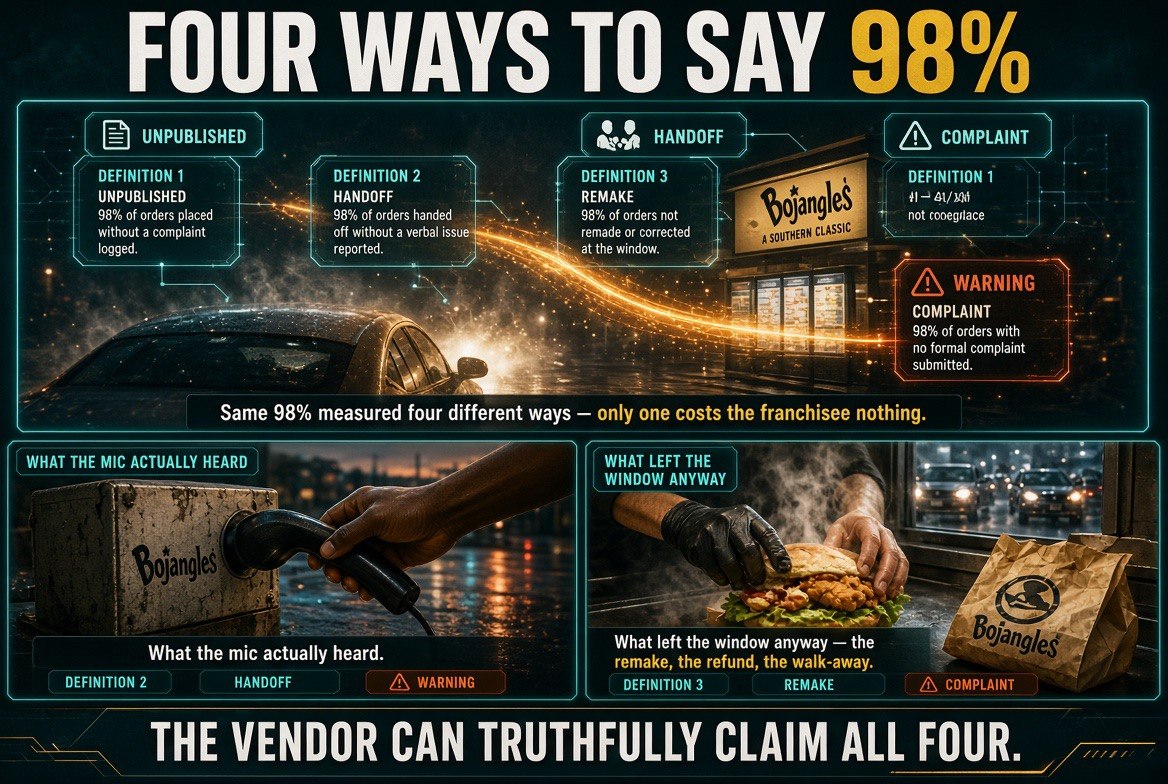
Here is what nobody has said publicly: what counts as a success. Is it an order that reached the kitchen with the correct items? An order the customer did not have to repeat? An order the system itself did not have to hand off to a human? An order that produced a sale at all, regardless of whether it was the item the customer asked for?
Those are four different metrics. The gap between the worst and the best of them is where 20,000 errors a week lives or dies.
| What “Success” Could Mean | What It Hides | Who Pays When It Fails |
|---|---|---|
| Order reached the kitchen correctly | Nothing — this is the real number | Franchisee |
| Order was completed by a human without a complaint | Handoffs, repeats and quiet corrections | Franchisee |
| Order produced a completed transaction | Wrong items that the customer accepted anyway | Franchisee |
| Order was not escalated to a manager | Every dissatisfied customer who just drove off | Franchisee, twice |
A vendor can truthfully report 98% against any of those four. Only the first one costs the franchisee nothing.
What the Other Two Percent Actually Costs
Walk through a single failed order in a drive-thru that has no cashier to catch it.
A customer pulls up and orders a Cajun chicken sandwich combo, no pickles, with a sweet tea. The system hears it. The kitchen makes it with pickles. The customer opens the bag a mile down the road and either throws the pickles off and eats it angry, or turns around and comes back.
If they come back: a remake at food cost, a moment of labor at the window, an apology, and a queue of six cars behind them now watching the line stall. If they do not come back: a one-star review, a lower revisit probability, and a customer who now tells people the Bojangles drive-thru gets orders wrong.
None of that lands on Hi Auto’s P&L. All of it lands on the operator who pays the franchise fee, the build-out, the wages, and the rent — and who now has a robot at the window whose errors they cannot coach.
That is the structure of every voice AI deal in this industry. The vendor is paid for deployment. The operator absorbs the variance.
This Is Not a Bojangles Problem. It Is a Category Problem.
The record on drive-thru voice AI is not clean, and the failures are public.
McDonald’s IBM test struggled with order accuracy and ended badly enough that the chain has since built its own system, Archy, as part of its Next strategy. Taco Bell’s rollout became a case study in absurd edge cases — the BBC reported last year that an order for 18,000 waters contributed to an AI strategy rethink at the chain. Dairy Queen has given some franchisees access to Presto’s voice ordering tech. Taco Bell continues with Omilia.
Against that backdrop, Bojangles’ 98% reads as the strongest claim in the category. It may well be true. But a category with this record owes operators a definition behind its headline number, and so far the number has arrived without one.
| Brand | Voice AI Status | Public Accuracy Number |
|---|---|---|
| Bojangles | Bo-Linda at ~500 stores, +100 by mid-2027 | 98% “or better,” undefined |
| McDonald’s | IBM test discontinued; building Archy in-house | Not published |
| Taco Bell | Rolling out via Omilia | Not published |
| Dairy Queen | Some franchisees on Presto | Not published |
Only one of those four rows contains a number, and it is the row where the number is least defined.
The New Features Tell You What the Old Ones Missed
The extension is not just more stores. It brings specific capabilities, and each one is an admission about the previous version.
Queue-aware upselling.
Bo-Linda now adjusts recommendations based on drive-thru queue length — pushing quick-to-prepare items when the line is long, and slower, higher-margin items when it is slack. The existing upsell logic already weighs daypart, weather and inventory.
That is a smart feature for the operator’s average ticket. It is also a system that now decides when to slow your kitchen down. When the line is long, the AI sells the item that keeps the line moving; when nobody is waiting, it sells the item that takes the most labor but earns the most. That is textbook revenue management, and it is exactly the kind of optimization a human cashier would never have the bandwidth to run. It is also a decision that lives in the vendor’s model, not in your store’s judgment.
Vehicle-photo order pairing.
Dual-lane drive-thrus have a chronic problem: two cars order, the lanes merge, and two orders arrive at the window with nobody sure which is which. Bo-Linda now pairs each order with an image of the car that placed it, so staff can verify at the merge point.
Read that feature as a confession. If the accuracy number were computed at the point of order, lane mix-ups would not be the failure mode worth engineering around. The fact that the vendor built vehicle-image matching means the errors that reached the window were real enough to fix.
Global Payments Genius integration.
The new agreement includes an upgraded payment integration, moving Bo-Linda deeper into the transaction layer.
Each of these is genuinely useful. None of them is a definition of accuracy.
The Counter-Argument, Stated Fairly
Hi Auto is not a startup selling a demo. The company says it serves more than 1,000 stores across the U.S., United Kingdom and Australia, with clients including Checkers & Rally’s, Lee’s Famous Recipe Chicken, Burger King in New Zealand and Popeyes in the U.K. Bojangles has run this system since 2024 and is choosing to expand it, not test it — from roughly 50 stores at pilot to nearly 500 today, heading for two-thirds of the footprint.
Del Valle’s own framing is that Bo-Linda is “a rare tool that improves the guest and employee experience at the same time,” and that the success rate gave the chain “the confidence to continue and expand.” A CIO at a publicly traded chain putting his name to a number he was not required to disclose is not nothing.
But confidence is not audit. The chain has not published order-level error rates, the cost of remakes, how often a human has to take over, or the customer complaint trend at AI stores versus non-AI stores. Until those exist, 98% is a marketing number with a decimal point’s precision and no denominator.
What an Operator Should Ask Before Signing
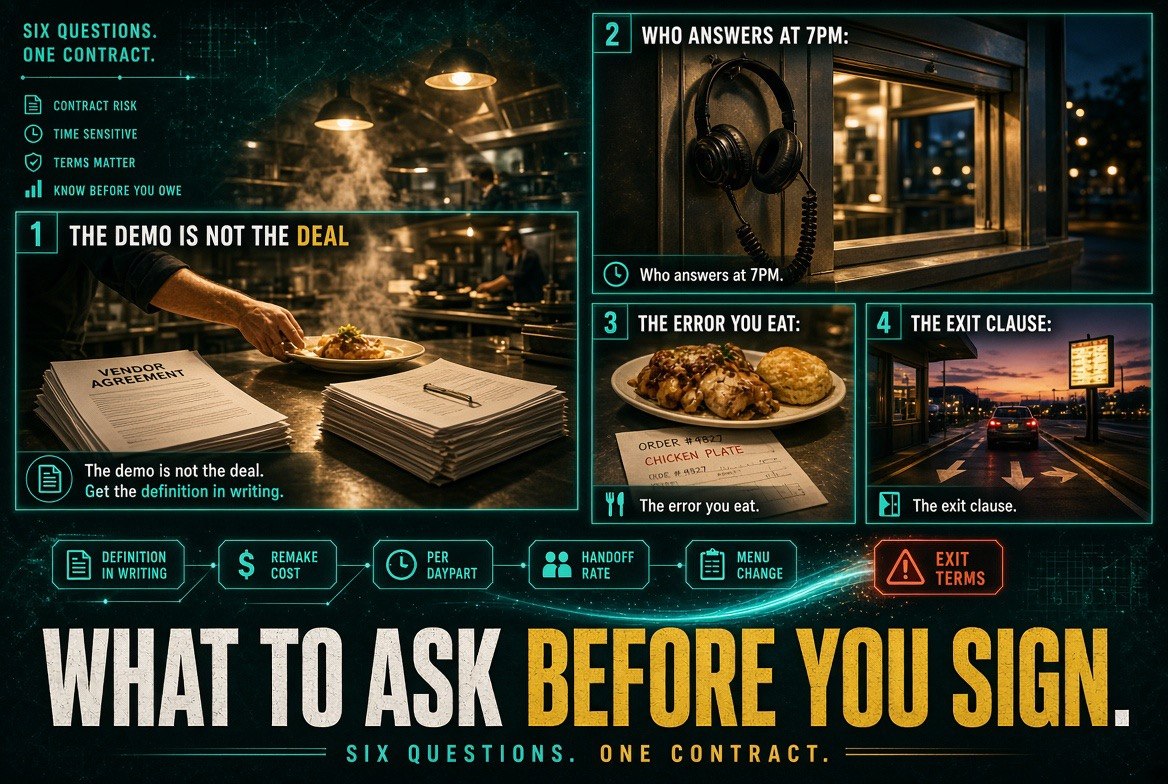
If you are a franchisee being offered voice AI — this one or another — the deal is not in the pilot. The pilot is designed to succeed. The deal is in the contract terms around failure.
Ask for the definition in writing.
“Success rate” must be specified: at order capture, at payment, or at handoff. Get the definition appended to the agreement, not stated in a call.
Ask who owns the error cost.
Remakes, refunds, voids and comps during a pilot. If the vendor’s number is 98% and your food cost variance does not match, you are funding their accuracy.
Ask for per-lane and per-daypart numbers, not a system average.
A system that is 99% at 11 a.m. and 92% at 7 p.m. is not a 98% system. It is a system that fails when you can least afford it.
Ask how escalation works.
When the AI hands off to a human, is that counted as a success or a failure? In most vendor decks it is a success. In your labor schedule it is a cost.
Ask what happens at 3 a.m. and during a menu change.
Bundles, LTOs, and limited availability are where speech recognition breaks. A number measured on a stable menu tells you nothing about the week your chain launches a new sandwich.
Ask about the exit.
Multi-year extensions are how these deals scale. What is the unwind clause if your error rate diverges from the system average?
The Real Question
Bojangles’ announcement is good news framed as a hardware story: more stores, better upsell, smarter lanes, tighter payments. Under the framing sits an unexamined number that every franchisee in that two-thirds is now exposed to.
20,000 orders a week. That is the figure behind the headline, derived from the company’s own arithmetic, at the company’s own success rate.
The question worth asking is not whether voice AI works. It clearly does, most of the time. The question is who is holding the 2% — and in the current structure of these deals, it is the person who already owns the building, the payroll, and the chicken.
Until a vendor publishes an audited, defined, per-daypart error rate, a franchisee signing a multi-year extension is trusting a number whose definition they have never seen.
Ask for it in writing. Then watch the food cost line.
Frequently Asked Questions
What did Bojangles announce?
Bojangles extended its partnership with Hi Auto, the vendor behind its AI drive-thru ordering system Bo-Linda, and will add 100 more locations by mid-2027. Bo-Linda currently runs in nearly 500 of the chain’s roughly 890 restaurants.
What is the 98% accuracy claim?
CIO Richard Del Valle said Bo-Linda processes more than one million orders a week at “a 98%, or better, success rate.” Bojangles has not publicly defined what counts as a success.
How many wrong orders is that?
At 98% on one million orders, two percent is 20,000 orders a week — about 2,857 a day if spread evenly across the week.
Who is Hi Auto?
Hi Auto is a Tel Aviv-based voice AI vendor. The company says it serves more than 1,000 stores across the U.S., the U.K. and Australia, with clients including Checkers & Rally’s, Lee’s Famous Recipe Chicken, Burger King New Zealand and Popeyes U.K.
How long has Bojangles used Bo-Linda?
Since 2024. The system was piloted at roughly 50 locations before being deployed across hundreds of company-owned and franchised stores.
What new features come with the extension?
Queue-length-aware upselling that prioritizes fast-to-prepare items during busy periods, vehicle-photo pairing so staff can match orders when dual lanes merge, and an upgraded Global Payments Genius integration.
Has voice AI worked for other chains?
Unevenly. McDonald’s discontinued its IBM voice AI test after accuracy problems and is building an in-house system called Archy. A Taco Bell order for 18,000 waters reportedly contributed to an AI strategy rethink at that chain.
Is 98% good for drive-thru voice AI?
It is the strongest number publicly claimed in the category. Whether it is good depends entirely on the definition, which has not been disclosed.
What should a franchisee ask before signing?
The written definition of success, who absorbs remake and refund costs, per-daypart and per-lane accuracy, how human handoffs are counted, and the unwind clause if error rates diverge from the system average.
Does this mean voice AI is a bad idea for independent restaurants?
No. It means the contract matters more than the demo. Accuracy claims without a definition transfer the risk from the vendor to the operator, and that is the term to negotiate.
About Barak Schurr
Barak Schurr built and exited a major ticketing platform, ran global operations at Eventbrite, and now focuses on one question: which AI tools actually help independent restaurant owners run leaner and grow faster. He writes from the operator’s perspective — no vendor spin, no theory, just what’s real in 2026.
Email: [email protected]
More AI Resources for Your Business