How Restaurant Managers Actually Use AI: What Toast IQ Data Shows
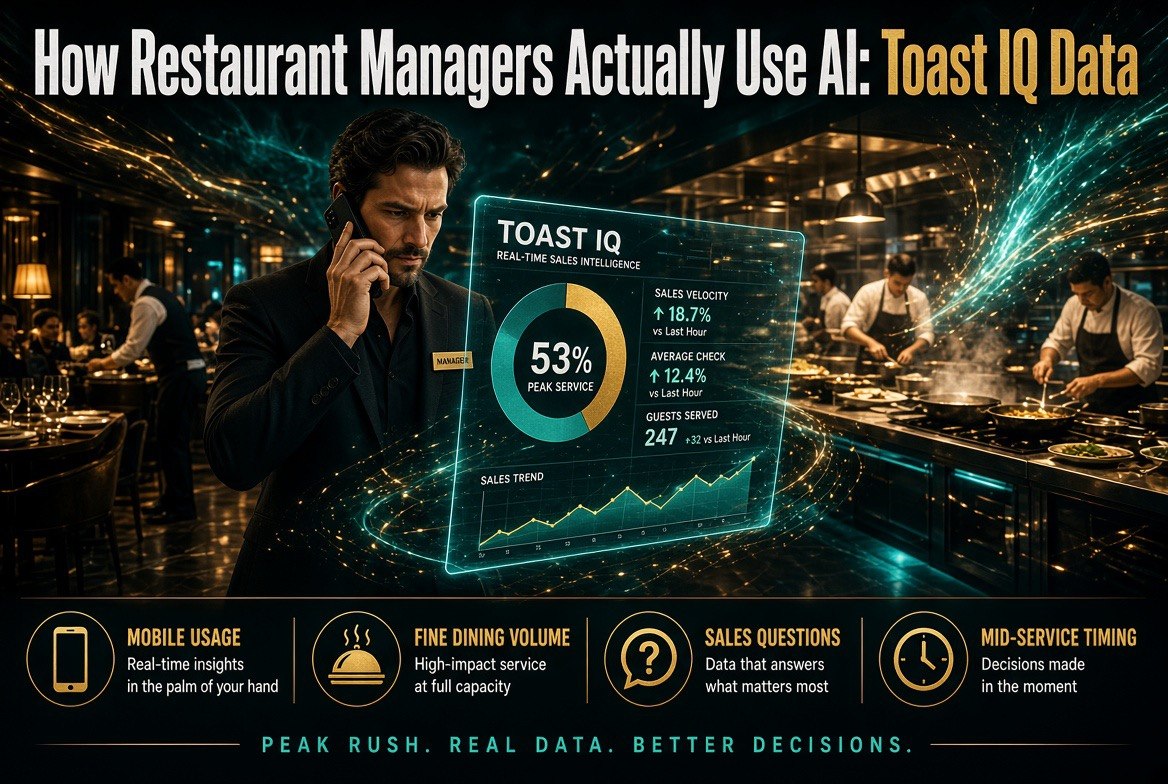
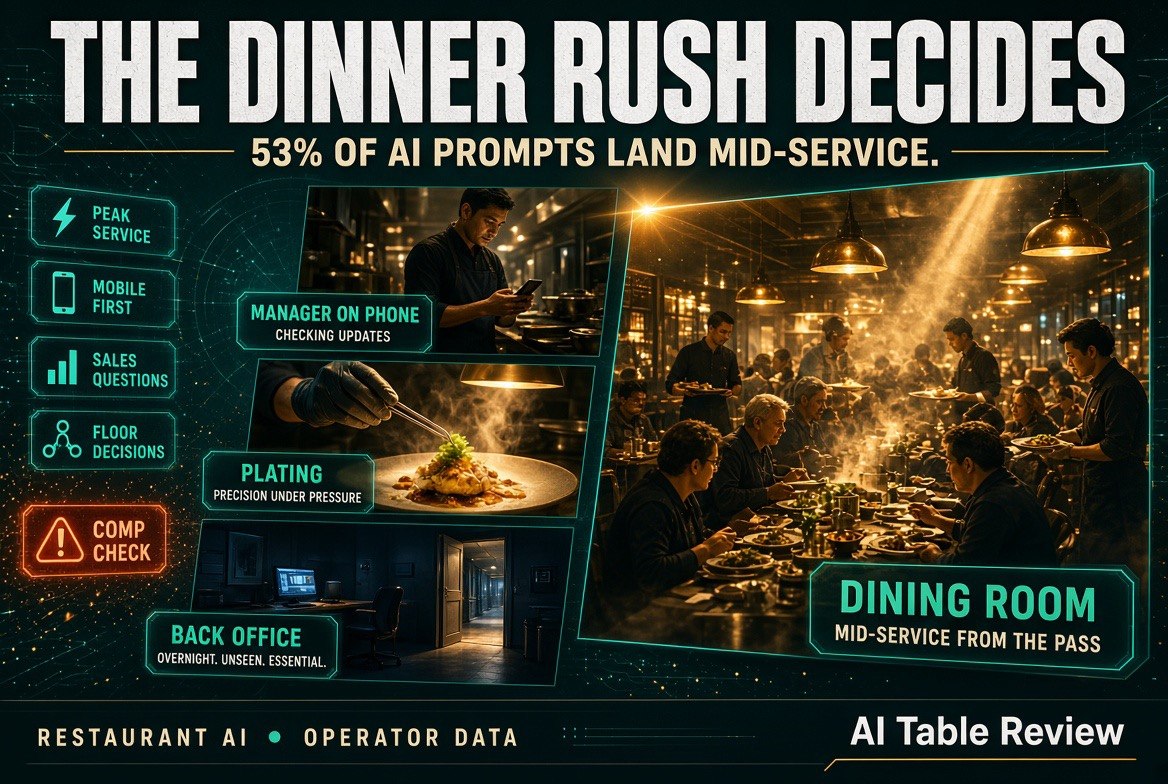
⚡ Expert Summary: Toast’s Q2 2026 Restaurant AI Report pulled aggregated, anonymized data from Toast IQ across April through June. The headline finding is timing, not technology: 53% of manager prompts landed during peak lunch or dinner service. Fine dining managers sent 67% more prompts per location than fast casual. Sales questions dominated at 30% of all threads, and 54% of interactions started on a phone. Managers are not using AI to write reports after the fact — they are checking numbers while there is still a shift to save.
Most restaurant AI coverage is about what a tool can do. Almost none of it is about what operators actually type into it at 7:15 on a Friday night. Toast’s report answers that second question, and the answer is more useful than any vendor demo.
What the Report Measured
The 2026 Restaurant AI Report draws on aggregated, anonymized prompt data from Toast IQ — the AI assistant built into the Toast platform — covering April 1 through June 30, 2026, for U.S. restaurant locations only. Retail locations are excluded.
One caveat matters before any number below: the report analyzes prompts, not outcomes. It does not measure whether any resulting action was completed. When it says managers requested an item be marked out of stock, that means the request was typed into chat — not that it was confirmed saved. Treat every figure as evidence of intent, not of execution.
The Headline Finding: AI Is Used Mid-Service
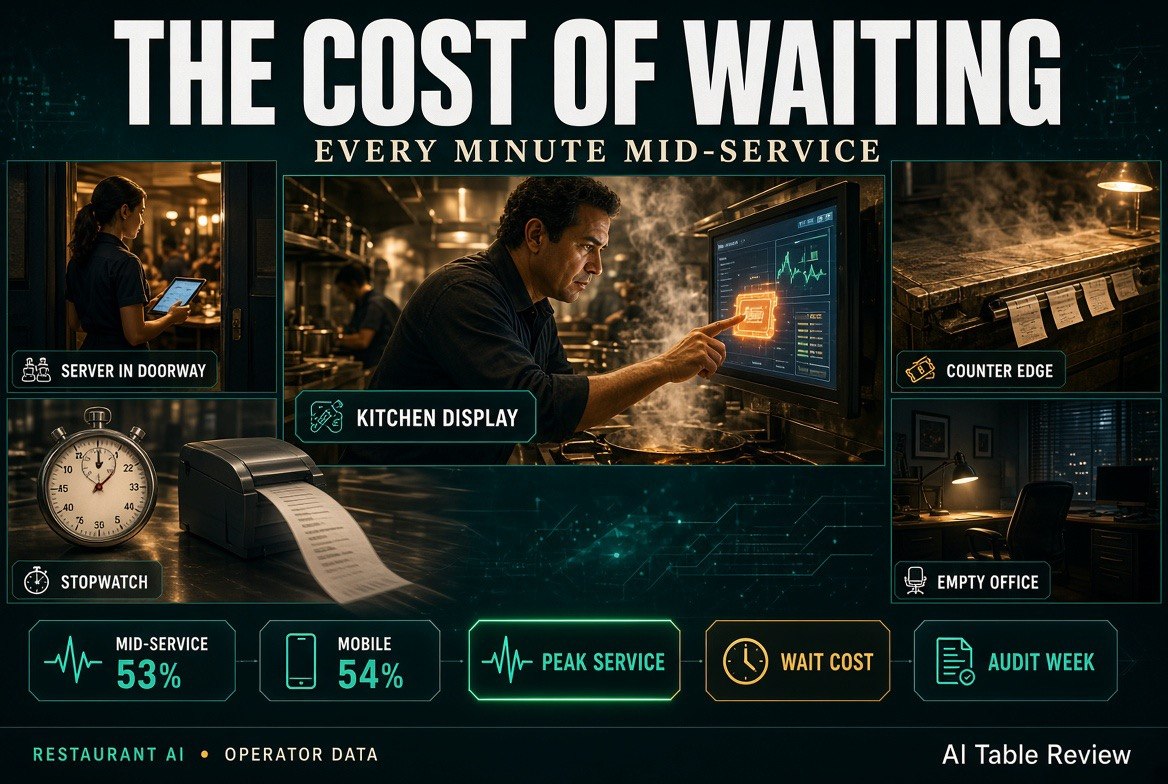
Lunch and dinner rushes accounted for 53% of all prompts. Morning prep took 19%, nightly close 15%, and the mid-day lull 13%.
That distribution is the whole story. A report pulled the next morning explains a night that is already over. An answer at 7 p.m. can still change it. Operators are not using AI as a post-mortem tool — they are using it as a live one.
| Time of day | Share of prompts | What that implies |
|---|---|---|
| Peak lunch and dinner | 53% | Decisions made while there is still time to act |
| Morning prep | 19% | Planning and par levels before service |
| Nightly close | 15% | Reconciliation and cash-up |
| Mid-day lull | 13% | Admin and catch-up work |
Fine Dining Asks More — and About Different Things
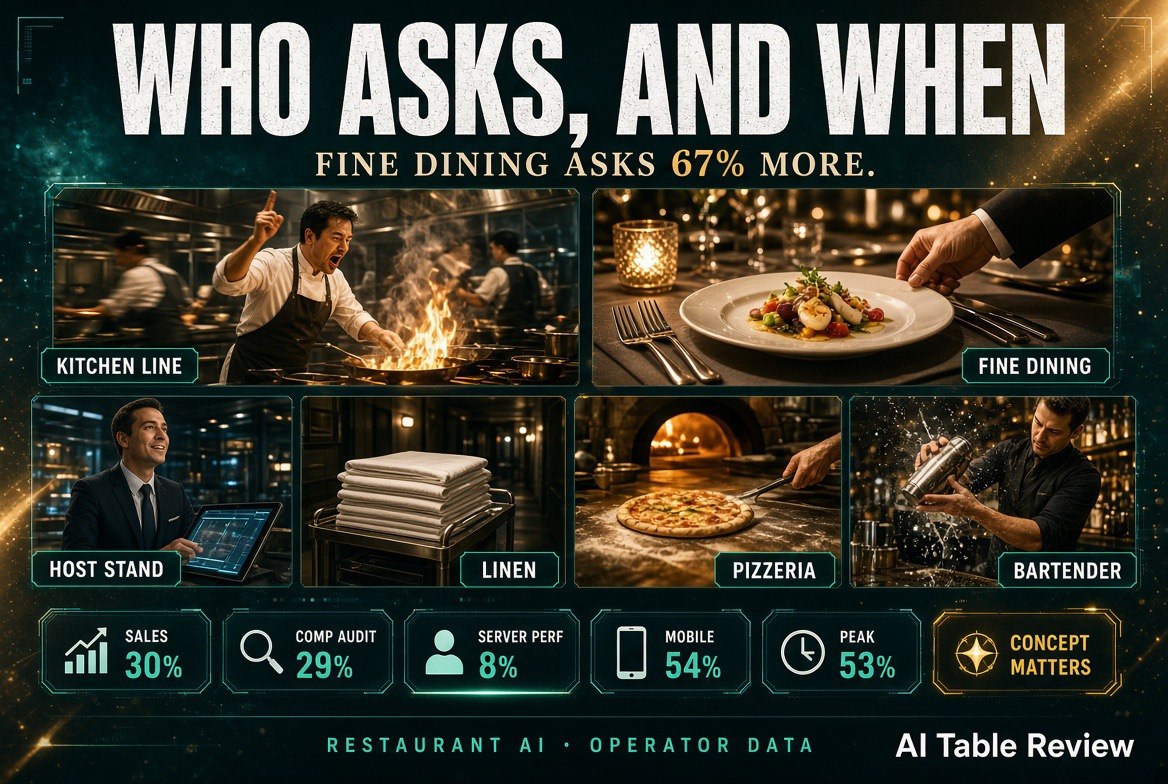
Fine dining managers sent 67% more prompts per location than fast casual. Full-service restaurants sent 41% more, casual full-service 38% more, and pizzerias 33% more.
Volume is only half of it. Where those questions point is the other half. Fine dining directed 8% of sales threads toward server performance — nearly four times the fast casual rate. And in loss audits, 29% of their questions were about manager comps, double the platform average.
That is not an accident of concept. Fine dining runs on a thinner margin per cover and a higher check average, so a manager comp is a bigger number and a server’s upsell rate is a direct lever on the night. Fast casual, by contrast, asked about payments and store-to-store comparisons more than any other concept — payment and tender breakdowns made up 10% of their sales questions, with location comparisons at another 4%.
Concept by Concept: Where the Attention Goes
Every concept uses AI to protect margin. What changes is where they look.
| Factor | Fine dining | Fast casual |
|---|---|---|
| Prompt volume vs. baseline | +67% per location | Baseline (lowest) |
| Sales threads on server performance | 8% | About 2% |
| Loss-audit questions on manager comps | 29% | Roughly half the platform average |
| Payment and tender breakdowns | Not a leading category | 10% of sales questions |
| Store-to-store comparisons | Not a leading category | 4% of sales questions |
| What they are protecting | Check average and dining room reputation | Speed and consistency across units |
Sales Questions Dominate — and Then Ask for a Change
Sales and revenue questions were the single largest category at 30% of all threads. That is unsurprising. What follows it is the interesting part.
Menu and inventory questions came second, and about 12% of those included a request for a change inside the chat — most often an update to item stock. The manager is not just asking whether the salmon is running low. They are asking the system to mark it out, from the floor, mid-service.
That behavior points at a gap worth naming: a request is not an action. The report explicitly does not confirm that these requests were saved. If you are building a workflow around this, the check is simple — request a change on your own system, then verify it saved in the item record. If it did not, your manager is managing on a request they believe is a change.
Managers Are on Their Feet, Not at a Desk
54% of user-initiated AI interactions started on a mobile device rather than a desktop. The task shapes the device, too: sales-related prompts made up 40% of mobile activity versus 19% on desktop, and operators submitted 32% more labor and staffing prompts on mobile.
That is a phone in a pocket on the floor, not a terminal in the back office. And it tracks with the timing data — when labor runs hot at 7 p.m., a manager can shift coverage before the overtime lands, rather than reading about it on Tuesday.
The Cost of Waiting: A Simple Audit
The report offers one exercise that does not require the Toast platform at all. Every restaurant runs on two clocks: when something happened, and when you found out.
Pick your busiest night last week and compare a few pairs. When did an item run out, and when did it come off the menu? When did a clock-in error happen, and when did payroll catch it? When did a comp get poured, and when did a manager review it?
The lag between each pair is your cost of waiting. Run the same check 30 days after your team starts pulling numbers from the floor, and the gap should shrink. If it does not, the tool is not the problem — the workflow around it is.
What This Means for an Independent Operator
Two things, and neither requires a platform migration.
First, the timing is the product. If your team only looks at sales data on the Monday after, you are running the report half of this. Moving one habitual question — how are we tracking against last Friday — from Tuesday morning to 7 p.m. costs nothing and changes what you can still fix.
Second, match the question to your concept. A pizza shop chasing payments and cross-location consistency is asking different questions than a fine dining room auditing comps. Copying another operator’s AI workflow takes you to their margins, not yours.
If you are weighing which platforms are worth the monthly line item, our breakdown of AI tools for restaurants covers the categories worth auditing first.
Why the Concept Split Matters More Than the Total
It would be easy to read the volume numbers and conclude that fine dining operators are simply more tech-forward. The topic data argues against that. If fine dining were just further along the same curve, it would ask the same questions in larger numbers. It does not — it asks different questions entirely.
Server performance and manager comps are dining room problems. Payment tenders and cross-location comparisons are consistency problems. One operator is protecting a guest experience that depends on a specific person on a specific night. The other is protecting a standard that has to hold identically across a group of units regardless of who is running them.
That is why copying another restaurant’s AI playbook tends to disappoint. The tool is the same; the question being asked into it is not. An independent operator should look at the concept closest to their own service model before borrowing anyone’s workflow. For a single-location full-service restaurant, the fine dining numbers are the relevant comparison even if the check average is lower — the dining room is still the thing that has to go right.
Where the Data Ends and Your Judgment Starts
One restraint is worth stating plainly. This report measures what managers typed, not what changed. It cannot tell you whether AI made a shift better, only that managers reached for it during the shift. Any vendor using this data to claim an outcome — faster turns, lower labor, higher check averages — is going beyond what the methodology supports.
The honest use of the report is as a mirror. If your team’s AI use is concentrated after close and at a desk, you are not using the same pattern as the majority of operators in this dataset. That is not automatically wrong. It is worth knowing, and it is worth asking whether it is deliberate.
Frequently Asked Questions
What did the 2026 Toast Restaurant AI Report find?
It found that restaurant managers use AI most heavily during service. 53% of prompts landed during peak lunch or dinner, fine dining managers sent 67% more prompts per location than fast casual, and sales and revenue questions made up 30% of all threads. The data covers U.S. restaurant locations from April 1 to June 30, 2026.
Do restaurant managers use AI more on mobile or desktop?
Mobile. 54% of user-initiated interactions started on a mobile device. Sales prompts made up 40% of mobile activity versus 19% on desktop, and labor and staffing prompts were 32% higher on mobile — consistent with managers working the floor rather than sitting at a terminal.
What do fine dining managers ask AI about?
Fine dining managers focused on the dining room. They directed 8% of sales threads toward server performance, nearly four times the fast casual rate, and 29% of their loss-audit questions were about manager comps — double the platform average.
Does the Toast IQ data prove AI is fixing restaurant problems?
No. The report analyzes prompts, not outcomes. It does not measure whether requested actions were completed, and where it describes changes such as updating item stock, it refers to requests made in chat that are not confirmed as saved in the product.
How can a restaurant manager measure the cost of slow reporting?
Compare two clocks on your busiest night: when something happened and when you found out. When did an item run out versus when it came off the menu, or when a clock-in error happened versus when payroll caught it. The lag between each pair is your cost of waiting.

About Barak Schurr
Barak Schurr built and exited a major ticketing platform, ran global operations at Eventbrite, and now focuses on one question: which AI tools actually help independent restaurant owners run leaner and grow faster. He writes from the operator’s perspective — no vendor spin, no theory, just what’s real in 2026.
Email: [email protected]
More Resources for Restaurant Operators