Get the AI Restaurant Quick-Start Guide — Free
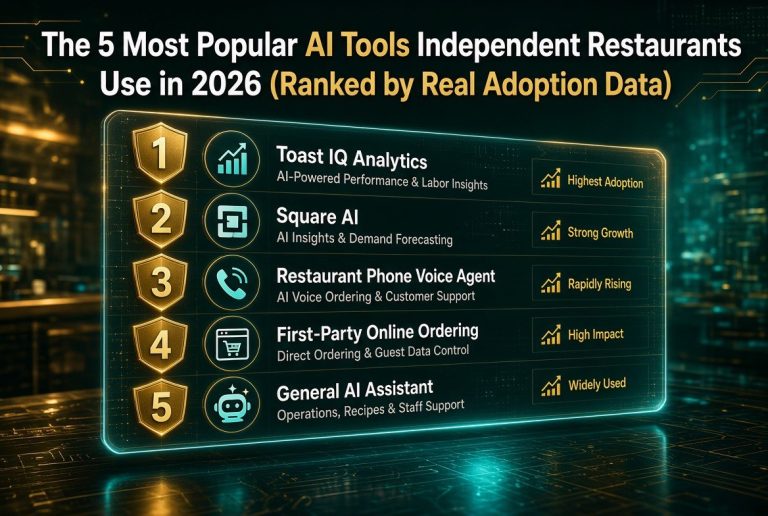
The 5 AI tools independent US restaurant owners are using right now to cut labor costs and answer every call.
DoorDash DashOS: What the New AI Restaurant OS Means for Independent Operators
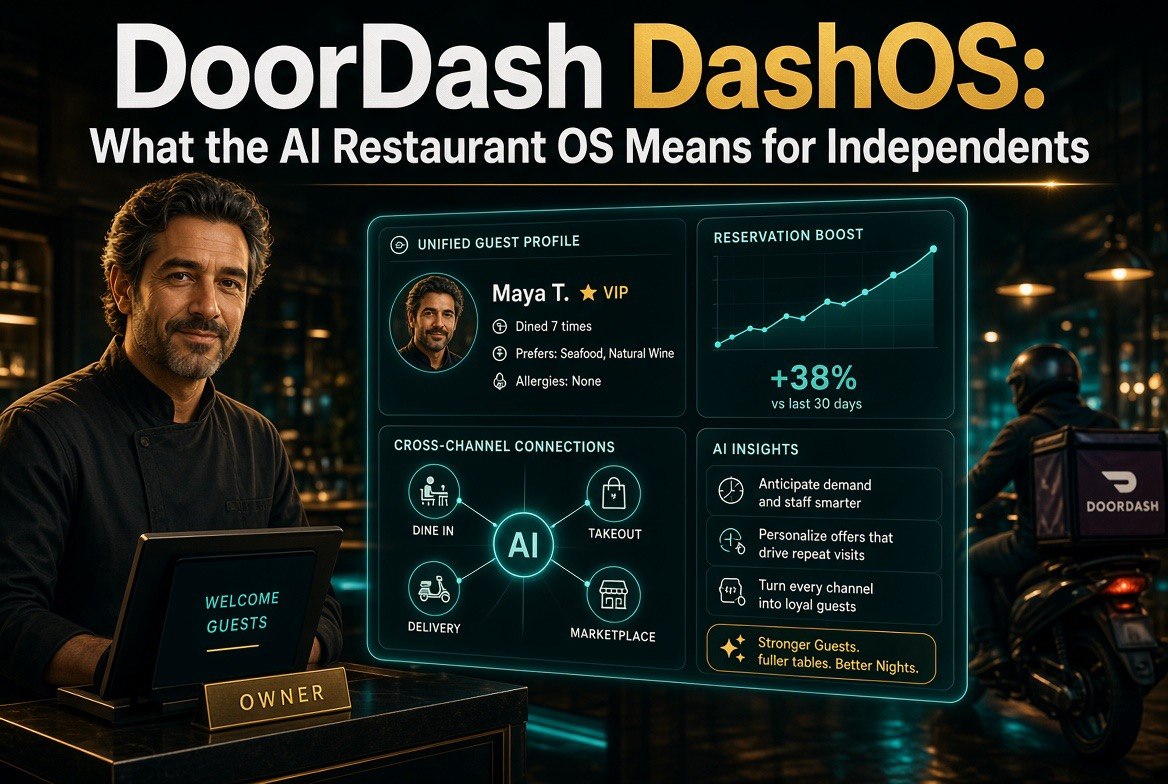
⚡ Expert Summary: DoorDash unveiled DashOS, an operating system that ties its marketplace, direct ordering, reservations, loyalty and marketing into one data layer — and uses AI to drive personalized guest recommendations. DoorDash claims it can lift reservations by up to 15%, and it plugs into POS systems you already run: Clover, Qu, Checkmate, Chowly, Deliverect, Stream and Urban Piper. No new system, no rip-and-replace. Here is what an independent operator actually gets, and the three things to check before you turn it on.
Every independent restaurant owner has the same invisible problem. Your guests are already there — they ordered delivery last month, they booked a table in June, they signed up for your email list in 2024. But that information lives in four different dashboards that do not talk to each other, so your “personalization” is a monthly blast to a list that includes people who moved away two years ago.
DoorDash just made a serious move at that problem, and if you run an independent restaurant in the US, it is worth thirty minutes of your attention — because this is one of the rare platform changes that does not require you to replace anything you own.
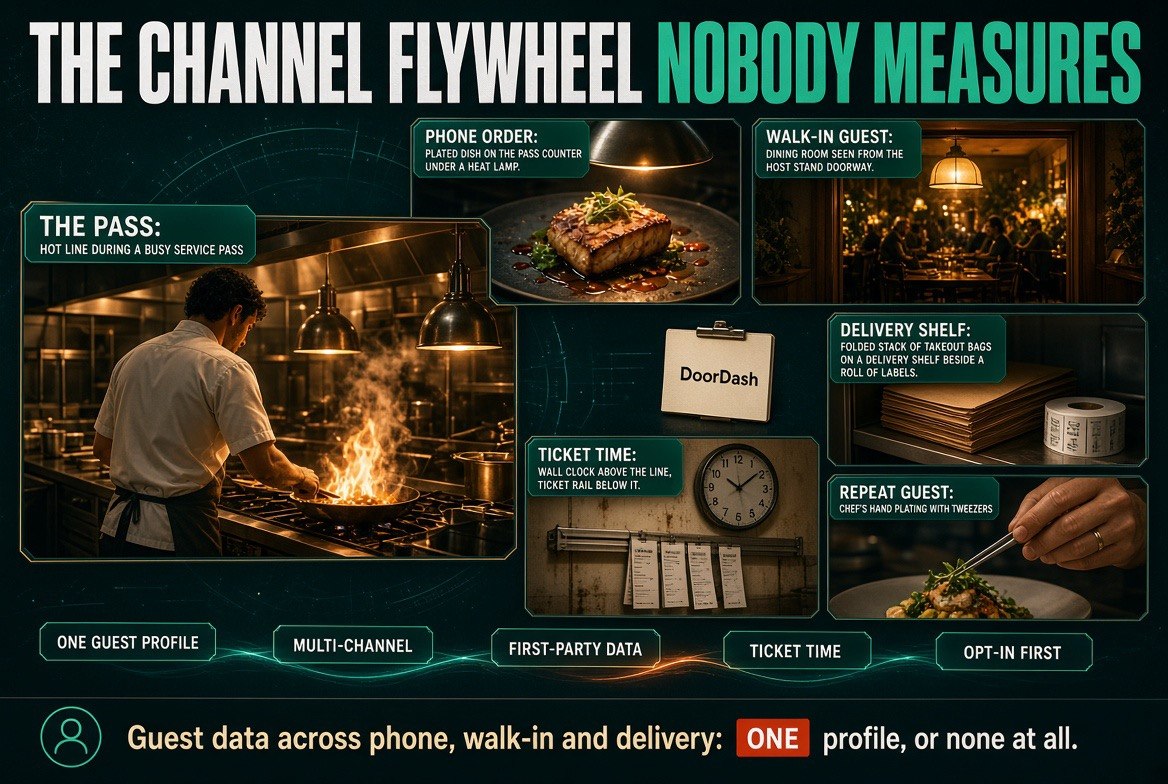
Every channel in the room is a data point: the phone order, the walk-in, the delivery bag and the ticket on the rail. DashOS is a bet that they belong to one profile instead of five.
What DashOS Actually Is
DoorDash unveiled an operating system called DashOS at its 2026 Dash Forward event. The plain-language version: it ties together the delivery giant’s separate tools — its marketplace, direct ordering, reservations, loyalty guest management and marketing — into a single layer that connects customer interactions across every channel where a guest touches your restaurant, including your own website.
The critical detail for an operator is what it does not require. According to DoorDash, DashOS works without restaurants adopting a new system or overhauling their tech stack. It integrates with a range of point-of-sale systems and restaurant tech platforms, including Clover from Fiserv, Qu, Checkmate, Chowly, Deliverect, Stream and Urban Piper.
Read that list again if you are a Toast or Square shop, because that is the question every owner asks first: does this mean switching POS? No. DashOS is a data and intelligence layer that sits across the systems already running your floor.
Where the AI Comes In
This is the part that matters for the AI-first question, because “another loyalty dashboard” is not news. DashOS uses artificial intelligence to provide guests with personalized recommendations, and DoorDash claims the tool could increase reservations at restaurants by up to 15%.
The AI in DashOS — alongside technology from SevenRooms, which DoorDash acquired last year — is aimed at automating the work that eats your week before service even starts: creating marketing campaigns, analyzing customer behavior, responding to reviews, and answering calls.
Here is why the AI gets better in this setup rather than just being bolted on. Combining guest data from a variety of sources means the AI has more context, and more context is what makes a recommendation relevant instead of creepy. An AI that knows the person in front of it ordered the short rib three times by delivery and once dined in on a Tuesday is doing something genuinely different from a system that only sees a delivery history.
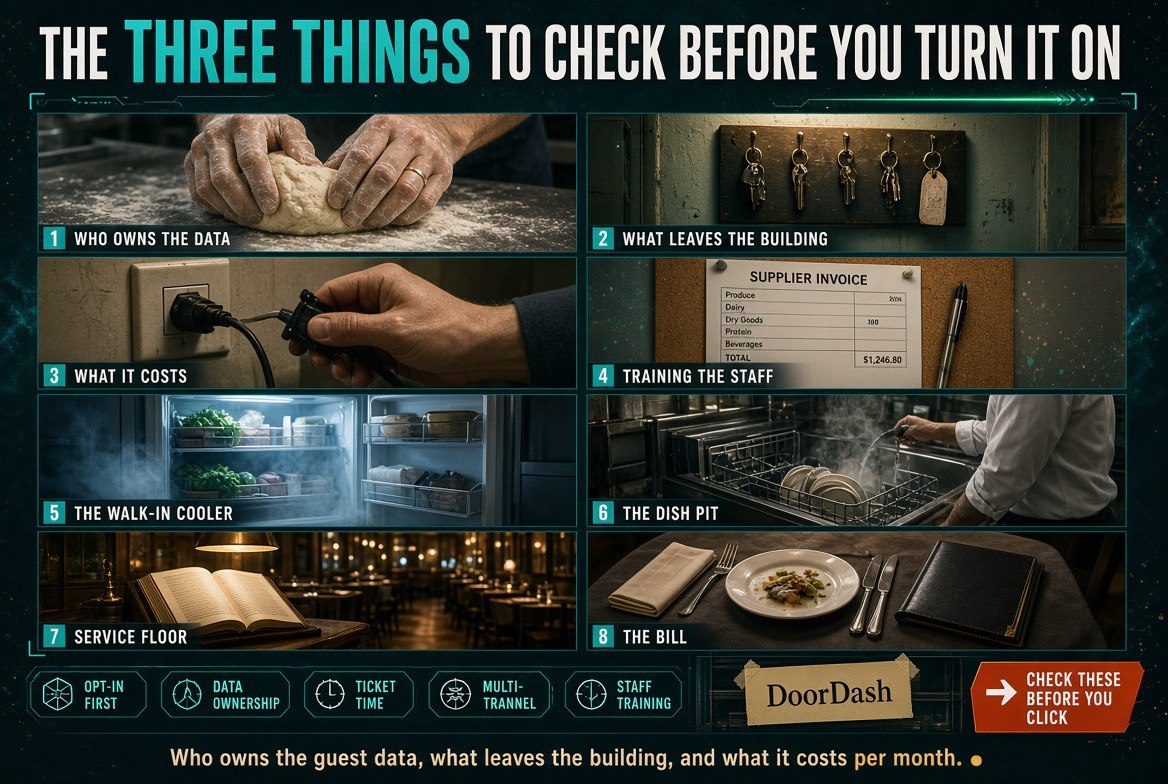
The three questions that decide it: who owns the guest data, what leaves the building, and what the per-month figure actually covers once the trial ends.
The Channel Flywheel Nobody Measures
DoorDash’s own research explains why connecting these channels is worth the effort. Per a DoorDash report from earlier in 2026, 74% of surveyed consumers said a dine-in visit led them to later order delivery from the same restaurant, while 62% said a delivery order generated an eventual dine-in visit.
Those two numbers describe a flywheel. Most independent operators are only looking at half of it, because their delivery data lives in one app and their dine-in data lives in a POS they never export. DashOS is essentially a bet that the operator who can see both halves will market to them differently — and better.
The Comparison: What You Get Versus What It Asks of You
Before you sign anything, here is the honest side-by-side of what DashOS delivers against what it costs you in attention and dependency.
| Factor | What DashOS Promises | What Independent Operators Should Weigh |
|---|---|---|
| Guest data | One layer across marketplace, direct ordering, reservations and loyalty | More of your guest record now sits in DoorDash’s system, not yours |
| AI personalization | Recommendations driven by cross-channel context; up to 15% more reservations claimed | Ask for the lift in your own numbers after 90 days, not the platform average |
| Setup burden | No new system, no tech overhaul; works with Clover, Qu, Checkmate, Chowly, Deliverect, Stream, Urban Piper | Confirm your POS is on the integration list before you plan anything |
| Marketing automation | Campaign creation, behavior analysis, review responses and call answering | Automated review replies still need a human tone pass on bad nights |
| Channel economics | Dine-in and delivery reinforce each other (74% / 62%) | You still pay third-party commission; the data does not change the fee |
The Three Things to Check Before You Turn It On
This is where I would slow down if I were sitting across the table from you. DashOS is genuinely interesting, and it is also a platform move by the company that already takes a commission on your delivery orders. Both things are true.
One — is your POS on the list? Clover, Qu, Checkmate, Chowly, Deliverect, Stream and Urban Piper are named. If you run one of those, you are in. If you run something else, ask the question before you plan anything, because “integrates with a variety of systems” is not the same as “integrates with yours.”
Two — who owns the guest record? The value of DashOS is that it holds a unified view of your customers. That is also the risk. Ask plainly what happens to that data if you stop using the platform, and get the answer in writing before you build a marketing calendar on top of it.
Three — what is the fee structure? Personalized recommendations do not change your commission rate. The AI might genuinely send you more reservations — that up-to-15% figure is DoorDash’s own claim and worth testing against your own 90-day numbers — but the economics of third-party delivery stay what they are.
How This Fits the Wider Restaurant AI Shift
DashOS is not landing in a vacuum. It is one move in a broader shift across restaurant tech toward greater personalization of guest interactions and integration of data across systems — the same direction as Toast’s AI products, Square’s ordering integrations, and the wave of voice AI that has moved into drive-thrus and phone lines.
What makes this one different for an independent operator is the integration list. Voice AI usually means adopting new hardware. A new POS means retraining staff. DashOS is aimed at the layer above all of that, which is why it is worth reading even if you never sign up — it tells you exactly what the big platforms believe your customer data is worth.
| Operator Type | Where You Stand Today | The Practical Move |
|---|---|---|
| Heavy delivery, no dine-in data | You are already paying commission and getting little guest insight in return | Connect it, but export your guest list monthly so you own a copy |
| Strong dine-in, light delivery | Your regulars are known to your staff, not to any system | The loyalty enrollment angle is the real prize here, not delivery |
| Single location, no marketing staff | Campaigns and review replies simply do not happen in a busy week | The automated review responses and campaign drafts are the fastest win |
| Multi-unit, 3-10 stores | Each location runs its own coupons and its own idea of a regular | This is the profile where a unified guest layer pays off fastest |
What to Do This Week, Realistically
You do not need to make a decision today. You need to find out three facts.
- Check your POS against the integration list. Clover, Qu, Checkmate, Chowly, Deliverect, Stream, Urban Piper. Two minutes in your back office.
- Pull your own channel split. What percentage of your revenue comes from delivery versus dine-in over the last 90 days? If you cannot answer that in under ten minutes, that is the actual problem DashOS is being sold to solve.
- Write down your guest count. How many unique customers do you have on an email or loyalty list right now? Compare it to your monthly covers. The gap is the opportunity the AI is being pointed at.
Then wait one quarter and look at whether the operators who turned it on are reporting the reservation lift in their own numbers. The technology is real. The marketing claim is a claim. A quarter of patience costs you nothing.
The Honest Read
For an independent operator, DashOS is less interesting as a product than as a signal. It is a delivery company saying out loud that the future of restaurant revenue is a unified guest relationship across every channel — and it is willing to build the data layer to own that relationship.
That is the part worth your attention. Whether you adopt DashOS or not, the operators who win the next three years are the ones who can answer the question: do I know who my customers are, across every channel they use, and can I act on it before the competition does?
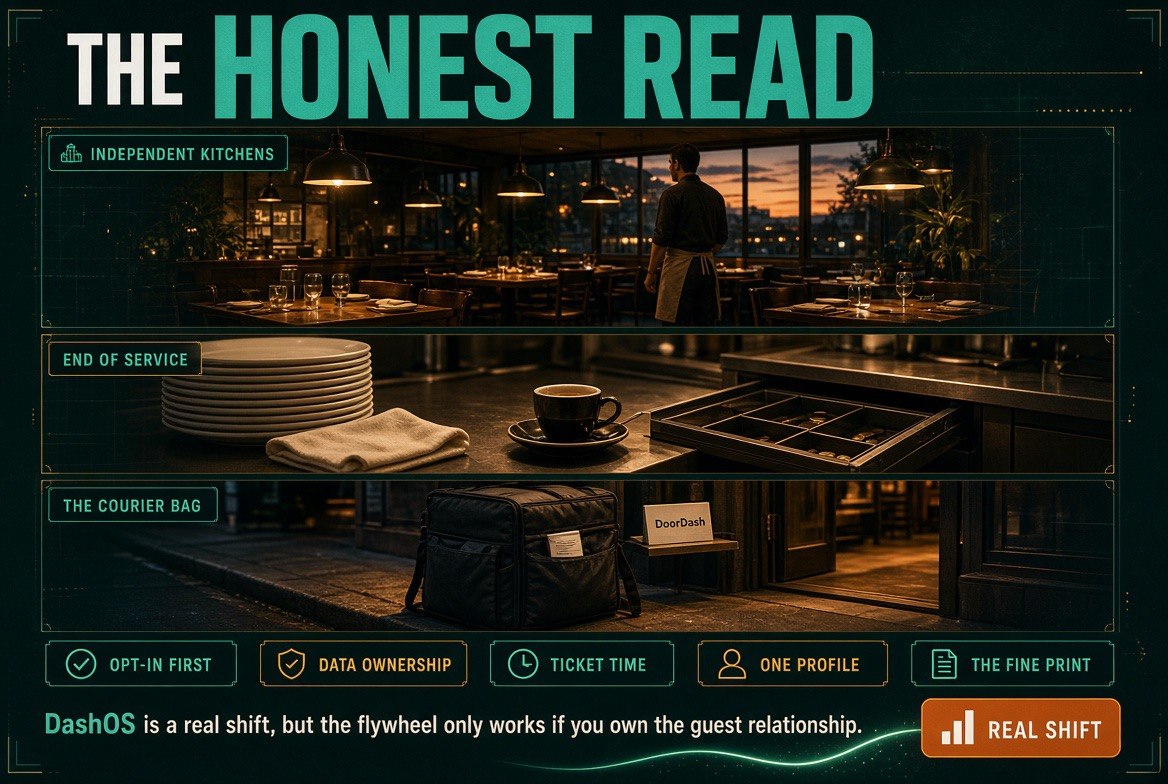
The honest read: DashOS genuinely changes what an independent operator can see, but the flywheel only pays off for the restaurant that owns the guest relationship at the end of it.
Frequently Asked Questions
What is DoorDash DashOS?
DashOS is an operating system DoorDash unveiled at its 2026 Dash Forward event that ties together its marketplace, direct ordering, reservations, loyalty guest management and marketing tools into a single data layer. It uses AI to deliver personalized guest recommendations and connects customer interactions across every ordering channel, including a restaurant’s own website.
Does DashOS require switching POS systems?
No. DoorDash says DashOS works without restaurants adopting a new system or overhauling their tech stack. It integrates with Clover from Fiserv, Qu, Checkmate, Chowly, Deliverect, Stream and Urban Piper, among other restaurant tech platforms.
How much can DashOS increase restaurant reservations?
DoorDash claims the AI-driven personalized recommendations in DashOS could increase reservations at restaurants by up to 15%. That figure comes from DoorDash itself, so independent operators should measure the actual lift in their own 90-day numbers rather than relying on the platform average.
What AI features does DashOS include for restaurants?
DashOS uses AI for personalized guest recommendations, and — with technology from SevenRooms, which DoorDash acquired last year — automates time-consuming work like creating marketing campaigns, analyzing customer behavior, responding to reviews and answering calls.
Is DoorDash DashOS worth it for an independent restaurant?
It depends on three factors: whether your POS appears on the integration list, what happens to your guest data if you leave the platform, and whether your commission rate changes. The automation for review responses and campaign creation is the fastest practical win for a single-location operator with no marketing staff.
Do diners really cross over between delivery and dine-in?
According to DoorDash research from earlier in 2026, 74% of surveyed consumers said a dine-in visit led them to later order delivery from the same restaurant, and 62% said a delivery order generated an eventual dine-in visit. That crossover is the core argument for connecting the data in one place.

About Barak Schurr
Barak Schurr built and exited a major ticketing platform, ran global operations at Eventbrite, and now focuses on one question: which AI tools actually help independent restaurant owners run leaner and grow faster. He writes from the operator’s perspective — no vendor spin, no theory, just what’s real in 2026.
Email: [email protected]
More Resources for Restaurant Operators