Get the AI Restaurant Quick-Start Guide — Free
The 5 AI tools independent US restaurant owners are using right now to cut labor costs and answer every call.
Deliverect and Yext Sync Restaurant Data for AI Search
⚡ Expert Summary: Deliverect, the ordering platform behind 80,000+ restaurant locations across 70+ countries, has partnered with Yext to pipe live operational data — menus, hours, item availability, allergens — straight into the Yext Knowledge Graph. When something changes in the restaurant, the update flows automatically to search engines, maps and AI assistants. For independent operators, this targets the most common and most expensive discovery failure: a diner seeing wrong information online. Here is what the integration does, what it costs you to keep data accurate manually, and whether it matters for a single-location restaurant.
There is a specific kind of lost sale that never shows up in your POS report. A diner searches for a place to eat, finds your restaurant, sees hours from last winter, assumes you are closed, and picks somewhere else. You never knew the customer existed. Multiply that by a menu item that sold out two days ago, a curbside pickup option that is no longer offered, or an allergen line that is out of date, and you have a quiet, permanent tax on your revenue.
On October 8, 2026, Deliverect and Yext announced a partnership aimed squarely at that problem — and the detail that matters most is where the data ends up: not just search engines and maps, but the AI assistants diners increasingly ask for recommendations.
What Deliverect and Yext Announced
Deliverect is a global restaurant technology platform serving more than 80,000 locations across 70+ countries. Yext describes itself as an enterprise agentic marketing platform. Under the partnership, Deliverect’s operational data layer — menus, opening hours, item availability and allergen information — now connects directly to the Yext Knowledge Graph.
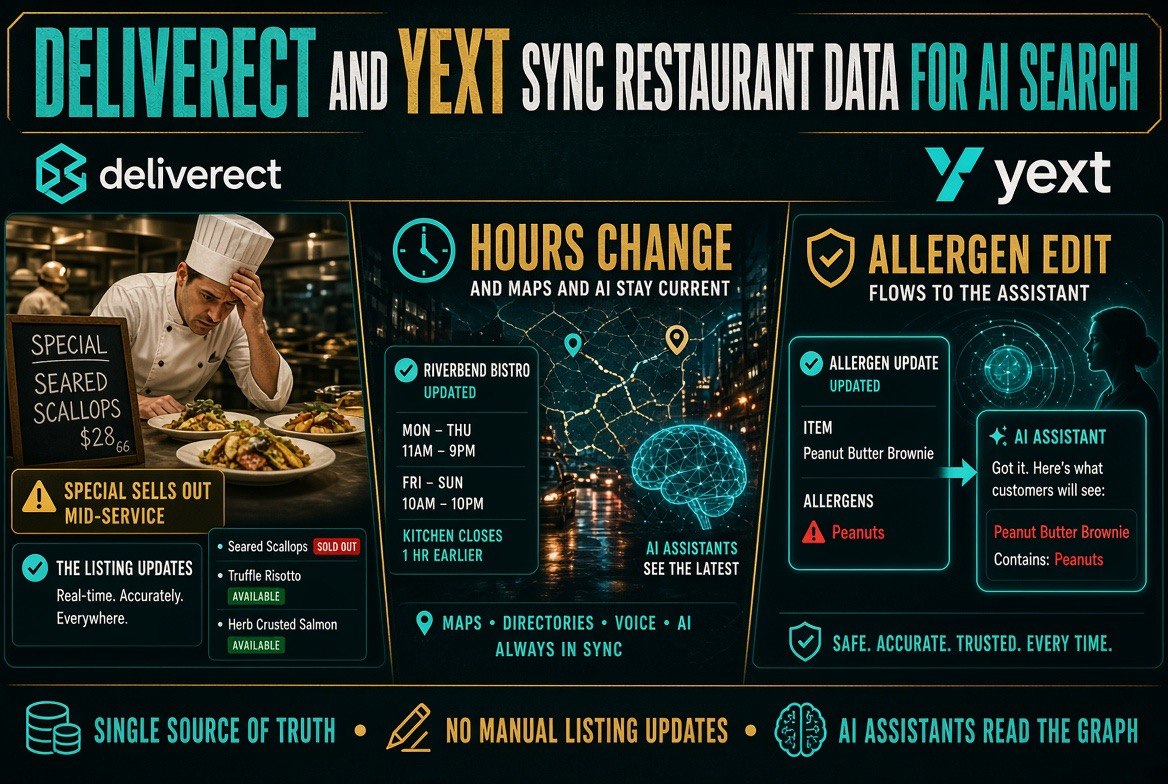
The mechanism is the important part. When key data changes at a restaurant, that update automatically flows through to search engines, maps and AI assistants without manual intervention. No one logs into a listings dashboard to fix an hours change. The operational data the restaurant already maintains for ordering becomes the source for how it appears to the outside world.
“In partnering with Deliverect, Yext demonstrates its commitment to brand accuracy and data enrichment by pulling live operational information directly into the Yext Knowledge Graph,” said Stephan Giordani, Product Partnerships Manager, North America at Yext. “We’re eliminating a layer of manual data entry for our food and beverage clients so they can focus on serving consumers while Yext and Deliverect make sure their restaurants are accurately and consistently discoverable in AI and traditional search.”
Don MacMillan, Head of Partnerships, North America at Deliverect, framed it from the operator’s side: “Restaurant operators already have enough to manage without worrying whether their menu or hours are showing up correctly everywhere customers look. This partnership means the operational data flowing through Deliverect becomes the single source of truth for how a restaurant appears across search and AI.”
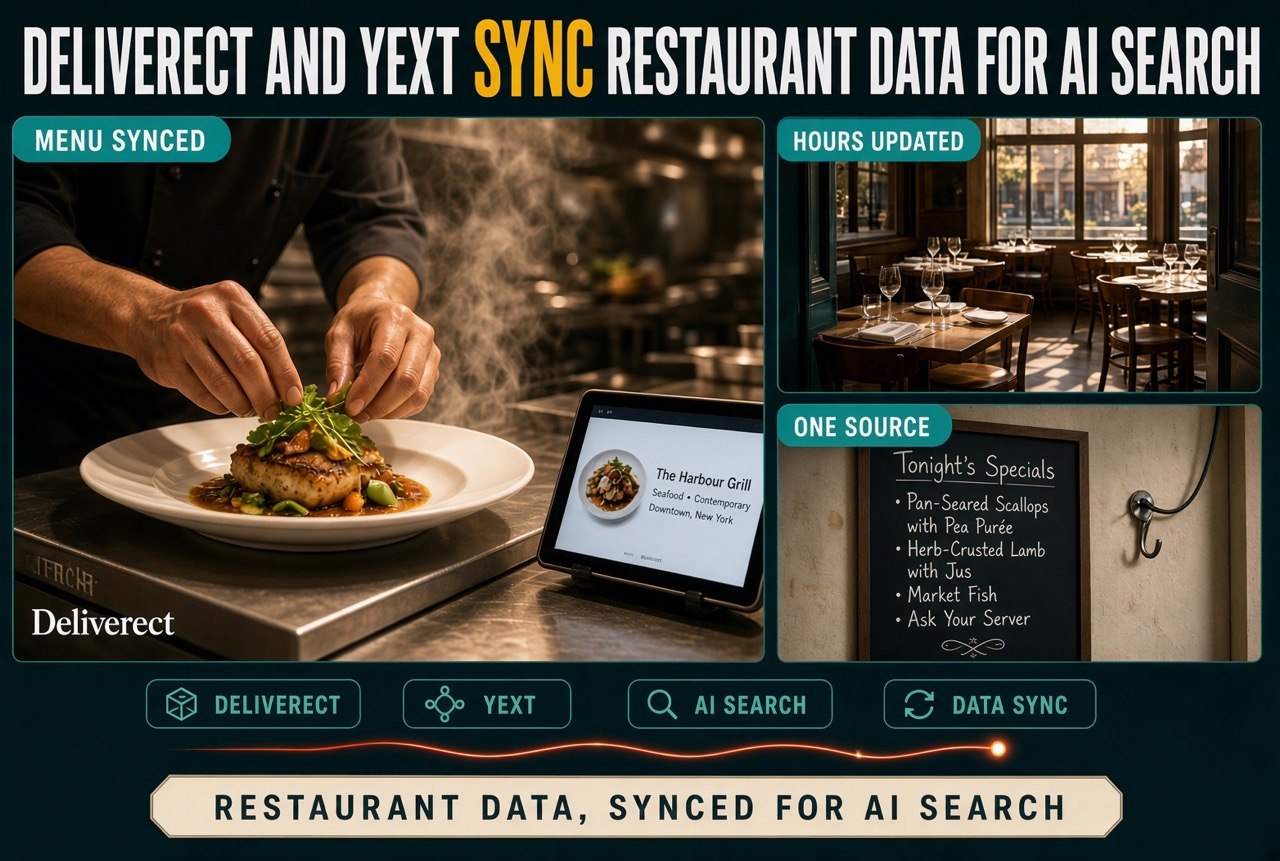
A single source of truth is the point: menu, hours, prices and availability all traced back to one place instead of scattered listings.
Why Restaurant Data Goes Stale So Fast
Restaurants are unusual among local businesses in how much of their customer-facing information changes week to week. A retail store keeps roughly the same hours and inventory for months. A restaurant cycles specials, sells out of items mid-service, adjusts hours seasonally, adds and drops delivery and pickup options, and reformulates dishes when suppliers change.
Every one of those changes is a chance for a public listing to drift out of date. And the drift is not symmetrical — it is far easier to add a new menu item than it is to remove one that has been discontinued. Over a year, a single-location restaurant can accumulate dozens of small inaccuracies across Google, Apple Maps, delivery marketplaces and review sites, each one a potential lost customer.
For a multi-location brand the problem compounds. Ten locations means ten times the surface area to keep accurate, and any centralized marketing team is working from data that lives in the operations stack, not in their dashboard. That separation between where the data is maintained and where it is published is the root cause the integration addresses.
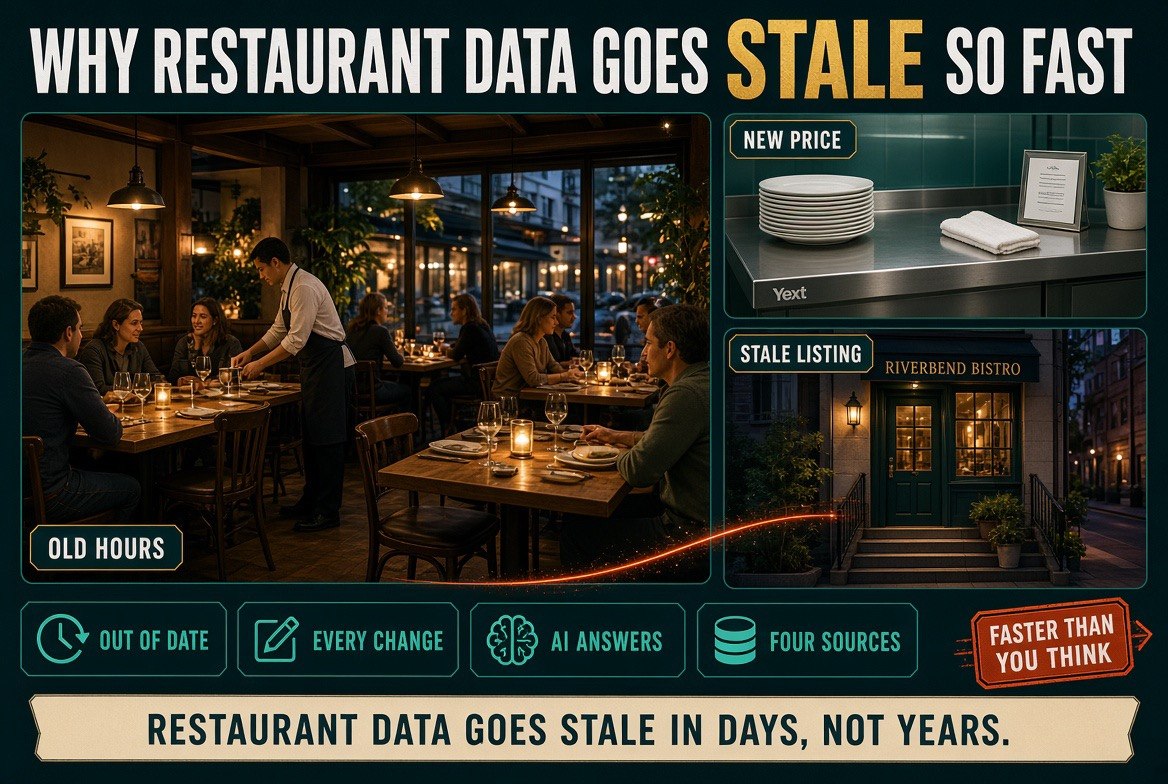
Stale data is the quiet failure mode: hours change, prices move, and every outside listing keeps answering with yesterday’s information.
The AI Search Angle: Why This Is an AI Story
Two years ago, “keep your Google listing accurate” was a local SEO housekeeping task. In 2026 it is a machine-readable data problem, because the way diners find restaurants has changed.
AI assistants answer questions like “what is open near me right now,” “which of these has gluten-free options,” and “where can I get delivery in 30 minutes” by reading structured data about businesses. When that data is wrong or missing, the assistant does not call to check. It recommends someone else, or it says nothing at all. A restaurant that is invisible to the AI layer is invisible to a growing share of discovery, and unlike a bad Yelp review, there is no notification telling you it happened.
This is what makes the Yext Knowledge Graph the load-bearing component. The graph is the structured representation of the business that AI systems and search engines read from. Feeding it live operational data means the answers AI assistants give are pulled from what is actually happening in the restaurant, not from whatever was last typed into a listing form.
Manual Data Management vs. Automated Sync: The Real Cost
The honest question for an independent operator is not whether accurate data matters — it obviously does. It is what it costs to keep that data accurate today, and whether automation beats the manual process. Here is the comparison that actually matters.
| Factor | Manual Listing Updates | Automated Sync (Deliverect → Yext) |
|---|---|---|
| Time per change | Minutes per platform, per location | Zero — flows from operational data |
| Platforms covered | Whichever ones someone remembers | Search engines, maps and AI assistants |
| Sold-out items | Usually not updated at all | Reflected from availability data |
| Peak-service reliability | Fails exactly when staff are busiest | Unaffected by service volume |
| Multi-location scaling | Cost grows with every site added | Same pipeline, more locations |
| Allergen accuracy | High risk of stale entries | Synced from maintained records |
The cost of the manual column is not the fifteen minutes it takes to fix one entry. It is that the fifteenth minute never gets spent during a Friday dinner rush, and that is precisely when the data is changing fastest.
When the Data Update Actually Happens
The second table walks through a normal week of operational change and what each item does to your public listings, with and without the integration. It is a more useful way to see the value than another feature list.
| Operational Change | Without Sync | With Sync |
|---|---|---|
| Special runs out mid-service | Still advertised online for days | Availability reflects the change |
| Seasonal hours begin | Diners arrive to a closed door | Hours update across channels |
| New delivery option added | Discoverable only if you post about it | Shows wherever customers search |
| Recipe reformulated for allergens | Old allergen list stays live | Updates from maintained records |
| Price increase | Mismatched prices across sites | One source pushes to all |
Notice that none of these are exotic events. They are just a normal week. The question is not whether your data will change, but whether the change reaches the customer before the customer makes a decision.
Does This Matter for a Single-Location Restaurant?
This is the fair question, and the honest answer is: less than it matters to a chain, but not zero.
A single-location independent is not losing hours of staff time to listing maintenance. You know your hours. You know what sold out. The pain shows up in a different place — in the gap between what you know and what the internet says, and in the fact that nobody at a ten-table restaurant has “update the listings” on their list during service.
The more relevant consideration is AI search. If diners in your area increasingly ask an assistant where to eat, the accuracy of your structured data determines whether you are in the answer. That bar is the same whether you run one location or fifty. A chain with a marketing department can assign someone to police it. An independent operator generally cannot, which makes an automatic feed from systems you already use more valuable, not less.
The practical limitation is the dependency on Deliverect. If your ordering and menu data already runs through Deliverect, this integration is close to free accuracy. If it does not, you are looking at adopting the platform first, and that is a bigger decision than fixing a handful of listings.
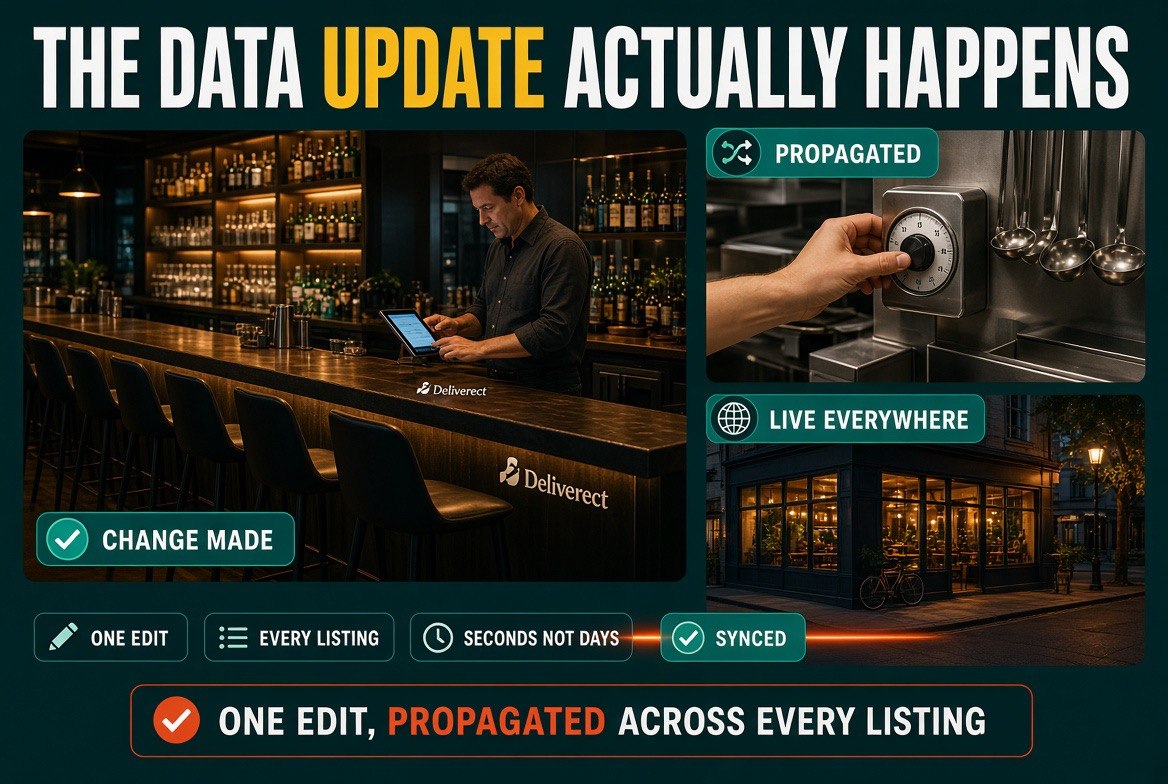
The real test is propagation: one edit in the source system, then confirm that change landed everywhere diners and AI assistants look.
What to Check Before You Assume You Are Covered
Three things worth verifying, whether or not you use either platform.
First, check what an AI assistant currently says about you. Ask three different assistants what your hours are, whether you take reservations, and what your signature dish is. Compare the answers to reality. Most operators who do this find at least one outdated fact. That gap is the problem this partnership is built to close, and you can measure your own exposure for free today.
Second, find out where your operational data actually lives. If menu and availability information is maintained in one system and published through another by hand, you have the exact separation this integration removes. The fix does not have to be Deliverect and Yext specifically — but the principle of a single source feeding all channels is the right target.
Third, treat allergens as a liability question, not a marketing one. Stale allergen information is the one item on this list that can hurt a customer rather than simply lose a sale. If that data is maintained by hand in more than one place, it is worth fixing independent of any partnership announcement.
The Bottom Line
The Deliverect and Yext partnership does not add a new capability to either platform. It removes a manual step that restaurant operators have quietly been paying for in lost customers for years — and it targets the layer where that step now matters most, the structured data that AI assistants read when they recommend a place to eat.
For brands already running on Deliverect, the accuracy arrives largely for free. For independent operators on other systems, the announcement is less a product recommendation than a reminder: the distance between your real operation and your public data is measurable, and it is costing you. The fix is to make the data flow automatic, because the alternative is hoping someone remembers during a Friday night service. They will not.
For more on how AI is reshaping independent restaurant operations, see our coverage in restaurant AI.
Frequently Asked Questions
What did Deliverect and Yext actually announce?
A partnership connecting Deliverect’s operational data layer — menus, opening hours, item availability and allergen information — directly to the Yext Knowledge Graph. When data changes at a restaurant, the update automatically syncs to search engines, maps and AI assistants without anyone updating listings by hand.
How many locations does Deliverect serve?
Deliverect states it serves more than 80,000 restaurant locations across 70+ countries. It describes itself as a global restaurant technology platform covering carryout, delivery, catering and in-store fulfillment.
Why does restaurant data go out of date so quickly?
Restaurants change customer-facing information constantly: specials cycle, items sell out mid-service, hours shift seasonally, delivery and pickup options come and go, and recipes are reformulated. Adding an item online is easy; removing one is easy to forget. Over a year, small inaccuracies accumulate across every platform that lists the restaurant.
Is this an AI story or a local SEO story?
Both, but the AI half is newer and more consequential. AI assistants answer “what is open near me” and “who has gluten-free options” by reading structured business data. If that data is wrong or missing, the assistant recommends a competitor instead, and there is no notification that it happened.
Does a single-location restaurant need this?
Less urgently than a chain, but the AI-search problem is the same at any size. A single-location operator rarely has staff time to police listings during service, which makes an automatic feed from existing systems more useful rather than less. The main dependency is whether your menu and ordering data already runs through Deliverect.
How do I check whether my own data is accurate?
Ask several AI assistants for your hours, reservation policy and signature dish, then compare the answers with reality. Most operators find at least one outdated fact. That exercise measures your exposure for free and shows exactly what an automated sync would be fixing.

About Barak Schurr
Barak Schurr built and exited a major ticketing platform, ran global operations at Eventbrite, and now focuses on one question: which AI tools actually help independent restaurant owners run leaner and grow faster. He writes from the operator’s perspective — no vendor spin, no theory, just what’s real in 2026.
Email: [email protected]
More Resources for Restaurant Operators