Get the AI Restaurant Quick-Start Guide — Free
The 5 AI tools independent US restaurant owners are using right now to cut labor costs and answer every call.
AI Slop Menus: What Fake Food Photos Cost You
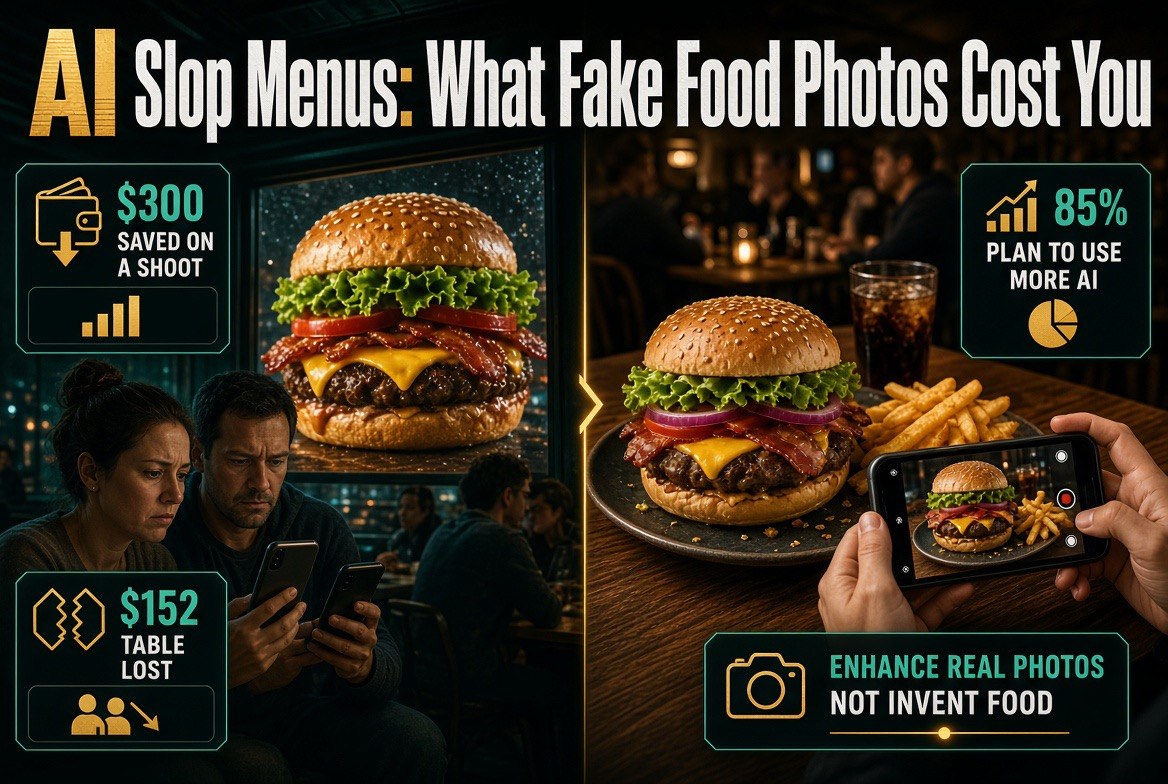
⚡ Expert Summary: AI-generated food photos have moved off delivery apps and onto real menus, posters, and deli signs — and customers are noticing. WIRED reported the trend in September 2026 after guests began photographing obviously fake dishes, and the backlash has gone national. The operator math is brutal: you save $300 on a photoshoot and lose a table that came in expecting what the photo showed. Popmenu CEO Brendan Sweeney told WIRED he found five different pizza places using the same AI-generated image on Uber Eats. Meanwhile a Toast poll found roughly 85% of restaurateurs say they feel comfortable using AI tools and plan to use them more. The gap between those two facts is where independent operators are getting hurt. This is the difference between using AI to enhance a real photo of your real food — which works — and using AI to invent a dish you do not serve.
Somebody walks into your restaurant on a Friday night because of a photo. That is the entire transaction. The photo did the selling before a single employee spoke to them, before the smell of the kitchen reached the dining room, before anyone asked if they wanted still or sparkling. Every operator understands this instinctively, which is why you spent money on food photography, window decals, the menu insert, and the delivery app listing.
Now consider what happens when the photo is a lie in a way the customer can see in four seconds flat. Not a stylized lie — every food photo is styled, and every customer knows it. A fabricated lie. A burrito with ingredients that do not exist. Pasta with the plastic sheen of a rendering artifact. A burger with a texture that reads as wrong before the customer’s brain can explain why.
In September 2026 this stopped being a hypothetical. Customers started photographing obviously AI-generated menu posters, posting them, and going viral — a digital version of holding up a sign that says “we don’t know what our food looks like.”
What AI Slop Menus Actually Are
WIRED’s reporting described the moment AI-generated food images jumped from online listings into the physical world. It started with delivery, and the logic was seductive. Getting professional food photographs is expensive: a photographer, a food stylist, prop costs, a day of prep, and menu items held out of service while they are shot. Faced with pressure from delivery apps — where a listing’s visibility depends heavily on imagery — and armed with models that can output photorealistic food, thousands of operators took the shortcut.
The results were predictable to anyone who has looked closely at generated food. WIRED’s description of the aesthetic is queasily precise: “maggot-infested burrito or a plasticky pasta,” the giveaway being random artifacts that a human food stylist would never produce because a human food stylist has eaten the dish.
What changed in 2026 is placement. Those images crept from the delivery listing into posters in coffee shops, printed deli menus, and tabletop signage. Online, a bad image scrolls past. Painted on your wall, it becomes the first thing a customer sees and the thing they compare their plate against.
| Approach | What The Guest Sees | What It Costs You |
|---|---|---|
| Fully AI-generated dish | A dish you do not serve, in a style no kitchen produces | Refunds, comped meals, one-star reviews that mention the poster |
| AI-cleaned real photo | Your actual dish, evenly lit and consistently plated | Photoshoot cost only — no expectation gap |
| AI-written menu copy | Descriptions of food you may not actually cook | Order confusion, wasted prep, staff forced to explain the menu |
| Unedited phone photo | Slightly rough but honest picture of the real plate | Nothing on this list — and increasingly, it converts better |
That table is the whole decision, and notice that only one row is a trap. AI is not the problem. AI inventing food is the problem. The exact same tools, pointed at photos of dishes your kitchen actually produces, remove the single largest cost barrier most independents face.
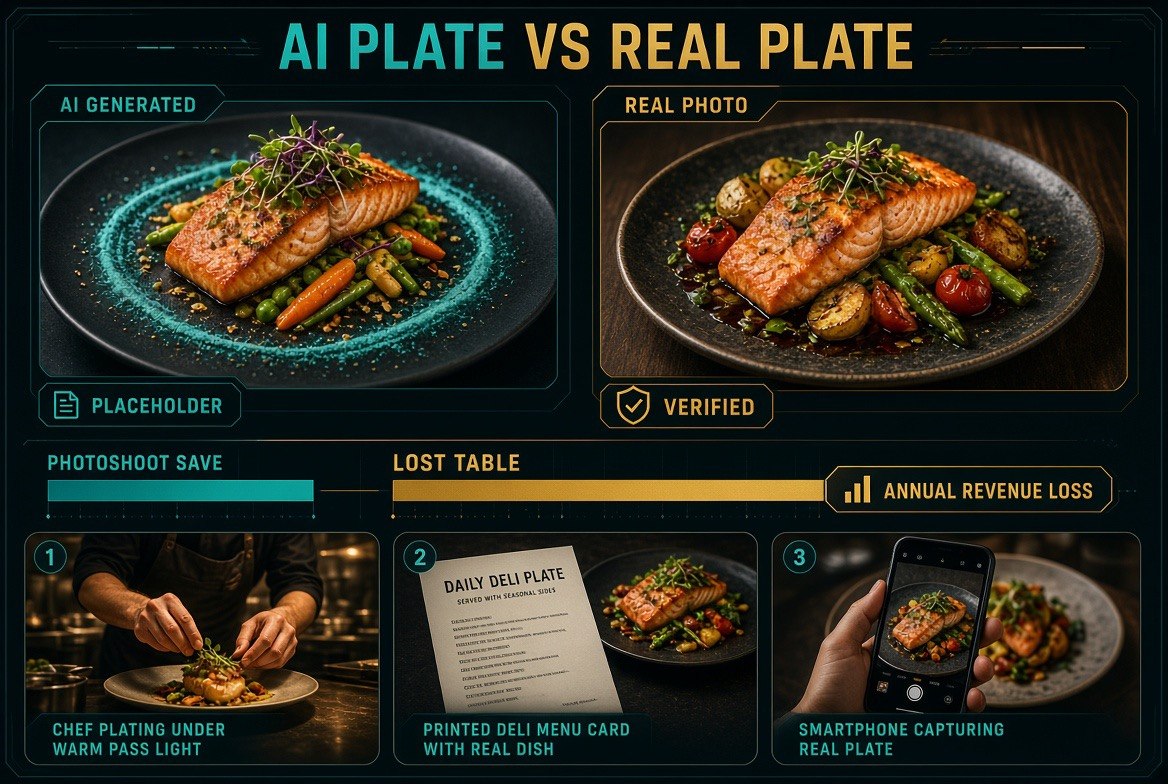
The trade is never close. The photoshoot you skipped is a rounding error next to the tables that never come back.
The Five-Pizza Problem Nobody Checked For
The most damning detail in WIRED’s reporting came from Brendan Sweeney, CEO and cofounder of Popmenu, the digital marketing software company. He described ordering pizza one night on Uber Eats and finding five different pizza places using the same AI-generated image.
Sit with that for a second. Five competitors, one image, all visible to the same customer in the same scroll. The customer does not need to be an AI expert to spot it. They just see the identical pie five times, and every listing in that scroll loses credibility simultaneously.
This is the part operators misunderstand about the slop problem. You are not being judged in isolation. You are being judged next to your neighbors in a feed designed for side-by-side comparison. When one operator cheats with a generated image, the customer’s suspicion spills over onto the honest listings around it. The whole category pays.
WIRED also noted something that deserves more attention than it got: restaurants are now going viral for the opposite behavior. Local spots are posting handwritten notes pledging not to use generative AI food posters, and those notes are getting shared. Customers have started treating the absence of AI slop as a signal of quality — the same way “no preservatives” or “family owned” functioned a decade ago. That is a marketing position sitting there unclaimed in most markets.
Where the AI Actually Belongs on Your Menu
Here is the distinction that separates operators who win with AI from operators who end up on a viral poster.
Use AI to fix the photo you already have. Sweeney’s recommendation is specific and it is the right one. Rather than generating dishes from nothing, use software to enhance photos of real food captured on the smartphone in your pocket. In his words, AI “can now very easily patch those up, plate them all the same, and make the lighting consistent.” That is a genuine professional standard applied to real food — the dish exists, the plate is real, the lighting is now consistent across your whole menu.
That combination solves the problem AI was being used to solve in the first place. You still avoid the photographer, the stylist, and the lost prep day. You still get a menu where every item looks like it came from the same kitchen. But the customer who orders it receives what the photo showed, which is the only version of this that survives a second visit.
Use AI to decide what to cook, not to depict food you don’t cook. WIRED reported on Tastewise, whose platform includes an agent that tests new concepts and an agent that finds opportunity gaps in current menus. Tastewise’s director of marketing and partnerships, Michael Bortinger, framed the real question as one of training: how you guide an AI on what should be in a dish and what belongs on the menu at all. The company says it holds billions of data points on consumer food behavior. In a short test of Tastewise’s TasteGPT chatbot, it flagged dates as a rising flavor and pegged ube as trending but possibly past its peak. Whatever you make of any individual call, the shape of the tool is sound: use AI on the intelligence layer to spot menu gaps and validate a special before you commit prep and inventory to it. Then photograph the real thing.
Do not let AI write your menu copy unsupervised. This is the quieter half of the slop problem and it causes direct operational damage. An AI-written menu description invents ingredients, implies preparation methods, and promises portion sizes your kitchen does not deliver. Your servers then spend service explaining the gap, and every explanation costs the table’s confidence.
The Operator Math on a Bad Food Photo
Let me put numbers on the failure so it stops being an aesthetic argument.
Say you run a full-service independent restaurant with an average check of $38 per person. A party of four is $152. Now say one table a week comes in specifically because of a poster showing a dish that does not match what arrives. They are disappointed. Maybe they send one item back — call it $24 in wasted food and labor. Maybe they ask for a manager. On some percentage of those nights, they leave a review that names the misleading photo, and that review lives on a public page for years, screening out future customers.
One lost table a week at $152 is roughly $7,900 a year in revenue you did not record as a loss, because there is no line item for “customers who did not come back.” Add the comped entrees and the review damage, and the $200 to $500 you saved on photography is the most expensive discount in your operation.
Now flip it. Toast polling reported by WIRED found roughly 85% of restaurateurs say they feel comfortable using AI tools and plan to use them more extensively. That comfort is not the problem — it is the opportunity. The operators who direct that comfort toward the intelligence layer, and keep AI away from the depiction of food, will end up with menus that look better than their competitors’ and match reality.
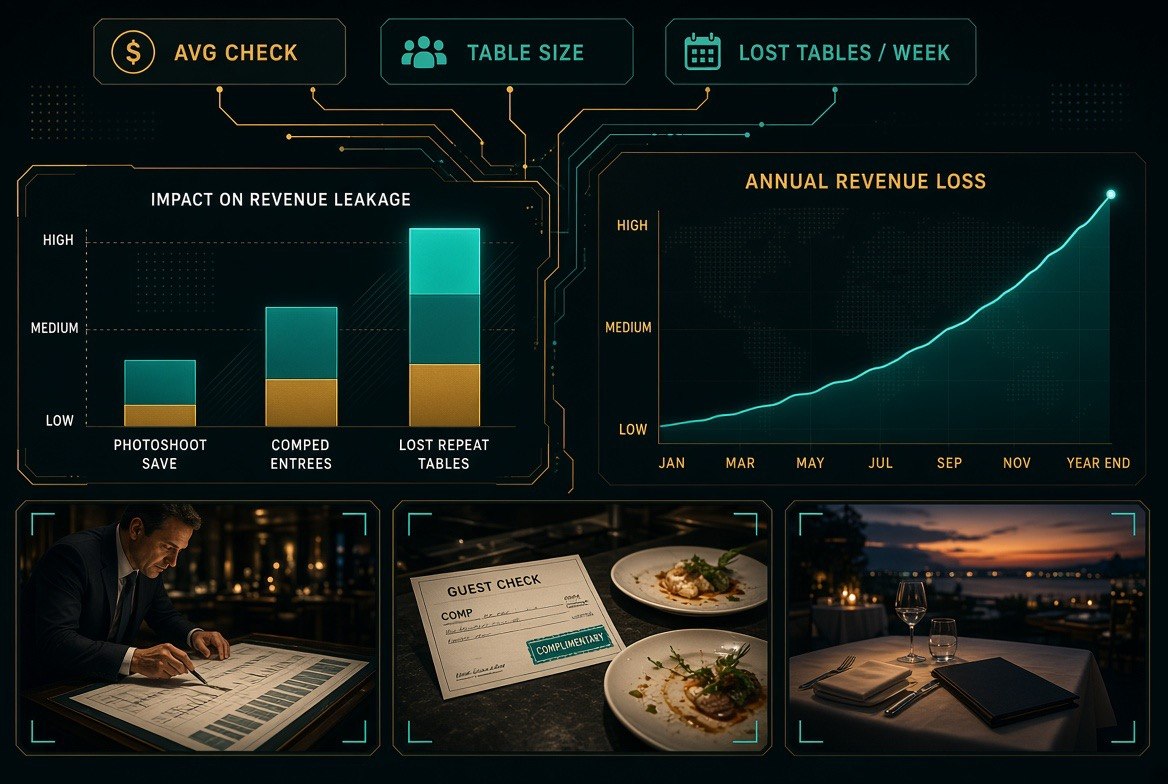
Run your own numbers. The photoshoot you skipped is never the largest bar on the chart.
What Independent Operators Should Do This Week
| Where The Image Appears | Risk Level | What To Check This Week |
|---|---|---|
| Third-party delivery listing | High — judged next to five competitors in one scroll | Reverse-image your own listings against nearby restaurants |
| Printed window poster or tabletop card | Highest — makes a claim guests verify from their chair | Walk outside and read your own signage as a stranger |
| Website menu page | Medium — sets expectation before the visit | Confirm every dish pictured is actually on the menu today |
| Social feed | Medium — screenshotted and shared when it looks wrong | Retire any post whose image does not match the plate |
| Printed menu description text | High — AI copy invents ingredients and prep methods | Read every description against how the kitchen actually cooks it |
1. Audit every image you publish today. Pull up your delivery listings, your website menu, your printed inserts, and any signage. Look at each photo as a suspicious stranger would. If you cannot point to the actual dish in the photo, take it down. A missing photo costs you less than a misleading one.
2. Physically verify your poster inventory. If your windows, tabletops, or deli cases carry printed images, check whether those images were ever real photos of real plates. This is where the 2026 backlash is landing hardest, because print signage makes an implicit claim about what the kitchen does.
3. Shoot your real menu on a phone in one afternoon. Consistent angle, consistent distance, natural light near a window, one dish at a time. You are not making art. You are making evidence.
4. Run those photos through an AI cleanup pass. Consistent plating, consistent lighting, corrected white balance, background tidied. This is the step that replaces the stylist and the photographer, and it costs you almost nothing.
5. Turn the position into a claim. If your market is thick with AI-generated listings, say plainly on your menu and your listings that your food photos are your food. Restaurants are already going viral for refusing to participate. You can be the operator who says it out loud in your town first.
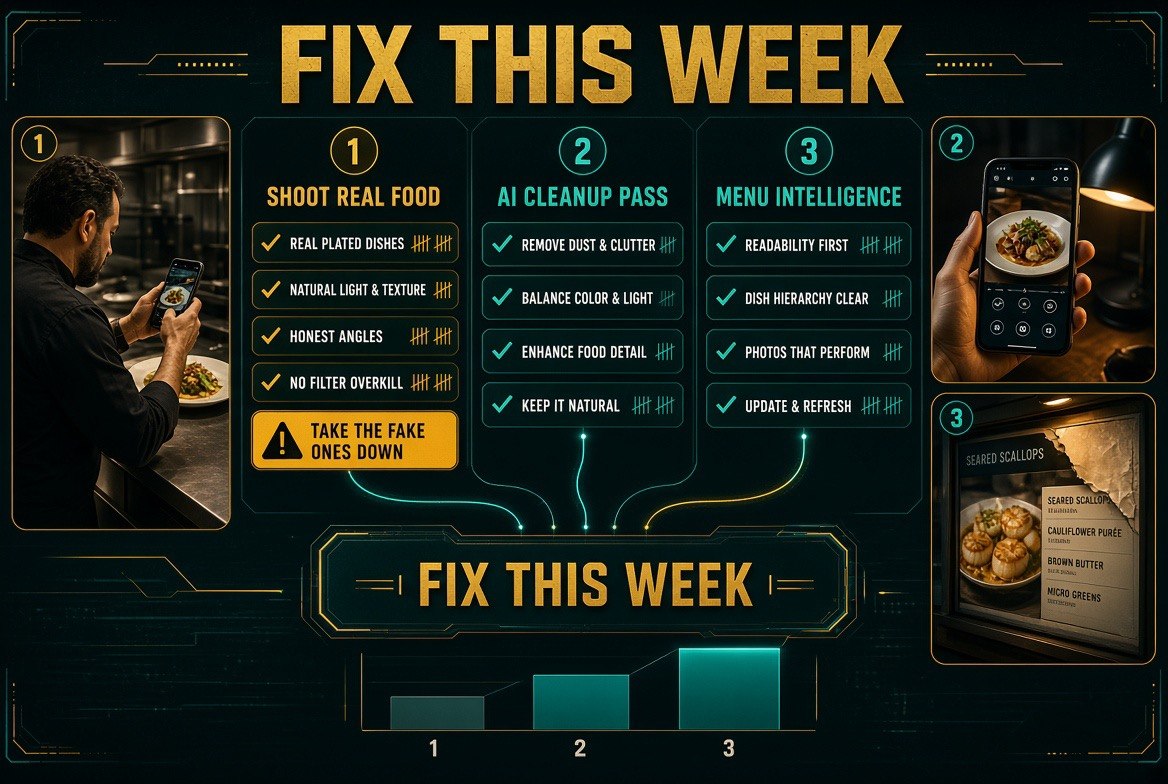
Three lanes, one week. Shoot what you serve, clean it up, and let AI work on the menu intelligence instead of the food itself.
Frequently Asked Questions
Are AI-generated food photos actually illegal for restaurants?
There is no specific US federal rule that bans AI-generated food imagery, so the risk is not primarily legal — it is commercial. The exposure sits in advertising standards around deceptive imagery and, far more likely, in refunds, chargebacks, comped meals, and public reviews. A customer who receives a dish materially different from the advertised photo has a straightforward complaint, and on delivery platforms that complaint escalates quickly.
Why do AI food photos look so bad even when the model is good?
Because the failure is not resolution, it is plausibility. WIRED’s reporting described images carrying artifacts like plastic sheen or textures that read as physically wrong. Real food photography has small irregularities — uneven browning, a little oil, a fallen garnish — that human eyes read as food. Generated images tend to be too clean and too symmetrical, and they are produced by a system that has never tasted the dish. Customers spot the tell in seconds even if they cannot name it.
Can I use AI to edit photos of my real food?
Yes, and this is where the value is. Popmenu CEO Brendan Sweeney recommends using software to enhance images of real food shot on a phone — evening out plating and normalizing lighting across the menu rather than fabricating dishes. The dish in the photo exists, the customer receives what they ordered, and you still skip the cost of a full photoshoot with a stylist and prop budget.
How common is AI use among restaurant owners now?
Very common and rising. In polling from Toast reported by WIRED, roughly 85% of restaurateurs said they feel comfortable using AI tools and intend to use them more extensively going forward. The question for independent operators is no longer whether to use AI, it is which layer of the business to point it at — menu intelligence and photo cleanup, rather than inventing dishes.
What should I do if I already published AI-generated menu images?
Replace them with photos of real dishes, even rough ones shot on a phone, and correct any AI-written menu copy that describes food you do not serve. Then check whether the images appear in print — window posters, tabletop cards, deli signage — because printed signage is where the 2026 backlash concentrated. Customers are more forgiving of a mediocre real photo than of a convincing fake one.
Is refusing to use AI on the menu a good marketing angle?
In markets saturated with AI slop, it is a genuinely differentiated one. WIRED reported that popular local restaurants have gone viral by posting handwritten notes pledging not to use generative AI food posters. The angle works when it is true and specific — say your photos are your food, and let guests verify it at the table. It also gives your staff a clean answer when someone asks whether the menu image is real.

About Barak Schurr
Barak Schurr built and exited a major ticketing platform, ran global operations at Eventbrite, and now focuses on one question: which AI tools actually help independent restaurant owners run leaner and grow faster. He writes from the operator’s perspective — no vendor spin, no theory, just what’s real in 2026.
Email: [email protected]
More Resources for Restaurant Operators