Get the AI Restaurant Quick-Start Guide — Free
The 5 AI tools independent US restaurant owners are using right now to cut labor costs and answer every call.
DoorDash’s $425M Wonder Deal: What Independent Restaurants Must Know About Delivery Consolidation
⚡ Expert Summary: DoorDash is buying Wonder for $425 million and absorbing its Grubhub campus dining operations, consolidating more of the US third-party delivery layer under one roof. For independent restaurant owners, the practical stakes are commission rates that now sit between 15% and 30% per order, menu-data leverage, and who actually owns the customer relationship at renewal. This breakdown covers what changed, what it means for your margin math in 2026, and the specific contract terms operators should renegotiate before their next agreement auto-renews.
When a $425 million acquisition lands in your delivery stack, it rarely shows up as a line item you can see. It shows up eighteen months later as a commission bump, a new “marketing services” fee, or a preferred-placement auction you did not agree to join. That is why the DoorDash–Wonder deal matters more to a 3-unit operator in Ohio than to the analysts writing about it this week.
DoorDash announced the $425 million deal for Wonder in September 2026, folding in Grubhub’s campus dining business as part of the transaction. The headline reads like a corporate chess move in New York. The operational reality reads like a shift in how much leverage independent restaurants have when they sit down to negotiate delivery terms.
What Actually Changed in the DoorDash–Wonder Deal
Wonder is Marc Lore’s food delivery and ghost-kitchen venture. It built a model around centralized production facilities, automated makelines, and a fleet of mobile kitchens that bring prepared food directly to neighborhoods. Grubhub’s campus dining arm handles university and institutional contracts — captive audiences with high order volume and low price sensitivity.
The $425 million acquisition gives DoorDash three things it did not fully control before:
1. Production capacity it owns outright. DoorDash has historically been a logistics layer — it moves food someone else makes. Owning Wonder’s facilities means DoorDash now makes some of the food it delivers. Competitor, customer, and distributor in one stack.
2. Institutional and campus volume. Campus dining contracts are long-term and resistant to price shopping. That is recurring, predictable revenue most delivery platforms would pay a premium to access.
3. More of the order flow. Every acquisition in this space removes a competitive alternative. Fewer platforms competing for restaurant exclusivity means less pressure to offer favorable commission structures.
Why Consolidation Is a Margin Event for Independents
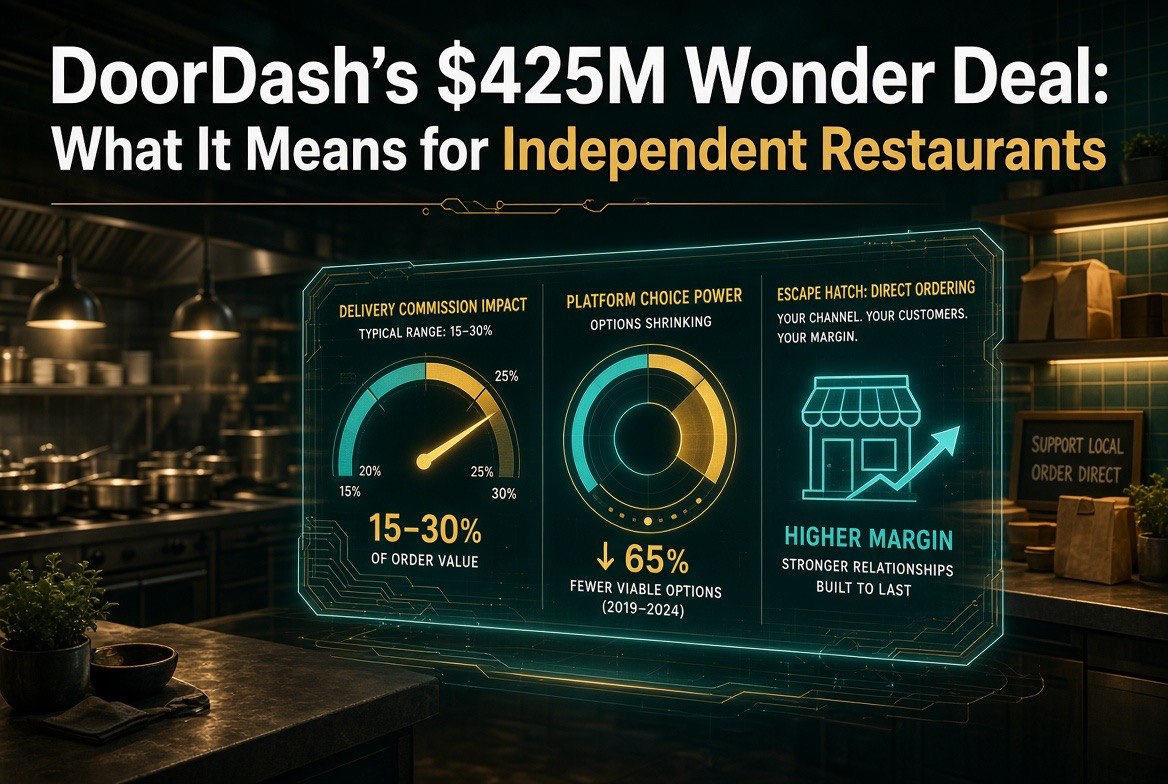
Third-party delivery commissions already run between 15% and 30% of order value depending on tier, volume, and whether the order flows through the platform’s own marketing. For a restaurant running 28% food cost and 30% labor, a 30% delivery commission is not a marketing expense — it is a structural loss on every order the customer believes was profitable.
The consolidation logic runs one direction. When three or four platforms compete, a restaurant can threaten to shift volume to another provider and get real concessions. When two platforms own most of the flow, that threat loses its teeth. Operators who have not renegotiated in two years are negotiating against a market that no longer exists.
| Leverage Factor | Fragmented Market (4+ platforms) | Consolidated Market (2 platforms) |
|---|---|---|
| Typical commission rate | 15%–25% | 22%–30% |
| Negotiation room | High — credible threat to switch | Low — few real alternatives |
| Customer data access | Partial — platform controls most | Minimal — platform owns the relationship |
| Menu placement control | Bid-driven, competitive | Auction prices rise with less competition |
| Contract renewal position | You have options | You have terms |
The table above is not a prediction. It is the pattern operators have already lived through in every market where delivery consolidation happened faster than restaurant-side organizing.
The Campus Dining Angle Most Operators Miss
Grubhub’s campus dining business is the quiet part of this deal. University contracts are frequently exclusive, multi-year, and negotiated at the institutional level — not the restaurant level. When those contracts move under a new owner, the restaurants serving that volume do not get a vote.
If you operate near a large university, a hospital campus, or a corporate park, you have probably already felt this. Exclusive institutional contracts mean one platform controls the entire order flow for thousands of daily transactions. The restaurant gets the volume. The platform gets the relationship, the data, and the pricing power.
The practical question for these operators is simple: what happens to your institutional contract terms when the entity holding that contract changes hands? In most cases, the contract transfers with obligations intact — but the service levels and fee schedules do not. Read the assignment clause before renewal, not after.
What Independent Operators Should Actually Do This Quarter
Consolidation is not a reason to panic. It is a reason to renegotiate on your terms while you still have alternatives. Here is the operational sequence that protects margin:
1. Audit your true delivery cost per order
Pull 90 days of delivery orders and calculate fully loaded cost: commission, packaging, refunds, chargebacks, and the labor to manage platform tickets. Most operators discover their effective commission is higher than their contract rate because of fees they never modeled. Any AI-powered accounting tool that connects to your POS can automate this — MarginEdge and similar tools pull delivery line items into your P&L instead of leaving them in a separate report.
2. Compare against direct ordering economics
A commission-free ordering site changes the math entirely. Tools like Orders.co, Owner.com, and Popmenu let you build a branded ordering channel with zero commission. When you negotiate with a consolidated platform, arriving with a working direct channel changes the conversation from “what will you give me” to “why should I stay.”
3. Get your customer data in writing
Insist your contract grants access to customer contact data for orders you fulfill. When platforms consolidate, data leverage consolidates with it. If you cannot market to your own customers, you are renting demand you should own.
4. Negotiate terms longer than the market’s mood
If you have any leverage today, lock it into a multi-year agreement with capped commission increases. A rate locked in 2026 is worth more than a handshake in a market that will only get tighter.
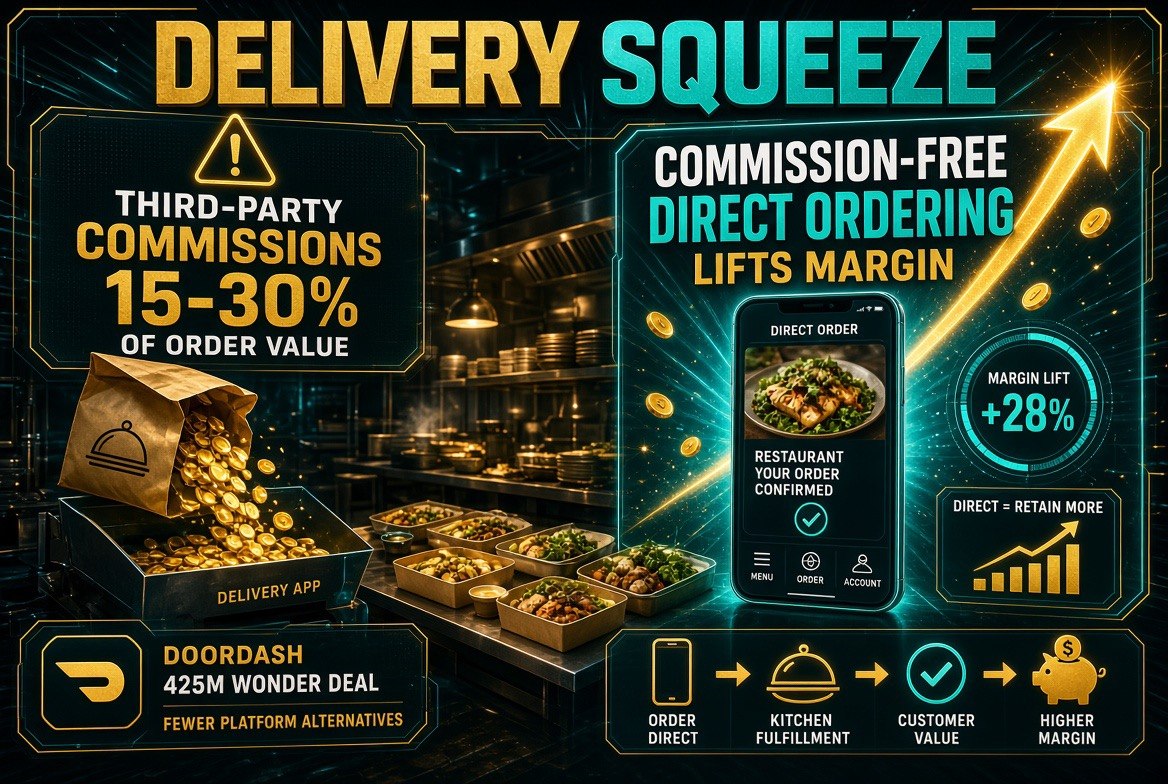
Delivery platforms take 15-30% of every order. After the $425M Wonder deal, commission-free direct ordering is the margin lever independent operators actually control.
How AI Changes the Delivery Margin Equation
The reason this consolidation matters now — not in 2019 — is that AI has made the alternative to third-party delivery genuinely viable for small operators.
AI phone answering systems take orders without staffing a line. AI menu engineering reshapes pricing by item margin rather than gut feel. AI demand forecasting tells you what to prep before the Friday rush instead of after. Each of these reduces the operational reason you needed a platform’s reach in the first place.
| Capability | AI Tool Type | Margin Impact | Typical Monthly Range |
|---|---|---|---|
| Phone order capture | AI voice answering | Recovers missed calls; no added labor | $150–$500 |
| Direct ordering site | Commission-free platform | Removes 15%–30% platform cut | $99–$399 |
| Menu pricing | AI menu engineering | 2%–6% blended margin lift | $50–$250 |
| Prep accuracy | AI demand forecasting | Cuts waste 10%–30% | $100–$400 |
| Cost visibility | AI accounting integration | Exposes hidden fee leakage | $75–$300 |
These are not replacement costs for delivery. They are the tools that make the threat to leave credible — and credibility is the only thing that moves a consolidated platform’s pricing.
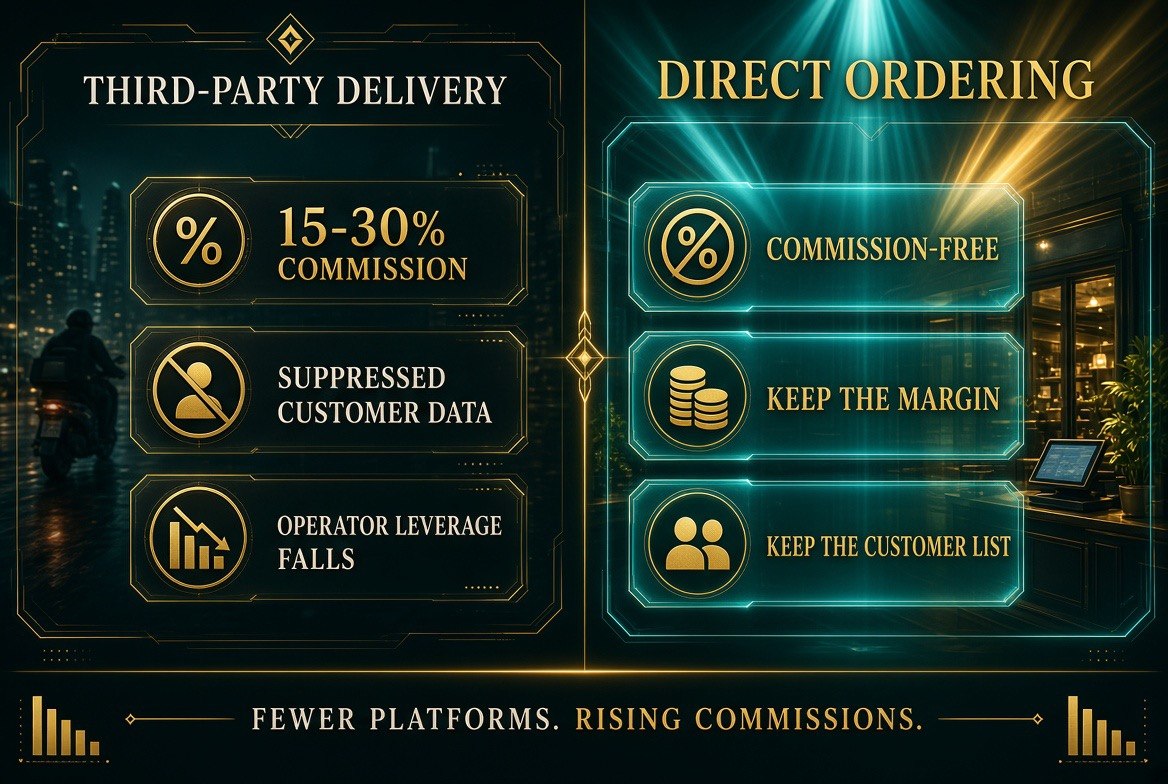
Fewer platforms means less leverage. This is the trade every independent operator now faces: pay 15-30% and lose the customer relationship, or build a direct channel that keeps both.
The Hidden Cost of Platform-Owned Production
There is a second-order effect in this deal that deserves its own heading. DoorDash now operates production facilities through Wonder. That makes DoorDash a supplier to the same restaurants it delivers for — and in some markets, a direct competitor to them.
This is not theoretical. Wonder’s model is centralized commissary production feeding mobile kitchens and delivery. When a delivery platform can make its own version of a menu item at its own facility and deliver it on its own fleet at a marginal cost no independent restaurant can match, the platform does not need to raise commissions to squeeze you. It simply needs to compete with you on price for the same customer, using the demand data it collected from your orders.
Ask any operator who has watched a platform launch a private-label menu line. The commission question is the visible one. The competition question is the one that shows up in year three.
Reference Points: What Delivery Economics Look Like in 2026
Operators who want to benchmark their own numbers should anchor against published industry data rather than anecdote. The National Restaurant Association’s 2026 State of the Industry report continues to show restaurant industry sales above $1.5 trillion nationally, with off-premise channels accounting for a historically elevated share of transactions — a structural shift that began in 2020 and has never reverted.
On the delivery side, the economics are stark. Industry analyses of US third-party delivery consistently find effective commission rates clustered in the mid-20s as a percentage of order value once marketing fees, delivery fees, and promotional participation are included. For a restaurant doing $40,000 per month in delivery volume, the difference between a 22% blended rate and a 28% blended rate is $2,400 per month — $28,800 a year — on identical food cost.
That is the number to bring to a renewal conversation. Not the rate card. The effective rate, calculated from your own POS export.
What the Grubhub Campus Deal Signals About the Next Move
Grubhub’s campus dining business was one of the last structurally protected positions in delivery. Institutional contracts with universities, hospitals, and corporate campuses created a moat of exclusivity that insulated that revenue from normal platform competition.
DoorDash buying its way into that moat tells you where the company believes growth is: not in winning new delivery orders from the open market, but in owning channels where competition has been contractually excluded. That is a consolidation logic, not a growth logic — and consolidation logic always ends in pricing power for the consolidator.
If you serve an institutional catchment area and do not know the term structure on the contract that governs your order flow, that is the single highest-value document you can read this month.
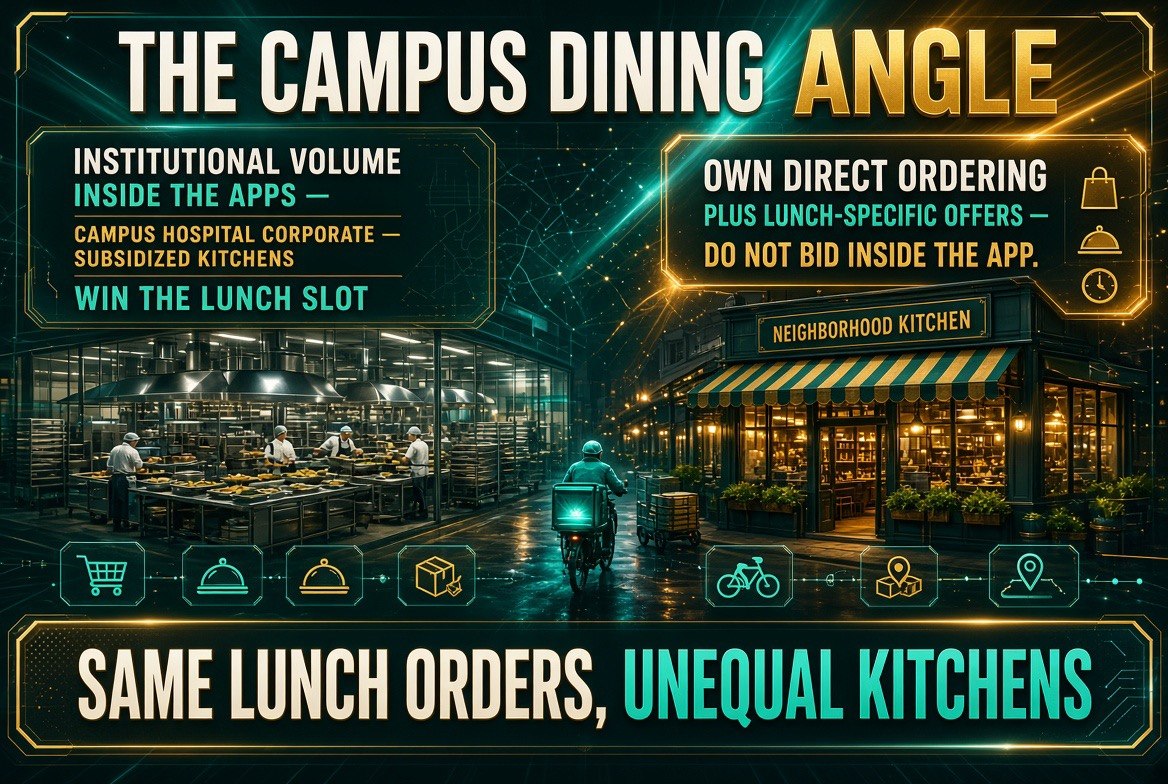
Campus and corporate dining volume now flows through the big delivery apps. Independent kitchens compete for the same lunch spend against subsidized institutional kitchens — which is why owning a direct channel matters more than bidding for placement.
Who Wins and Who Gets Squeezed
Multi-unit operators with strong direct channels and real data on their own customers will likely come out fine. They have the volume to negotiate and the infrastructure to shift orders off-platform when terms get unreasonable.
Single-location independents who rely on platform discovery and have no direct channel are the ones exposed. They cannot credibly walk away, they cannot access their customer data, and they bid against rising placement costs with no alternative to fall back on.
That gap is the real story. The DoorDash–Wonder deal did not create it. It widened it — and it made the window to build an alternative, this quarter, considerably more urgent than it was last quarter.
The Bottom Line for Your Restaurant
Delivery consolidation is not a technology story. It is a purchasing-power story. The platforms are getting bigger. The commission structures are getting less negotiable. The operators who will be fine in 2028 are the ones who start treating their own ordering channel, their own customer data, and their own margin visibility as infrastructure — not as someday projects.
Start with the audit. Know your true cost per delivery order. Then build the direct channel. Then negotiate. In that order, with real numbers on the table, you are a customer worth keeping. Without them, you are volume.
Frequently Asked Questions
What does the DoorDash $425 million Wonder acquisition mean for independent restaurants?
It reduces the number of competing delivery platforms, which weakens an independents’ ability to negotiate commission rates. Operators with no direct ordering channel have the most exposure, because they cannot credibly threaten to shift volume elsewhere.
Will DoorDash raise commissions after acquiring Wonder?
No public pricing commitment has been made. Historically, market consolidation in delivery has correlated with higher effective commission rates over a 12–24 month period. Operators should lock favorable rates into multi-year agreements while alternatives still exist.
Do campus dining contracts transfer in the Wonder acquisition?
Institutional contracts typically transfer with obligations intact, but fee schedules and service levels often do not. Restaurants serving university or hospital campuses should review the assignment clause in their contract before the next renewal cycle.
How can an independent restaurant reduce third-party delivery commissions?
Build a commission-free direct ordering channel, audit your true loaded cost per delivery order, demand access to your own customer data, and negotiate capped rate increases into a multi-year term. Each step increases your leverage with the platform.
Is AI worth it for a small restaurant trying to cut delivery costs?
Yes, specifically for phone order capture, direct ordering sites, and cost visibility. These tools make the alternative to platform delivery operational, which is what gives you negotiating power in the first place.

About Barak Schurr
Barak Schurr built and exited a major ticketing platform, ran global operations at Eventbrite, and now focuses on one question: which AI tools actually help independent restaurant owners run leaner and grow faster. He writes from the operator’s perspective — no vendor spin, no theory, just what’s real in 2026.
Email: [email protected]
More Resources for Restaurant Operators