Get the AI Restaurant Quick-Start Guide — Free
The 5 AI tools independent US restaurant owners are using right now to cut labor costs and answer every call.
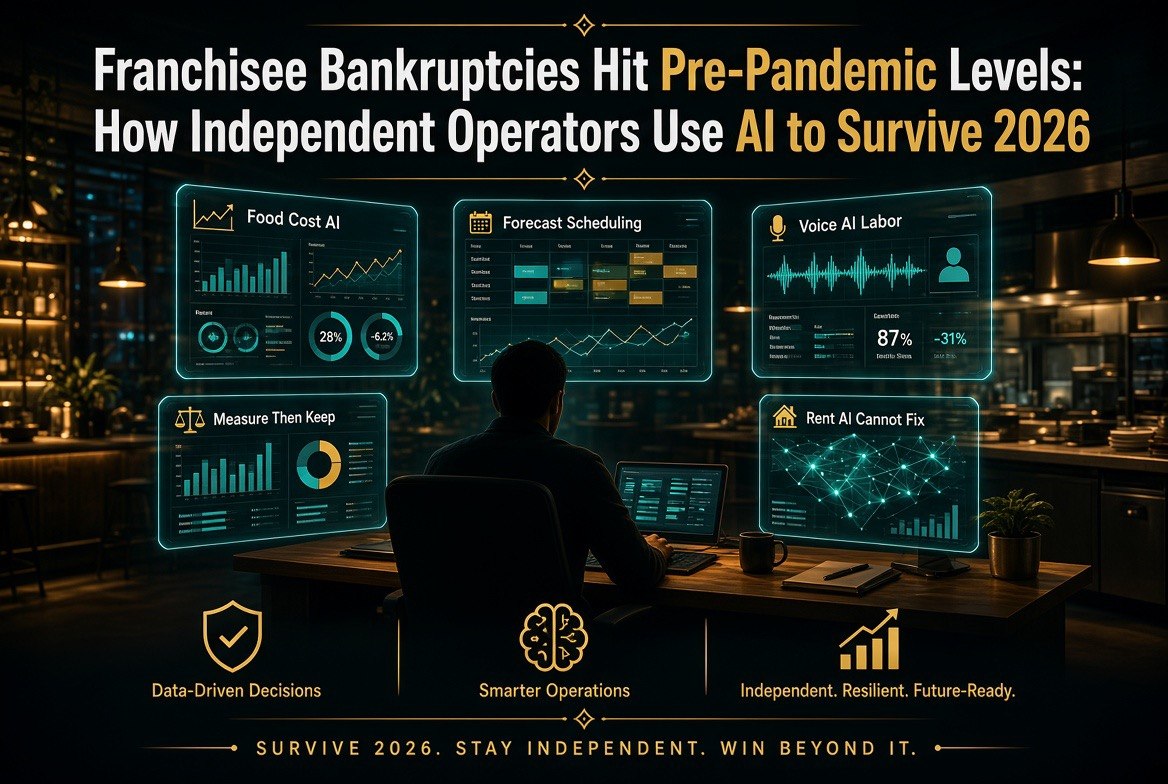
Franchisee Bankruptcies Hit Pre-Pandemic Levels: How Independent Operators Use AI to Survive 2026
⚡ Expert Summary: Multi-unit franchisee bankruptcies are back at pre-pandemic levels in 2026, driven by three cost lines — labor, food, and rent — that independent operators can actually attack with AI. The winners are not the chains with the biggest budgets. They are the operators running one system per problem: inventory AI for food cost, voice AI for phone and drive-thru labor, forecasting AI for scheduling. A Restaurant Dive analysis of the 2026 bankruptcy wave shows the failure modes clearly. Here is how to be on the other side of that line.
Restaurant bankruptcies are back. Not restaurant closures — restaurant bankruptcies, the multi-unit kind where an operator with eight, twenty, or two hundred locations files and the lenders start circling. Restaurant Dive reports the wave has pushed franchisee bankruptcy filings to pre-pandemic levels, and the pattern in the filings is consistent enough to be instructive.
That matters to independent operators for an uncomfortable reason: the arithmetic that kills a fifty-unit franchisee is the same arithmetic that kills a two-unit independent. The difference is one of them has a CFO who sees it coming and the other is standing at the register on a Friday night hoping the weekend covers the payroll run.
This is not a doom piece. It is the opposite. The cost lines that are breaking multi-unit operators in 2026 are the same cost lines AI has gotten genuinely good at attacking — and for once, the independent has an advantage: no franchise system to get approval from, no corporate IT roadmap, no eighteen-month rollout.
What the 2026 Bankruptcy Wave Actually Looks Like
Strip the legal filings down to their economic drivers and three lines do almost all the damage.
Labor. Restaurant labor runs 28% to 35% of revenue for most full-service independents, and in high-cost metropolitan areas it pushes past that. Minimum wage increases in more than twenty US states took effect this year, and the operators hit hardest are those who staffed to a pre-2024 model and never rebuilt the schedule around actual traffic.
Food cost. Commodity volatility, tariff pass-through on imported ingredients, and shrink — the food you buy and never sell — keep food cost on a knife edge between 30% and 33% for operators who do not count. Every point above 30% comes directly out of a margin that was thin before the wave started.
Rent and debt service. This is the one AI cannot fix, and it is why the wave is hitting multi-unit franchisees hardest. Sale-leaseback structures and variable-rate debt loaded during the low-rate years reset into a much more expensive world. An operator who signed a fifteen-year lease on a site that now does 70% of projected volume has a fixed obligation that no amount of operational efficiency can clear.
That is the honest picture. AI is a margin tool, not a refinancing tool. If a location is structurally underwater on rent, no vendor will save it and any vendor promising otherwise is lying to you.
But if the location works and the margin is leaking, the leak is almost always in the first two categories — and those are fixable.
Mapping Each Cost Driver to a System You Can Deploy This Quarter
Here is where operators get lost. “Use AI” is not a strategy. A specific system pointed at a specific cost line is a strategy.
| Cost Driver | Manual Approach Today | AI System That Attacks It | Realistic Year-One Impact |
|---|---|---|---|
| Food cost / shrink | Monthly count, clipboard, estimated usage | Inventory + recipe costing platforms that reconcile invoices against actual usage | 2 to 4 points of food cost found in the first two counted periods |
| Phone labor | A server answering between tables, missing 30-40% of calls at peak | Voice AI that answers, books, and takes takeout orders without a headset | 15 to 25 labor hours per week recaptured at a single location |
| Scheduling cost | Same schedule every week regardless of forecast sales | Forecasting + scheduling platforms using POS history and weather | 3 to 6% of labor spend recovered without cutting service levels |
| Waste / prep | Prep to habit, not to forecast | Demand forecasting tied to prep lists and par levels | Meaningful reduction in end-of-night throwaway on perishables |
| Rent / debt service | Lease obligations fixed for years | No software solves this — it is a site-level economics question | None. Be honest with yourself here first. |
Read that last row twice. The operators who survive a bankruptcy wave are the ones willing to look at an underperforming site and say the quiet part out loud: this location cannot be saved by efficiency, and every dollar spent trying is a dollar not spent on the locations that work.
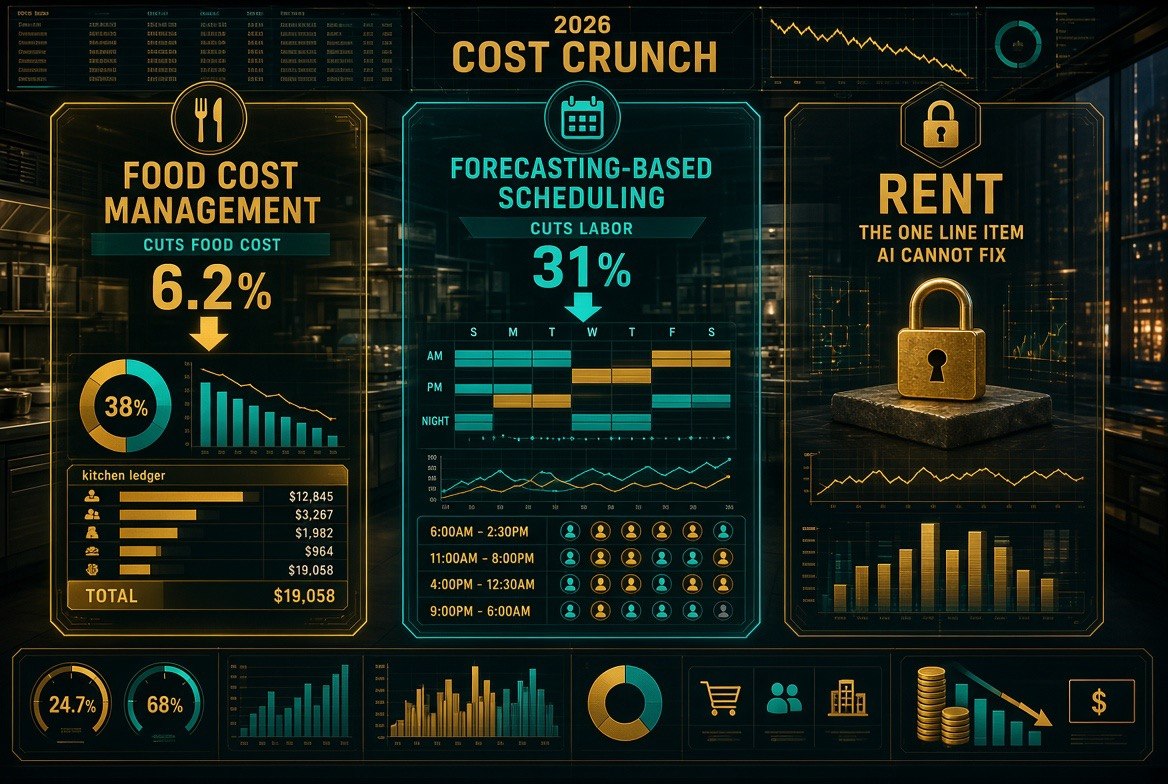
Two line items AI can actually move — food-cost management at 6.2% and forecast-driven scheduling at 31% labor savings — against rent, the one fixed cost no software touches. That gap is the whole 2026 margin story.
The Manual vs. AI Cost Comparison for a Single Independent Location
Vendors love to talk about percentages. Operators think in dollars. Here is the same argument in dollars, using a two-unit independent doing roughly $1.4 million in annual revenue — a realistic profile for a full-service US independent, not a chain.
| Line Item | Manual Operation (Annual) | With AI Systems (Annual) | Delta |
|---|---|---|---|
| Food cost at 32% of revenue | $448,000 | $420,000 at 30% after 2 points recovered | +$28,000 |
| Labor at 31% of revenue | $434,000 | $416,640 at 29.76% after 4% recovery | +$17,360 |
| Software spend | $1,200 (POS + payroll only) | $9,000 to $14,000 across three systems | -$9,000 to $13,000 |
| Manager admin hours | 15 to 20 hrs/week on counts and schedules | 5 to 8 hrs/week on exception review | ~500 hours returned |
| Net annual position | — | — | +$33,000 to $45,000 |
Two things about that table deserve plain language. First, the delta is not a fantasy number — it is the arithmetic of two points of food cost and four percent of labor, both of which are consistently reported by operators running these systems rather than promised by vendors alone. Second, the software line is real: you will spend $9,000 to $14,000 a year across an inventory system, a voice agent, and scheduling. If you only buy one, buy the one that attacks your worst line, not the one with the best sales demo.
The 2026 Restaurant Technology Report found 61% of US operators running AI in some form reported lower food costs — a figure consistent with the food-cost recovery above. That is not a guarantee for your kitchen. It is a signal that the operators who count are the operators who find money.
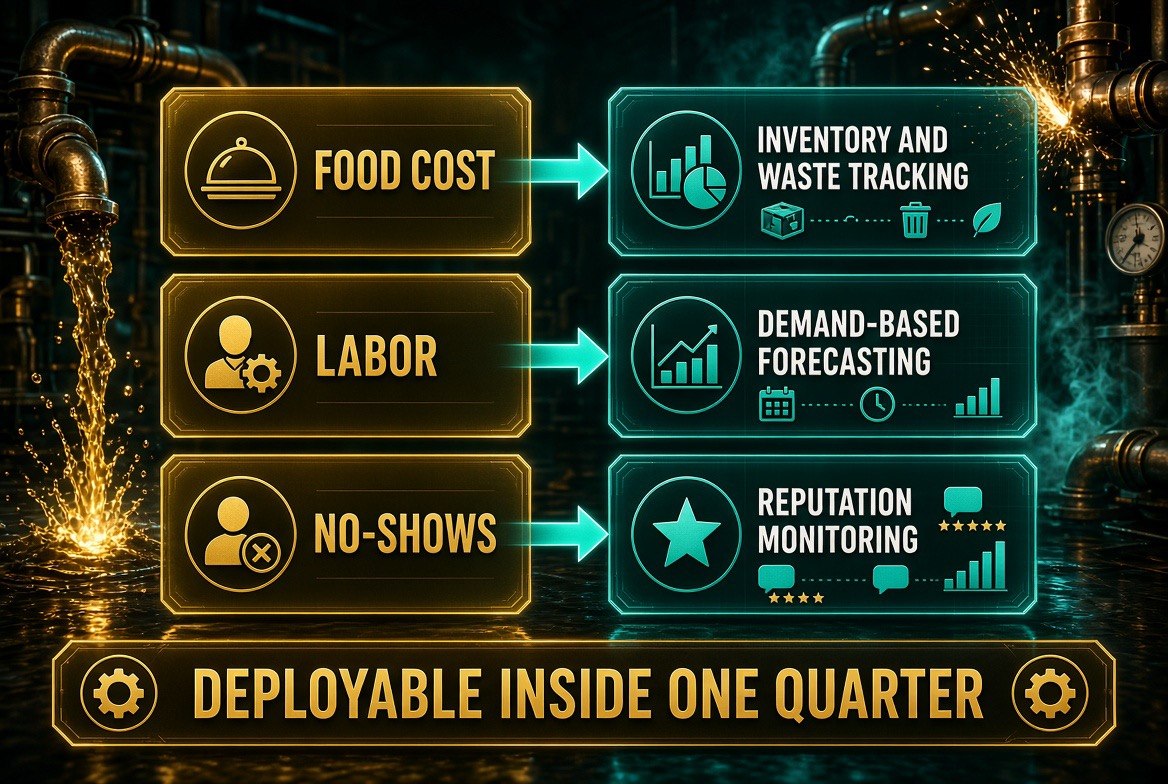
The mapping that matters: every bleeding cost line has a system it answers to. Food cost to inventory and waste tracking, labor to demand-based forecasting, no-shows to automated confirmation — each deployable inside a single quarter.
Why Independents Have the Advantage Right Now
Multi-unit franchisees are filing because their cost structure is locked by contracts they cannot renegotiate quickly: franchise agreements, leases, system-wide technology mandates, corporate approval chains.
An independent with two locations can decide on a Tuesday and be running a voice agent by the following Monday.
That speed is a genuine competitive advantage in a market where the chains are getting slower, not faster. A franchisee cannot switch POS systems without corporate sign-off. A franchisee cannot adopt a third-party inventory tool without arguing with a franchise business consultant. An independent can test something for one month at one location, measure it, and either keep it or kill it with no politics attached.
The practical version of that advantage looks like this: pick your worst cost line. Count it for one full period so you have a real baseline — not an estimate, a count. Deploy one system against it. Measure again the next period. If the number moved, keep it and go to the next line. If it did not move, cancel and try a different approach.
That is the whole method, and it is the opposite of how most operators buy software — which is to sign an annual contract for a bundle after a single sales call and then never measure whether the number moved.
What to Do in the Next 30 Days
Week one: get a real food cost number. Not last month’s estimate. A physical count, reconciled against invoices, with recipe-level costing on your top twenty items. Most independents find their actual food cost is 2 to 4 points higher than the number in their head. That gap is the money you are looking for.
Week two: count the calls you miss. Put a tally sheet at the phone or pull your call log from your provider. If you are missing 30% or more of calls during peak, you are not just losing reservations — you are paying a server to fail at a second job. That is the clearest case for a voice agent and the easiest one to prove with data.
Week three: pull your labor against your actual sales by daypart. If your schedule looks the same on a Tuesday that does $4,000 as a Saturday that does $11,000, you are overstaffed on slow days and understaffed on the days that pay your rent. Forecasting and scheduling tools exist specifically to close that gap, and the recovery is typically 3 to 6% of labor spend.
Week four: decide on your underperforming site. This is the hard one. If a location’s rent and debt service exceed what the site can generate at reasonable efficiency, no technology changes that arithmetic. Better to have that conversation with your lender while you still have the other locations performing than eighteen months from now when you do not.
The operator’s read: the bankruptcy wave is a margin story, not a demand story. Traffic is not collapsing. Costs are. That is good news, because costs are the thing you can attack.
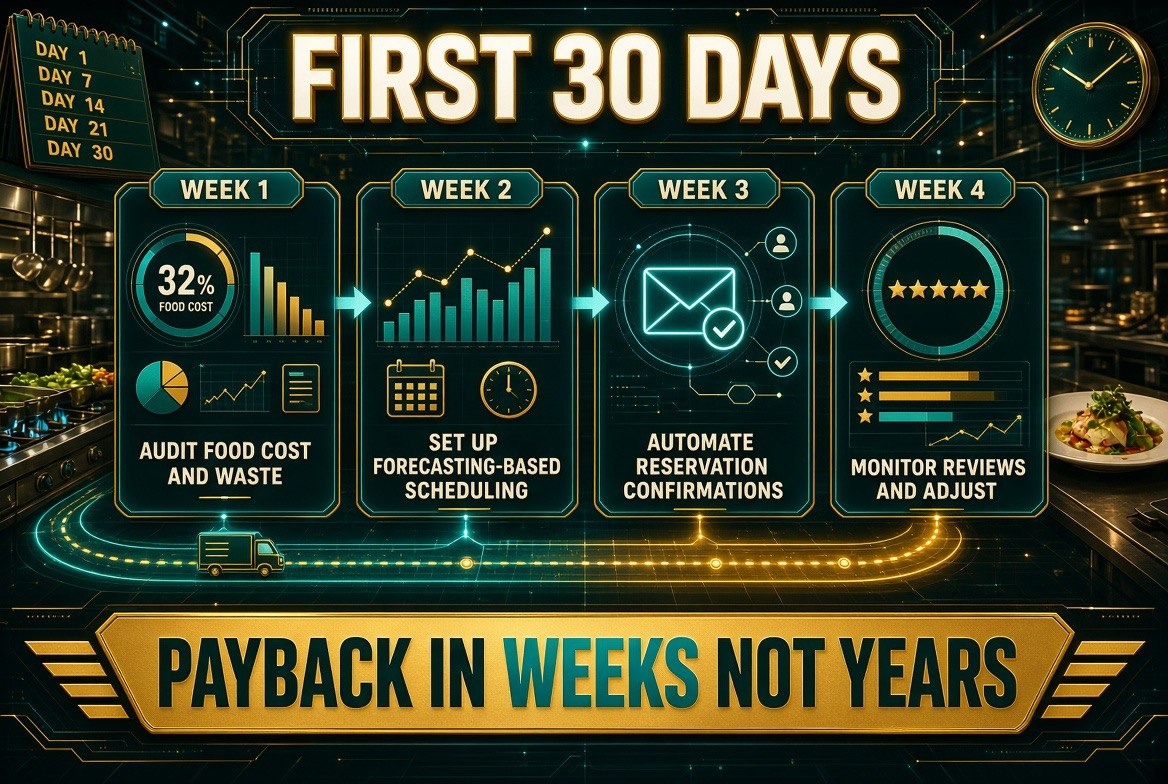
A 30-day sequence an independent can actually run: audit food cost and waste, then forecasting-based scheduling, then automated reservation confirmations, then review monitoring. Payback lands in weeks, not years — which is the only reason this is viable at independent scale.
The Systems Worth Looking At
You do not need a stack. You need one system per broken line, and you need to measure whether it moved the number.
For food cost and inventory: platforms that reconcile invoices against actual usage at recipe level. MarginEdge and meez both work this lane; the choice usually comes down to how much of your invoice workflow you want automated versus controlled manually.
For voice and phone labor: voice agents that answer, book, and take orders. Toast for restaurants running its POS has a voice product, and Presto and Slang.ai both compete in this space. Verify whether each integrates with your existing phone number before you commit.
For scheduling and forecasting: tools that read your POS history rather than your gut. 7shifts and HotSchedules are the common starting points for independents.
For the whole picture: if you want the back-office suite rather than point solutions, Restaurant365 is the most widely deployed option among US operators and its reporting is what most consultants ask for first.
Start with one. Measure it. Then decide about the second. Read our full breakdown of how AI tools are reshaping independent restaurant operations for the wider picture on where these systems actually earn their money.
Frequently Asked Questions
Why are restaurant franchisee bankruptcies surging in 2026?
The 2026 wave is driven by three cost lines rather than collapsing demand. Labor has risen to 28% to 35% of revenue with minimum wage increases across more than twenty US states. Food cost sits between 30% and 33% for operators who do not count. And rent and debt service signed during the low-rate years now reset against variable-rate structures that multi-unit franchisees cannot renegotiate quickly.
Can AI actually save an independent restaurant from bankruptcy?
AI can fix margin leaks in labor and food cost, which are the two cost lines independents can control. It cannot fix a site whose rent and debt service exceed what the location can generate, because no software changes a lease. Give AI the locations that are structurally sound and it will move the numbers. Do not use it as a reason to delay the hard conversation about an underwater site.
What is the fastest AI win for an independent restaurant operator?
Counting your missed calls. Most independents lose 30% or more of inbound calls during peak service, and every missed call is a lost reservation or takeout order plus a server paid to fail at a second job. A voice AI that answers, books, and takes orders produces a measurable result in the first week, which makes it the easiest system to justify and verify.
How much does an AI stack cost for a single independent location?
Realistically $9,000 to $14,000 per year across three systems — inventory and recipe costing, voice AI, and forecasting and scheduling. Against roughly $33,000 to $45,000 in recovered margin from two points of food cost and four percent of labor, the stack pays for itself several times over. But buy one system at a time and measure each before adding the next.
Do I need to replace my POS to use AI in my restaurant?
Usually no. Most inventory, voice, and scheduling systems integrate with the major POS platforms, and the integrations are typically the deciding factor in which vendor to choose rather than a reason to rip out your POS. Verify integration with your specific POS and phone setup before signing anything. Switching POS mid-crisis adds cost without addressing either broken margin line.

About Barak Schurr
Barak Schurr built and exited a major ticketing platform, ran global operations at Eventbrite, and now focuses on one question: which AI tools actually help independent restaurant owners run leaner and grow faster. He writes from the operator’s perspective — no vendor spin, no theory, just what’s real in 2026.
Email: [email protected]
More AI Resources for Operators