Get the AI Restaurant Quick-Start Guide — Free
The 5 AI tools independent US restaurant owners are using right now to cut labor costs and answer every call.
Metafoodx Launches a Mobile App for Real-Time Restaurant Kitchen Intelligence: What It Means for Independent Operators
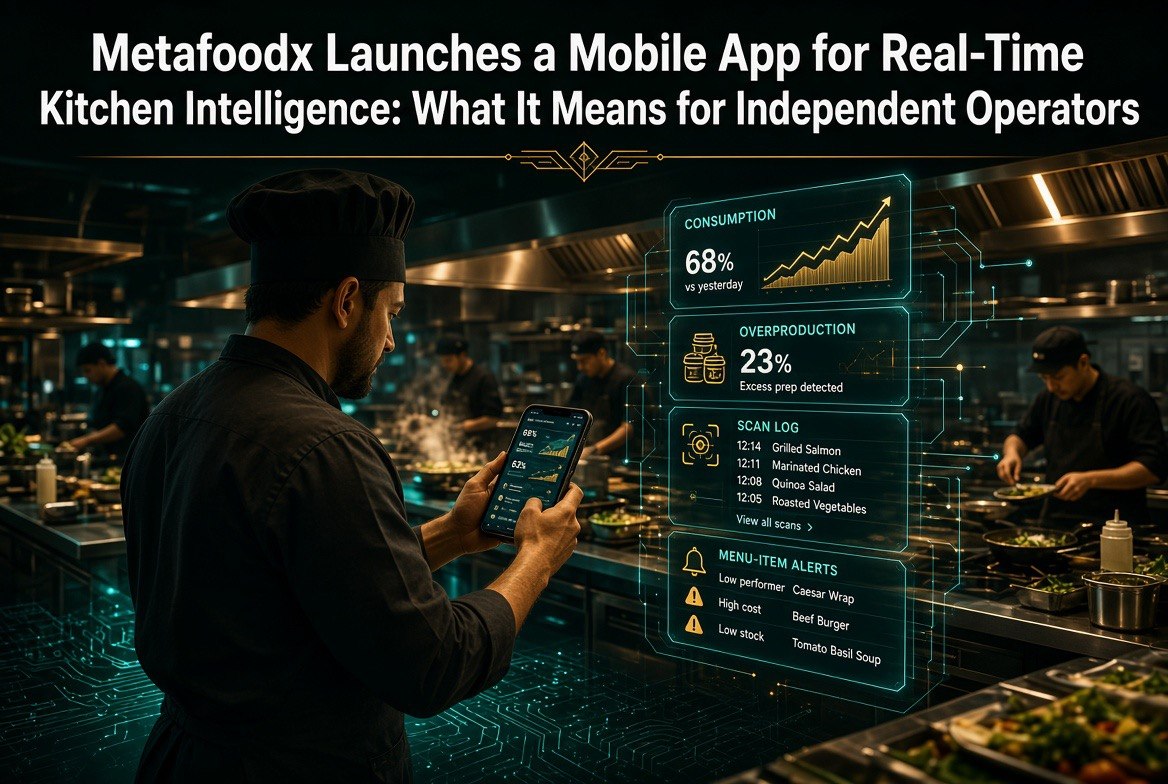
⚡ Expert Summary: Metafoodx — an AI-powered kitchen intelligence platform — launched an iOS app that puts live consumption, overproduction, and scan data in a kitchen manager’s hand instead of on a back-office screen. The app is built around four views: Home (at-a-glance consumption and overproduction across venues), Live View (real-time, menu-item-level data filterable by cost or volume), Scan Log (a live feed of individual scans for line-level quality checks), and Manage (download and share reports from the phone). The headline shift is timing: decisions that used to wait until someone returned to a desk can now happen during service, when they still matter. Android is coming next.
Ask any independent restaurant operator where food cost gets away from them and you’ll get the same answer: it’s not the invoice, it’s the walk-in. Inventory sits, product ages, portions drift, and by the time anyone reconciles the numbers the loss is already booked. The problem has never been a lack of data. It’s that the data lives in a place no one stands during a Friday night rush.
Metafoodx built its business on closing that gap with AI-driven kitchen intelligence. On September 10, 2026, the company took the next logical step and put the whole thing on a phone.
What the Metafoodx App Actually Does
The app isn’t a chopped-down dashboard. It’s organized around four areas that map directly onto how a kitchen manager’s day actually runs — and the important detail is that all of it displays live, same-day data, built for use during service rather than in a Monday morning review.
| Factor | Desktop Dashboard (Old Way) | Metafoodx Mobile App |
|---|---|---|
| Where you check it | Back office or desk | Anywhere in the venue, on the floor |
| When you see the data | After the shift, or whenever you step away | Live, same-day, during service |
| Overproduction visibility | Daily or weekly rollup | Real-time at menu-item level, filterable by cost or volume |
| Scan activity | Reviewed as a report | Live feed of individual scans for line quality checks |
| Multi-venue view | Separate logins or consolidated report | At-a-glance across venues from Home |
| Reporting | Export from a computer, then email | Download and share directly from the phone |
Read the fourth row carefully, because it’s the one that changes behavior on the line. A traditional overproduction report tells you what went wrong. A live feed of individual scans tells you what’s happening right now — that the line is skipping a step, that a station is scanning inconsistently, that a specific item is moving faster than the forecast. One is a post-mortem. The other is a conversation you can have while the cook is still at the station.
Metafoodx CEO and co-founder Fengmin Gong put the logic plainly: kitchen managers shouldn’t have to step away from the floor to know what’s happening in their operation, so they can catch a scanning gap or a high-demand item running low before it becomes a bigger problem. That’s the entire value proposition in one sentence.
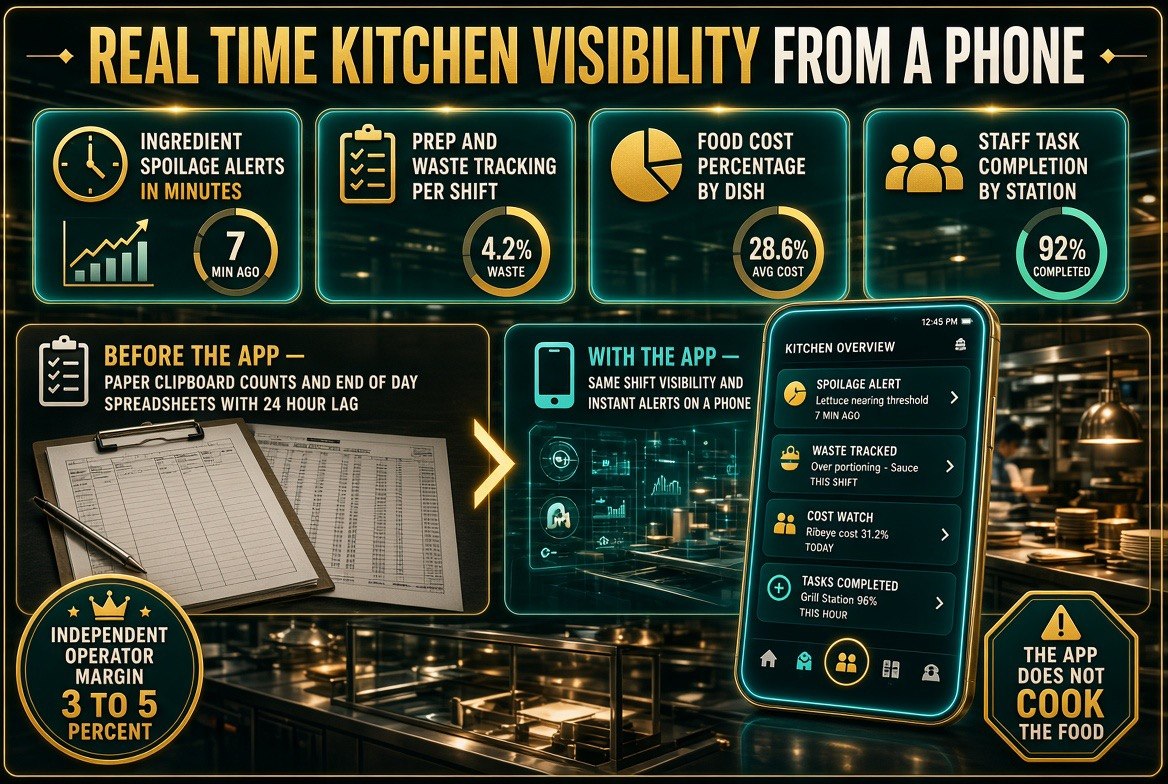
What changes when the count lives on a phone: instead of a clipboard and a next-day spreadsheet, spoilage, waste, food cost, and station tasks surface on the same shift — while the food still has to be cooked by someone.
Why an App Is a Bigger Deal Than It Sounds
It’s tempting to read “mobile app” as a convenience update. For restaurant operators, it’s closer to a category change, for three reasons.
First, it moves the decision point forward in time. Food cost problems compound. A high-demand item running low at 6:40 PM is a substitution you make calmly; the same discovery at 9:15 PM is a comped ticket and a bad review. Every minute you move the decision earlier is money you don’t lose. That’s the difference between an analytics product and an operational one.
Second, it fits the actual work environment. Independent operators don’t sit. They’re expediting, checking plates, talking to guests, and covering gaps. A dashboard that requires sitting down gets checked once a day at best. A phone that’s already in their pocket gets checked between tasks. Adoption isn’t about features — it’s about whether the tool fits into the ten seconds someone actually has.
Third, it works for multi-unit operators without an office culture. The Home view spans venues, which matters if you run two or three locations and can’t be everywhere. That’s a segment — small multi-unit operators, campus dining operations, and food service groups — that usually gets priced out of enterprise kitchen intelligence platforms.
An early user quote backs the adoption point. Pete Allard, Assistant Manager of Hampshire Dining Commons at the University of Massachusetts at Amherst, said it’s nice to have the information so quickly at your fingertips while walking around or in the office, and that he can just pull it up quickly. That’s a non-technical manager describing a tool that fits his day rather than one he has to make room for.
Honest Limits: What the App Doesn’t Fix
Three things worth knowing before you evaluate this for your own operation.
- It requires the underlying scanning workflow to exist. The app surfaces consumption, overproduction, and scan data — which means there has to be data. If your kitchen isn’t already doing consistent scan-based or weigh-based tracking, the app is a very good view of nothing. Fix the data capture first; the visibility layer only pays off after that.
- iOS first, Android later. The app is iOS-only at launch and Metafoodx says the Android version is coming soon. If your team carries Android phones — which is common for back-of-house staff — you’re waiting, and there’s no announced date.
- Live data is only as good as the discipline behind it. Real-time visibility across venues is genuinely powerful, but if a location scans lazily, its Live View will look accurate and be wrong. The system works where the process is followed consistently.
| Your Operation | Fit for the Metafoodx App |
|---|---|
| Single independent location, no existing scan tracking | Fix inventory capture first — the app has nothing to display yet |
| Single location already scanning consistently | Strong fit — live floor access is exactly the missing piece |
| Two to five locations, manager on the road | Best fit — Home view plus live data across venues |
| Android-only phone team | Wait for the Android release |
What This Means for Labor and Training
There’s an operational consequence here that has nothing to do with software. Live, item-level visibility changes what a manager can delegate, because it changes what a manager can verify without standing next to the person doing the work.
In most independent kitchens, quality control is positional. You know the line is prepping correctly because you’re watching it. Step away to the office, and your knowledge of the kitchen freezes at the moment you left. That’s why managers don’t take breaks during service and why the office is where data goes to die — being in the office means not being on the line, and being on the line means not having data. The two have been mutually exclusive.
An app on the phone collapses that trade-off. A manager walking the floor can check Scan Log mid-walk and see whether a station is skipping steps, then correct it in the moment instead of discovering it in a variance report three days later when the training moment is long gone. Coaching works when it’s immediate. A report that surfaces a mistake from last Tuesday teaches nobody anything.
For multi-unit operators, this is the difference between managing by exception and managing by presence. You can’t be at three locations. You can see a scanning gap at any of them from wherever you are, and make one phone call. The value isn’t analytics — it’s knowing which of your three kitchens actually needs you today.
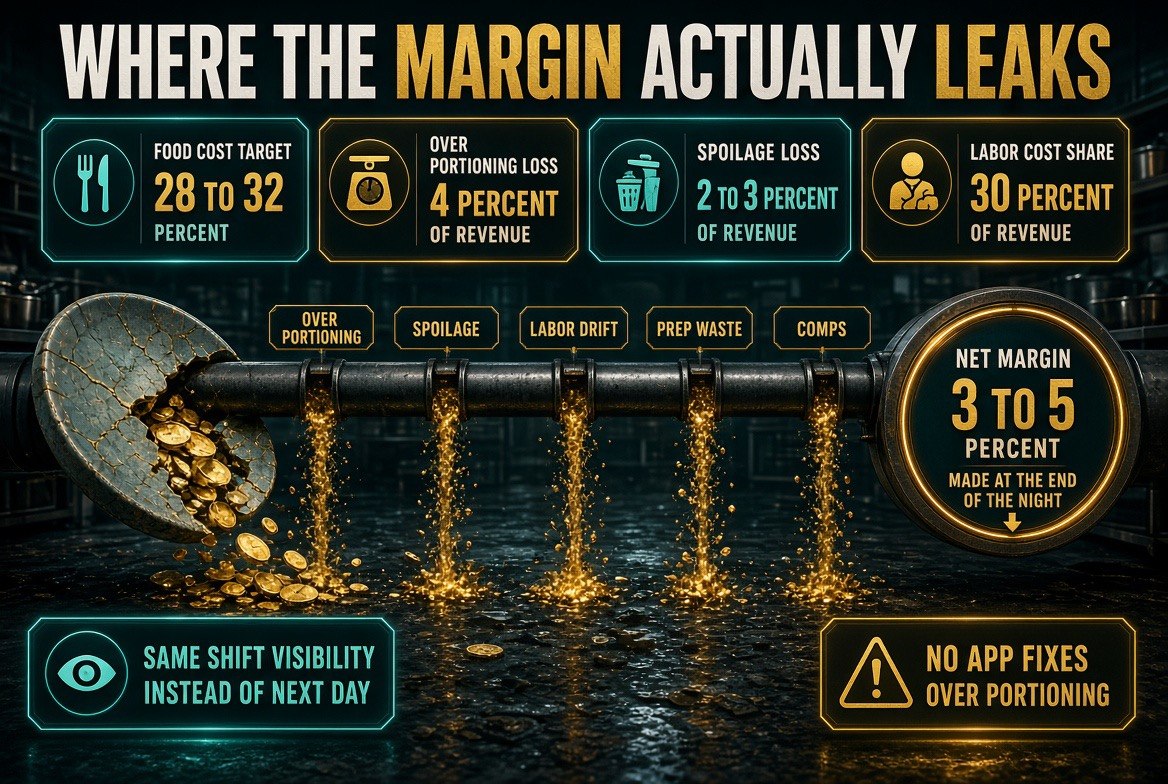
Where the margin goes: over portioning, spoilage, labor drift, prep waste, and comps drain the same pipe — and an app can see the leak, but it still cannot fix your portioning.
The Vendor Landscape: How to Compare Kitchen Intelligence Tools
Metafoodx is not alone in selling visibility, so it’s worth knowing what to compare when you’re evaluating any kitchen intelligence platform this year. Feature lists converge quickly; the differences that matter operationally don’t show up in a demo.
| What to Compare | Why It Matters On Your Line |
|---|---|
| Where the data is visible | A desk-only dashboard gets checked once a day; a phone gets checked during service |
| Data freshness | Same-day live data supports action; week-old rollups support regret |
| Granularity | Menu-item level tells you what to do; category level tells you what happened |
| Multi-venue support | Determines whether you can manage more than one location without living in one |
| Platform coverage | iOS-only leaves Android-using back-of-house staff out until a release lands |
| Integration with your POS | Determines whether consumption ties to actual sales or stays a separate silo |
If you’re running Toast as your POS, that last row is worth a direct question to any vendor: does the consumption data reconcile against what the POS says you sold, or do you have to eyeball two systems side by side? Answer that before you answer anything about AI features. A kitchen intelligence platform that can’t reconcile to sales is a very sophisticated clipboard.
The broader point is that these tools are converging on capability and diverging on fit. Metafoodx’s bet is mobile-first, floor-level access. If your operation’s bottleneck is that nobody sits at the desk, that bet is aimed directly at you.
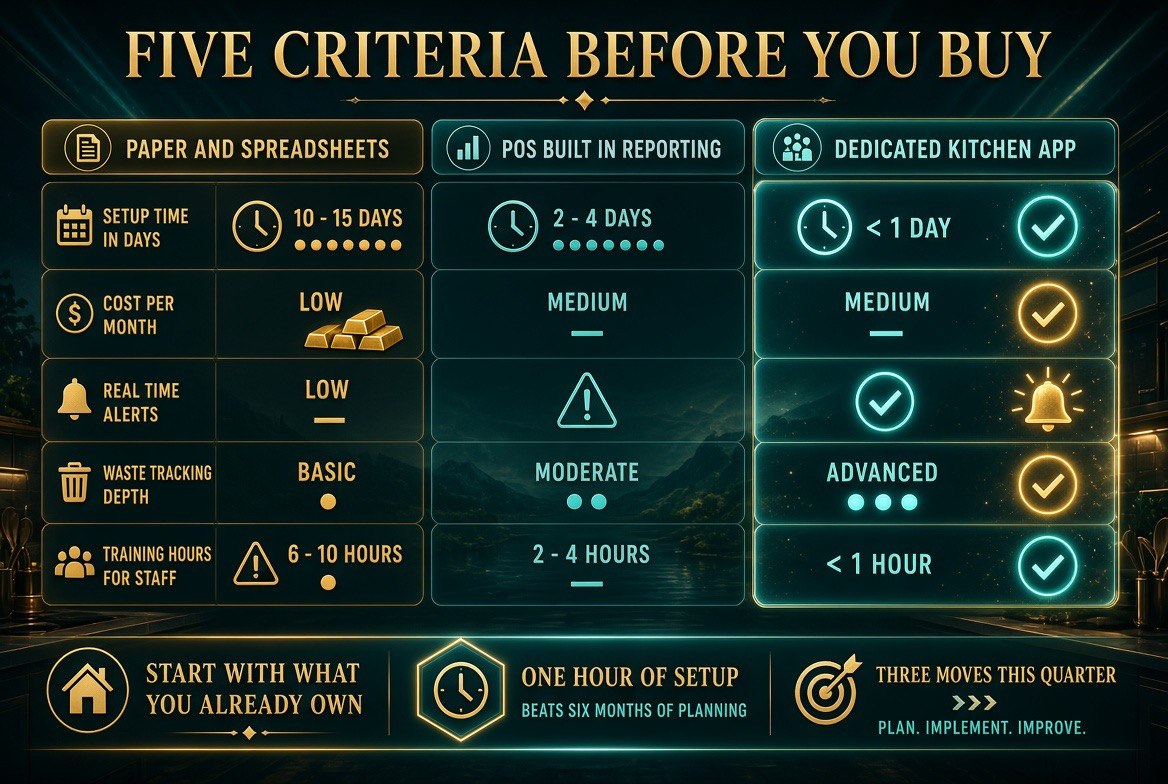
The comparison that matters before you buy: setup time, monthly cost, real-time alerts, waste depth, and staff training hours across the three realistic options — start with what you already own.
Where Operators Should Focus This Quarter
Put this next to everything else landing in restaurant AI right now and a pattern holds: the tools that stick are the ones that remove a trip — to the desk, to the office, to the back. Forecasting that lives in a report changes nothing. Forecasting that reaches a manager standing at the line changes what happens in the next ten minutes.
If you’re evaluating kitchen intelligence this quarter, the questions worth asking any vendor are simpler than the feature lists suggest: Does the data reach the person who can act on it, at the moment they can act? Does it work on the phone already in their pocket? And can they use it without leaving the floor?
Metafoodx just answered yes to all three on iOS. That’s a small update on paper and a meaningful one in a Thursday night dinner rush.
Frequently Asked Questions
What is the Metafoodx mobile app?
It’s an iOS app from Metafoodx, an AI-powered kitchen intelligence platform, that gives kitchen managers and chefs real-time access to consumption, overproduction, and scan data from anywhere in the venue. It launched on September 10, 2026, and displays live, same-day data intended for use during service.
What are the four sections of the Metafoodx app?
Home gives an at-a-glance view of consumption and overproduction across venues plus recent scanning activity. Live View shows real-time, menu-item-level consumption and overproduction filterable by cost or volume. Scan Log is a real-time feed of individual scans for quick quality checks on the line. Manage lets you download and share reports directly from the phone.
Does Metafoodx work on Android?
Not yet. The app launched on iOS and Metafoodx says an Android version will be available soon, without an announced date. If your team uses Android phones, plan to wait or confirm timing with the vendor.
Do I need existing scan tracking to use the app?
Effectively yes. The app is a visibility layer over consumption, overproduction, and scan data — so the data has to exist. Kitchens without consistent scan-based tracking should fix data capture first, since the app will otherwise display an accurate view of nothing.
How do I sign in to the Metafoodx app?
Existing Metafoodx credentials work, including single sign-on for teams already using SSO. New users can download the app by searching “Metafoodx” in the App Store.
Is this useful for a single-location independent restaurant?
Yes, if that location already tracks inventory and production consistently. The main benefit is moving decisions earlier in the day — catching a scanning gap or a high-demand item running low during service rather than after it. For multi-unit operators, the cross-venue Home view adds another reason to look at it.

About Barak Schurr
Barak Schurr built and exited a major ticketing platform, ran global operations at Eventbrite, and now focuses on one question: which AI tools actually help independent restaurant owners run leaner and grow faster. He writes from the operator’s perspective — no vendor spin, no theory, just what’s real in 2026.
Email: [email protected]
More AI Resources for Restaurant Operators