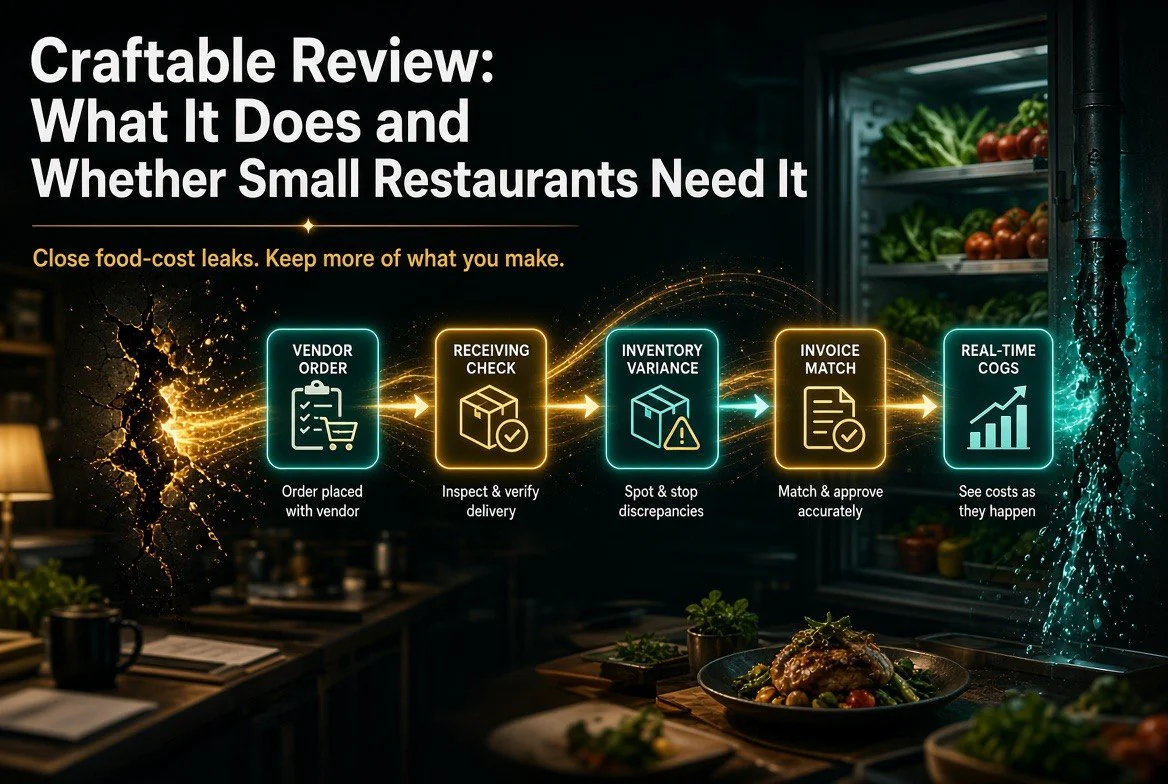
Craftable Review: What It Does and Whether Small Restaurants Need It
⚡ Expert Summary: Craftable is an AI-powered back-office platform that brings purchasing, inventory, accounts payable, and financial reporting into one place — replacing the spreadsheets, email ordering, and manual invoice entry most independent operators are still fighting. The company reports customers typically cut cost of goods by 5%, halve inventory time, and improve rogue-spend control by 30%, with some operators saving hundreds of thousands in food cost a year. It is not a front-of-house POS tool; it is food-cost control for the back office. This review helps independent restaurant owners decide whether the investment is right for their size.
Let’s start with the number that quietly decides whether an independent restaurant survives: food cost. Industry operators routinely target food cost somewhere in the low-to-mid 30s as a percentage of sales. Yet most independents have only a vague idea of their real number on any given day, because the data lives scattered across order emails, paper invoices, a POS system, and spreadsheets that rarely agree with each other.
Craftable is built to attack exactly that gap. It is a back-office platform for restaurants, bars, and hotels that pulls purchasing, inventory, accounts payable, and financial reporting into a single system. Instead of an owner or manager chasing numbers across five disconnected tools, Craftable gives one current source of truth for what you are buying, what you have on hand, what you owe, and what it is all costing you.
This review digs into what Craftable actually covers, the real return the company says operators see, and — most usefully — whether an independent restaurant of your size genuinely needs it, or whether leaner fixes come first.
What Craftable Actually Does
The honest way to understand Craftable is to compare it with what you are probably using right now. If you are like most independent operators, “food-cost management” means a patchwork: you order from vendors by email or phone, someone checks in deliveries and types the numbers somewhere, invoices pile up for manual entry, and inventory gets counted on a schedule that slips. Craftable replaces that patchwork with automation across the whole back office.
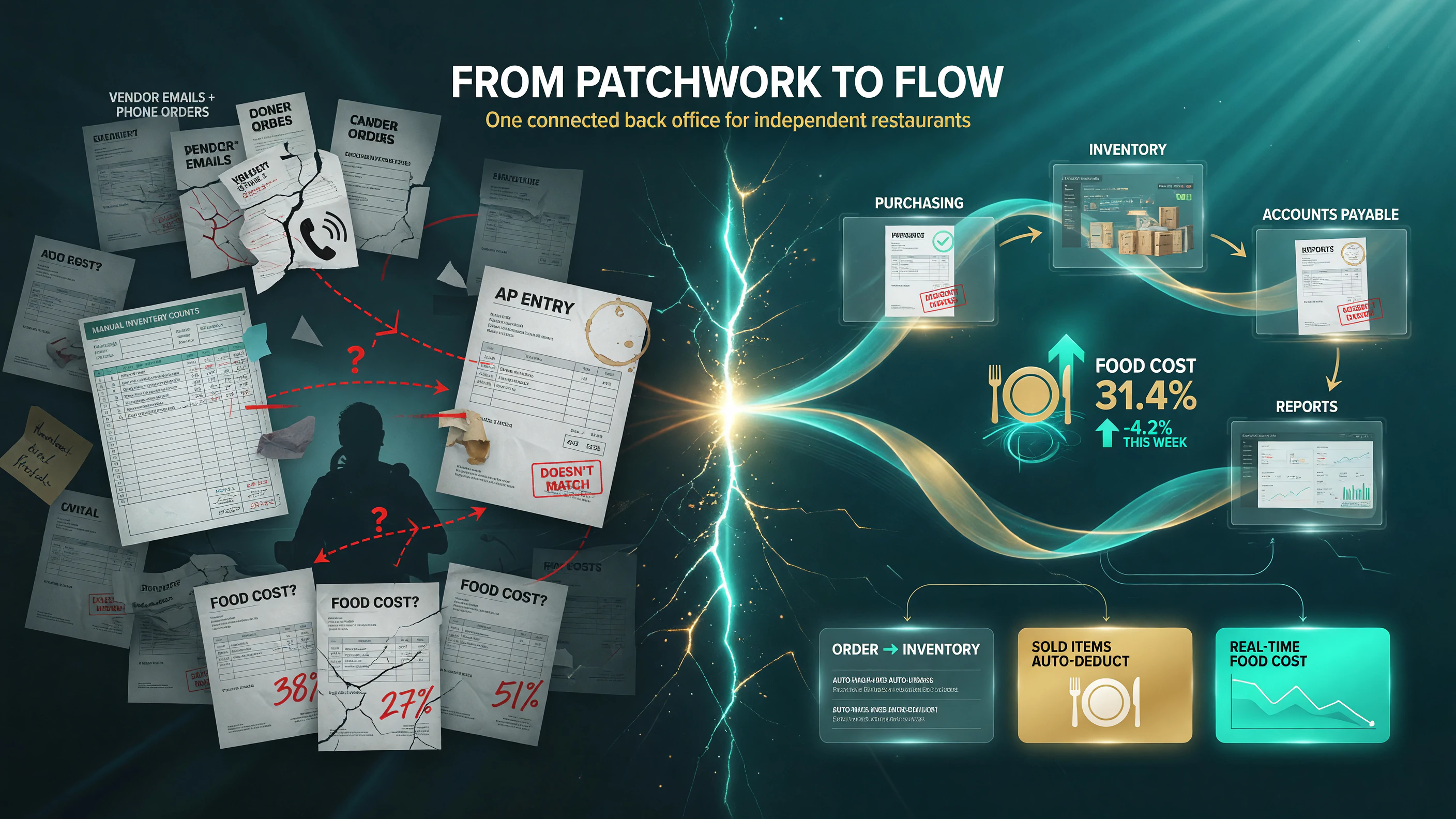
Most owners manage food cost as a patchwork of separate tools. The goal of automation is one connected flow — so an order becomes inventory, ties to sales, and lands in payables and reports automatically.
Here is what the platform covers in plain terms.
| Back-Office Function | What It Replaces | Why It Matters to You |
|---|---|---|
| Purchasing / ordering | Email and phone orders, catalogs, paper contracts | Automates ordering and flags price discrepancies and substitutions |
| Inventory management | Manual counts and spreadsheet par levels | Ties what you buy to what you actually use and sell |
| Accounts payable | Manual invoice entry and approval chasing | Automates invoices and approvals so nothing gets missed |
| Financial reporting | Disconnected reports that never quite match | One real-time view of food cost, vendor spend, and margin |
Because purchasing, inventory, AP, and reporting live in one place, the data flows together. An order you place becomes inventory on receipt, ties to what gets sold, and lands in accounts payable and financial reports automatically. That is what moves an owner from guessing at food cost to actually seeing it — and catching the leaks that quietly erase margin.
The Real Numbers Behind “Food-Cost Control”
Anyone can say their software controls food cost. The reason Craftable is worth a serious look is that the claimed outcomes are specific and large, and they come with named operator examples rather than vague promises.
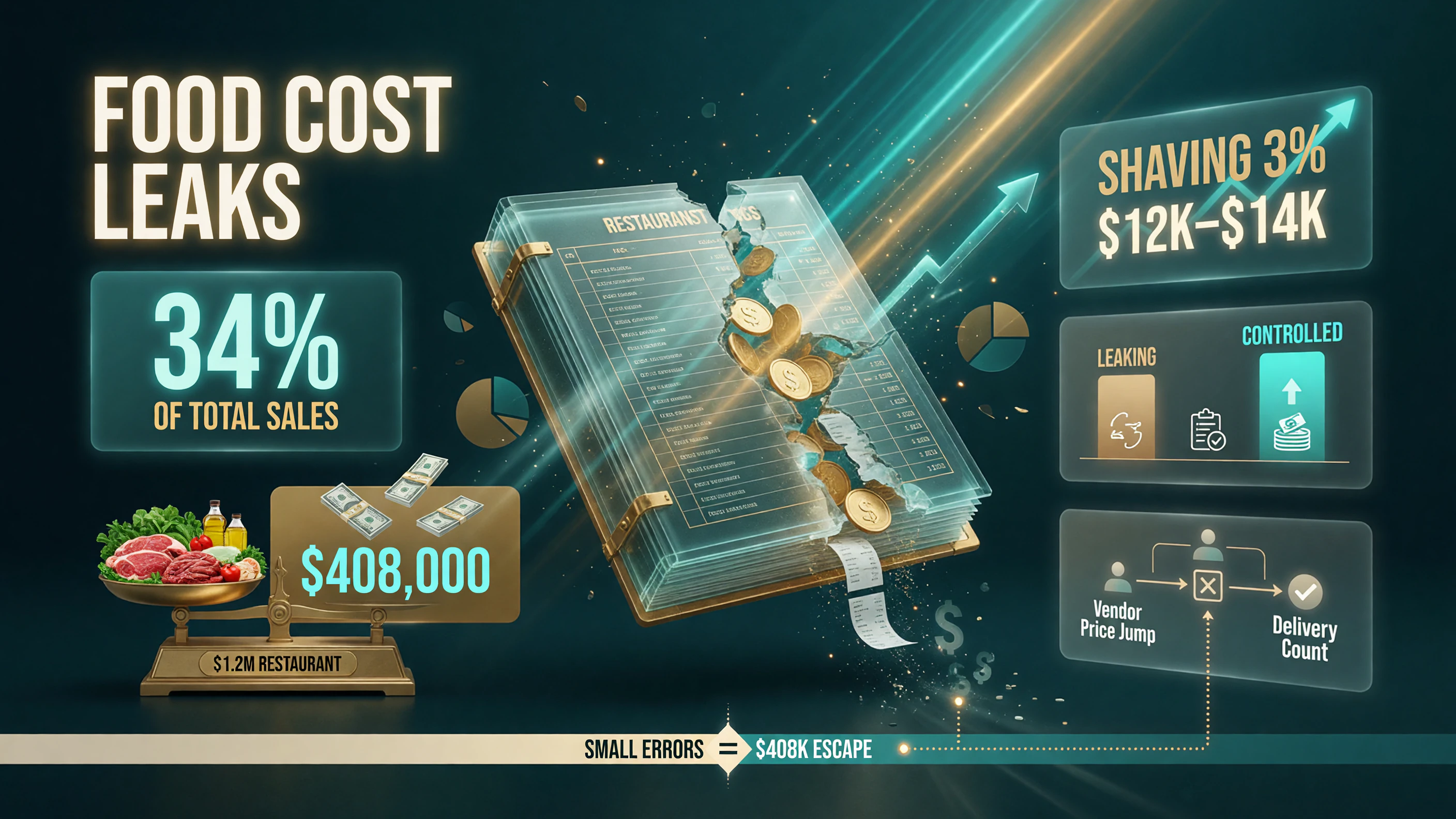
Food cost eats roughly a third of sales — and the leaks that quietly erase margin are dozens of small ones, not one big mistake.
Craftable reports that its customers typically see a 5% reduction in cost of goods, a 50% reduction in time spent on inventory, and a 30% improvement in controlling what it calls “rogue spend” — the off-catalog, unapproved, or overpriced purchases that slip past normal controls. The company cites operators like Jim’s Steakout saving $500,000 in food costs within a year, and bartaco saving $30,000 in food costs every single week.
Those examples are meaningful even if your restaurant is far smaller than either. The takeaway is not that you will save half a million dollars — it is that the category of waste Craftable targets is enormous, and the savings scale with how much uncontrolled purchasing you have. Let’s make that concrete with a realistic independent-restaurant example.
Say you do $1.2 million in annual sales with food cost running at 34% of sales — about $408,000 a year on product. If tighter purchasing, better inventory control, and fewer rogue purchases shave just 3% of that food cost, you keep roughly $12,000 to $14,000 a year that is currently leaking out. For most independents, that kind of number is the difference between a healthy margin and a thin one. And it is entirely realistic, because the leaks are almost never one big mistake; they are dozens of small ones — a vendor substitution you did not catch, a case ordered by habit when the price moved up, a delivery that was not actually counted.
Where the Money Leaks (and What Craftable Targets)
Back-office waste is not glamorous, which is exactly why it goes unmanaged. Owners spend their energy on the front of house — the food on the plate, the service, the reviews. The quiet bleed happens in procurement and inventory, where nobody is watching every line.
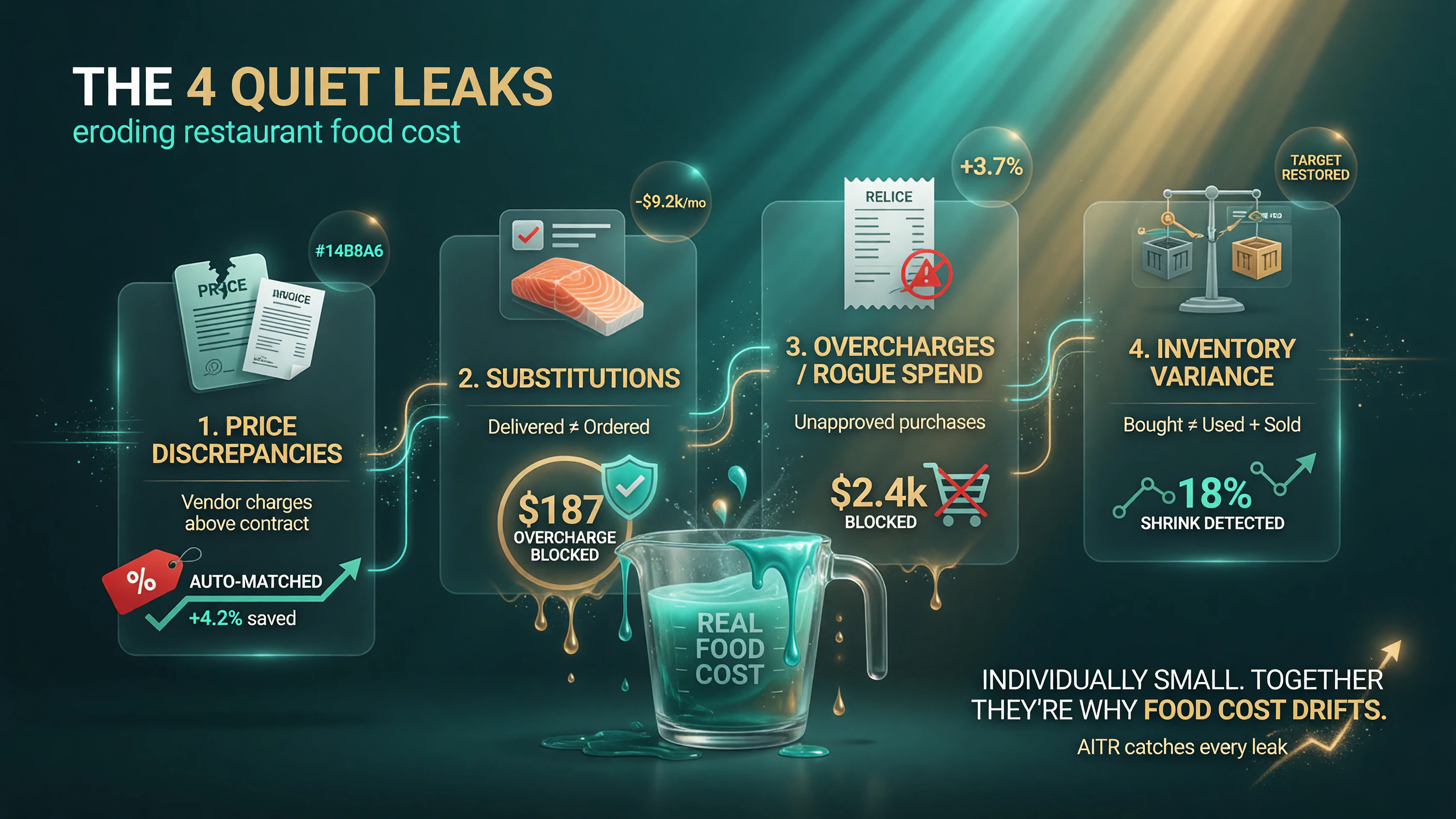
Each leak is small and easy to dismiss on its own. Together they are why real food cost drifts above target — so automation converts a vague “food cost feels high” into a specific, answered problem.
| Common Money Leak | How It Happens | What Catch-It Systems Do |
|---|---|---|
| Price discrepancies | A vendor charges more than the agreed contract price | Auto-checks invoices against contract pricing and flags the gap |
| Substitutions | Ordered one product, delivered a more expensive one | Detects substitutions so you are not charged for what you did not order |
| Overcharges and rogue spend | Off-catalog or unapproved purchases slip through | Budgets and approvals block spend that was never sanctioned |
| Inventory variance | What you bought never matches what you used and sold | Links purchases to usage and sales to surface the variance |
The through-line across all four leaks is the same: individually each one is small and easy to dismiss, but together they are the reason your real food cost drifts above your target. Automation that catches price discrepancies, substitutions, overcharges, and variance on every order is how you turn a vague “food cost feels high” into a specific, answered problem.
How Craftable Compares to the Usual Options
Before you commit to any platform, it helps to see it against the alternatives an independent owner realistically weighs. The comparison is not Craftable versus nothing — it is Craftable versus the DIY way, a point solution, or doing it by hand.
| Factor | Craftable (all-in-one back office) | Spreadsheets + manual invoices |
|---|---|---|
| Food-cost visibility | Real-time, from one source of truth | Delayed, fragmented, prone to error |
| Time on back office | Automated ordering, inventory, and AP | Hours of manual entry and reconciliation |
| Catching vendor errors | Auto-flags discrepancies and substitutions | Only if a human happens to catch them |
| Upfront cost | Subscription (a real investment) | Low on paper, expensive in hours and leaks |
| Best fit | Multi-location, growing, or food-cost-squeezed groups | Very small operations with simple ordering |
Does an Independent Restaurant Actually Need Craftable?
Here is the honest, operator-to-operator answer. Craftable is positioned for operators that range from independents up to large hotel and restaurant groups — the platform says it is trusted by more than 10,000 operators, including well-known brands. That breadth means there is no single “yes” or “no” for every restaurant. The right question is whether your situation matches where the platform pays for itself.
You are most likely to see real value if you have more than one location, if food cost is already drifting above your target and you cannot pinpoint why, if you are spending meaningful hours every week on ordering and invoices, or if you have enough vendor volume that price discrepancies and substitutions actually add up. In those situations, an all-in-one back office can pay for itself quickly — sometimes in the first year through recovered food cost and recovered time alone.
If you are a single-location operation buying from a handful of vendors with a simple menu, the math is different. You may not have the volume where automated discrepancy-catching saves more than the subscription costs. Before you invest in a platform, tighten the habits that matter — consistent receiving, counting inventory on schedule, reviewing invoices against orders — and prove to yourself where the leaks actually are. Then you will know with confidence whether the automation is worth it.
How to Get Food Cost Under Control Before Spending Money
Regardless of whether Craftable is right for you now, the discipline it automates is worth doing by hand first. Start with receiving: weigh and inspect every delivery against the order before the invoice is paid, and log what actually arrived, not just what the driver said. Count your inventory on a consistent schedule and compare what you used against what you sold to surface variance. Review every vendor invoice against contract pricing, and question any substitution or price move you did not approve. Getting these three habits consistent is the groundwork — and it tells you whether the leaks are big enough that automation will pay for itself.
If those efforts reveal that food cost is under control and the leaks are small, keep your lean setup and skip the subscription. If they reveal steady, painful leakage that you cannot stamp out by hand, you have found the exact problem a platform like Craftable is built to solve — and you will implement it with far more intent than someone buying software hoping it fixes a vague problem.
The Bottom Line for Independent Restaurant Owners
Craftable is not a front-of-house tool that fills seats or speeds up your line. It is a back-office weapon against the quiet bleed that erodes restaurant margins: unchecked purchasing, messy inventory, manual AP, and food cost that drifts higher than you realize. The company’s own numbers — 5% off cost of goods, 50% less inventory time, 30% better rogue-spend control — are meaningful because they are large and tied to real operator examples like a $500,000 food-cost recovery in a year.
Whether that payback reaches your restaurant depends on your size and your leaks. The disciplined way to decide is to get your own food-cost basics consistent first — consistent receiving, real inventory counts, invoice review — and measure the damage. If the leaks are big and you cannot stop them by hand, an all-in-one back office is a legitimate, potentially fast-paying investment. If not, harden the habits and skip the software for now. In both cases, you are running the numbers instead of guessing — and that is exactly the operator mindset that keeps margins alive.
Frequently Asked Questions
What is Craftable?
Craftable is a back-office software platform for restaurants, bars, and hotels that manages purchasing, inventory, accounts payable, and financial reporting in one place. It replaces spreadsheets, email-based ordering, manual invoice processing, and disconnected accounting tools with automated, real-time visibility into food cost, vendor spend, and margins.
Is Craftable only for big restaurant groups?
No. Craftable is trusted by more than 10,000 operators ranging from independents to large hotel and restaurant groups. That said, it pays off most for multi-location or food-cost-squeezed operators with enough vendor volume that automation beats a simple manual setup.
What kind of savings does Craftable deliver?
Craftable reports customers typically see about a 5% reduction in cost of goods, a 50% reduction in inventory time, and a 30% improvement in rogue-spend control. Named examples include an operator saving $500,000 in food cost within a year and a group saving $30,000 in food cost weekly.
Does Craftable replace my point-of-sale (POS) system?
No. Craftable is a back-office platform, not a front-of-house POS. It integrates with 1,000+ POS, EDI, and API systems so sales and inventory data connect, but you keep your POS for taking orders and payments.
Is Craftable compliant and secure?
Craftable states it is SOC 2 compliant and SSO-capable, which makes it compatible with the technology stack used by most mid-size to enterprise restaurant groups and hotel operators.
How is Craftable different from other restaurant software?
Unlike point solutions that handle only ordering or only inventory, Craftable connects purchasing, receiving, inventory, accounts payable, and financial reporting in one platform built specifically for hospitality — giving finance, operations, and accounting a single source of truth for back-office data.

About the Author
Barak Schurr built and exited a major ticketing platform, ran global operations at Eventbrite, and now focuses on one question: which AI tools actually help independent restaurant owners run leaner and grow faster. He writes from the operator’s perspective — no vendor spin, no theory, just what’s real in 2026. [email protected]
More Resources for Restaurant Operators