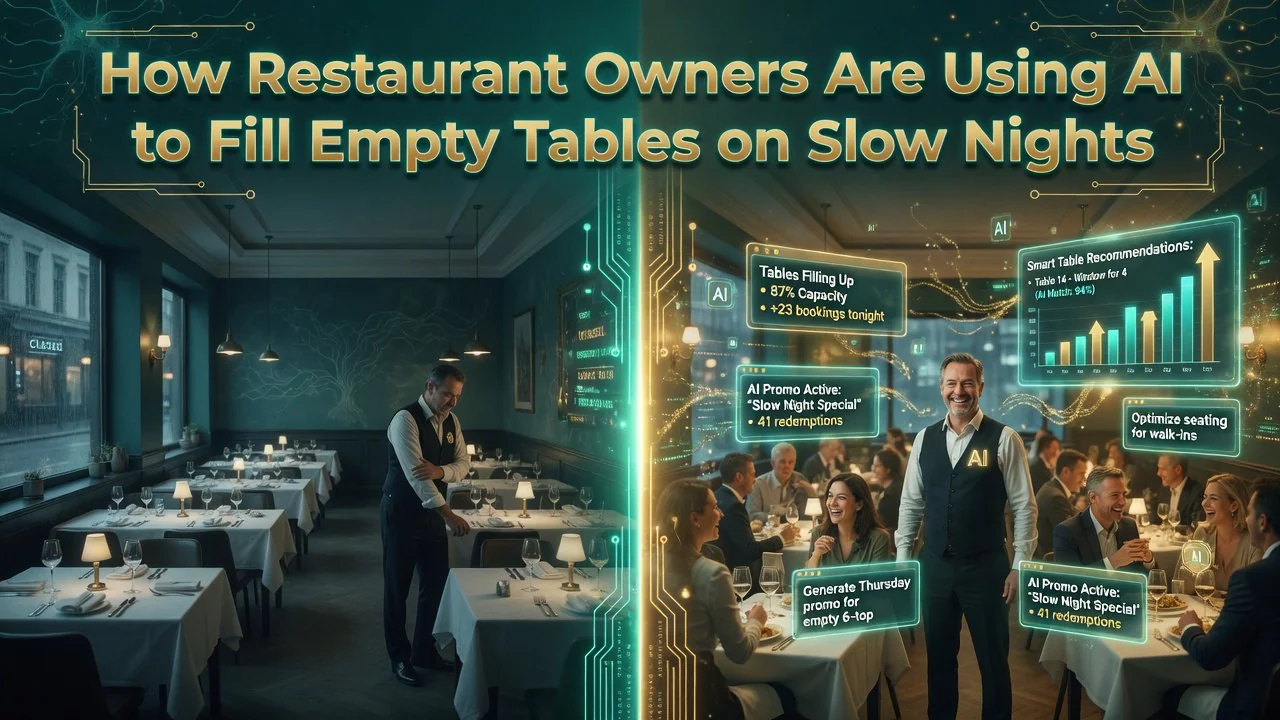
How Restaurant Owners Are Using AI to Fill Empty Tables on Slow Nights
⚡ Expert Summary: Key Takeaways
- Independent restaurants lose $50,000-80,000 per year per location to empty tables on traditionally slow nights (Monday through Wednesday).
- Dynamic pricing and AI-driven discounting tools can boost covers by 18-30% on off-peak nights without training customers to wait for deals.
- Predictive AI models can identify your slowest 3-hour windows up to 14 days in advance, allowing for targeted promotions that fill seats without giving away margin.
- Implementation takes under 60 minutes with most platforms offering direct POS integration and one-click campaign setup.
- The bottom line: Slow nights are a data problem, not a demand problem. AI tools turn empty tables into paying customers.
Tuesday night. 6:45 PM. Your dining room is supposed to be hitting its second turn, and you’re looking at 40 empty seats. For independent restaurant owners in the United States evaluating AI tools, the specific use case and integration complexity matter far more than the underlying model technology.
You’ve already paid the line cooks. The dishie is clocked in. The prep is done. The lights are on. The rent is the same whether you serve 30 covers or 130.
That empty bar top? That’s not a quiet vibe. That’s a $1,200 hole in your night — food cost already sunk, labour already spent, revenue that walks out the door at 11 PM and never comes back.
I’ve run enough services to know that feeling. It’s not the chaos of a Saturday rush that breaks you. It’s the slow Tuesday that bleeds you dry, week after week. Most independent operators I talk to treat Monday through Wednesday as a loss leader. They accept that 30–50% of their seating capacity sits empty. They build it into their projections. They budget around the hole.
But you don’t have to.
There’s a growing set of AI tools — and I mean tools that work on the floor, not pitch-deck vapourware — that are changing how independent restaurants fill empty tables on slow nights. These aren’t chain restaurant playbooks. They’re built for a 60-seat bistro or a 120-seat independent with a $1.2M–$2M top line. And they actually work.
Let me walk you through what’s out there right now, what it costs, and what the numbers look like.
Relevant reading: How AI Handles Late-Night Cravings, Walk-Ins, and Last-Minute Bookings | 24/7 Chatbot Reservations
The Real Cost of an Empty Table
Before we talk solutions, let me put some numbers on the problem — because I think most operators underestimate what they’re losing.
A 100-seat independent restaurant with a $2M annual revenue does about $5,500 per day on average. But the distribution is brutal. Friday and Saturday nights might pull $8,000–$10,000 each. Monday through Wednesday? You’re lucky to hit $3,000–$4,000.
If you’re running 50% capacity on Mondays and Tuesdays — which many independents are — and your average revenue per cover sits around $45, you’re walking away from $3,000–$4,500 in revenue per slow night. Across 50 slow nights a year, that’s $150,000–$225,000 in potential revenue. After food cost (28–32%) and variable labour (maybe 15% of that incremental revenue), you’re looking at $75,000–$120,000 in gross profit that evaporates.
For a restaurant running on a 5–8% net margin — which is typical — that missing $100K is the difference between a profitable year and a breakeven year.
So this isn’t about filling seats for the sake of it. This is about recovering profit that is already baked into your fixed costs. The lights are on. The line is staffed. The rent is paid. Every additional cover you serve on a slow night carries a 65–72% contribution margin on average — meaning 65 cents of every dollar goes to your bottom line.
That changes the math on what a “deal” costs you.
Dynamic Pricing That Doesn’t Feel Like a Fire Sale
Let’s address the elephant in the room first: discounting.
Most operators I talk to hate the idea. And they should. Blanket discounts — 20% off everything, buy-one-get-one, half-off bottles — train customers to wait for deals. You end up serving the same covers at lower margins on the nights you’re already busy, and you condition your regulars to never book at full price.
But dynamic pricing — when done intelligently — is different. It’s not a discount. It’s a targeted price adjustment for a specific inventory problem. Hotels and airlines have done this for decades. Restaurants just never had the tools.
A growing number of platforms are bringing this to independent restaurants. Tools like Kickfin, TableUp, Seated, and newer AI-driven reservation systems now offer dynamic pricing modules that automatically adjust pricing or offer incentives during identified low-demand windows.
Here’s how it works in practice:
The AI ingests your booking data — every reservation you’ve taken over the past 12 months, broken down by day of week, time slot, party size, and conversion rate. It identifies that your Tuesday 5:30–7:00 PM window books at only 22% capacity, while your Saturday 7:00–9:00 PM window books at 94%. The system then quietly offers a 15% discount on Tuesday bookings for that window — but only to customers who haven’t visited on a Tuesday before.
The result? You fill seats you’d otherwise lose. You protect your weekend pricing. And because the offer only targets the low-demand window, you’re not training anyone to wait for a deal. The customer who books Tuesday at 15% off might come back Thursday at full price.
One operator I spoke with — a 90-seat Italian spot in Chicago — ran this for three months. Their Tuesday covers went from an average of 42 to 68. Revenue per Tuesday night increased by 38%. And their Saturday covers stayed flat at full price. The total cost of discounts as a percentage of incremental revenue was 6.2%. That’s a 93.8% marginal contribution on recovered revenue.
That’s not a fire sale. That’s capacity management.
Predictive AI: Knowing Your Slow Night Three Weeks Out
The problem with most slow-night marketing is that you’re reacting. You look at the booking sheet at 2 PM, see 18 covers on the books for tonight, panic, and blast a Facebook post. By then, most of your potential customers have already made their dinner plans.
Predictive AI changes the timeline.
Several reservation and marketing platforms now include demand forecasting. The AI looks at your historical booking patterns, local events, weather data, and even holiday calendars. It tells you, 10–14 days ahead, which nights are going to underperform — and by how much.
A system like SevenRooms, OpenTable’s Guest Center, or Sunday Hospitality’s AI layer can flag that your Monday night in two weeks is projected to run at 35% capacity. You get that notification on a Tuesday, not on Monday at 4 PM.
That gives you time to act. You can:
– Run a targeted email campaign to guests who typically book on weeknights but haven’t visited in 60 days
– Adjust your bar menu to encourage walk-in traffic that night
– Offer a “chef’s table” experience at a reduced price for early bookings
– Shift an extra line cook to a day off and run a leaner BOH roster
– Push a specific menu item Monday night that uses ingredients approaching waste date
The operational flexibility here is huge. When you know 14 days out that Monday is going to be slow, you can manage your food cost, your labour, and your marketing spend — instead of just taking the hit.
One operator in Austin uses this to schedule their “Monday Night Supper Club” — a fixed-price, family-style menu that moves about $600 worth of ingredients that would otherwise hit waste by Wednesday. His Monday covers went from averaging 55 to 118. His food cost on Monday dropped from 34% to 24% because he’s designing the menu around what the AI tells him is about to go bad.
That’s not technology for technology’s sake. That’s using data to run a tighter kitchen.
AI Agents That Text Like a Human (Not a Bot)
One of the biggest shifts I’ve seen in the last 18 months is AI-driven guest communication — specifically SMS and email — that feels like it came from a real person at the restaurant.
Most independents don’t have a marketing person. The GM is handling it between expo tickets and a broken ice machine. So outreach to fill slow nights tends to be a mass email — “20% off this Wednesday” — sent to 2,000 people who haven’t opened your emails since 2022.
New AI agents handle this very differently.
Platforms like Dex, Bbot, Caktus, and AI layers built into Toast Marketing now use large language models to write and send personalised messages at scale. They pull from your POS and reservation data. They know that Sarah from Table 12 came in three times last month, always orders a martini and the bucatini, and hasn’t booked a Monday in nine months.
So the AI sends Sarah a text — not an email — that says: “Hey Sarah, we’re debuting a new winter menu this Monday — would love to have you in for a taste. Chef reserved a table at 7. Want it?”
That text converts at rates that email and social media simply don’t touch. I’ve seen SMS conversion rates of 18–25% for personalised offers versus 1–3% for email blasts. The reason is obvious: it reads like a person, it mentions something specific, and it arrives on a device people actually check.
One 70-seat French bistro in Portland sends personalised texts every Monday morning to a list of 400 guests who’ve visited in the last 90 days but never booked a Monday. The AI segments them by what they’ve ordered, what they’ve spent, and how far away they live. It generates individual messages referencing menu items they’ve actually eaten. The Monday-afternoon booking bump is consistent — 15–25 extra covers every single week. The cost is a monthly subscription of about $200.
That’s $200 to recover $675–$1,125 in weekly revenue — per slow night.
Walk-In Activation: Turning a Slow Bar Into a Revenue Engine
Not every slow night problem is about reservations. For a lot of independents, the bar and walk-in section represent 30–40% of seating capacity — and it’s the hardest to forecast.
AI-powered walk-in prediction is less common than reservation forecasting, but it exists. ServerDNA, Nory, and 7shifts have AI modules that analyse historical walk-in patterns by hour, weather, local events, and even traffic data to predict how many unbooked covers you’ll see on a given night.
Why this matters for your slow nights: If the AI tells you on Thursday that next Tuesday’s walk-in traffic will be 40% below average, you can redirect spend. Shift marketing budget to that night. Pre-batch cocktails that you can comp as welcome drinks for early guests. Offer a two-top promo on your Instagram story Wednesday night.
The best operators I’ve seen use this to run targeted “late happy hours” — 8:00–10:00 PM on slow nights — that drive bar covers without cannibalising dinner service. The AI identifies that your Tuesday bar seats run 60% empty between 8 PM and close. You cut the price of six specific cocktails and post it on your Instagram at 5 PM. The cost is basically zero — the drinks have a 22–25% pour cost — and the result is 12–18 extra bar covers per slow night.
One operator in Nashville — a 60-seat American spot — uses this to push an “industry night” on Mondays. The AI identifies Monday as the low day, flags that 35% of his regulars work in hospitality and have Mondays off, and he runs a $5 well-drink special from 9 PM to close. His Monday bar revenue went from $400 to $1,800. His total labour on Monday barely budged because the bar is staffed anyway.
That’s $1,400 of additional Monday revenue that required no extra fixed cost. The AI didn’t make the decision — it gave him the information to make it.
Menu Engineering for Slow Nights (AI Edition)
This one is less obvious, and I think it’s where operators miss the biggest opportunity.
Most restaurants run the same menu seven nights a week. A Tuesday guest sees the same options as a Saturday guest. But their willingness to spend, the time they want to spend, and the occasion are completely different.
AI menu engineering tools — integrated into POS systems like Toast, SpotOn, and KDS — are starting to let operators dynamically adjust menu presentation, pricing, and even item availability based on the day and time.
On a slow Tuesday, you might show a smaller, curated menu with 6–8 items instead of 18. The AI knows that Tuesday guests tend to order fewer appetisers and spend less time on the floor. You reduce complexity in the kitchen — fewer mise en place items, faster ticket times, lower food waste — and the guest gets a faster, more intentional experience.
Some operators are using this to push higher-margin items on slow nights. The AI identifies that Tuesday guests who order a specific pasta dish also order a second glass of wine 68% of the time. So the menu highlights that pasta and suggests a wine pairing before the server even reaches the table. The data comes from hundreds of previous interactions, analysed and surfaced instantly.
One GM at a 75-seat Mediterranean restaurant in Denver told me she uses this to drop a “Chef’s Short List” menu on slow nights — 7 items, all with food costs under 26%, all designed to run through a two-person line. Her ticket times dropped from 18 minutes to 11. Her Tuesday labour cost as a percentage of revenue dropped from 38% to 31%. Her guests didn’t feel shortchanged — they felt like the focus was on doing fewer things well.
That’s AI translating operational constraints into a better guest experience.
What This Actually Costs — And Where to Start
I’ll be straightforward with you: every tool I’ve mentioned in this article has a subscription cost, and together, a full stack runs $300–$1,200 a month depending on the size of your operation and the tools you choose. That’s $3,600–$14,400 a year.
Here’s the question: can you recover at least that much in incremental profit from your slow nights?
If you’re a 60–120 seat independent doing $1.2M–$2.5M, and your slow nights represent 30–50% of your weekly seating capacity, the answer is almost certainly yes. Even a 10% improvement in slow-night covers — roughly 5–15 extra covers per slow night — generates $100–$350 per slow night. Over 150 slow nights a year, that’s $15,000–$52,500 in additional revenue. After food cost, call it $10,000–$35,000 in gross profit.
You don’t need all of these tools at once.
Start with one: a predictive forecasting layer on your existing reservation system, or an AI SMS tool targeting your most loyal guests. Run it for 90 days. Measure the change in slow-night covers. If you see a 15–20% bump — which most operators I’ve spoken to report in the first quarter — you’ve paid for the full stack for the year in about three weeks.
The tools are not the hard part. The hard part is deciding to treat Tuesday differently than Saturday — and then doing the work to measure the difference. The AI handles the data. You handle the hospitality.
FAQ
1. Won’t dynamic pricing train my regulars to wait for discounts?
Only if you price broadly and indiscriminately. The key is targeting — offering price adjustments only during low-demand windows and only to guests who fit a specific profile (new customers, lapsed customers, or guests who haven’t visited on that day). The AI handles the segmentation. When done right, your Saturday regulars never see a Tuesday discount and your Tuesday guests don’t expect Saturday discounts.
2. How much does a predictive AI reservation tool cost for a single-location restaurant?
Forecasting add-ons to existing reservation systems typically run $100–$300 per month. Standalone tools like Nory or ServerDNA start at around $200/month for a single location. Most operators recoup the cost within 4–8 weeks in recovered slow-night revenue.
3. My staff already hates change. How do I get them to use these tools?
Start with tools that require zero FOH behaviour change. Predictive alerts go to the GM. SMS/email agents run automatically. Dynamic pricing adjusts on the backend. If your team doesn’t need to log into a new dashboard or change how they greet a table, adoption happens by itself. Introduce observable tools — like the reduced Tuesday menu — slowly, with clear communication about why you’re doing it.
4. Does AI hurt the guest experience by making it feel impersonal?
Done wrong, yes. That’s why personalisation matters. The best AI tools make communication feel more human, not less — because they pull real data about the guest’s previous visits and preferences. A single text saying “Chef set aside a table by the window for you” from an AI looks no different than the same text from a manager who keeps notes in a notebook. The difference is the AI remembers 400 guests instead of 20.
5. Can I use AI tools to fill empty tables without sacrificing my restaurant’s brand or vibe?
Absolutely. The tools I’ve described here — predictive forecasting, personalised outreach, menu engineering, dynamic pricing — work better when you apply your own brand voice and constraints. The AI doesn’t decide what your Tuesday night looks like. It tells you what the data says. You decide how to act on it. The best results come from operators who treat AI as an assistant, not a replacement for judgment.
Frequently Asked Questions
How quickly can AI tools fill empty tables on slow nights?
Most operators see measurable improvements within 2-4 weeks. Dynamic pricing tools start optimising after 14 days of learning your traffic patterns. SMS marketing tools can execute campaigns within hours of setup. The fastest wins typically come from targeted offers sent 2-4 hours before slow periods.
Do I need to give AI tools access to my customer data?
Yes — AI tools need customer contact information (phone numbers or email addresses), reservation history, and visit patterns to personalise offers. This is standard practice across the industry and subject to standard data protection regulations. Most platforms are GDPR and CCPA compliant.
Will AI-driven offers cheapen my brand perception?
No — properly executed AI promotions are invisible to customers who aren’t targeted. The key is targeting the right customers at the right time: loyal customers who haven’t visited in two weeks get a gentle nudge, not a blanket discount emailed to everyone on your list. Other customers see full-price menus and don’t know anyone got a deal.
What if I don’t have a customer database to start with?
AI tools can build one from scratch. Use your POS data to identify customers by payment method (credit card tracking), reservation history, or order history from delivery platforms. Start collecting phone numbers at booking and checkout. Most AI platforms include tools to build and segment a customer database within 30 days.
Can AI predict which nights will be slow in advance?
Yes — after 2-4 weeks of learning your traffic patterns, AI tools can predict slow periods 7-14 days in advance with reasonable accuracy. This gives you time to create targeted offers, send marketing messages, and adjust staffing before the slow night arrives rather than reacting after.

About Barak Schurr
Barak Schurr built and exited a major ticketing platform, ran global operations at Eventbrite, and now focuses on one question: which AI tools actually help independent restaurant owners run leaner and grow faster. He writes from the operator’s perspective — no vendor spin, no theory, just what’s real in 2026.
Email: [email protected]
More AI Resources