Get the AI Restaurant Quick-Start Guide — Free
The 5 AI tools independent US restaurant owners are using right now to cut labor costs and answer every call.
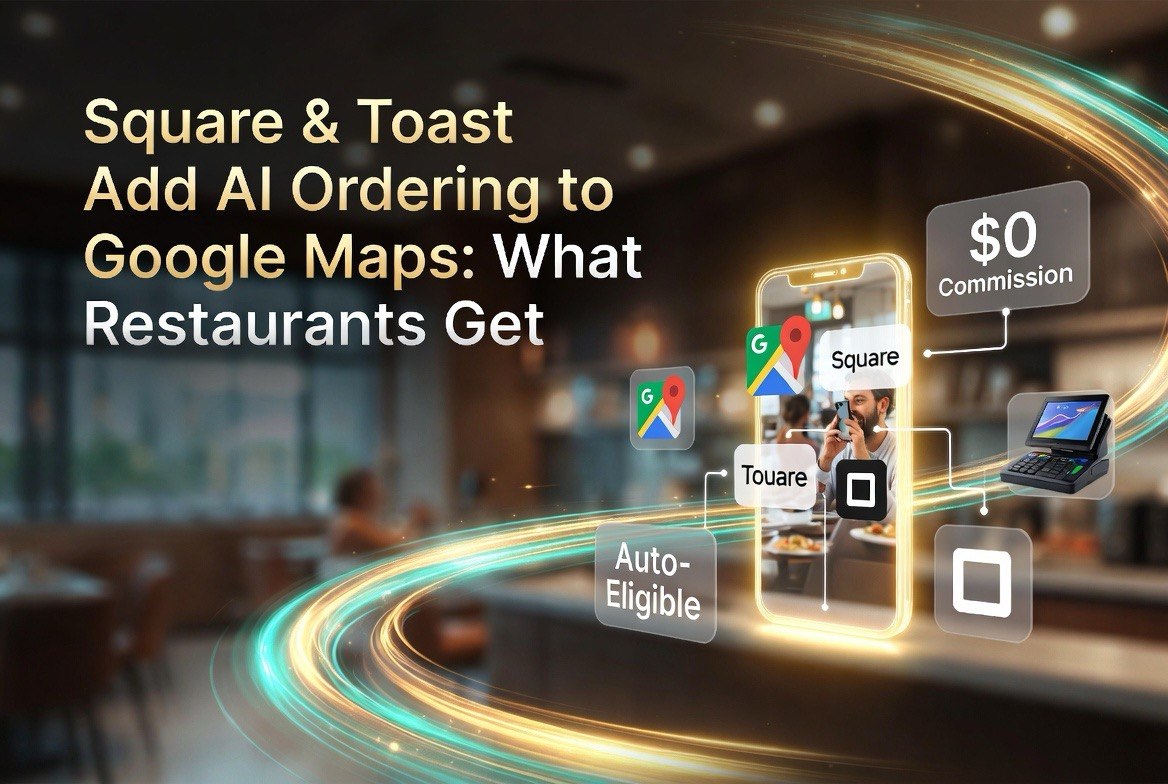
Square & Toast Add AI Ordering to Google Maps: What Restaurants Get
⚡ Expert Summary: Square and Toast have integrated conversational AI ordering into Google Maps’ new “Ask Maps” feature. Diners can now describe an order in plain language — voice or text — and complete it directly inside Maps, with orders flowing straight into your existing POS and kitchen displays. If your restaurant runs Square or Toast and has a Google Business Profile, you’re auto-eligible with zero setup, zero contracts, and zero commission. This moves AI ordering from a novelty channel into the exact app 1.5 billion people use to find restaurants every month — and independent operators get it by default.
What Just Changed With Google Maps AI Ordering
On August 5 and 6, 2026, Square (Block), Toast, and Google announced that conversational AI ordering is now live inside Google Maps through a feature called “Ask Maps.” The headline is simple: a diner can open Google Maps, ask for dinner in plain English, and finish the entire order without ever opening your app, your website, or a third-party delivery platform.
The query looks nothing like a traditional search. Instead of typing “restaurants near me” and picking from a list, a customer can say or type something like: “Order spicy pad kee mao with seafood for pickup on my way home.” The Gemini-powered system factors in location, route, dietary preferences, operating hours, and saved choices — then surfaces a restaurant that can actually fill that request and lets the customer order in the same conversation.
For independent restaurant owners, this is the first time conversational AI ordering has been wired into the single most-used discovery app in the world. It is not another app you have to make your customers download. It is not another platform to fight over. It lives inside the tool your diners already open when they are hungry and wondering where to eat.
This is the shift from “AI that orders for you” to “AI integrated into the search.” The distinction matters for every operator watching the ordering landscape in 2026.
How Ask Maps Ordering Works for Your Restaurant
Understanding the mechanism matters, because it tells you exactly what you get and what you don’t have to build. Here is the four-step flow for a Square or Toast restaurant.
Step 1 — Discovery in conversation. The customer opens Google Maps and describes what they want. Gemini interprets intent, dietary constraints, and convenience (pickup, delivery, dine-in) and recommends matches. Because the query is conversational, it can handle nuance a keyword search cannot — “something light near the office, pickup in 30 minutes.”
Step 2 — Seamless surfacing. If your restaurant is in the matching pool, your Google Business Profile appears. Crucially, your menu, hours, and details sync automatically from your Square or Toast dashboard. There is no manual data entry, no separate content upload, no extra setup. The integration pulls your live menu straight from the platform you already run.
Step 3 — Ordering in the conversation. The customer customizes and confirms the order without leaving Maps. Toppings, sides, modifiers — the conversational flow walks through the same options your POS supports. Checkout processes through Order by Cash App (Square) or the Toast flow, supporting cards, Google Pay, Apple Pay, Cash App balance, and the usual digital wallets.
Step 4 — Order hits your kitchen. The order lands in your POS and prints to your kitchen display system (KDS) like any other order. Your team does not learn a new workflow. The ticket arrives exactly as it would from a phone-in or in-house order, and the payment is handled.
The takeaway for an operator: this is not a new system you manage. It is a new source of traffic that plugs into the system you already run.
Why the Zero Commission Part Actually Matters
If you have been burned by third-party delivery fees — and almost every independent operator has — this is the number to watch.
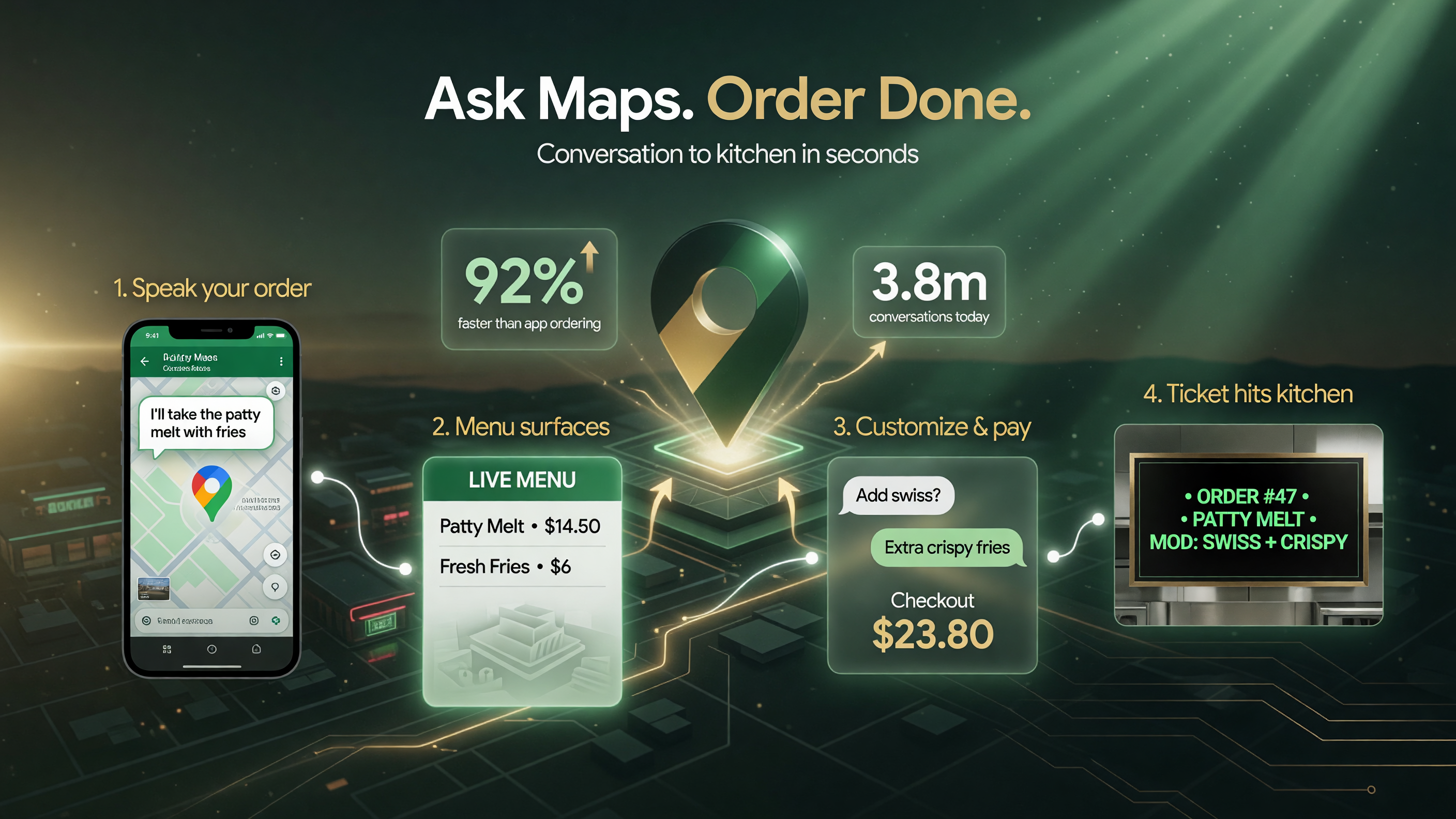
The Ask Maps order flow: discover in conversation, surface your live menu, customize and check out, then the ticket lands in your existing kitchen display system.
If you have been burned by third-party delivery fees — and almost every independent operator has — this is the number to watch. In this Ask Maps flow, there are no third-party commissions. Orders through Square or Toast route through the platform’s own checkout, not through a separate marketplace taking a cut.
Consider what that changes for your margins. Third-party delivery has historically taken between 15% and 30% of each order. On an average ticket of $35, that is $5 to $10 gone before your food cost is even accounted for. If even a fifth of your orders migrate to a no-commission conversational channel, the improvement hits the bottom line directly — not in traffic metrics, but in dollars retained on every ticket.
Square and Toast are also co-developing the Universal Commerce Protocol for Food, an open standard intended to let AI agents handle discovery, ordering, and checkout across the industry. That signals where this is headed: restaurant ordering becoming a standard, open, agentic layer rather than a dozen walled gardens. For independents, open standards have historically favored the smaller players — the ones who cannot afford to integrate with every closed system.
Square vs Toast: What Each Operator Gets
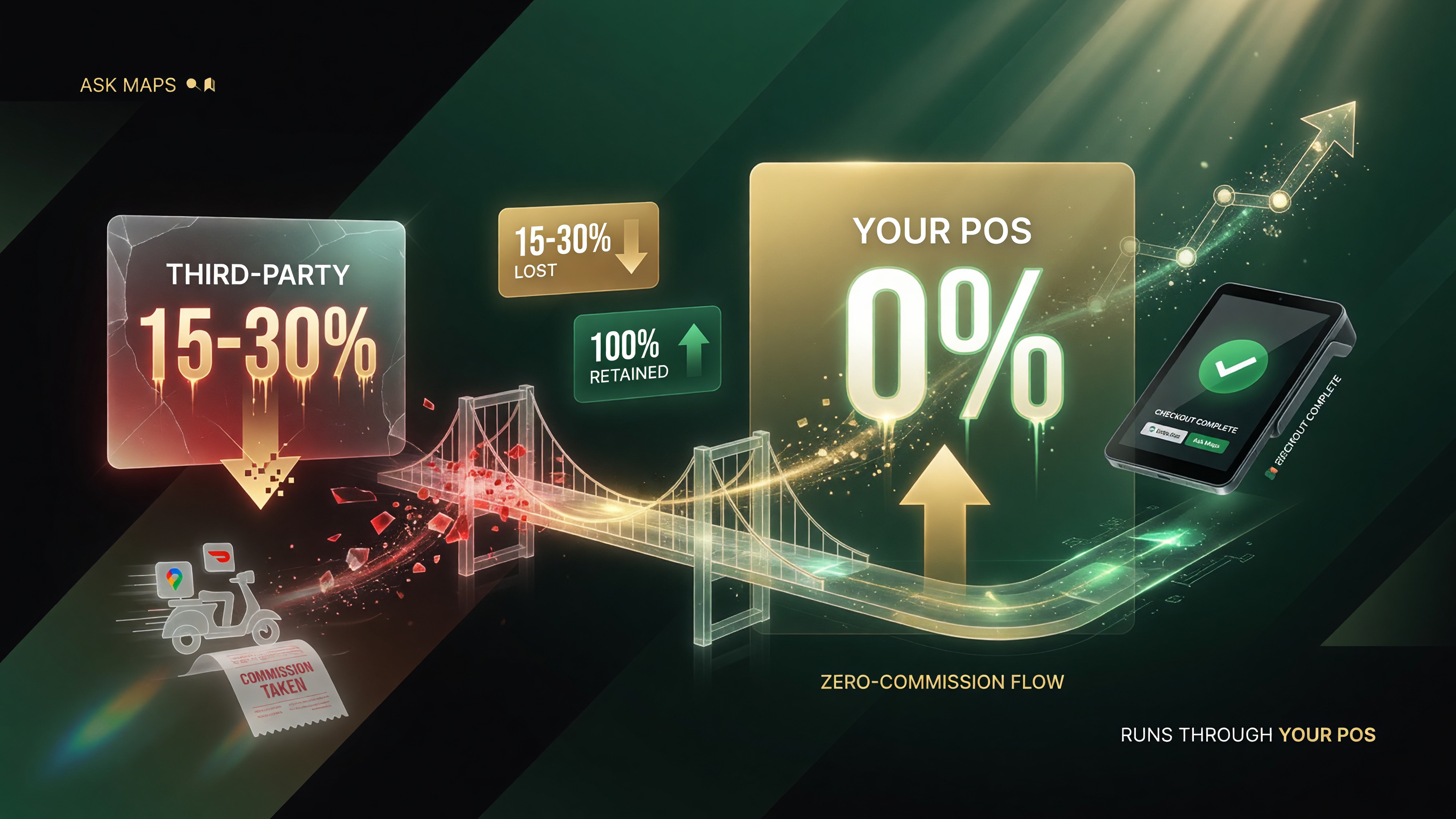
Third-party delivery has historically taken 15-30% of each order; Ask Maps ordering routes through your own POS checkout with no commission, keeping that revenue on your ticket.
| Capability | Square | Toast |
|---|---|---|
| Auto-eligibility | Google Business Profile + Square dashboard | Google Business Profile + Toast system |
| Menu sync | Automatic from Square dashboard | Automatic from Toast |
| Checkout | Order by Cash App (cards, GPay, Apple Pay, Cash App) | Toast flow, no third-party commission |
| Setup / contracts / fees | None — auto for Food & Beverage merchants | None — promo ($5 Toast Cash) starting later in August |
| Large-chain note | Same flow for any Square merchant size | Same flow for any Toast merchant size |
Neither platform charges you to be in the Ask Maps flow. Neither requires you to re-upload menu content by hand. The differentiator is which POS you already run — and the good news is that for the vast majority of independent operators in the United States, that answer is either Square or Toast.
What This Means for Independent Restaurants
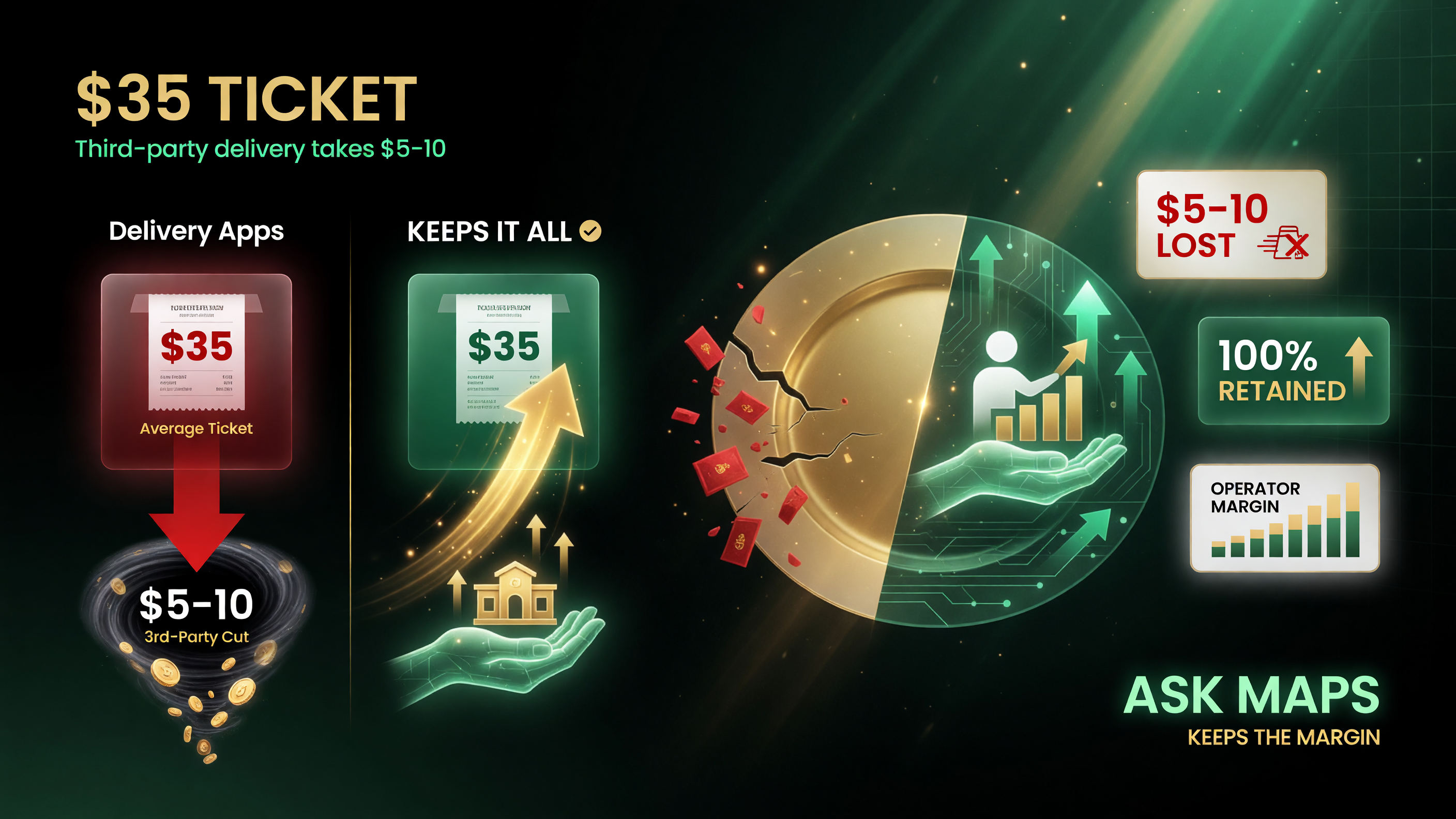
On a $35 average ticket, a 15-30% commission costs $5-$10 per order; the conversational channel keeps that margin working for the operator instead of the marketplace.
There are three practical implications for operators who are not part of a national chain with a dedicated tech team.
First, the discovery gap just narrowed. The 22% of US diners who use AI to choose restaurants — a figure that has been climbing all year — now have an AI that can also complete the order. The restaurant that appears in the conversational result and accepts the order in-place captures demand that previously ended in a search, then a website visit, then a phone call, then a possible abandonment at any step. Fewer steps between intent and ticket means more completed covers.
Second, your live menu is now a sales surface. Because the order syncs from your POS, the accuracy of your menu, availability, and modifiers directly determines what diners can order. An outdated item, a wrong price, or a missing modifier is no longer just a small annoyance — it can kill an order inside the conversation. The operators who keep their Square or Toast menu meticulously current will capture the most conversational demand. This is a reason to audit your menu data this week, not next month.
Third, you are no longer invisible to AI search. Restaurant visibility in AI-driven channels has been a recurring worry for independents — the fear that AI assistants will only recommend chains with big digital footprints. This integration flips that dynamic in your favor, because any Square or Toast restaurant with a Google Business Profile is surfaced with its real, live menu. You do not need a marketing budget to win in Ask Maps. You need accurate data and a POS that is wired in — and if you run Square or Toast, you already have the second part.
How Independent Operators Should Prepare Right Now
This feature does not require action to go live — but going live well does. Here is the practical checklist for the owner who wants to capture conversational ordering demand rather than leave it on the table.
1. Verify your Google Business Profile. This is the single non-negotiable. If your profile is unclaimed, outdated, or missing, you are not in the matching pool at all. Claim it, confirm your address and hours, and attach it to your Square or Toast account.
2. Audit your live menu in the POS. Every item, price, description, and modifier that is visible in your dashboard is what diners can order conversationally. Kill outdated items. Fix wrong modifiers. Make your most profitable items easy to describe and confirm.
3. Test the flow yourself. Open Google Maps, enable Ask Maps, and place a dummy order at your own restaurant. See exactly what a diner experiences. If the conversation offers choices you do not actually have, or misses an option you do, fix it in the POS now — not after a customer hits a dead end.
4. Watch the August Toast promotion. Toast is running a promo starting later in August offering $5 Toast Cash for qualifying Ask Maps orders. Promotions like this drive first-time usage and habitual adoption. If you run Toast, understand the terms and be ready for the volume spike.
5. Talk to your POS support about the Universal Commerce Protocol. Both Square and Toast are building toward this open ordering standard. Knowing your platform’s roadmap helps you decide whether to invest in deeper AI ordering features now or wait for the standard to mature across more channels.
Is Google Maps AI Ordering Right for Your Restaurant?
The honest answer for most independent operators in the US is: yes, adopt it — because it costs nothing, requires no new hardware, and delivers demand into the queue you already manage. There is no downside risk in being superficially available; the risk is in being available with inaccurate data that produces a poor conversational experience.
If you run a high-volume operation where your phone line and in-house orders already strain your kitchen, this adds a channel you can switch on gradually by keeping your menu tight and your availability accurate. If you run a smaller operation, this is the rare technology shift that does not demand more of your time — the discovery and ordering happen inside an app your customers already use, and the ticket arrives on the same kitchen display you have always used.
The operators who will win in conversational ordering are not the ones with the biggest marketing budgets. They are the ones with the cleanest live data and the fastest willingness to let diners order in the channel they already prefer. Google Maps AI ordering puts that within reach of every independent Square or Toast restaurant in the United States — starting today.
Frequently Asked Questions
How does AI ordering work in Google Maps for restaurants?
Ask Maps uses Google’s Gemini AI to let diners describe an order in plain language, then matches them to a restaurant, walks through customization, and completes checkout — all inside Google Maps, with the order flowing into the restaurant’s POS.
Do I need to pay to be on Google Maps AI ordering?
No. Square food and beverage merchants with a Google Business Profile appear automatically, with no extra setup, contracts, or fees. Toast restaurants get the same seamless flow with no third-party commission in the order path.
Which restaurants are eligible for Ask Maps ordering?
Any restaurant running Square or Toast that has a Google Business Profile. Menus, hours, and details sync automatically from the POS dashboard, so eligibility effectively requires accurate live menu data.
How do orders from Google Maps reach my kitchen?
Orders flow directly into your POS and kitchen display system exactly like a phone-in or in-house order. Your team uses the same workflow — no new training or hardware required.
Does Google Maps AI ordering charge commissions?
In this Ask Maps flow there are no third-party commissions. Orders route through Square’s or Toast’s own checkout, so the restaurant retains revenue that would otherwise go to a delivery marketplace.
Is this available now for US restaurant owners?
Yes. The Square and Toast integrations were announced August 5-6, 2026, with coverage from PYMNTS and Digital Transactions, and are rolling out to eligible restaurants with Google Business Profiles.

About Barak Schurr
Barak Schurr built and exited a major ticketing platform, ran global operations at Eventbrite, and now focuses on one question: which AI tools actually help independent restaurant owners run leaner and grow faster. He writes from the operator’s perspective — no vendor spin, no theory, just what’s real in 2026.
Email: [email protected]
More Resources for Restaurant Operators