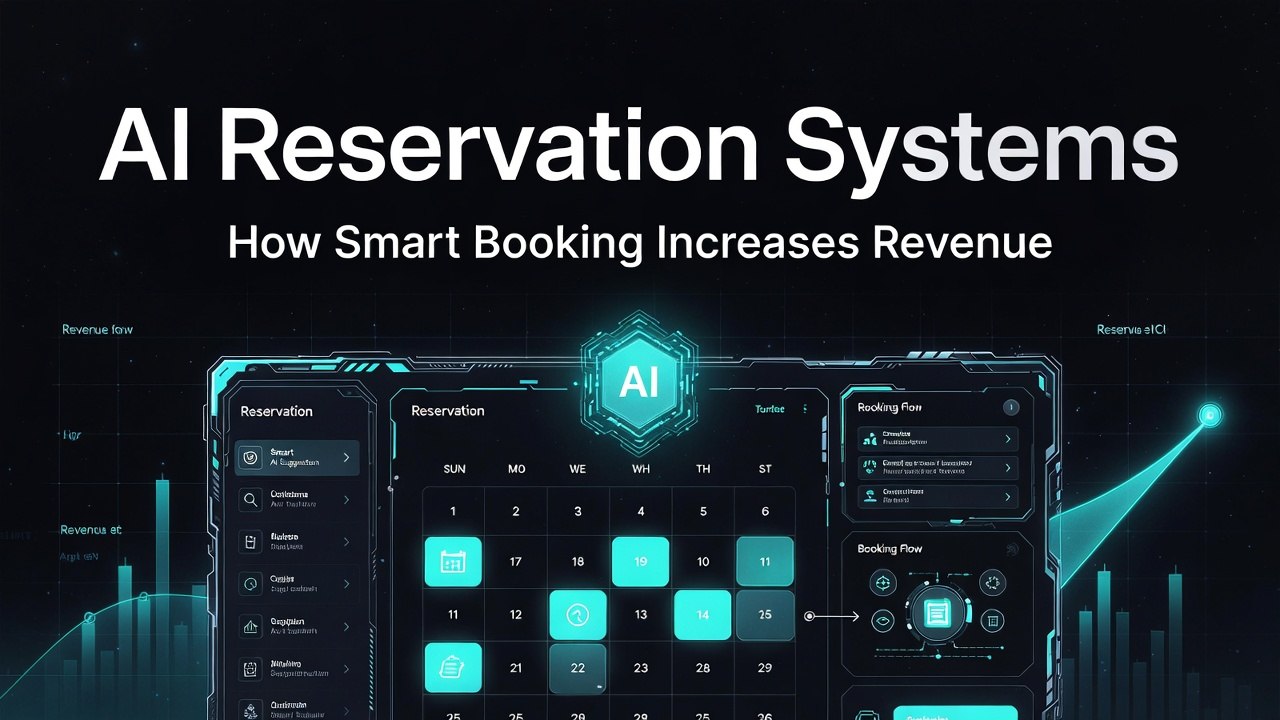
AI Reservation Systems: How Smart Booking Increases Revenue
No-Shows Are Destroying Your Revenue — And AI Is The Answer
Restaurant no-shows cost the industry billions annually. A 100-seat restaurant with 80 covers a night loses $300-500 per no-show (lost food cost, wasted labor, opportunity cost). If you average 15% no-show rate, you’re losing $50,000-80,000 per year on empty tables.
AI reservation systems change this by predicting which reservations will actually show up and optimizing your seating strategy accordingly.
How AI Reservation Intelligence Works
Modern AI analyzes dozens of variables to predict no-show probability:
- Customer History: Has this customer cancelled before? At what rate? What time do they typically arrive?
- Reservation Source: Phone bookings have different no-show rates than online bookings or app bookings. AI knows the difference by location and time.
- Party Size: Groups of 2 behave differently than groups of 6. Small parties no-show more frequently.
- Day of Week & Time: Friday night 7pm reservations have lower no-show rates than Tuesday lunch.
- Weather: Bad weather increases no-shows. Snow storms increase it dramatically.
- Local Events: Concert in town? Sports event? Graduation? No-shows spike.
- Seasonal Patterns: Holiday season, summer weekends, ski season—all have different behavior.
- Lead Time: Reservations booked 30 days in advance no-show at higher rates than next-day bookings.
The Strategy: Smart Overbooking
Armed with this data, AI systems recommend strategic overbooking:
- Accept 105-110% of capacity on Friday nights (high show-up rate + high demand).
- Accept only 95% on Tuesday lunches (higher no-show risk).
- Adjust for weather, local events, and seasonal patterns in real-time.
The key: you’re not guessing. You’re operating on data. This reduces empty tables without overselling to the point where you can’t seat walk-ins.
The Numbers: What Restaurants See
No-Show Rate Reduction:
- Before AI: 15-20% average no-show rate
- After AI: 5-8% average no-show rate
- Impact: On 60 dinner covers per night, that’s recovering 6-12 tables per night × 300 days/year = $540,000-1,080,000 in recovered revenue annually
Revenue Per Seating Increases:
- Smart overbooking + walk-in optimization = 12-18% increase in covers
- On a 100-seat restaurant averaging $50 per cover, that’s $180,000-270,000 additional revenue per year
Table Utilization Improvement:
- Average table utilization improves from 70-75% to 88-92%
- Translation: you’re extracting more revenue from the same square footage
Best AI Reservation Systems in 2026
OpenTable AI: The 800-pound gorilla. Integrated with thousands of restaurants. Strong no-show prediction. $0-99/month depending on plan.
Resy: Owned by American Express. Growing AI capabilities. Integrates with high-end POS systems. $0-149/month.
Yelp Reservations: Free integration for Yelp-listed restaurants. Decent AI, limited customization. Free to $49/month.
Tock: Community-focused. Strong for chef’s table and special event bookings. AI emerging. $99-299/month.
Implementation Strategy
Month 1: Activate reservation system, enable basic no-show tracking. Don’t overbooking yet—just watch the data.
Month 2-3: Analyze your historical no-show patterns by day, time, party size. Let AI make initial overbooking recommendations (conservative).
Month 4+: Gradually increase overbooking confidence as data accumulates. Fine-tune based on results.
The Mistakes Restaurants Make
- Aggressive overbooking from day one. Start conservative, scale gradually.
- Not communicating with guests. If you overbook and someone has to wait, the experience matters.
- Ignoring walk-ins. AI works best when you have a strategy for turning away reservations to capture walk-in revenue.
- Not monitoring the system. Set alerts for unusual no-show spikes or patterns.
Bottom Line
AI reservation systems are table stakes in 2026. The best restaurants aren’t just booking tables—they’re optimizing every seat for maximum revenue. If you’re not using this technology, your competitors are, and they’re out-earning you by 10-20% on the same number of covers.