Culver’s Rolls Out Computer Vision for Drive-Thru — What Independent Operators Should Know
⚡ Expert Summary: Culver’s is rolling out computer vision technology across its drive-thru lanes to measure service execution and vehicle flow — part of a broader wave of operational AI adoption by U.S. restaurant chains. Rather than flashy robots or voice ordering, this represents a quieter but arguably more practical use of AI: computer systems that watch, measure, and optimize the speed and accuracy of drive-thru operations in real time. For independent operators, the lesson is not about buying the same tech, but understanding the category of AI that generates the fastest ROI.
The Drive-Thru Is the Most Valuable Real Estate in a Restaurant
If you own or operate a restaurant with a drive-thru, you already know the numbers. Drive-thru sales account for 60 to 70 percent of revenue at quick-service and fast-casual brands in the United States. Every second you shave off the average service time translates directly into throughput — more cars, more tickets, more revenue per hour.
The problem is that most independent operators do not have real-time data on what is happening in their drive-thru lane. You know your average service time from the POS report at the end of the week. You do not know that the order taker on Wednesday lunch was averaging 45 seconds to greet each customer while the Saturday night crew was averaging 18 seconds. You do not know that the lane was backing up at 7:15 PM every night because the fry station was falling behind. You have a weekly average, but you do not have the granular data to fix the specific problems that are costing you money.
Computer vision changes that.
What Culver’s Is Actually Doing
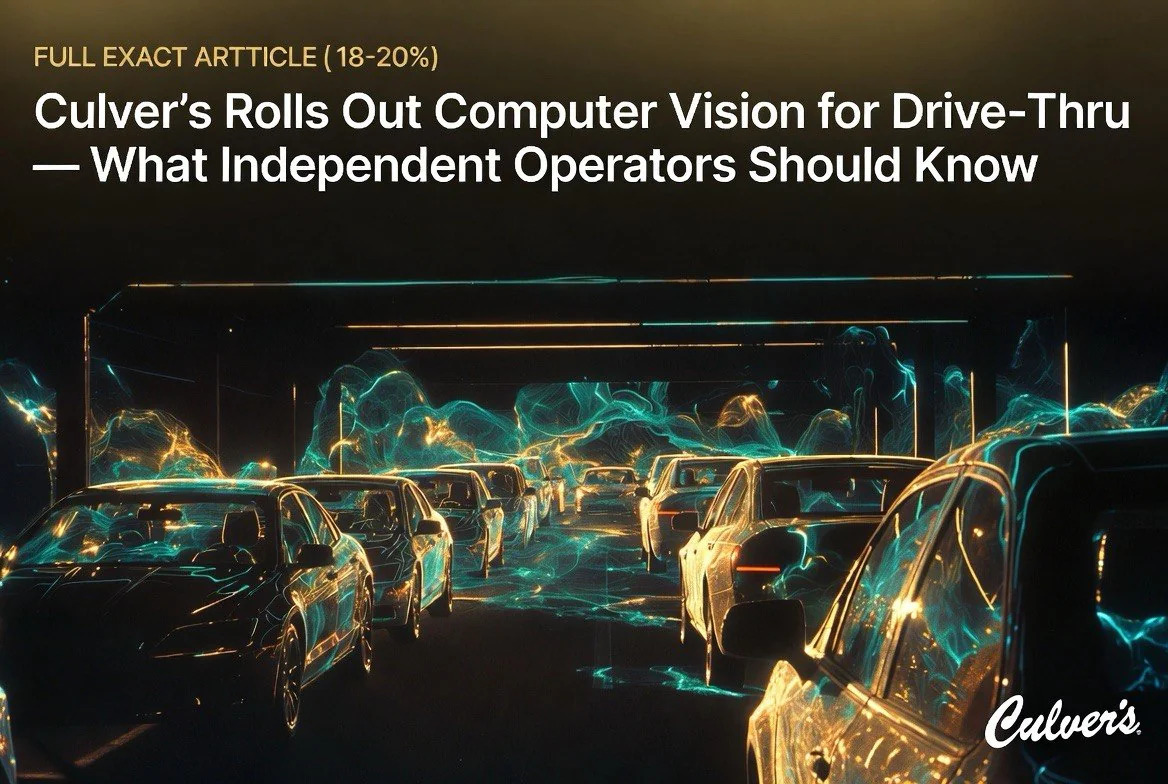
Culver’s is deploying computer vision cameras in its drive-thru lanes that track vehicle flow, measure service execution times at each station, and alert managers when bottlenecks develop in real time. The system does not replace any workers. It provides operational intelligence that lets managers make faster, data-driven decisions about staffing, station assignment, and service procedures.
This is not a speculative pilot. Culver’s is rolling it out across its system, joining a growing list of chains including Taco Bell, McDonald’s, and Dairy Queen that have deployed drive-thru computer vision in various forms. What distinguishes Culver’s approach is the focus on measurement and optimization rather than automation — the cameras watch, measure, and report, but humans still take orders, prepare food, and hand out bags.
Why This Matters for Independent Operators
If you run a single-unit independent restaurant with a drive-thru, you cannot afford Culver’s custom computer vision deployment. But you need to understand what it is doing and why, because the same logic applies at your scale — just with different tools.
The core insight is this: you cannot optimize what you cannot measure. If you do not know that your drive-thru is losing six seconds per car during the 6:00 PM hour because your headset battery is dying and the order taker cannot hear clearly, you will never fix it. You will just keep seeing the average service time drift higher and wonder why.
Several affordable computer vision and operational analytics tools have entered the market for independent operators. Camera-based systems from companies like Agot AI, AiFi, and others can be deployed for a few hundred dollars per month — a fraction of the cost of Culver’s enterprise deployment. These systems provide the same core functionality: real-time tracking of vehicle flow, service time measurement at each station, and alerts when performance drops below thresholds you set.
The Debate Around AI in Restaurants — Why Skepticism Is Healthy
The National Restaurant Association Show in May 2026 featured a notable undercurrent of skepticism about AI. When asked what people were getting wrong about the restaurant sector, tech leaders at Toast, Square, Popmenu, and SpotOn all pointed to the AI hype cycle. Their message was consistent: AI is not magic. It will not fix a broken operation. It works best when it augments a solid foundation, not when it replaces human judgment.
Kelly Esten, chief marketing officer at Toast, put it clearly: “There are some parts of running a restaurant that are all about reliability. AI can’t replace the core aspects of restaurant operations.” Kevin Bryla of SpotOn added: “Some people think an overdependence on AI is going to fix everything. AI at its best is going to serve up an option to an operator to make an informed decision.”
This skepticism is not anti-technology. It is the voice of an industry that has been burned by flashy tech that did not deliver. For independent operators, the lesson is to ignore the AI hype and focus on specific, measurable problems: drive-thru bottleneck, food waste, labor scheduling, inventory management. If the AI tool solves a problem you can quantify, it is worth the investment. If it just sounds impressive at a trade show, skip it.
How an Independent Restaurant Can Get Started With Operational AI
If you are an independent operator interested in the kind of operational intelligence Culver’s is deploying, here is a practical path forward that does not require a corporate IT budget.
Step one: identify your biggest operational pain point. Is your drive-thru backing up during specific hours? Are your kitchen ticket times inconsistent between shifts? Is food waste cutting into your margins? Pick the single most measurable problem and look for a tool that specifically addresses it.
Step two: look for AI that works with your existing systems. Most operational AI tools in the restaurant space integrate with major POS platforms like Toast, Square, and Clover. If a vendor requires you to replace your POS or install proprietary hardware beyond a camera, the cost and complexity will likely outweigh the benefit for a single-unit operation.
Step three: test before committing. Many vendors offer pilot programs or short-term trials. Run a 30-day pilot during a normal operating period and measure the before-and-after metrics. If the system does not deliver measurable improvement in the specific KPI you identified in step one, cancel it. The right tool for your restaurant will pay for itself in the first month.
Step four: involve your team. The most common reason operational AI deployments fail is that managers and crew see the cameras as surveillance, not as tools to help them work better. Frame the deployment as what it is: a way to identify bottlenecks and staffing gaps so the team can perform at its best. When your order takers see that the data helped you add a second person during the 7:00 PM rush instead of blaming them for slow service, they will buy in.
The technology Culver’s is deploying at hundreds of locations is not fundamentally different from what is available to a single-unit operator today. The difference is awareness, budget, and execution. Independent operators who approach operational AI methodically — measure a problem, find a tool, test it, involve the team — will capture the same efficiency gains the chains are chasing, without the enterprise price tag.
How Computer Vision Compares to Other Drive-Thru AI
The drive-thru AI landscape in 2026 breaks down into three categories:
Voice AI — Systems that take orders via automated voice, replacing human order takers. Deployed by Taco Bell, Wendy’s, and others. Highest profile but most controversial category — accuracy still varies significantly.
Computer vision for measurement — Systems like Culver’s that track vehicle flow and service times without replacing workers. Lower profile, lower cost, lower risk. The category most likely to deliver ROI quickly.
Computer vision for food prep — Systems that monitor food quality, cook times, and plating accuracy. Less common in drive-thrus but growing in kitchen operations.
For independent operators, the computer vision measurement category is the most practical starting point. It requires no change to your existing ordering process, no customer-facing technology, and no retraining of staff. The cameras watch, the system reports, and you make better decisions. That is the low-risk path to operational improvement.
What This Means for Your Restaurant
Culver’s rolling out computer vision across its drive-thru is a signal that this technology has graduated from pilot to standard operating procedure. When a chain of that scale deploys something system-wide, it means the ROI has been proven at hundreds of locations.
The question for independent operators is not whether to match Culver’s technology dollar for dollar. It is whether you have equivalent visibility into your own operations. Do you know your average drive-thru service time by hour of day? Do you know which station is the bottleneck during peak periods? Do you know whether your team is performing consistently across shifts?
If the answer to any of those questions is no, then you have a data gap that computer vision can fill — and there are affordable tools to fill it.
Frequently Asked Questions
What is Culver’s doing with computer vision?
Culver’s is deploying computer vision cameras in its drive-thru lanes to measure vehicle flow, service execution times, and alert managers to bottlenecks in real time.
Does computer vision replace drive-thru workers?
No. The system measures and reports — it does not take orders, prepare food, or interact with customers. Its purpose is operational intelligence, not automation.
How much does drive-thru computer vision cost for independent restaurants?
Affordable systems from vendors like Agot AI and AiFi range from a few hundred dollars per month, compared to enterprise deployments that cost tens of thousands.
What is the ROI of drive-thru computer vision?
Every second saved per car improves throughput. For an independent restaurant serving 200 drive-thru cars per day, shaving 10 seconds per car recovers roughly 30 minutes of service capacity per day.
Does computer vision work without changing my existing POS?
Most systems integrate with existing POS and timers to correlate vehicle flow with ticket times. No replacement of your current ordering system is required.
Is computer vision better than voice AI for drive-thrus?
Computer vision for measurement carries lower risk and is easier to deploy than voice AI, which still faces accuracy and customer acceptance issues. For most independent operators, measurement is the right first step.

About Barak Schurr
Barak Schurr built and exited a major ticketing platform, ran global operations at Eventbrite, and now focuses on one question: which AI tools actually help independent restaurant owners run leaner and grow faster. He writes from the operator’s perspective — no vendor spin, no theory, just what’s real in 2026.
Email: [email protected]
More AI Resources