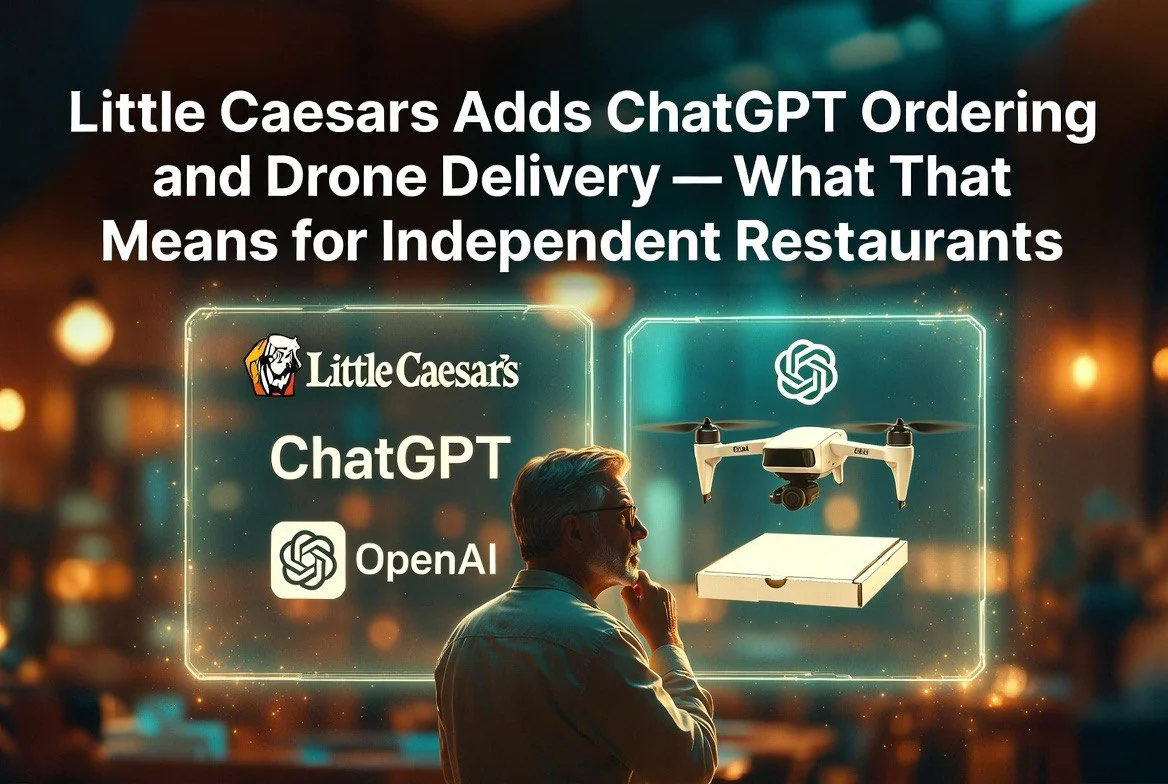
Little Caesars Adds ChatGPT Ordering and Drone Delivery — What That Means for Independent Restaurants
⚡ Expert Summary: Little Caesars partnered with Amazon Prime for a $5 large pizza deal (June 15-26, 2026) and their CMO Greg Hamilton revealed the chain is testing ChatGPT ordering via AI chatbots alongside drone delivery. The real story isn’t the promotion — it’s how major chains are using big-platform partnerships (Amazon, ChatGPT) as zero-cost ordering channels. For independent restaurant owners, this signals a shift: the battle for customer orders is moving from mobile apps to AI-driven voice and chat ordering through platforms customers already use. Independents don’t need Amazon’s budget — but they do need an AI ordering strategy.
The Deal That Got Everyone Talking
Little Caesars ran a June 15-26 promotion offering a $5 large pizza exclusively through Amazon Prime, leveraging Amazon’s 200 million US Prime members as a distribution channel. The deal went viral on social media — not because $5 pizza is unusual for Little Caesars (it is their whole brand), but because of how the orders were placed. Customers who had never considered ordering pizza through Amazon suddenly had a reason to try it, and the friction of downloading and setting up yet another food app was eliminated entirely.
Customers ordered through Amazon — not the Little Caesars app, not the website, not a phone call. The transaction happened entirely within Amazon’s ecosystem. For the pizza chain, this meant zero customer acquisition cost for 12 days of Prime member orders. For Amazon, it turned Prime into a pizza-ordering channel.
CMO Greg Hamilton told Restaurant Dive that the partnership is part of a broader strategy. Little Caesars is testing ChatGPT-powered ordering through AI chatbots and has drone delivery in the pipeline. The quote that matters: “We have to be where the customer is — and the customer is increasingly in AI interfaces, not in our app.”
That is the line independent restaurant owners need to pay attention to.
Why the Platform Play Matters More Than the Pizza Deal
The Little Caesars-Amazon partnership is a smart short-term promotion, but the long-term signal is the shift in how customers find and order food. Chains are moving away from building and maintaining their own ordering apps — a $50,000 to $200,000 investment per brand — and toward plugging into platforms customers already use.
Amazon Prime Day deals give chains access to millions of paying customers without ad spend. ChatGPT ordering lets customers place complex orders through natural conversation without downloading another app. Drone delivery removes the labor bottleneck that drives up delivery costs.
For Little Caesars, each of these is a channel. The brand’s own app is no longer the primary way customers interact — it is just one option among many. Independents cannot replicate the Amazon distribution or drone infrastructure, but the principle applies: your ordering strategy should not depend on customers downloading your app.
What ChatGPT Ordering Actually Looks Like in Restaurants
ChatGPT ordering works through conversational AI interfaces embedded in ChatGPT, WhatsApp, or text messaging. A customer types “I want a large pepperoni pizza and two orders of Crazy Bread” and the AI handles the order — confirming the items, checking pricing, routing to the correct location, processing payment. The entire interaction takes about 30 seconds. No phone hold music. No navigating an IVR menu. No creating a passworded account.
The technical architecture is simpler than most operators assume. The AI chatbot connects to the restaurant’s POS system through an API middleware layer — the same kind of integration that powers online ordering widgets. The AI handles natural language interpretation, then passes the structured order data to the POS. The kitchen receives the same ticket it would from any other order channel.
Several platforms already offer this for restaurants without requiring custom development:
OpenSpan (featured on AITR in May 2026): An AI voice and chat ordering system that integrates with existing POS systems and handles phone, text, and web orders. It launched an Australian pilot with Telstra for small business AI voice ordering in June 2026. OpenSpan’s differentiator is that it handles voice calls and text chats through the same AI engine, so a customer can start an order by voice and finish by text without repeating themselves.
Slang AI: An AI phone ordering system designed for restaurants that handles reservations, order modifications, and FAQs. It integrates with Toast, Square, and other major POS platforms and launched WhatsApp ordering support in early 2026. Slang’s strength is its restaurant-specific language model: it understands menu terminology, substitution requests, and common modifications without explicit training.
WhatsApp AI bots: Third-party AI agents that plug into WhatsApp Business API, allowing customers to order by sending a text message. No app download, no phone call — just a familiar chat interface. WhatsApp has over 2 billion monthly active users globally, which means your customers almost certainly already have the app installed. The barrier to trying your restaurant drops from “download our app and create an account” to “send a text.”
Toast AI Ordering: Built directly into the Toast POS system, this feature launched in Q1 2026 and adds AI-driven order-taking through voice and chat to the existing Toast online ordering infrastructure. It costs nothing extra beyond standard processing fees — a significant advantage for the roughly 25,000 independent restaurants already on Toast.
The difference between these AI ordering tools and a standard online ordering page is conversational capability. Instead of clicking through dropdown menus and selecting modifiers one by one, customers can say “I want the same thing as last Tuesday but with extra sauce” and the AI interprets the intent by checking their order history. For regular customers — the ones who generate 70% of revenue for most independent restaurants according to a 2025 Toast survey — this is a dramatically better experience than any mobile app.
The Drone Delivery Angle: Still Early, But Worth Watching
Little Caesars has been testing drone delivery since 2024 in select markets. The technology is not ready for broad deployment — regulatory hurdles, weather limitations, and noise complaints remain unresolved. But the direction is clear: chains are investing in delivery methods that do not depend on human drivers.
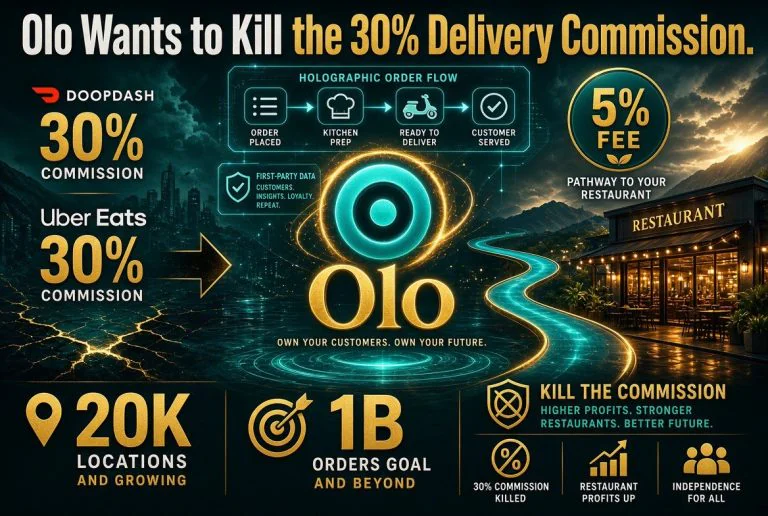
For independent restaurants, drone delivery is not relevant today. But the trend it represents — reducing labor dependency in delivery — is. AI-powered delivery routing, automated order consolidation, and dynamic pricing for delivery slots are all available now through third-party platforms like DoorFish, Uber Direct, and Chowly. These tools do not require a drone fleet. They use AI to optimize the delivery process using existing infrastructure.
The key lesson from Little Caesars’ drone tests: chains are solving the unit economics of delivery through automation. Independents should be looking at AI-powered delivery optimization tools, not waiting for drone service to arrive in their area.
How Independents Can Compete Without a $4 Billion Marketing Budget
Little Caesars spent zero on customer acquisition for its Amazon deal — Amazon’s existing user base absorbed the cost. Independents cannot replicate that, but they can use the same principle: meet customers where they already are, not where you wish they were.
Step 1: Enable AI chat ordering through existing platforms
Most POS systems used by independent restaurants — Toast, Square, Clover — now have AI ordering integrations available. Toast’s AI ordering feature launched in Q1 2026 and costs $0 per order beyond standard processing fees. Square’s AI chatbot for ordering rolled out in beta in May 2026. If you are already paying for a POS, check whether AI chat ordering is included in your plan before paying for a separate service.
Step 2: Optimize for platform discovery, not app downloads
Customers find restaurants through Google Maps, Yelp, DoorDash, Uber Eats, and increasingly through AI search (ChatGPT, Gemini, Perplexity). Your menu, hours, and ordering link need to be accurate and current on every platform. A 2025 study by SOCi found that 68% of independent restaurants had incorrect information on at least one major platform, directly costing them orders. AI search makes this worse — inaccurate data that an AI chatbot trusts and repeats amplifies the error across every surface.
Step 3: Build a regular-customer AI loop
The most cost-effective AI strategy for independents is not customer acquisition — it is repeat-customer retention through AI. An AI ordering system that recognizes regulars, remembers their preferences, and suggests their usual order creates retention lift at near-zero marginal cost. Little Caesars is investing in ChatGPT ordering to capture new customers. Independents should invest in AI that turns a first-time visitor into a weekly regular.
How this works in practice: a regular customer sends a text saying “the usual.” The AI looks up their order history, confirms their standard items (which might include customizations that a phone order taker would need to ask about each time), and checks the current price. The customer confirms with “yes” and the order is submitted. Total interaction: 15 seconds. Compare that to a phone call where the customer says “the usual” and the employee has to search for the name, find the order in the system, and confirm each item verbally — a two-to-three-minute interaction that costs labor time and risks errors.
Step 4: Watch the AI ordering platforms, not the hardware
Drone delivery is a distraction for most independents. The real innovation is happening in the ordering layer: conversational AI that replaces the phone call, the mobile app, and the website. The chain that wins the next five years is not the one with the best pizza — it is the one that makes ordering frictionless. Independents can win on that axis without spending millions.
The Bottom Line for Independent Restaurant Owners
Little Caesars’ ChatGPT and Amazon Prime strategy is not a threat to independent restaurants. It is a preview of where restaurant ordering is heading: platform-first, conversational, app-optional. The tools to compete on this axis — AI chat ordering, platform optimization, regular-customer AI — are available to any restaurant with a modern POS and a willingness to stop relying on phone orders and app downloads as their primary ordering channels.
The gap between chains and independents in AI ordering is not a technology gap. It is a strategy gap. Chains are treating AI as a new distribution channel. Most independents are still treating it as something to “look into next year.” The difference between those two approaches is the gap that will determine who gets the order.
FAQ
Is Little Caesars actually using ChatGPT for ordering?
Yes. Little Caesars CMO Greg Hamilton confirmed the chain is testing ChatGPT-powered ordering through AI chatbots. The exact rollout timeline has not been announced, but the testing is active as of June 2026.
What AI ordering tools are available for independent restaurants?
Several platforms offer AI ordering without requiring custom development. Toast and Square have built AI ordering features into their existing POS systems. OpenSpan and Slang AI offer standalone AI voice and chat ordering that integrates with major POS platforms. WhatsApp Business API supports AI chatbot ordering through third-party agents.
Do I need drone delivery to compete with chains?
No. Drone delivery is still in early testing and faces regulatory and operational hurdles. The more relevant trend is AI-powered delivery optimization — routing, order consolidation, and dynamic pricing — which is available now through existing delivery platforms like DoorFish and Uber Direct.
How much does AI chat ordering cost for a small restaurant?
If your POS already supports AI ordering (Toast, Square, Clover), the marginal cost is near zero — typically standard payment processing fees only. Standalone AI ordering platforms like OpenSpan and Slang AI charge monthly subscription fees starting around $99-$199 per location. The cost is generally lower than maintaining a custom mobile app.

About Barak Schurr
Barak Schurr built and exited a major ticketing platform, ran global operations at Eventbrite, and now focuses on one question: which AI tools actually help independent restaurant owners run leaner and grow faster. He writes from the operator’s perspective — no vendor spin, no theory, just what’s real in 2026.
Email: [email protected]
More AI Resources for Your Business