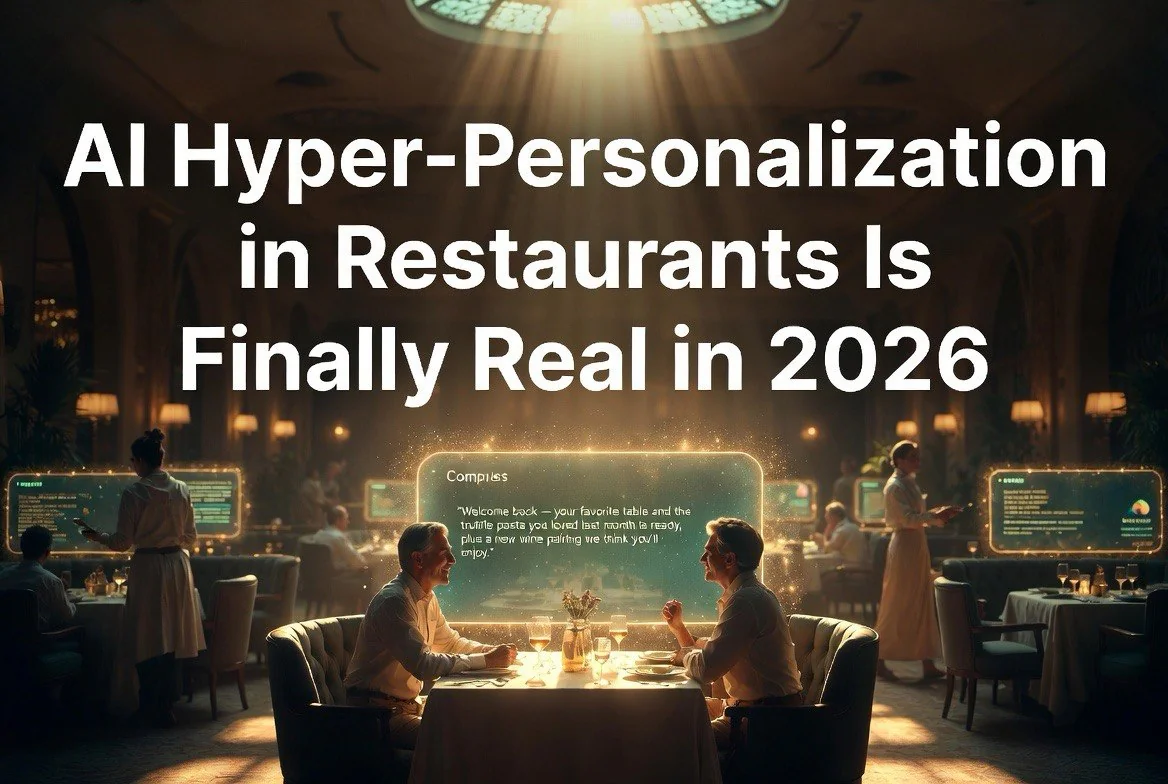
AI Hyper-Personalization in Restaurants Is Finally Real in 2026
⚡ Expert Summary: AI hyper-personalization in restaurants has moved from concept to deployed reality in 2026. Major platforms like Toast, Square, and OpenTable now offer AI-driven menu recommendations, dynamic pricing based on individual customer history, and personalized marketing that learns from every order. For American independent operators, this means treating every guest based on their unique preferences without adding labor cost. The cost is $60-$200 per month for the complete stack. This represents the most significant shift in restaurant customer relationship management since the transition from paper reservation books to digital POS systems.
What AI Hyper-Personalization Means for Restaurant Operators
Hyper-personalization uses artificial intelligence to tailor the dining experience to each individual customer based on their order history, dietary preferences, visit timing, and even weather conditions. It is different from basic personalization in the same way a curated playlist differs from shuffle. Instead of sending the same promotion to everyone in your database, hyper-personalization sends the right offer to the right person at the right time.
According to the National Restaurant Association’s 2026 State of the Industry report, 67% of American restaurant operators plan to invest in customer-facing technology in 2026, with personalization tools ranking third behind POS upgrades and online ordering. More than 15.5 million people work in the United States restaurant industry, and labor costs are the single largest expense. Hyper-personalization increases revenue per guest without adding labor, which is why it is gaining traction so quickly in 2026.
The Intouch Insight 2026 Drive-Thru Study found that 73% of American consumers are more likely to visit a restaurant that remembers their previous orders. This is no longer a nice-to-have but a competitive expectation. When customers walk into a restaurant and the system already knows they prefer oat milk and an extra shot, they feel recognized. That recognition drives repeat visits and positive reviews.
How AI Hyper-Personalization Works in Practice
AI hyper-personalization for restaurants operates on a simple data loop: collect customer order data, analyze it with machine learning models, generate personalized recommendations and offers, and measure the response to improve future predictions. Here is how it works across the three most common restaurant touchpoints:
Personalized Menu Recommendations
Toast’s AI-powered menu module ($79/month for the AI add-on) uses each customer’s order history to recommend items during checkout. If a customer always orders the spicy chicken sandwich with extra pickles, the system surfaces those items first. Toast reports that restaurants using AI menu recommendations see a 12-18% increase in average check size because customers are shown items they are genuinely likely to order rather than generic daily specials.
Square’s AI personalization engine (included with Square for Restaurants at $60/month) incorporates weather data and time of day. On a cold rainy day, it surfaces soup and hot coffee options. On a Friday afternoon, it suggests beer and appetizer combos. Square’s internal data shows that weather-adaptive menu recommendations increase conversion rates by 8-14% on days with extreme weather.
Dynamic Pricing Based on Customer History
Sauce ($99/month) enables personalized dynamic pricing for takeout and delivery orders. Unlike blanket discount codes that reduce margin on every order, Sauce’s AI adjusts pricing based on individual customer behavior. A customer who hasn’t ordered in 60 days gets a win-back incentive. A loyal customer who orders twice a week gets priority access to limited-time items instead of a discount they don’t need.
A 2025 study from Cornell University found that personalized pricing in restaurants increases customer lifetime value by 22-35% because offers are relevant rather than wasteful. Cornell’s research showed that 89% of American consumers prefer receiving targeted offers over generic discounts, because targeted offers feel curated rather than desperate.
Personalized Marketing Automation
OpenTable’s AI marketing tools (included with the $249/month OpenTable for Restaurants plan) segment diners by behavior patterns and automatically send personalized emails. Guests who always book Friday night dinner get a Thursday afternoon reminder with their most-ordered items featured. Guests who haven’t visited in 90 days get a win-back email with a personalized recommendation.
According to Deloitte’s 2025 restaurant technology survey, AI-powered email personalization increases click-through rates by 350% compared to batch-and-blast campaigns. For an independent operator sending 1,000 emails per month, that means 48 clicks versus 216 clicks. Mailchimp’s AI segmentation tools ($39/month) can connect to your POS and deliver this without any technical setup.
Why Independent Operators Have an Advantage in Personalization
This is the counterintuitive advantage independent operators have over large chains. A national chain with 500 locations collects data across millions of transactions, but that data is generalized. An independent operator with 3,000 regular customers collects data on a smaller scale but at higher quality. Every interaction in an independent restaurant generates more meaningful data: the regular who always sits at table 7, the lunch customer who always orders the same salad without onions, the weekend brunch group that comes in every Saturday at 11 AM.
The National Restaurant Association notes that independent restaurants in the United States account for 91% of all eating and drinking establishments. Independent operators know their customers by name in a way chain managers rarely can. AI hyper-personalization amplifies that knowledge by capturing and acting on preferences the operator already knows intuitively.
The Revenue Impact of Hyper-Personalization
Understanding why hyper-personalization delivers such strong returns is critical for independent operators making a technology investment decision. The United States restaurant industry serves 60% of American adults at least once per week. Each customer represents a recurring revenue stream that compounds over years. Losing a $15-per-week customer to a competitor who personalizes better costs $780 per year in lost revenue. AI tools that improve retention by even 10% pay for themselves many times over at $60-$200 per month.
Reduced Marketing Waste. Generic email blasts convert at 1-3%. AI-segmented campaigns convert at 8-15%. For a restaurant sending 1,000 emails per week, that is 80-150 reservations versus 10-30 from batch blasts. Mailchimp at $39/month with AI segmentation delivers this delta without increasing your marketing budget.
Higher Check Size Without Pushy Upsells. When AI recommends a beer pairing with a customer’s usual burger, it doesn’t feel like an upsell. Toast’s data shows AI recommendations placed at the right moment convert at 22%, versus 8% for static promotional banners. The difference is entirely in relevance.
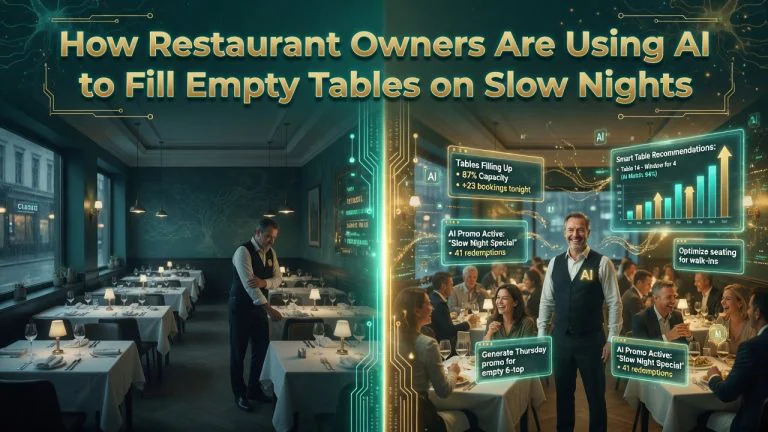
Improved Traffic During Slow Periods. Tuesday night generates low traffic for most independent restaurants. AI personalization identifies which customers are most likely to come in on a Tuesday based on previous visit patterns and sends them a targeted offer. Square’s AI promotion tools automate this entirely. Operators report 15-25% higher traffic on traditionally slow days after implementing AI-driven promotions.
Menu Engineering Insights. When AI shows that 40% of regular customers order the same three items, those items are anchor products. If a specific appetizer converts at 3% while consuming 8% of food cost, it is a replacement candidate. This feedback loop between personalization data and menu decisions is a hidden value of AI tools that most operators don’t account for in their ROI calculations.
Dietary Preference Management. The National Restaurant Association reports that 32% of US adults follow a specific diet. When a customer profile notes gluten-free preferences, the AI automatically filters menu options to show only compatible items. This eliminates back-and-forth with servers and reduces allergen risk. For operators, it means fewer modifications and faster table turns.
VIP Customer Detection. OpenTable’s AI tools identify VIP customers when they book. Customers who spend 20% above median are flagged for priority seating or a complimentary welcome item. SevenRooms ($99/month base plan) offers similar VIP detection. This doesn’t require extra labor — the AI flags the data and the existing host acts on it.
How to Implement AI Hyper-Personalization in Your Restaurant
For independent operators who want to deploy AI hyper-personalization in 2026, here is a phased approach that requires no technical background:
Phase 1: Collect the Data. Before you can personalize, you need a system that captures customer order history. If you are already using Toast ($79/month base), Square ($60/month), or Clover, you have the data. Connect your POS to a CRM that can store and analyze it. Bbot’s QR ordering platform (free setup, transaction-based fees) captures every order with customer identification.
Phase 2: Start With Email Personalization. Mailchimp’s AI segmentation tools ($39/month) connect to your POS and send personalized emails based on order history. Start simple: a birthday offer, a 90-day win-back offer, and a favorite-item-returned offer. Track open rates and conversion. Most operators see a 3-5x improvement in email ROI within 60 days.
Phase 3: Add Menu Recommendations. If you have online ordering, enable Toast’s AI menu recommendation module ($79/month add-on). The system requires zero setup — it learns from your customer data and surfaces relevant items at checkout. Monitor average check size for 30 days and compare.
Phase 4: Deploy Dynamic Pricing. Once your personalization foundation is solid, add Sauce ($99/month) for targeted pricing. Start with the win-back campaign for lapsed customers — the highest ROI use case. Measure customer lifetime value before and after implementation.
Phase 5: Add VIP Recognition. OpenTable ($249/month) or SevenRooms ($99/month) integration flags VIP customers automatically. This is the final piece that transforms data into genuine hospitality.
The Bottom Line on Restaurant Hyper-Personalization
AI hyper-personalization is real and deployable for independent restaurants in 2026. The tools cost $60-$250 per month per tool, require no technical expertise, and deliver measurable ROI in customer retention and average check size. Operators who implement personalization now will build stronger customer relationships that compound over time. Operators who wait will find customers gravitating to competitors who remember their name, their order, and their preferences.
For American independent operators, the bar is higher than ever. Customers expect the same recognition at their local restaurant that they get from Amazon and Netflix. AI hyper-personalization tools make that expectation achievable at indie scale for less than the cost of a single shift of labor per month.
Frequently Asked Questions
What is AI hyper-personalization in restaurants?
AI hyper-personalization uses machine learning to tailor menu recommendations, pricing, and marketing to each individual customer based on their order history, preferences, and behavior patterns. It goes beyond basic segmentation to create unique experiences for every guest.
How much does AI hyper-personalization cost for independent restaurants?
AI personalization tools for independent restaurants range from $39/month for email segmentation (Mailchimp) to $99/month for dynamic pricing (Sauce) to $79/month for menu recommendations (Toast AI add-on). Most operators need 2-3 tools for full coverage totaling $120-$200 per month.
Does AI hyper-personalization increase average check size?
Yes. Toast reports 12-18% increases in average check size from AI menu recommendations. Square’s weather-adaptive recommendations boost conversion by 8-14%. Personalized marketing increases customer lifetime value by 22-35% according to Cornell University research.
Do customers actually want personalized restaurant experiences?
Yes. The Intouch Insight 2026 Drive-Thru Study found that 73% of American consumers are more likely to visit a restaurant that remembers their previous orders. Cornell’s research shows 89% of consumers prefer targeted offers over generic discounts.
Can small independent restaurants implement AI personalization?
Yes. Independent operators actually have an advantage because they know their regular customers personally. AI tools like Toast AI Menu Recommendations, Mailchimp with POS integration, and Sauce dynamic pricing require no technical skills and work with existing POS systems.

About Barak Schurr
Barak Schurr built and exited a major ticketing platform, ran global operations at Eventbrite, and now focuses on one question: which AI tools actually help independent restaurant owners run leaner and grow faster. He writes from the operator’s perspective — no vendor spin, no theory, just what’s real in 2026.
Email: [email protected]
More AI Resources