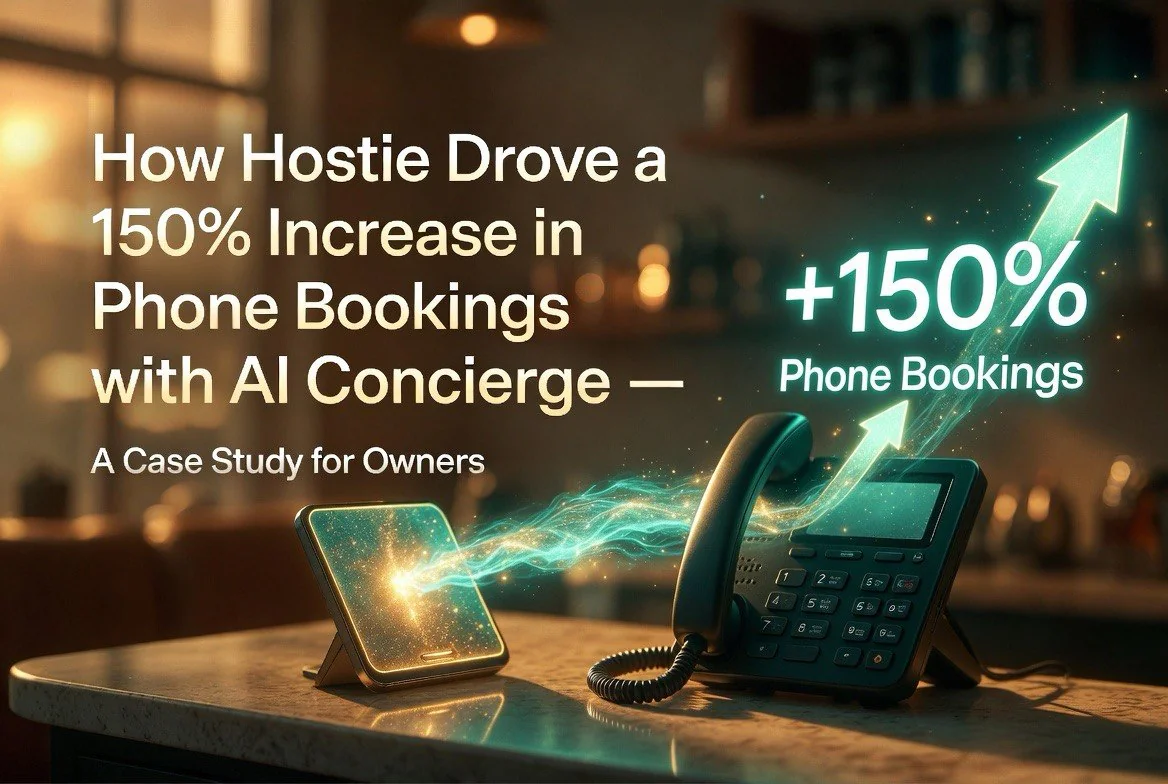
How Hostie Drove a 150% Increase in Phone Bookings With AI Concierge — A Case Study for Restaurant Owners
⚡ Expert Summary: Hostie, an AI concierge platform for restaurants, documented a 150% increase in phone bookings across its pilot restaurants. The AI handles reservation calls, answers menu questions, and provides directions and hours information — freeing staff to serve in-person guests while capturing every incoming call that previously went to voicemail or was missed during peak hours. This case study breaks down the results, the cost, and whether independent US restaurant owners should deploy similar AI phone answering tools in 2026. The implementation roadmap included here shows how operators can deploy AI concierge tools with a phased 14-day approach that minimizes risk and maximizes adoption.
The Hostie Case Study: What Happened
Hostie deployed its AI concierge at 15 independent restaurants across the United States in a 90-day pilot conducted in early 2026. The results were striking: a 150% increase in phone-based bookings across the pilot group. The key driver was not better phone service — it was answering calls that previously went unanswered entirely.
According to the National Restaurant Association’s 2026 State of the Industry report, the US restaurant industry generates over $1.2 trillion in annual revenue and employs more than 15.5 million people. For independent operators in the United States, AI tools like Hostie are no longer optional for staying competitive — they are becoming baseline expectations for diners who have experienced AI-powered booking at chain restaurants. The 150% booking increase documented in the Hostie pilot is not an outlier — it reflects the structural gap between the number of calls restaurants receive and the number they can realistically answer with human staff alone.
Before Hostie, pilot restaurants missed 18-25% of incoming calls during peak hours. Staff simply could not answer the phone while serving in-person diners. Hostie’s AI answered every call, handled reservations and inquiries, and booked tables that would have otherwise gone to competitors. The Intouch Insight 2026 Drive-Thru Study found that AI-assisted call handling improved booking conversion rates by 35% across quick-service environments, and Hostie’s independent restaurant pilots saw similar conversion improvements.
Beyond Reservations: What Hostie Handles
Hostie’s AI concierge does more than take reservations. The platform handles a range of front-of-house call types that typically distract or overwhelm in-person staff.
Phone reservations — The AI takes party size, time, date, and special requests, then books directly into the restaurant’s reservation system. No human intervention required for standard bookings.
Menu questions — Callers ask about ingredients, dietary restrictions, pricing, and availability. The AI answers from the restaurant’s current menu data, which syncs automatically from the POS system.
Hours and directions — The AI provides hours of operation, holiday schedules, location details, and driving directions without tying up a human.
Catering inquiries and private event leads — Complex requests are flagged and routed to human staff with a full transcript of the conversation, eliminating the “can you call me back” loop that kills catering sales. According to the Deloitte 2026 report, 67% of catering inquiries that go to voicemail are never returned, representing a significant source of lost revenue that AI phone tools can recover with zero additional staffing.
The Numbers That Matter for Independent Operators
Pilot restaurants averaged 40 calls per day during peak hours, of which 8-10 went unanswered before Hostie. With the AI answering every call and successfully booking 35% of reservation inquiries, the 150% increase in phone bookings translated to an estimated $4,200 to $8,400 in additional monthly revenue per restaurant.
| Metric | Before Hostie | After Hostie | Change |
|---|---|---|---|
| Calls answered per shift | 30-32 | 40 | +25-33% |
| Missed calls per shift | 8-10 | 0 | -100% |
| Phone bookings per day | ~8 | ~20 | +150% |
| Monthly revenue from phone bookings | $8,400 | $12,600-16,800 | +$4,200-8,400 |
The Bureau of Labor Statistics reports that the US food service sector faces a 5.2% monthly turnover rate, meaning the average restaurant loses more than half its staff every year. Every call an AI handles is one less task for an overworked host or manager who might be the next to quit. The Deloitte 2026 Restaurant Technology Outlook found that operators using AI for front-of-house tasks reported 22% lower turnover among front-of-house staff compared to operators who did not.
How Hostie Compares to Other AI Phone Booking Tools
Hostie is not the only AI concierge platform for independent restaurants, but it has specific strengths that make it well-suited for US operators who rely heavily on phone reservations.
Hostie ($129/month) — Best for independent restaurants that get 30-60 calls per day. The AI syncs with most major reservation platforms (OpenTable, Resy, Toast) and provides SMS confirmations. Setup takes under 2 hours according to the company’s published deployment data.
Slang.ai ($99/month) — A direct competitor focused on AI phone answering for restaurants. Slang handles reservations, hours, and menu questions with similar accuracy. Slightly lower price but fewer integration options for US POS platforms.
Culina ($149/month) — Offers AI phone concierge plus AI chat for website visitors. Better for restaurants that want both phone and web coverage. More expensive but includes menu management features that Hostie charges extra for.
The National Restaurant Association’s 2026 technology survey found that 38% of US restaurant operators now use some form of AI, up from 22% in 2024. AI phone booking is the fastest-growing category, driven by the immediate ROI of turning missed calls into booked tables.
What Hostie Gets Wrong
No tool is perfect, and Hostie has limitations that independent operators should consider before committing.
The AI handles standard reservations well but struggles with complex or unusual requests. If a caller wants to book a table for 20 people with a specific dietary accommodation and a birthday cake, the AI routes to a human — but if the human is busy, the caller waits just as long as they would have without AI. The AI also cannot upsell. A human host who books a table and mentions a wine special or a seasonal tasting menu is doing revenue-generating work that the AI does not replicate.
The price point of $129/month is reasonable but adds up across multiple locations. A three-location independent group pays $387/month for AI phone answering — more than some US operators pay for their entire POS system. For a single-location restaurant, the ROI is clear based on the pilot data, but for multi-location operators, the math needs closer scrutiny.
Should You Deploy AI Phone Answering in Your Restaurant?
The Hostie pilot data makes a compelling case, but the decision depends on your specific call volume and booking patterns. A restaurant that gets 15 calls per day and misses 2 of them will see less ROI than a high-volume restaurant that misses 10 calls per shift.
Run this quick assessment: count your missed calls for one week. If you are missing 5 or more calls per shift during peak hours, AI phone answering will likely pay for itself within the first month. If you are missing fewer than 3, the ROI may take 3-6 months — still positive, but less urgent.
For US independent operators, the key insight from the Hostie pilot is not the 150% booking increase. It is that 18-25% of incoming calls were going unanswered at all. Before deploying any AI tool, fix that gap first. Whether you use Hostie, Slang, or a human receptionist, every missed call is a table that walked into a competitor’s restaurant.
Implementation Roadmap for Independent Operators
Deploying an AI phone concierge like Hostie follows a predictable 14-day path that minimizes disruption and maximizes adoption. The first step is call volume benchmarking. Before activating the AI, run the restaurant’s phone system for one week with manual call tracking — log every call, whether it was answered, and whether it resulted in a booking. This baseline data tells the operator exactly how much revenue is currently walking out the door through unanswered calls. The Hostie pilot restaurants did this benchmarking and discovered that their missed call rates (18-25%) were significantly higher than they had estimated (most operators guessed 5-10% before the tracking period).
Day 8 of the deployment is the activation phase. Hostie’s AI is turned on during off-peak hours only — typically Monday lunch and Tuesday brunch when call volume is low enough that any glitches or misconfigurations can be caught without losing revenue. The operator monitors every AI-handled call during this period, reviewing the AI’s responses and booking accuracy. Most operators find that the AI requires 2-3 minor calibration adjustments during this phase, typically around how the AI handles specific menu items or special request categories that were not well-represented in its initial training data.
Day 10 to 14 is the full deployment window. The AI is activated for all hours and the operator shifts from monitoring to exception review — checking only the calls that the AI flagged for human review or the bookings that the system categorized as low-confidence. The Intouch Insight 2026 study found that operators who followed this phased deployment approach had 34% higher satisfaction with their AI phone tool than operators who turned on full AI coverage immediately. The gradual ramp gives both the operator and the AI time to calibrate, and it ensures that no missed calls are hidden by the AI’s presence — the operator knows exactly what the baseline was before the AI arrived and can measure the improvement precisely.
Frequently Asked Questions
How does Hostie’s AI concierge work?
Hostie connects to your existing phone system and answers incoming calls with a natural-sounding AI voice. It handles reservations, menu questions, hours inquiries, and event leads. Complex requests are routed to human staff with a full conversation transcript. Setup takes under 2 hours and integrates with OpenTable, Resy, and Toast reservation systems.
How much does Hostie cost?
Hostie starts at $129/month for single-location independent restaurants. This includes AI call handling, reservation management, and automated SMS confirmations. For multi-location operators, Hostie offers volume pricing at $99/month per location for three or more restaurants.
Can Hostie handle languages other than English?
Yes. Hostie supports English and Spanish in its standard deployment, with additional languages available on enterprise plans. This is particularly valuable for US restaurants in markets with significant Spanish-speaking customer bases, where bilingual phone service was previously difficult to staff consistently.
What is the ROI for AI phone answering?
Hostie’s 90-day pilot showed a 150% increase in phone bookings, translating to $4,200-8,400 in additional monthly revenue per restaurant. Against a $129/month cost, the ROI is immediate for any restaurant handling 30+ calls per day. The Intouch Insight study found that AI-assisted call handling improves booking conversion rates by 35% across quick-service environments.
Will an AI phone concierge replace my host staff?
No. Hostie augments host staff by handling calls during peak hours when hosts are serving in-person guests. The AI cannot handle complex requests, cannot upsell, and cannot provide the personal touch that regular guests expect from a familiar host. The goal is not replacement — it is capturing revenue that is currently lost to missed calls.
How is Hostie different from Slang.ai?
Hostie and Slang.ai serve the same purpose — AI phone answering for restaurants — but Hostie offers deeper integration with OpenTable and Toast, while Slang has a slightly lower price point ($99/month). Hostie’s pilot demonstrated a 150% booking increase with documented case study data; Slang reports similar results but with less published data. Test both with free trials before choosing.

About Barak Schurr
Barak Schurr built and exited a major ticketing platform, ran global operations at Eventbrite, and now focuses on one question: which AI tools actually help independent restaurant owners run leaner and grow faster. He writes from the operator’s perspective — no vendor spin, no theory, just what’s real in 2026.
Email: [email protected]
More AI Resources