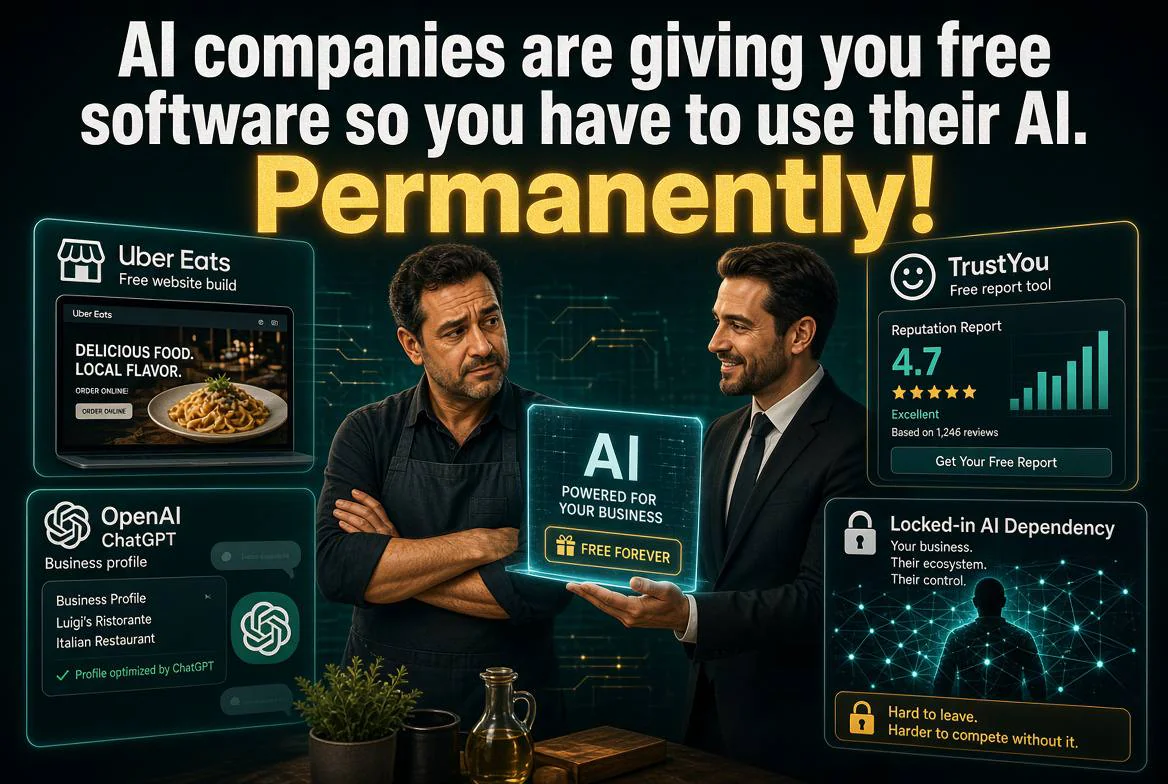
AI companies are giving you free software so you have to use their AI. Permanently!
⚡ Expert Summary: Uber Eats will now build your restaurant a free AI-generated website and hand you a free AI assistant that reads your sales and ad performance. OpenAI put local business profiles inside ChatGPT so your listing lives in a chatbot. TrustYou shipped a report tool aimed at owners who never log in — free to the point of contact. Every one of these is free because the product being bought is not the website. It is the exit. Nobody in public reporting will say who owns the domain, whether you can take the site with you, or what the fee is after the free period.
Three companies walked into your restaurant this week and offered you free software. A free website. A free listing. A free report your regional manager will actually read.
None of them are being generous. Every one of them is buying the same thing: the position inside your operation where their model sits between you and your guest. Once it is there, leaving is not a switch you flip. It is a rebuild you pay for.
This is the part the press release leaves out. Free is not a discount on the software. Free is the price of the door closing behind you.
What actually got offered this week
Start with the biggest one. Uber Eats announced at its Delivered product event that restaurants using the platform can now create AI-generated websites through a partnership with online ordering provider Owner. Reported by Joe Guszkowski at Nation’s Restaurant News on November 17: restaurants that use Uber Eats can now create AI-generated websites through the new partnership.
What is free is the build. What is also free is the Merchant Assistant, an AI chatbot sitting inside the Uber Eats Merchant app that analyses sales patterns, advertising performance, promotions and operations. Owner’s other products — a custom mobile app and marketing services — are offered at 60% off, which is a discount that only means anything if you have already decided to buy them.
Then there is ChatGPT. OpenAI rolled out Google-style local business profiles inside the chatbot, letting restaurants, bars and hospitality operators claim and manage their listings on a conversational interface. Your restaurant is now something a person can ask a chatbot about, and you can claim the record of what it says.
And then TrustYou, which launched a conversational report builder aimed squarely at the hotel owner or multi-property director who never logs into the dashboard they already pay for. Set your KPIs once, and it emails scheduled reports as PDF or Excel in each recipient’s language.
Look at the shape of all three together. One builds your website. One holds your listing. One writes the report your boss reads. That is not a product bundle. That is the entire digital surface of your business, each piece handed over to a different vendor for free.
Why free is the hook, and what the hook is attached to
A restaurant website is not a trivial expense. Custom design runs from $1,000 to $5,000 upfront, with hosting and maintenance commonly cited at $50 to $200 a month on top. A free version of that is a genuine saving for a single-site independent doing $1.2 million a year on a 4% net margin — which is $48,000 in profit, before the owner takes a dollar out.
That is exactly why the offer works. The saving is real, the price is zero, and the thing being asked for in return is the part nobody puts in the terms.
Here is what the reporting does not tell you, and what I could not find published anywhere:
| Question that decides everything | What is published | What silence means |
|---|---|---|
| Who owns the domain? | Silent | Assume it is not you until you see it in writing |
| Can you export the site and leave? | Silent | A rebuild is the likely exit cost |
| What is the fee after the free period? | Not confirmed | The price is set later, by the party that owns the tool |
| How is ChatGPT ranking decided? | Nothing confirmed | No disclosure means no defence if it changes |
| Is sponsored placement coming? | Nothing confirmed | The question exists, which is the answer |
| What guest data is retained or trained on? | Silent | Read the terms, then read them again |
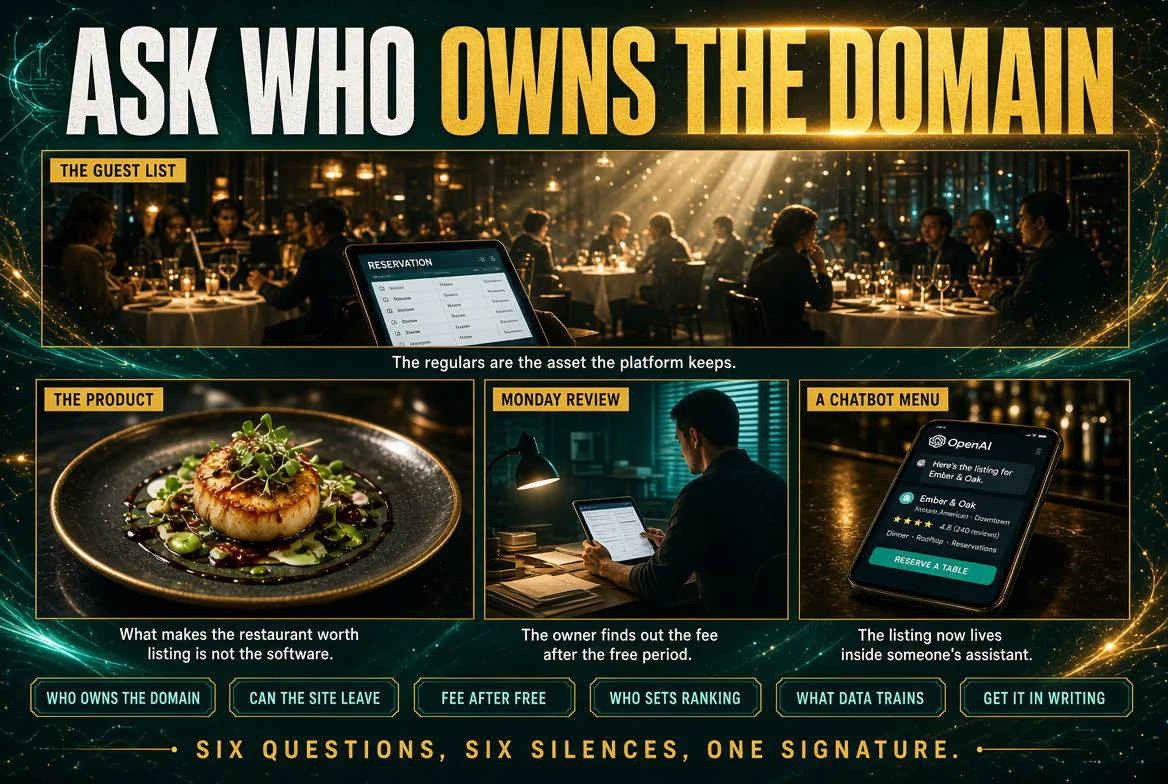
Six questions. Six silences. Not one of those gaps is an accident of reporting — they are gaps because the companies doing the offering have not published answers, and the trade coverage cannot quote what does not exist.
When a vendor gives you something valuable for nothing and will not tell you who owns it, the answer is the one you would guess. The only question is how expensive the discovery turns out to be.
The numbers you are being asked to forget
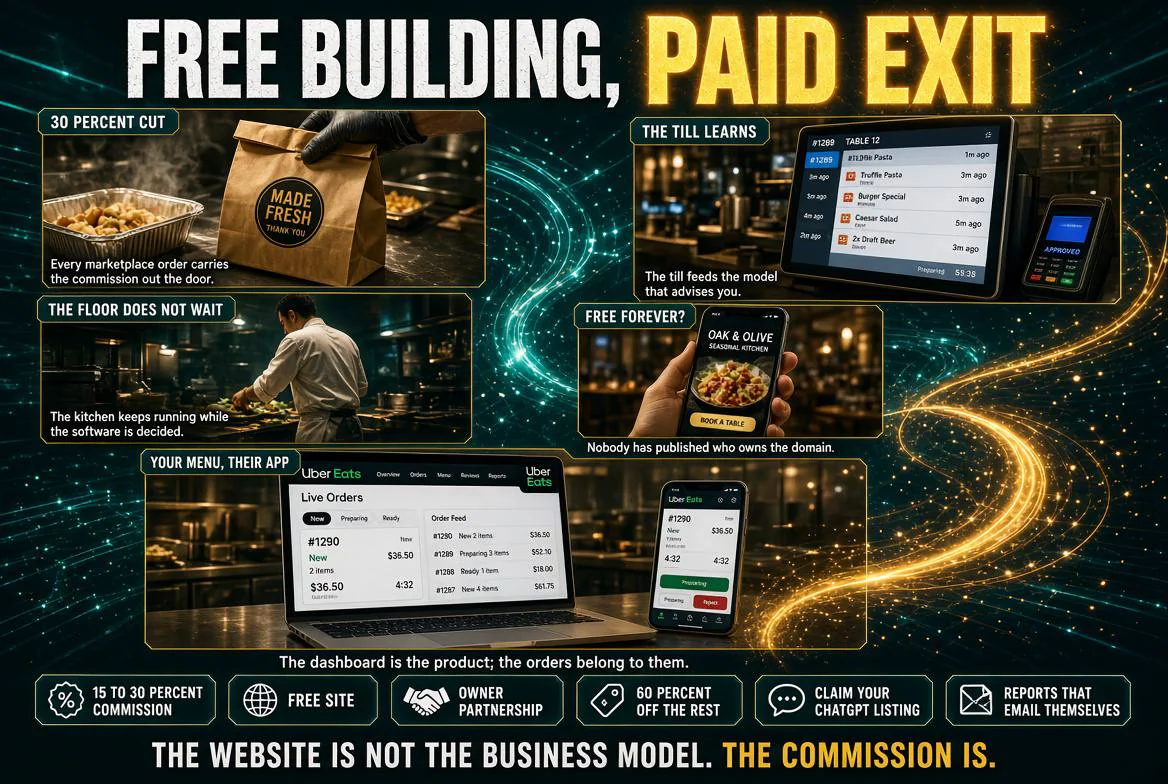
Here is the arithmetic the free website is sitting on top of. Third-party marketplace commission rates commonly run between 15% and 30% per order. Industry benchmarks regularly put independent restaurants’ reliance on third-party aggregators at 30% to 50% of off-premise volume.
Run that on a restaurant doing $40,000 a month in off-premise. Take the midpoint: 40% through marketplaces is $16,000, and 22.5% commission on that is $3,600 a month. That is $43,200 a year handed to a platform, and it is more than the entire net profit of a $1.2 million restaurant at 4% margin.
Now put the free website next to that number. The website is not the business model. The commission is the business model. The website is the thing that makes the commission feel like a partnership instead of a toll.
This is not an argument against using delivery platforms. It is an argument for knowing which line on the P&L the free gift is designed to protect. If a free website builder keeps you inside an ordering stack that charges 15% to 30%, the website did not save you $4,000. It protected $43,200 of somebody else’s revenue.
The comparison that matters: what you keep
| What it costs and what you keep | Free platform tool | Paid tool you control |
|---|---|---|
| Upfront cost | $0 | $1,000-$5,000 plus $50-$200 monthly |
| Who owns the domain | Not published | You, registered in your name |
| Who owns the content | Not published | You, exportable any time |
| Guest and order data | Lives in their stack | Lives in yours |
| Cost of leaving | Rebuild from zero | Migrate a database |
| Who sets the future price | They do, unilaterally | A contract you negotiated |
| Commission exposure | 15%-30% per order | Whatever your processor charges |
Yes, the right column costs money today. The left column costs you the ability to negotiate tomorrow, and the right to take your own guest list to a different supplier.
An operator I would respect does not refuse the free tool. He takes it, and he reads the data ownership clause before he lets it touch the domain his business is registered under.
The counterweight: automation that cuts a cost instead of capturing a customer
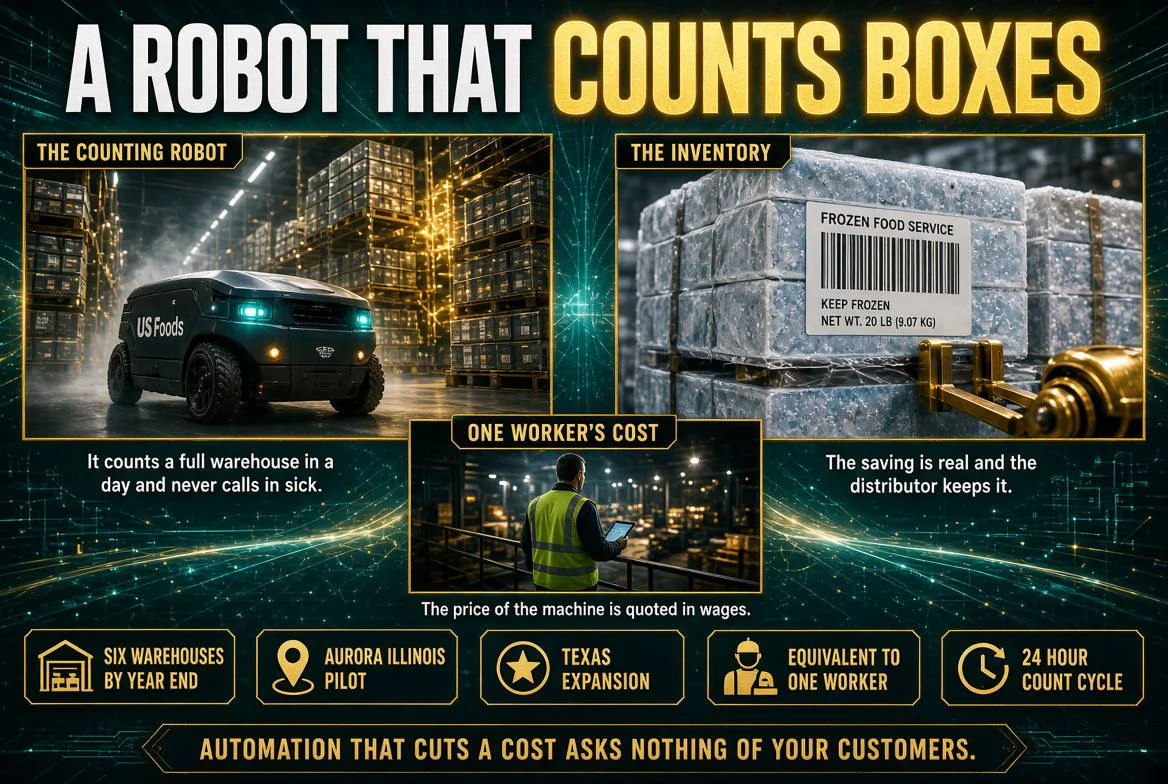
Not everything happening this month is a landgrab, and the contrast is instructive. US Foods is expanding autonomous inventory-scanning robots to six additional warehouses by year-end, following pilots in facilities including Aurora, Illinois, with further expansion across Texas. Reported by Antone Gonsalves in Supply Chain Dive on November 17.
CEO David Flitman told investors the plan is to begin piloting the technology in each of the facilities by year-end. On cost, his line was specific: US Foods’ automation technology for inventory counting is roughly the equivalent cost of one worker.
Sit with that comparison for a second. One worker’s cost buys an inventory system that counts a full warehouse with high precision inside a 24-hour cycle, and never calls in sick on a Friday.
Now ask what US Foods is asking for in return. Not your domain. Not your guest list. Not a position between you and your customer. They are removing a cost from their own operation and selling you the same product. That is what automation looks like when it is not a landgrab — the saving is real, it is theirs, and nobody is asking you to hand over the exit in exchange for it.
The difference between the two categories is not technology. It is who captures the relationship. US Foods uses robots to count boxes. Uber Eats uses a free website to count you.
What the operator actually does on Monday
Take the free tool if it saves you real money. Do it with your eyes open and a short checklist.
First: ask for the domain in writing. Not “can we use our own domain” — get the sentence that says the domain is registered to your business and transfers on request. If the answer is a link to a help article rather than a clause, treat it as a no.
Second: find out what happens to the site if you stop using the delivery platform. Not the website product — the delivery platform. If the site is tied to the ordering stack, the site is a retention tool and you should price that into your decision.
Third: read the training data clause. Every AI assistant that reads your sales and ad performance is also, potentially, learning from your sales and ad performance. Ask explicitly whether your data trains a model, and whether you can opt out. If nobody can answer, that is the answer.
Fourth: keep your guest list in something you own. A platform-hosted website that holds your reservations, your emails and your regulars is a guest list you do not have. Export it monthly, into a file, on your own machine. It takes twenty minutes and it is the difference between leaving and being held.
Fifth: put a date in the diary for the free period’s end. Whatever the price becomes after that, you want to find out on your terms rather than discovering it on a statement.
None of this is dramatic. It is the same discipline you already apply to a beer supplier or a linen contract. The only new thing is that the vendor offering you a free gift is now also the vendor holding your customer data, your website and your listing, and that concentration deserves the same attention you give a lease.
The honest verdict
Free software from a platform is not a gift and not a trap. It is a trade, and the terms of the trade are deliberately unpublished because publishing them would make the price obvious.
Uber Eats gets a website build, a merchant assistant and a discount on Owner’s other products into thousands of restaurants. OpenAI gets a claimed local listing inside the interface where a growing number of people decide where to eat. TrustYou gets a report emailed weekly to the person who signs the chequebook. Each of them gives away something that costs them almost nothing and receives a position they could not otherwise buy.
What none of them have published is who owns the domain, whether the site can leave, what the fee becomes, or how the ranking is decided. That silence is the tell. It is also, for now, the only piece of leverage an operator has: ask the question, get the answer in writing, and decide before the free period ends rather than after.
The free tool is not the product. You are the product, and the model they are locking you into is designed to be the only exit.
Frequently asked questions
Is the Uber Eats free website builder really free?
The website build and the Merchant Assistant are offered free through the Uber Eats partnership with Owner. Other Owner products, including a custom mobile app and marketing services, are discounted at 60% off. No post-introductory fee for the website itself has been published.
Who owns the domain and the content of an AI-generated restaurant website?
Public reporting and announcements do not say. Neither Uber Eats nor Owner has published terms stating whether the merchant retains domain ownership or can migrate the generated site out of the ecosystem. Treat that silence as a material contract risk.
What are third-party delivery commissions for restaurants?
Marketplace commission rates commonly run between 15% and 30% per order. Industry benchmarks regularly put independent restaurants’ reliance on third-party aggregators at 30% to 50% of off-premise volume, which makes commission the dominant platform cost rather than any software fee.
Can a restaurant opt out of its data training an AI model?
Nothing confirmed has been published on training-data terms for these specific products. Ask the vendor directly and get the answer in writing before connecting sales or guest data to any AI assistant.
Does ChatGPT show restaurant listings, and can operators control them?
OpenAI has rolled out local business profiles inside ChatGPT that merchants can claim and manage. OpenAI has not published how ranking inside local chat discovery is decided, or whether sponsored placement exists or is planned.
What does a normal restaurant website cost?
Independent restaurants typically pay $1,000 to $5,000 upfront for custom web design, plus $50 to $200 a month in hosting and maintenance. That range is the saving a free builder offers, and it is also the scale of what is being traded.
Is any hospitality automation genuinely cost-cutting rather than lock-in?
Yes. US Foods is expanding autonomous inventory-scanning robots to six more warehouses, with CEO David Flitman describing the technology as roughly the equivalent cost of one worker. It removes a cost without capturing the operator’s customer relationship.

About Barak Schurr
Barak Schurr built and exited a major ticketing platform, ran global operations at Eventbrite, and now focuses on one question: which AI tools actually help independent restaurant owners run leaner and grow faster. He writes from the operator’s perspective — no vendor spin, no theory, just what’s real in 2026.
Email: [email protected]
More Resources for Restaurant Operators