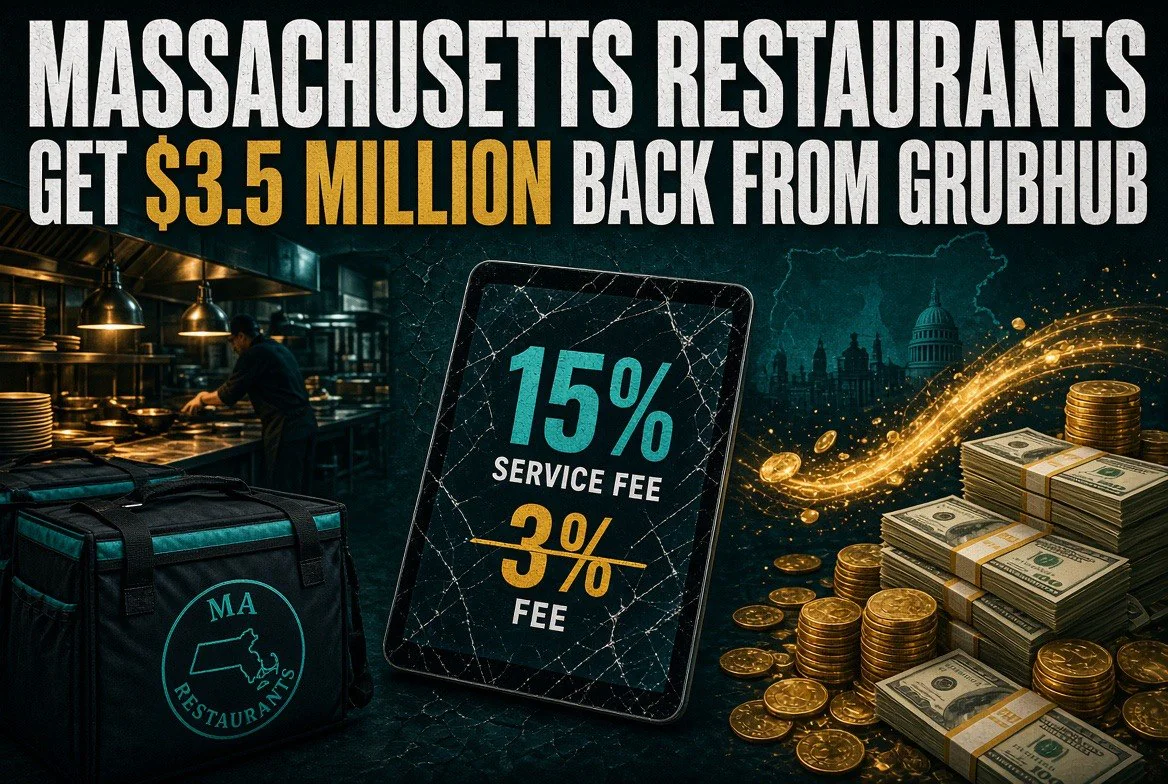
Massachusetts Restaurants Get $3.5 Million Back From Grubhub
⚡ Expert Summary: Massachusetts capped what delivery apps could charge restaurants at 15% during the pandemic. Grubhub charged the cap — and then added a 3% “processing fee” on top, arguing it was not a fee at all. A judge rejected that, and Grubhub paid $3.5 million back to restaurants plus $125,000 to the Commonwealth. On a $30 order the difference was $5.40 versus $8.40. If you run an independent restaurant and have never audited the line items on your delivery statements, this settlement is your free audit template. The fee cap is the law. The wording of the fee is not.
The statute was never complicated. Massachusetts Session Law 2020, Chapter 358, Section 98(a) said third-party delivery companies could not charge a restaurant more than 15 percent of the order for delivery services during the declared emergency. It applied to restaurants with fewer than 25 locations. It expired on 15 June 2021.
Grubhub says it complied with it. The company’s public position, delivered by attorney Joshua Lipshutz of Gibson, Dunn & Crutcher, opened with a clause that has now cost the company several million dollars: “While we have always complied with Massachusetts’ temporary price control…”
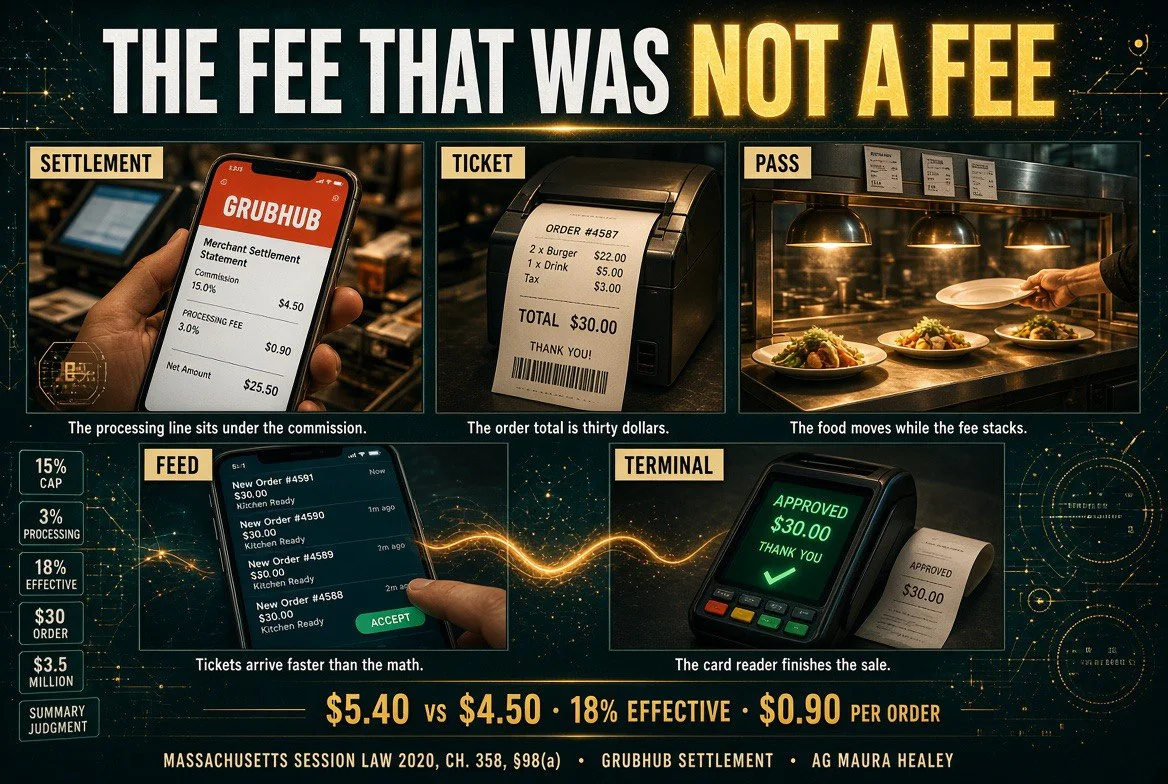
Here is what complying looked like. Fifteen percent commission, as the statute required. Then a separate line item, labeled a processing fee, adding roughly 3 percent for credit card processing. On a $30 order that is $4.50 in commission plus $0.90 in processing, or $5.40 — an 18 percent total charge, against a legal ceiling of 15 percent.
Grubhub’s argument was that the processing fee was not a delivery fee, and the statute only governed delivery fees. Judge Robert Gordon declined to accept it, in language that has since become the most quoted line in the case: accepting the company’s reading would mean “an order processing fee is somehow not a fee at all.”
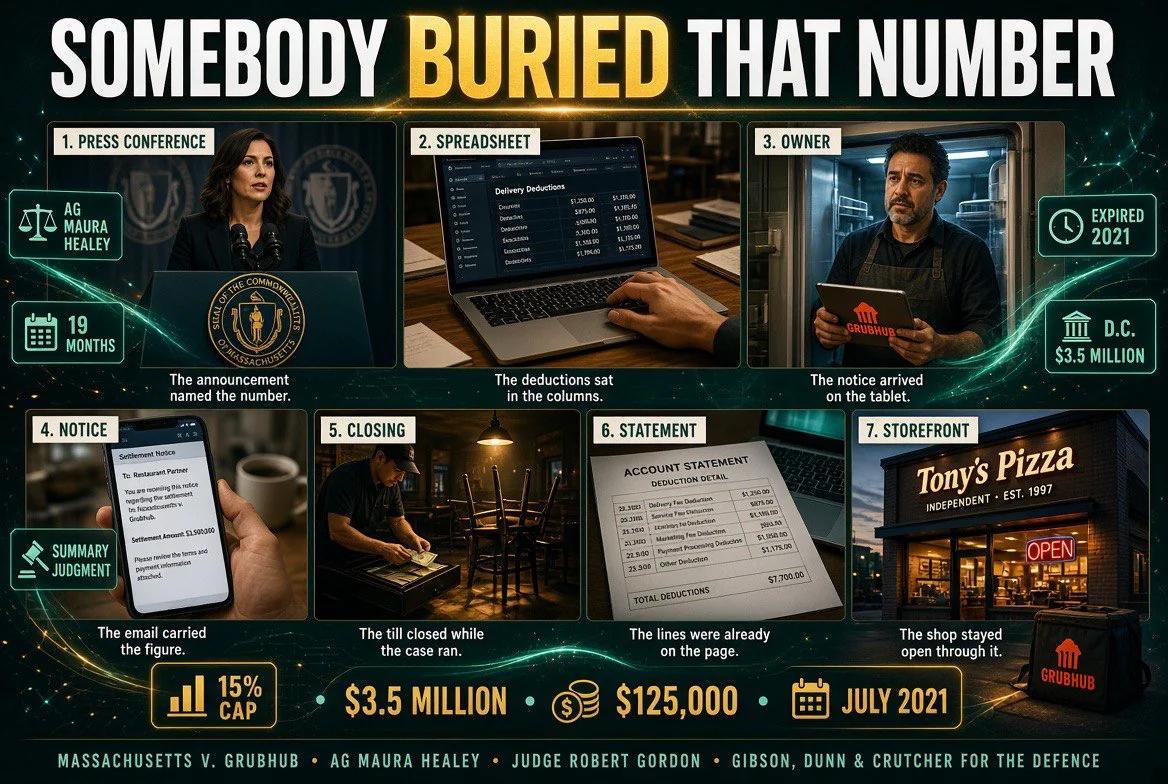
The result is a settlement of more than $3.5 million returned to Massachusetts restaurants and $125,000 paid to the Commonwealth. Filed by Attorney General Maura Healey in July 2021, decided on summary judgment in March 2023, settled on 12 January 2024 under Attorney General Andrea Campbell. It is one of the clearest pieces of paper in the restaurant delivery business: a legal definition of what counts as a fee, and a demonstration of how easily one gets renamed.
That is why it matters to anyone running an independent restaurant in the United States right now, regardless of what state they operate in. The mechanics of the workaround were not unique to Massachusetts, and the discipline that catches it — reading the line items, not the headline percentage — costs nothing but an evening with your statements.
The Fee That Was Not a Fee
Understand the shape of the maneuver before you get angry about it, because the shape is what repeats.
Massachusetts did not regulate delivery app revenue. It regulated one specific charge: what a delivery company may collect from a restaurant in connection with an order. The legislature set a number, 15 percent, and a duration, the state of emergency. That was the whole intervention.
Grubhub’s response was to keep the regulated charge exactly at the ceiling — 15 percent — and put the additional cost into a differently named line. Processing, not delivery. The commission stayed legal on its face. The customer’s total cost went up anyway.
Judge Gordon’s ruling treats that as a distinction without a difference. If the money comes out of the restaurant’s settlement for the same order, and it is collected by the same platform under the same agreement, calling it processing instead of delivery does not move it outside the statute. The words “processing fee” describe what the money is nominally for. They do not change who pays it or why.
| On a $30 Order | Massachusetts Cap | Grubhub’s Structure |
|---|---|---|
| Commission | $4.50 (15%) | $4.50 (15%) |
| Processing fee | Included in the cap | $0.90 (roughly 3%) |
| Total charged to restaurant | $4.50 | $5.40 |
| Effective rate | 15% | 18% |
| Difference per order | — | $0.90 |
| One hundred such orders | $450.00 | $540.00 |
A dollar a night sounds like nothing. It is also not what an uncapped market looks like. Outside the special statutory window, delivery platforms stack: 15 percent base commission, plus marketing or visibility fees commonly around 10 percent, plus the processing charge at roughly 3 percent. That lands near 28 percent on a $30 order — about $8.40 — and every one of those line items has an innocent name.
For an operator clearing 3 to 6 percent net margin on a good month, the distance between 15 percent and 28 percent is not a cost increase. It is the entire profit, plus some of the owner’s pay.
Who This Settlement Actually Pays
The money went to restaurants that were charged during a specific statutory window, in one state, under one temporary law that expired in June 2021. If you operate outside Massachusetts, or you opened after that window closed, the settlement check is not coming to you.
What you can take from it is the ruling, not the refund. There is now a judge’s finding that renaming a delivery charge does not exempt it from a rule that governs delivery charges. That holding travels. It is the most useful kind of precedent for a restaurant owner: it tells you exactly what kind of line item to look for, and it tells you that the platform’s defense has already been tested and lost once.
Read that against the broader pattern. In December 2022, the District of Columbia reached a $3.5 million settlement with Grubhub over similar pandemic-era fee cap allegations. Pennsylvania collected a $125,000 donation to a food bank in a 2022 matter. Three jurisdictions, two years, the same basic allegation: the cap was respected on one line and recovered on another.
That consistency is what makes this useful rather than interesting. A single settlement in a single state can be read as one company’s mistake. The same structure surfacing in Massachusetts, D.C., and Pennsylvania reads as an operating practice, and operating practices are what other platforms also run.
| Jurisdiction | Outcome | What It Signals |
|---|---|---|
| Massachusetts, settled 12 January 2024 | $3.5M+ to restaurants, $125,000 to the state | A processing fee counts as a fee under a fee cap |
| District of Columbia, December 2022 | $3.5M settlement | Same allegation, different regulator, similar number |
| Pennsylvania, 2022 | $125,000 food bank donation | Resolution without admission, still a cost |
| Pattern | Three jurisdictions over two years | A repeatable structure, not a one-off error |
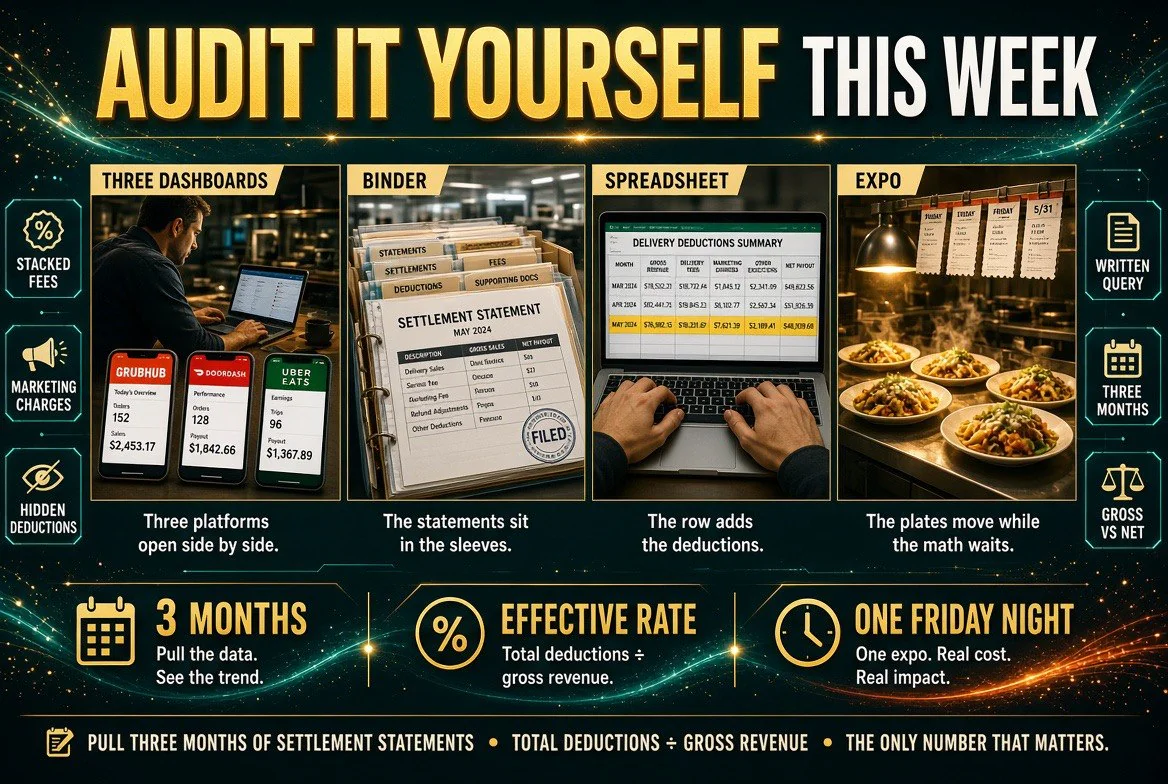
How to Audit Your Own Delivery Statements This Week
This is the part the settlement cannot do for you. The ruling tells you the shape of the trick. Your statements tell you whether it is on your invoices.
Pull three months of statements from every delivery platform you use. Not the dashboard summary — the settlement statements, the ones with line items and deductions. Put them in one spreadsheet, one row per order or per statement period, and build four columns: gross food and beverage revenue, commission charged, every other deduction, and the total the platform kept.
Then divide. Total deductions over gross revenue gives you your real effective rate. That is the only number that matters, and it is almost never the number on the sales call.
Do it on a single Friday night first. Take the orders that came in during your busiest four hours, apply the real effective rate, and subtract your food cost percentage. Most independent operators who run this exercise for the first time discover that their delivery channel is either break-even or negative on their highest-volume night — which is why a $0.90 processing charge is not a rounding error. It is the margin.
Four things to look for specifically, in order of how much money they hide:
Separate processing or payment fees stacked on top of commission, exactly as Massachusetts found. Marketing or visibility charges that were added without a written change to your agreement. Promotions the platform funded by discounting your menu price rather than its own commission, which quietly moves the cost onto your food. Adjustments and chargebacks that appear as line items with no corresponding order detail.
If any of those appear, you do not need a lawyer to start. You need a written query to your account manager, naming the line item, the date range, and the section of your agreement that authorizes it. Platforms respond to paper trails far faster than to complaints. The Massachusetts case was decided on summary judgment because the records were unambiguous — the charges were on statements, in black and white, on thousands of orders.
Where does AI fit into this? The same place it fits into your food cost work: pattern detection on boring data. A spreadsheet with three months of statements is enough for a general-purpose model to flag line items that appear irregularly, deduce your actual effective rate per platform, and draft the account manager email. The reasoning is arithmetic, which is the one thing these tools are genuinely reliable at. The value is that it takes a job nobody wants to do on a Sunday and makes it forty minutes of work.
Do not skip the arithmetic and go straight to the model’s summary. A restaurant owner in Massachusetts lost $0.90 an order because a line item was named one thing and functioned as another. A model that summarizes without you checking the numbers is the same failure, one layer up.
What Grubhub Says Now, and What the Cap Left Behind
Grubhub’s public statement has not softened. The company maintains it complied with the temporary price control, and disputes the characterization of the case. That is the ordinary posture of a defendant that settled without conceding, and it is worth stating plainly so nobody reads this as a court finding of intentional deception.
The court found that the charges fell under the statute. The court did not find that Grubhub set out to defraud restaurants. Those are different findings, and the second one is not in the record.
The statute itself is gone. Massachusetts’ 15 percent cap expired on 15 June 2021, and it was temporary by design — emergency legislation for restaurants operating under capacity limits and shutdown orders. Most of the emergency fee caps in other states expired on similar timelines. A handful of cities made theirs permanent. The rest of the country went back to negotiated rates, which is a polite term for rates the platform sets and the restaurant accepts.
Which is why the successor fights look the way they do. Ongoing litigation over delivery platform fees, menu pricing, and how much of a customer’s payment must reach the restaurant is now a permanent feature of the sector rather than an emergency measure. The question stopped being whether the pandemic caps were legal and became whether the structure they exposed was ever acceptable.
For an independent operator in the United States, the practical answer arrived with the settlement: the structure is legal, mostly, and it is priced by whoever holds the customer. Your leverage is not in the law. It is in your own numbers, your own statement audit, and your willingness to move volume to a channel where you control the order — your own site, your own reservation list, your own repeat customer.
The $3.5 million went to restaurants that kept their receipts. The rest of the lesson is available for the cost of an evening and a spreadsheet.
Frequently Asked Questions
How much did Grubhub pay Massachusetts restaurants?
More than $3.5 million was returned to Massachusetts restaurants, plus $125,000 paid to the Commonwealth. The matter was filed in July 2021, decided on summary judgment in March 2023, and settled on 12 January 2024.
What was the 15% cap in Massachusetts?
Session Law 2020, Chapter 358, Section 98(a) limited what third-party delivery companies could charge restaurants with fewer than 25 locations to 15 percent of the order during the declared emergency. It expired on 15 June 2021.
Why did the processing fee violate the cap?
Grubhub charged the 15 percent commission and then added a roughly 3 percent processing fee on top, bringing the effective rate to about 18 percent on a $30 order — $5.40 instead of $4.50. Judge Robert Gordon held that treating it otherwise would mean “an order processing fee is somehow not a fee at all.”
Does this settlement apply to my restaurant if I am not in Massachusetts?
No, the refund applies only to restaurants charged during that Massachusetts statutory window. But the ruling establishes that renaming a delivery charge does not exempt it from rules governing delivery charges, which is useful anywhere.
What does an uncapped delivery rate actually look like?
Outside a statutory cap, platforms commonly stack a 15 percent base commission, roughly 10 percent in marketing or visibility fees, and about 3 percent in processing, landing near 28 percent of the order — around $8.40 on a $30 ticket.
What should I check on my own delivery statements?
Processing fees stacked on commission, marketing charges added without a written agreement change, promotions funded by discounting your menu price, and unexplained adjustments. Divide total deductions by gross revenue to get your real effective rate, then compare it to what you were quoted.
Did Grubhub admit wrongdoing?
No. Grubhub settled without conceding and maintains it complied with Massachusetts’ temporary price control. The court found the charges fell under the statute; it did not find an intent to defraud.

About Barak Schurr
Barak Schurr built and exited a major ticketing platform, ran global operations at Eventbrite, and now focuses on one question: which AI tools actually help independent restaurant owners run leaner and grow faster. He writes from the operator’s perspective — no vendor spin, no theory, just what’s real in 2026.
Email: [email protected]
More Resources for Restaurant Operators