Just Eat Painted Fake Food on Real Restaurants’ Menus
⚡ Expert Summary: Just Eat generated AI images for restaurant menus, and one Belfast cafe’s bacon and egg soda bread came back as bacon and eggs floating in a soft drink. The company apologised and paused the trial. But the operators whose names sat under those pictures never approved them, never saw them coming, and got no warning until the internet started laughing. The lesson is not that AI image tools are bad. It is that a menu photo is a commercial promise, and someone has to sign it before it goes live.
Here is what happened, according to Restaurant Technology News, which covered the apology on October 26, 2026, citing a BBC News report by Laura Cress published October 21.
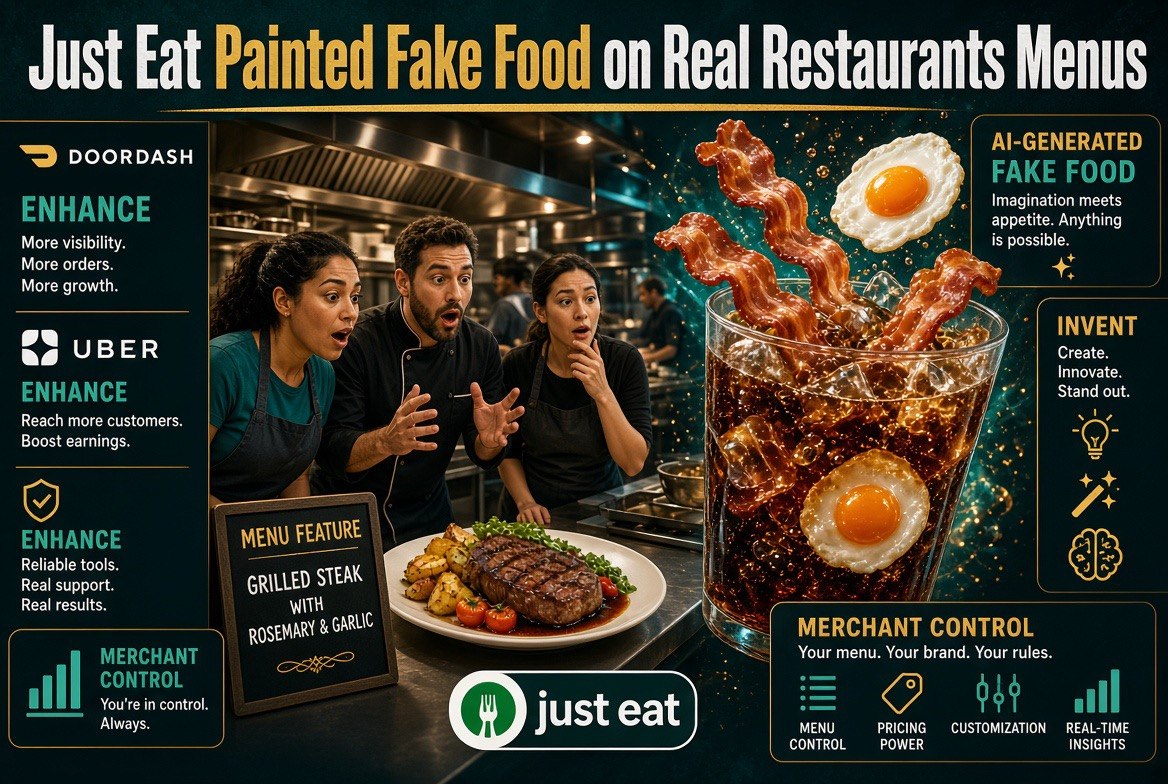
Just Eat ran a trial generating images for restaurant menu listings. The results were not subtle failures. A Belfast cafe’s bacon and egg soda bread — a regional dish with a specific meaning to anyone who has ordered one — was rendered as bacon and eggs floating in a soft drink. Other images confused regional dishes with entirely different foods. The BBC reported that the AI-generated images carried labels, and that some of the unusual examples were still visible at the time of reporting.
Just Eat said it was removing inaccurate images and would stop producing more until the tool was further developed.
That is the story as a press release. Here is the story as an operator.
Who Approved the Picture of Your Food?
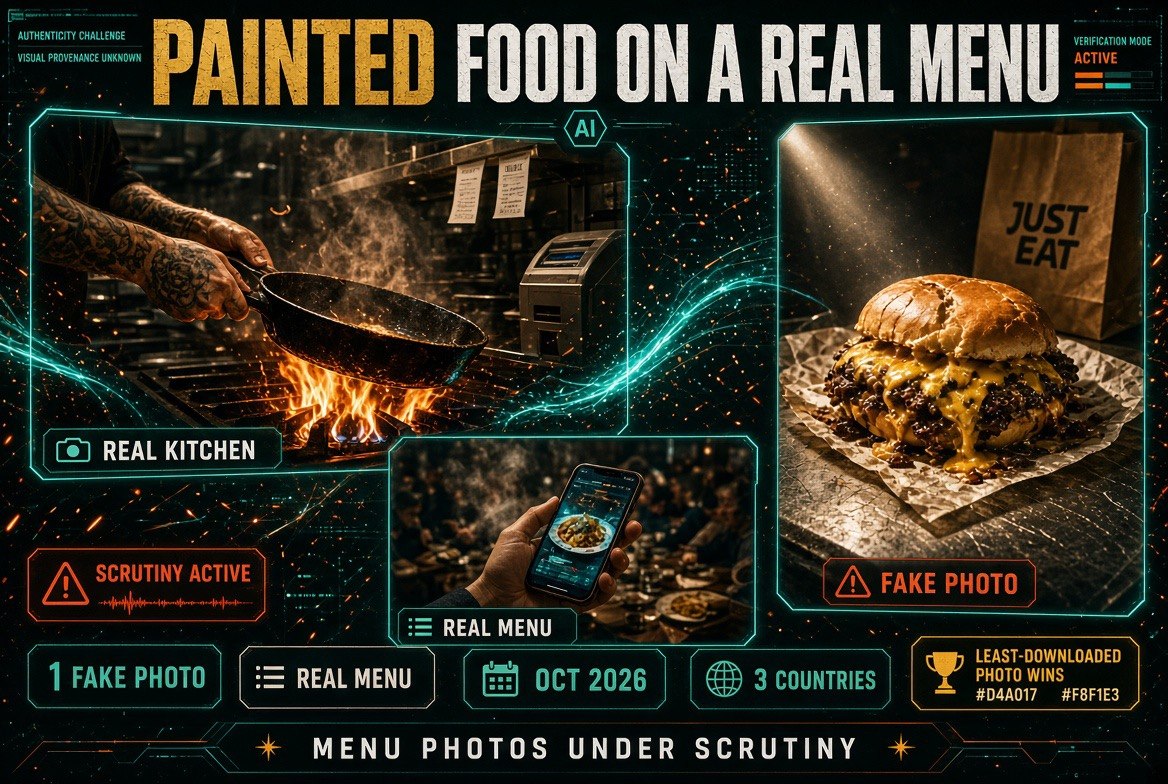
Sit with this question for a minute, because it is the entire issue. When an AI system generates an image and attaches it to a menu item with your restaurant’s name on it, who signed off?
For a chain, maybe a marketing department checks listings across delivery platforms. For an independent operator, the realistic answer is that nobody was checking anything, because the person responsible for those listings is also taking a supplier delivery, working the lunch rush, and covering a callout. The RTN report makes this point directly: neither type of operator should have to discover an inaccurate representation of its own food through social media.
Read the sequence of events in order. A platform runs a trial. A tool generates images from menu item names. The images publish to listings. Customers see them. Customers post screenshots. Screenshots go viral. Journalists call. The platform apologises and pulls them. At no point in that chain did the restaurant get a decision.
That is not an AI problem. That is a permission problem wearing an AI costume.
Why a Menu Photo Is Not Decoration
A menu image is a commercial promise. If the picture shows a sandwich with a generous filling, the customer expects a sandwich resembling that picture. That expectation is legally and commercially real, and it attaches to whoever’s name is on the listing.
When the platform changes the image, the restaurant inherits a complaint about an expectation it never created and never agreed to. The platform can correct the listing. The customer remembers the restaurant.
The RTN analysis puts it plainly: an image attached to a menu item makes a commercial promise, and a plausible image is insufficient unless someone has established that it matches the dish the restaurant actually serves.
Now add the label. Just Eat’s AI images carried disclosures marking them as AI-generated. Disclosure is honest — and it solves nothing. A customer reading an “AI-generated” label on a photo of bacon and eggs floating in cola does not conclude “this is a harmless placeholder.” They conclude “these people do not know what they are selling.” The label marks the image. It does not protect the operator.
How the Big Platforms Handle It Differently
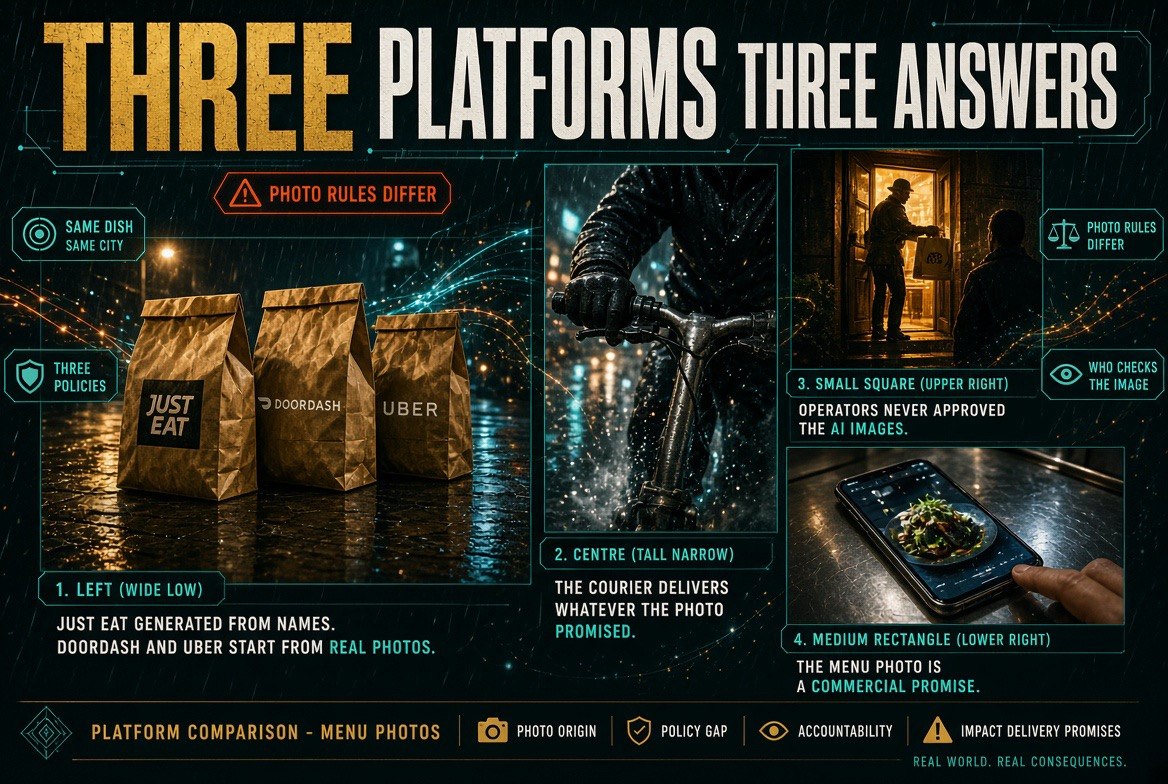
This is where the Just Eat story stops being an isolated embarrassment and becomes a comparison worth making. The other major delivery platforms have shipped image tools with meaningfully different controls, and the differences are not cosmetic.
| Platform | What the tool does | Merchant control | Starting point |
|---|---|---|---|
| Just Eat (paused) | Generated images for listings; labelled as AI; regional dishes misrendered | No visible approval step in the reported trial | Menu item names |
| DoorDash | Retouching mode for lighting, sharpness, background; other modes change plating or apply a reference style | Merchant previews the result and can reset to the original; platform still reviews submissions | A real photo the merchant supplies |
| Uber | Enhancements for lighting, resolution, framing and plating; invites customer photos for items lacking images | Merchant-supplied base images; customer contributions fill gaps | A real photo, or one from a diner |
| The dividing line | Enhance vs. invent | Preview and revert | Real photograph vs. text prompt |
The pattern is obvious once you lay it side by side. DoorDash and Uber start from a photograph that already exists and improve it. Just Eat, in this trial, appears to have generated a picture from a name. Starting from a real image and improving the lighting is a completely different act from inventing the dish.
Even the “safe” version needs judgment from the operator. Replating a dish or changing its framing alters expectations. A customer-submitted photo may capture a bad night, an unusual portion, or a delivery failure that had nothing to do with the kitchen. Every published result still needs to represent what the restaurant actually sells.
The Uncomfortable Arithmetic of Not Having Photos
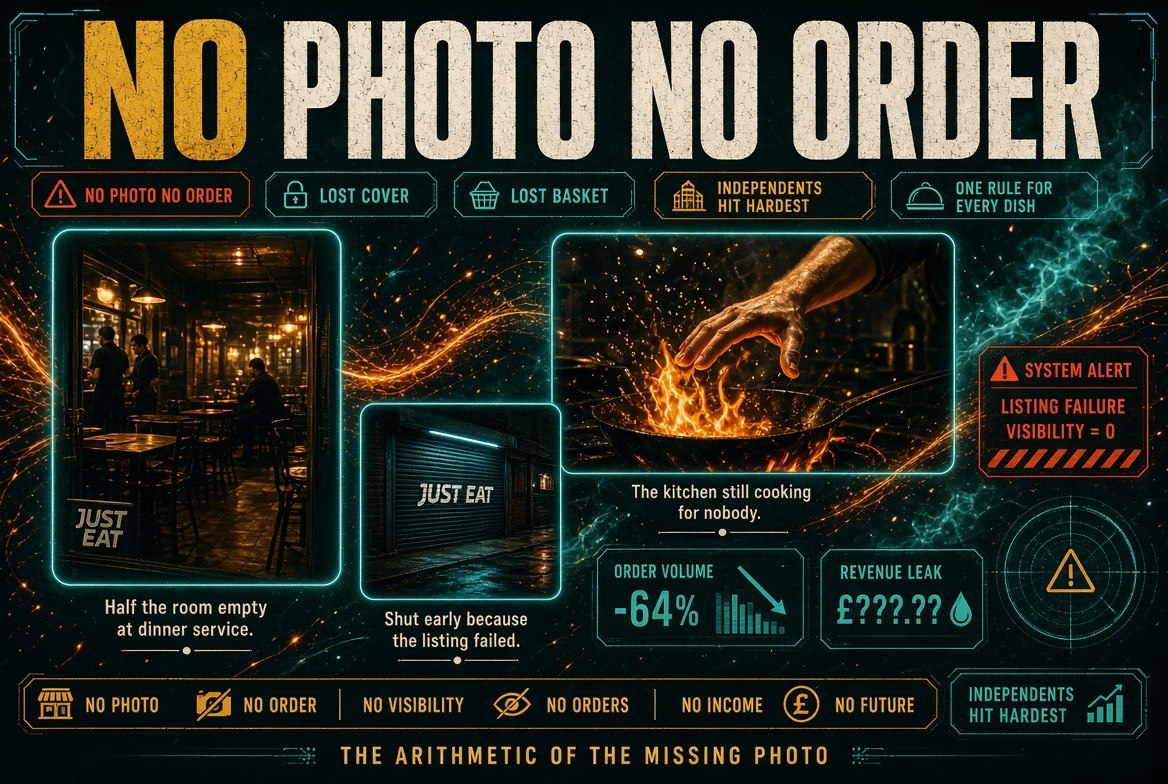
Before anyone gets on a high horse about this, understand why platforms are generating images in the first place. Professional photography is a real expense for a small restaurant, and it is a recurring one if the menu changes seasonally. An empty image slot looks bad precisely when competing listings look complete and polished. The commercial pressure to fill that slot is intense, and “we’ll book a photographer next quarter” loses to “the platform will fill it for free today” every single time.
That is why the Just Eat approach was tempting and why it failed. It solved a real problem by taking a decision that belonged to someone else.
The RTN piece points at the better answer: expand practical assistance rather than replace operator judgment. Just Eat told the BBC it already supports restaurant imagery, including funding professional local photographers. That is the right instinct — fund the photograph instead of hallucinating a replacement. Pair it with simple upload tools and restrained editing that makes an ordinary phone photo usable.
Generating an image from a menu name requires enough information to verify the result against the actual dish. Regional names, spelling errors, and location-specific recipes make that harder than it sounds. A Belfast soda bread is not a universal object. Neither is a New England johnnycake, a Texas kolache, or whatever your grandmother called the thing on your menu. The model has never eaten any of them.
| Question to ask your delivery partner | Why it matters to your P&L |
|---|---|
| Can the platform generate or replace images on my listings? | Determines whether a picture of your food can appear without you seeing it |
| How are image changes approved before they go live? | Tells you if there is a human checkpoint or just an automated publish |
| How fast can I remove an image I did not approve? | Measures your exposure window on a bad listing |
| Does the tool enhance my photo or invent from the item name? | Separates a lighting fix from a fabricated dish |
| Can I preview and revert before publishing? | The single control that prevents the Just Eat outcome |
| Will you fund a real photographer for my menu? | Turns a recurring cost into a platform expense, and a real photo cannot be wrong about your food |
| Ask all six in writing | A screenshot of the answer beats a memory of a phone call |
What the Apology Actually Concedes
Just Eat did the right thing after the fact. It removed inaccurate images. It stopped producing more until the tool improves. It apologised publicly. There is no villain here in the cartoon sense, and the platform deserves credit for pulling the plug instead of defending the output.
But read what the apology concedes. “We will stop producing more until the tool is further developed” is an admission that the tool was not ready to publish to live listings. The gap between “not ready” and “published anyway” is where the operator’s reputation lived for however many days those images stayed up.
The RTN report also notes that AI-generated images carried labels and that some unusual examples remained visible at the time of the BBC’s reporting. So the correction was not instant. Every hour an inaccurate picture sits on a listing, it is making a claim on someone’s behalf.
The Rule Every Restaurant Should Adopt This Week
One sentence, and it covers the entire category: no image goes live against a menu item unless the operator of that location has approved that specific image for that specific dish.
Not the brand. Not the platform. Not an algorithm reading a menu name. The person who cooks it.
Practically, that means three things this week, all of them free:
First, audit your listings on every platform you sell through. Not the dashboard you think is current — the live customer-facing page. Screenshot what a customer sees. That is the version of your food that is out there making promises.
Second, photograph your own top sellers yourself. You do not need a studio. You need a window at 11am, a clean plate, and a phone. An honest mediocre photo beats a beautiful fabricated one, because the honest one will not generate a complaint you cannot defend.
Third, put the approval question to your reps in writing. Use the table above. If a platform cannot answer whether it can replace your images without your consent, you have your answer.
AI can genuinely help restaurant operators with images using photographs they already have. Retouching a real picture, fixing bad lighting, cleaning up a cluttered background — that is real value for an independent that cannot afford a shoot. The line is fabrication. The moment a system invents a dish instead of improving a photo of it, the operator is carrying risk they never agreed to.
Just Eat taught the whole industry that lesson with a plate of bacon floating in cola. Cheap tuition for everyone else, expensive for the Belfast cafe whose name was on it.
Frequently Asked Questions
What did Just Eat actually do wrong with its AI menu images?
According to Restaurant Technology News, citing BBC reporting, Just Eat ran a trial generating AI images for restaurant listings. Regional dishes were misrendered — a Belfast cafe’s bacon and egg soda bread appeared as bacon and eggs floating in a soft drink. The operator whose menu carried that image had no approval step in the reported process.
Did Just Eat apologise and stop the trial?
Yes. Just Eat said it was removing inaccurate images and would stop producing more until the tool was further developed. The BBC reported the images carried AI labels and that some unusual examples remained visible at the time of reporting.
Are AI menu images always a bad idea for restaurants?
No. Enhancing a real photograph the operator already supplied is genuinely useful — lighting, sharpness, background cleanup. The problem is generating an image from a menu item name, which invents a dish nobody verified against what the kitchen actually serves.
How do DoorDash and Uber handle AI menu images differently?
Both start from real photographs. DoorDash offers a retouching mode that preserves the dish plus modes that change plating, with merchant preview and a reset-to-original option, and submissions still go through platform review. Uber offers enhancements for lighting, resolution, framing and plating, plus customer-contributed photos for items with no image.
Is an “AI-generated” label enough to protect my restaurant?
No. A label discloses how the image was made, not whether it represents the meal. Customers should not have to read the label as a warning that a pictured ingredient, portion, or preparation method might be imaginary. Approval before publishing is the control that matters.
What should I ask my delivery platforms about menu images?
Six things: whether the platform can generate or replace images, how changes get approved, how fast you can remove one, whether the tool enhances or invents, whether you can preview and revert, and whether they will fund a real photographer for your menu.
About Barak Schurr
Barak Schurr built and exited a major ticketing platform, ran global operations at Eventbrite, and now focuses on one question: which AI tools actually help independent restaurant owners run leaner and grow faster. He writes from the operator’s perspective — no vendor spin, no theory, just what’s real in 2026.
Email: [email protected]
More Resources for Restaurant Operators