Yelp Is Now Charging Restaurants to Answer Their Own Phone
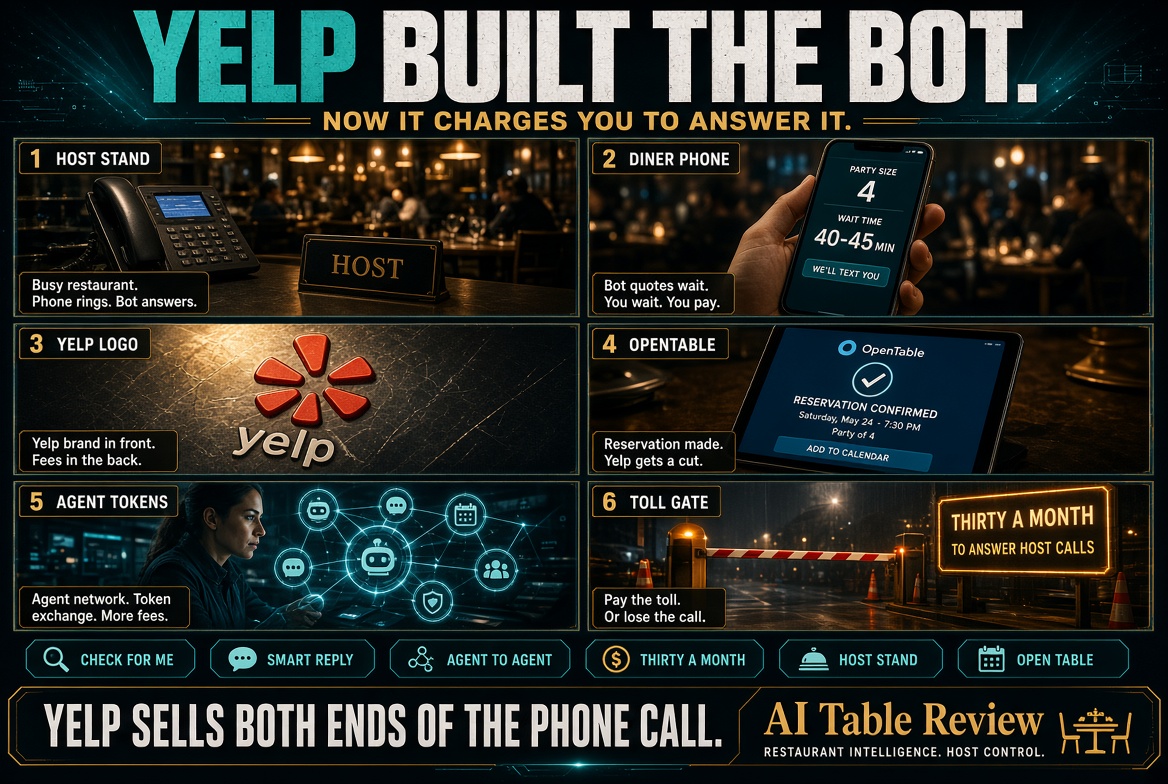
⚡ Expert Summary: On October 20, 2026, Yelp started letting an AI agent phone restaurants on a diner’s behalf to ask how long the wait is. Two weeks earlier it started selling restaurants a $30-a-month AI tool that answers customers for them. Yelp built the question and is now selling you the answer box. That is not a product update. That is a toll booth installed on a road you already paid to build.
Here is the part Yelp’s press release does not say out loud.
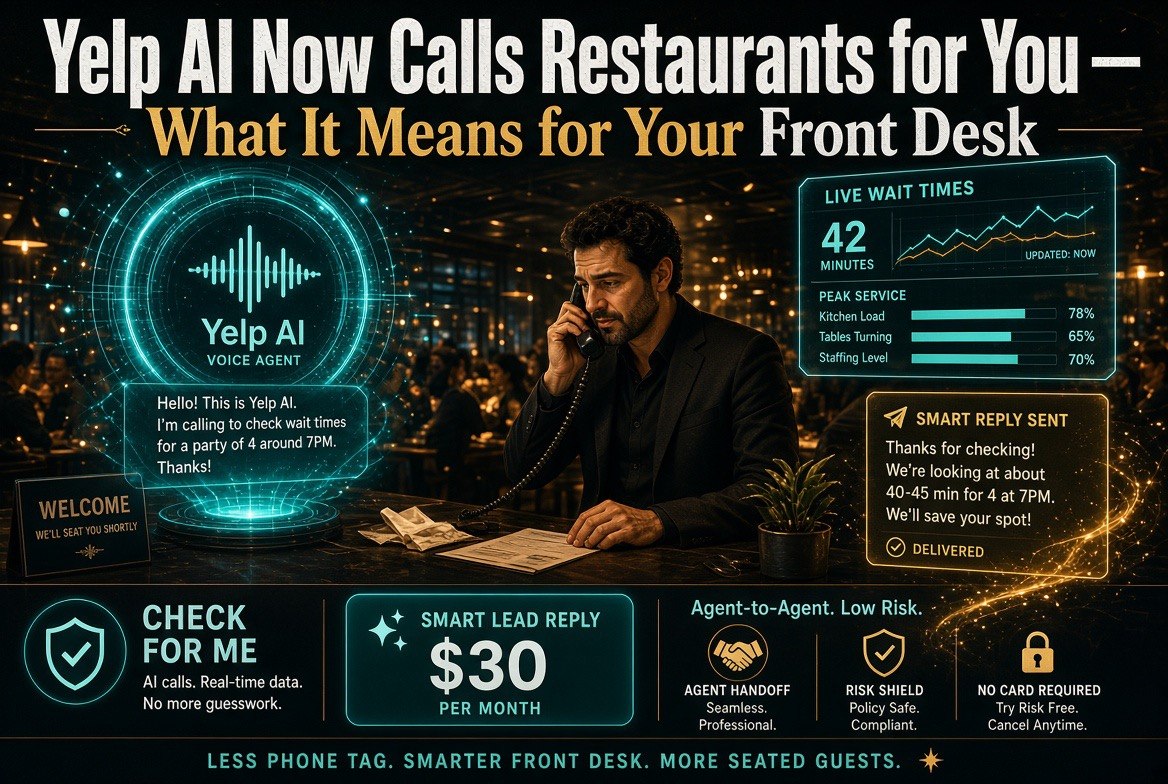
On October 20, 2026, a user opens the Yelp app, taps a restaurant page, enters a party size and a phone number, and Yelp’s voice agent dials the restaurant. It asks about the wait. It texts the answer back. The diner never speaks to a human. Neither does the restaurant, if it happens to run an AI phone system of its own — and increasingly it does, because Yelp has been selling that too.
The same company is charging restaurant owners $30 a month for Smart Lead Reply, an AI that answers inbound customer messages and qualifies leads. Read those two facts together and the business model stops being subtle. Yelp generates the automated call. Yelp sells you the automated answer. Whatever happens in between, Yelp owns the transaction, the transcript, and the data on both ends of the line.
For twenty years, a restaurant’s phone was the one channel no platform controlled. A host answered it, quoted a wait, took a name, made a judgment call. Yelp has now inserted itself on both sides of that conversation and attached a monthly fee to one of them.
The price is the least interesting thing about it.
| What Yelp Shipped | Who Pays | What Yelp Gets |
|---|---|---|
| Check for Me (voice agent calls your restaurant) | Diners | Demand data — who wants a table, when, for how many |
| OpenTable integration (book without leaving Yelp) | Diners | The booking relationship you used to own |
| Smart Lead Reply — $30/month | Restaurants | $360 a year from every independent that says yes |
| Assistant memory + 30-day chat history | Diners | A preference graph of your regulars |
| Net effect | Everyone | Both ends of the phone call |
Your Host Stand Is Now a Customer Service Queue for Yelp’s Bot
Here is what October 20 actually looked like inside a busy restaurant that has not thought about any of this.
It is 7:40 on a Friday. The wait is forty minutes. The host is seating a party of six, the phone rings, and the voice on the other end is not a person. It asks for the wait time in a flat, slightly-too-even cadence that any experienced host will clock immediately. The host answers — because what else is there to do — and the bot hangs up satisfied.
That call was not free. It cost the host eight seconds of attention at the exact moment the room was loudest, and it bought Yelp a data point it will use later.
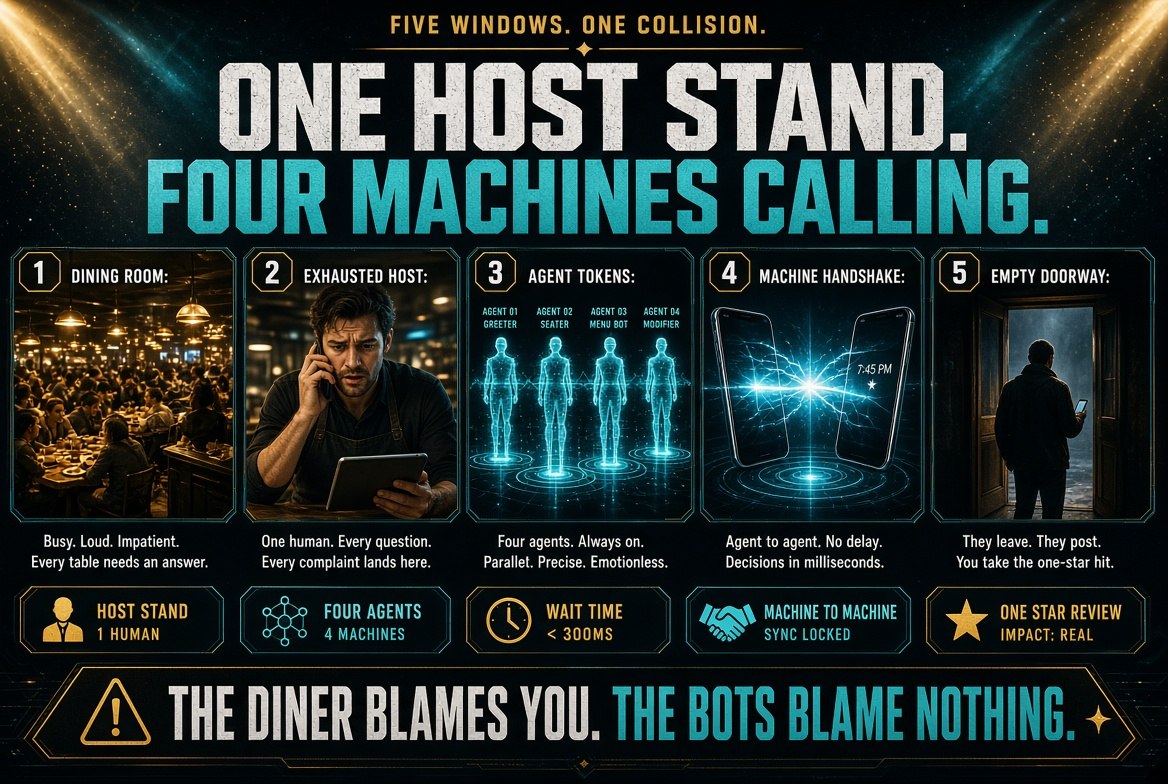
Now multiply. Yelp’s agent is not the only one dialing. Instinct, Fo, and Muse all started calling businesses on their users’ behalf over the past few weeks. Four different agents, four different question structures, four different ideas about how long to wait on hold. None of them identify themselves to the diner as anything other than a helpful assistant. All of them get answered by the same exhausted host who has a table waiting.
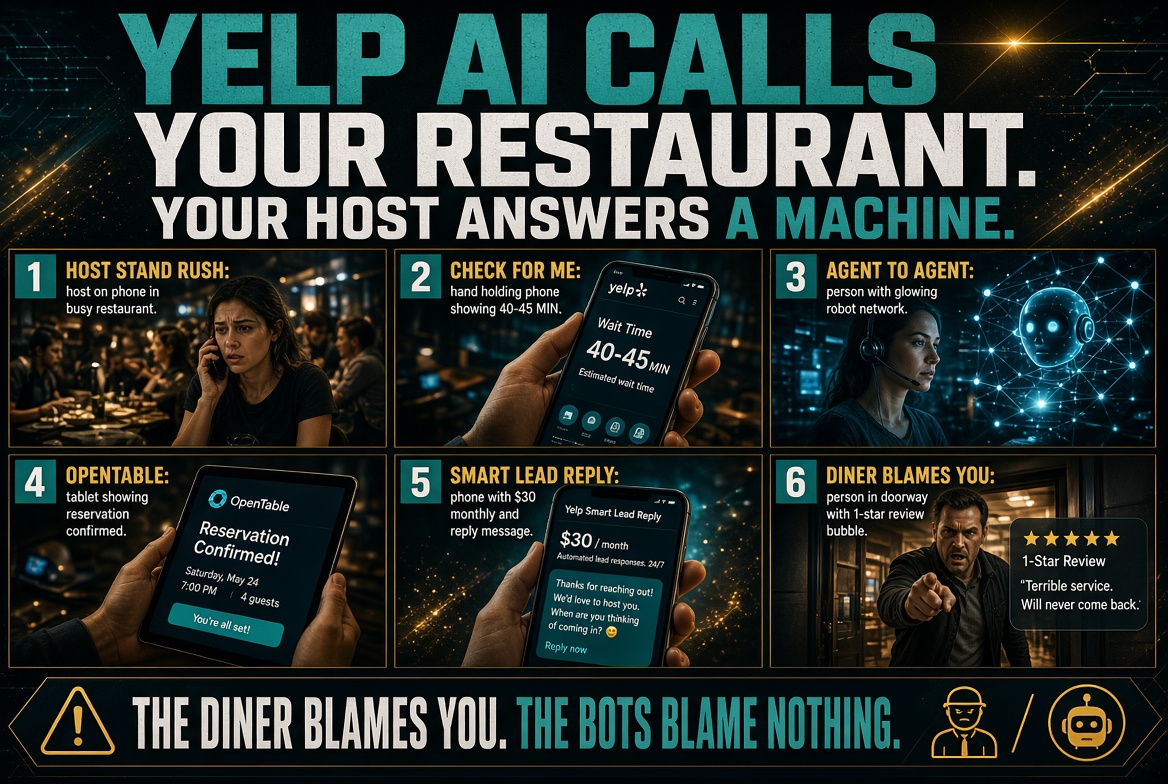
And if the restaurant runs its own AI phone agent — which is exactly what Yelp has been selling since last year — then the two machines talk to each other. An agent optimized to extract a wait time, talking to an agent optimized to sound helpful. When that exchange goes wrong, and it will, the diner gets a number that was never true and shows up expecting a table that does not exist. They will not blame the bot. They will blame you, in a one-star review, by name.
The failure mode of 2026 is not a rude employee. It is a synthetic voice asking your front desk a vague question, receiving a vague answer, and reporting it to a hungry stranger as fact.
The Copyright Playbook Nobody Is Talking About
Yelp has spent the last two years fighting very publicly over data — what reviewers own, what restaurants can do with their own pages, who gets to scrape whom. The complaint from Yelp’s side has always been the same: other companies are monetizing the value Yelp created without paying for it.
That is a defensible position. It is also the exact position Yelp is now occupying, two steps closer to the diner. The platform that spent years arguing nobody should build a business on top of its user data has just built a business on top of restaurant phone lines — the operators’ data, the operators’ staff time, the operators’ reputation with their own customers — and is charging the operators $30 a month for a slice of it back.
Nobody at Yelp will frame it that way. They do not have to. The product does the framing, and it is on the record as of this week.
| Who Ends Up Holding It | What They Were Told | What They Actually Got |
|---|---|---|
| The diner | A quick answer from the restaurant | A wait time quoted by a bot to a bot, then a table that was never held |
| The restaurant owner | A $30 tool that saves staff time | A second call queue, a monthly bill, and a one-star review they did not cause |
| The platform | A neutral directory | Both ends of the phone call, the transcript, and the preference graph |
| The other agents | A helpful assistant | Free access to the same host stand, competing for the same eight seconds |
| Net effect | Everyone was promised convenience | The operator absorbs the error and the platform keeps the data |
What Smart Lead Reply Actually Is — and Why $30 Matters
Yelp’s other business-facing launch is Smart Lead Reply, a paid product that automatically replies to inbound customer messages and engages with them to qualify a lead. Business owners can specify how the agent should handle a conversation with a customer. The price is $30 per month.
For an independent restaurant, $30 a month is lunch for two. Cheap enough to say yes to without thinking. That’s exactly the problem.
The real cost isn’t the subscription. It’s the moment a prospect asks whether you can do a party of eighteen on a Friday and the AI answers with something generic, or promises a private room you don’t have, or commits to a vegan menu you’ve never run. You don’t see that exchange until the customer arrives expecting what the machine promised. Then someone at the door has to be the bad guy.
Meta and others are courting small businesses with the same offer — AI handling inbound inquiries. That’s the competitive shape of this market now: platforms selling you automation that answers your customers before you do. The smarter operators will treat these tools as a first-response layer, not a closing layer. Anything involving money, capacity, or a promise gets a human.
If You Own a Restaurant, Here Is the Damage Control
This isn’t a story you read and forget. Here’s what actually protects an independent restaurant.
1. Audit how your phone gets answered
Before an AI agent calls your line, you should know what happens when it does. Call your own restaurant at 6:30pm on a Friday from a number your team doesn’t recognize. Note exactly how long it rings, what the greeting says, whether wait times are quoted in a standard format, and whether the person answering can quote a time consistently.
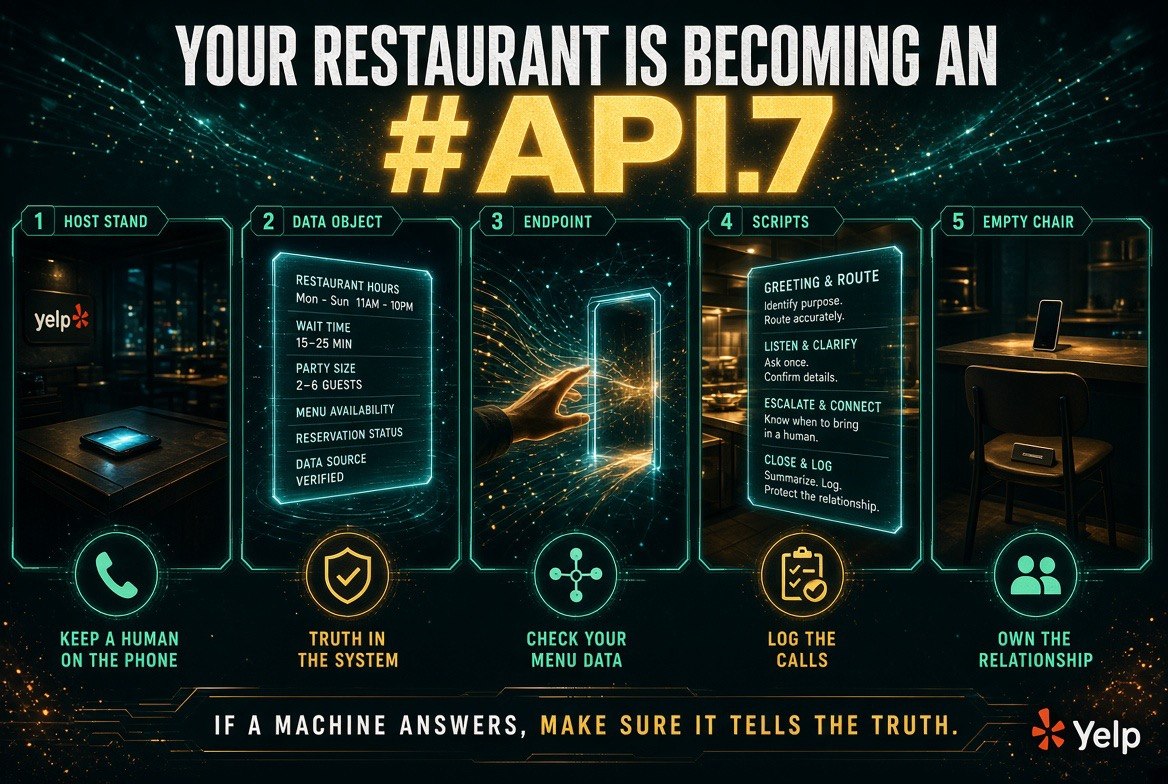
An AI agent struggles with ambiguity. If your host says “maybe half an hour, maybe more, depends,” the agent has nothing to work with. Train the host stand to give a single clear number, every single time. “Our current wait is thirty minutes.” That sentence is now an API response. Write it into your scripts.
2. Decide whether your own phone gets automated
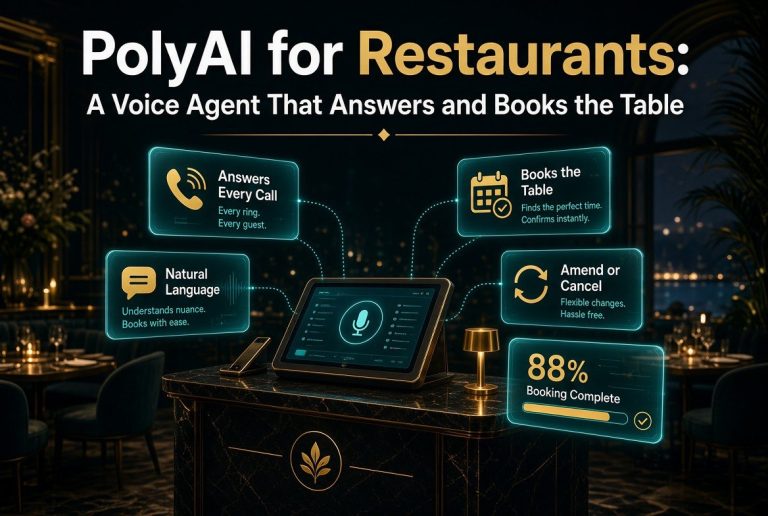
Yelp already launched voice tooling for restaurants and service providers last year. If you’re still losing calls at peak, the honest answer is that a well-configured AI phone agent beats a phone that rings out. But configure it deliberately: it must state the wait cleanly, take reservations accurately, and hard-stop on anything involving parties over eight, allergen questions, and refunds.
3. Don’t let OpenTable-and-Yelp become your only booking source
The new integration lets diners book without leaving the Yelp app. That’s convenient — and it puts the platform between you and your regular’s contact information. Keep at least one owned channel alive: a text list, an email list, or a direct booking link you promote on every table tent.
Platform-mediated diners are rented diners. The list is the only thing you actually own. If you haven’t built one, five-minute setup with a simple SMS tool pays for itself the first slow Tuesday you can fill with a text blast.
4. Watch your personalized recommendations before your competitor does
Yelp’s assistant now remembers preferences mentioned in previous chats and keeps 30 days of history, with full history coming. Next month, it starts showing weekly personalized recommendations based on saved items and rankings. Two new lists — “Been Here” and “Want to Go” — let users organize restaurants by location, category, and cuisine, add notes, and share them.
Translation: Yelp is building a preference graph of your customers and using it to rank restaurants in their feeds. The specifics of what drives that ranking will matter more than your ad spend. Ask yourself now whether your Yelp profile is complete enough for an AI to recommend you confidently — because a model with incomplete data doesn’t guess in your favor. It picks the safe option, which is the restaurant with photos, a full menu, accurate hours, and a hundred recent reviews.
The Bigger Shift: Your Restaurant Is Becoming an API
Step back from the product details and look at what’s actually happening in the dining discovery layer. For twenty years, a restaurant’s public interface was a phone number and a listing. A human called, a human answered. There was friction, and friction was a filter.
That’s gone. Now the discovery layer is agents: Yelp’s agent, Instinct, Fo, Muse, and whatever ships next quarter. Each of them queries your restaurant as if you were a service endpoint — party size in, wait time out. The restaurants that respond cleanly, consistently, and in machine-readable terms will get recommended more often. The ones that answer vaguely will get quietly filtered out, and nobody will ever send you a report explaining why.
⚡ The operator’s takeaway: Your host stand is now your integration layer. Consistency in what they say is worth more than charm. Train the number, not the script.
This is the same pattern that reshaped hotel booking, airline inventory, and restaurant delivery a decade ago. First a platform aggregates demand. Then it automates the query. Then it charges you to participate in the automation it created. Yelp’s $30 Smart Lead Reply is the first small invoice. It won’t be the last, and it won’t be the biggest.
For more coverage of how AI is reshaping independent restaurant operations, browse our restaurant AI section.
What to Watch Next
Three signals tell you where this goes.
First, whether agents start booking instead of waiting. Check for Me only reports wait times today. The moment it can hold or confirm a table — which the OpenTable integration makes trivial — the entire host-stand workflow changes. Watch for that.
Second, whether the platform starts ranking restaurants by responsiveness. If Yelp measures how well a restaurant’s line handles agent queries, responsiveness becomes a ranking factor. That means your phone answering speed becomes an SEO metric. It’s uncomfortable, and it’s probably coming.
Third, whether agent-to-agent failures generate public backlash. The first time an AI agent texts a diner the wrong wait time and a viral post blames the restaurant, the industry will demand standards for how automated agents identify themselves. Watch for disclosure requirements.
Frequently Asked Questions
What is Yelp’s Check for Me feature?
Check for Me is a new Yelp app feature that lets a diner enter their party size and phone number on a restaurant page. Yelp’s AI voice agent then calls the restaurant on the diner’s behalf to ask about current wait times and texts the result back to the user. It launched in October 2026.
Does Yelp charge restaurants for Check for Me calls?
Yelp has not announced a per-call charge for Check for Me. The feature is consumer-facing. However, Yelp did introduce a separate paid tool for business owners called Smart Lead Reply, priced at $30 per month, which automatically replies to customer messages and qualifies leads.
What happens when an AI agent calls my restaurant and my host answers?
The call proceeds like a normal phone call from your host’s perspective, but the caller is automated. This means ambiguous answers — like “probably half an hour” — can confuse the agent or be reported inaccurately to the diner. Restaurants should train staff to give one clear, standard wait-time figure on every call.
Can two AI agents talk to each other on a restaurant call?
Yes, and that’s a real risk. If a restaurant uses its own AI phone answering system and a diner uses an AI agent like Yelp’s Check for Me, Instinct, Fo, or Muse, the call becomes machine-to-machine. These exchanges can break down, loop, or convey incorrect information, and the restaurant typically bears the reputational cost.
Is Yelp’s Smart Lead Reply worth $30 per month for a small restaurant?
It depends on volume and risk. For a restaurant with a steady flow of inbound inquiries it can save real staff time on first responses. But any conversation involving pricing, capacity, party size, allergens, or a promise should route to a human. Treat it as a first-response filter, not a closer.
Does this affect my Yelp ranking?
Yelp has not stated that Check for Me affects ranking. However, the platform is rolling out personalized weekly recommendations based on saved lists and rankings, which means profile completeness — photos, menu, hours, recent reviews — increasingly determines whether an AI recommends your restaurant or picks a competitor with better data.

About Barak Schurr
Barak Schurr built and exited a major ticketing platform, ran global operations at Eventbrite, and now focuses on one question: which AI tools actually help independent restaurant owners run leaner and grow faster. He writes from the operator’s perspective — no vendor spin, no theory, just what’s real in 2026.
Email: [email protected]
More Resources for Restaurant Operators