Get the AI Restaurant Quick-Start Guide — Free
The 5 AI tools independent US restaurant owners are using right now to cut labor costs and answer every call.
McDonald’s AI Pricing Lawsuit: What the Antitrust Class Action Means for Independent Restaurants
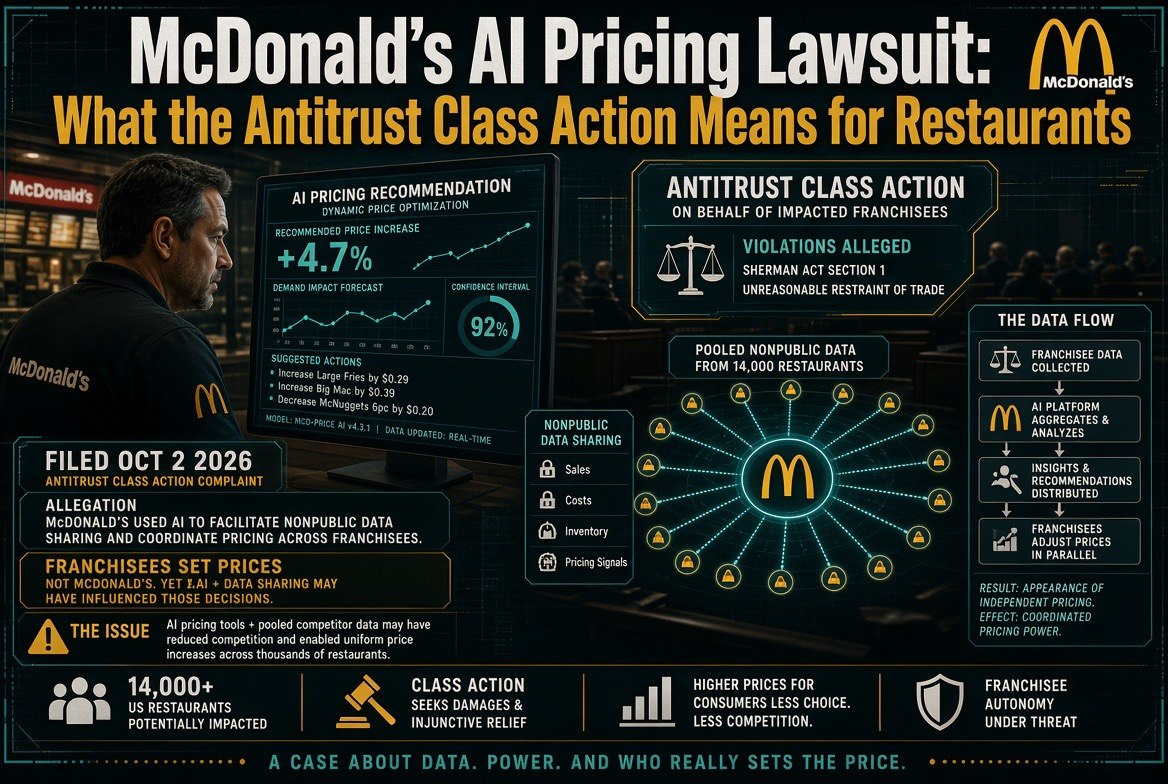
⚡ Expert Summary: A federal antitrust class action filed October 2, 2026 in the Northern District of Illinois alleges McDonald’s ran an AI “pricing engine” trained on nonpublic transaction data from nearly 14,000 U.S. restaurants and used it to coordinate menu prices across independent franchisees — which the plaintiff calls algorithmic price fixing. McDonald’s denies it: “AI does not set the price of a Big Mac or any other menu item.” Here is what the case actually claims, what it does not, and what an independent operator should take from it.
If you own one restaurant, the phrase “algorithmic price fixing” probably sounds like somebody else’s problem — a Big Mac, a billion-dollar corporate legal department, a headline you scroll past.
It is not somebody else’s problem. The theory at the centre of this lawsuit applies to any restaurant that uses software to recommend prices, and it applies most sharply to operators who buy pricing tools that were trained on data pooled from their competitors.
Here is what is actually alleged, what is denied, and what you should do about it.
What Was Filed, and Where
A proposed class action was filed on October 2, 2026 in the U.S. District Court for the Northern District of Illinois — federal court in Chicago. The plaintiff is Michael Thomas, a McDonald’s customer from DeKalb, Illinois. Reuters reported on the filing on October 5.
The named corporate defendant is McDonald’s Corporation. The complaint also refers to franchisees alleged to have participated in the pricing arrangement, though the available reporting identifies McDonald’s as the principal named corporate defendant. The proposed class is a nationwide class of McDonald’s customers who purchased affected menu items. The complaint seeks certification, damages, and injunctive relief.
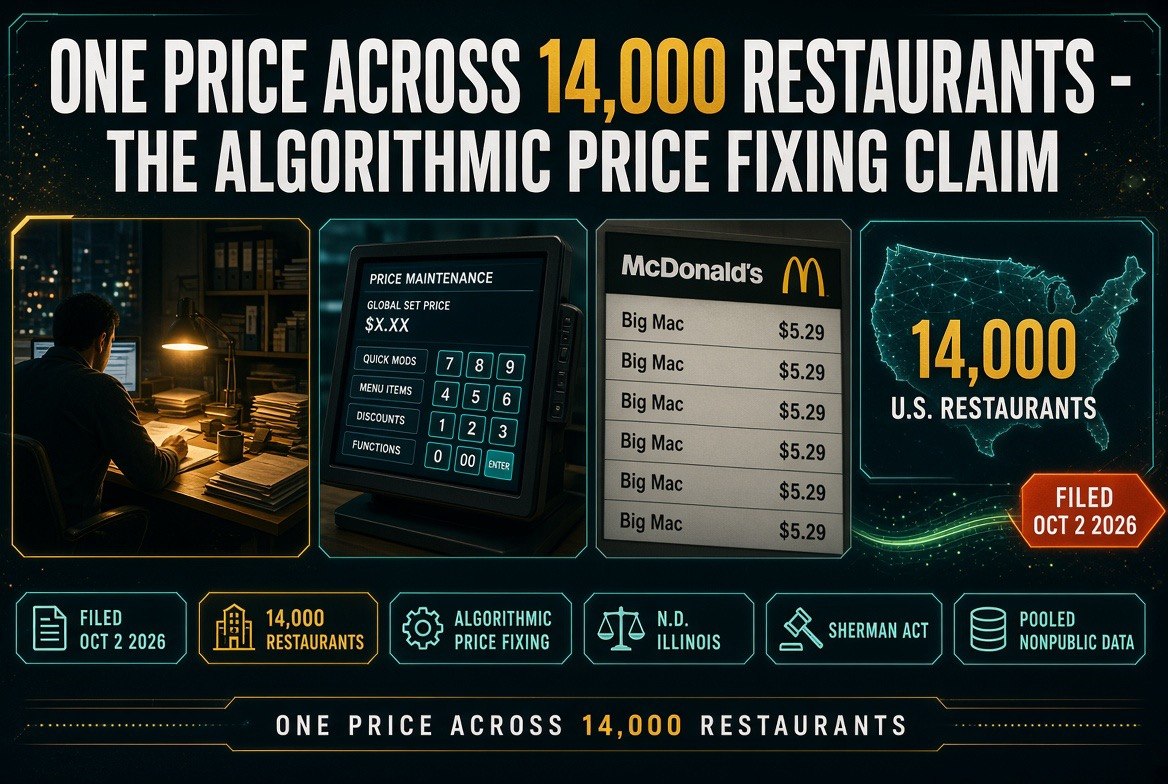
One thing to be precise about, because it is easy to overstate: the roughly 14,000-location figure describes the restaurant network allegedly covered by the pricing system, not the number of named defendants. If you read a headline suggesting 14,000 franchisees were sued, that is not what the filing says.
| Case Detail | What the Filing Says |
|---|---|
| Filed | October 2, 2026 (Reuters reported October 5) |
| Court | U.S. District Court, Northern District of Illinois (Chicago) |
| Plaintiff | Michael Thomas, McDonald’s customer, DeKalb, Illinois |
| Core allegation | Algorithmic price fixing and unlawful information sharing via an AI pricing engine |
| Network implicated | Nearly 14,000 U.S. restaurants, franchised and company-owned |
| Relief sought | Class certification, damages, injunctive relief |
| Status | Early stage — no ruling on certification or liability |
What the Pricing Engine Allegedly Did
The complaint’s central factual claim is that McDonald’s built an internal pricing platform that drew on nonpublic sales, transaction, and pricing data — described as millions of daily transactions — and used machine learning to generate what the company called “the optimal price” for each menu item at each location.
In practice, the allegation is that this produced price recommendations for franchisees covering items like Big Macs, fries, meals, and discounted coffee.
The crux of the legal theory is not the software. It is the coordination. Independent franchisees would normally compete on price. The complaint alleges they instead received recommendations generated from pooled, nonpublic information — and that McDonald’s pressured or required franchisees to follow those recommendations, even though franchisees nominally retained the right to set their own prices. Reuters characterised the claim as alleging McDonald’s “polic[es]” compliance with the pricing engine’s recommendations.
The complaint’s own language, as reported, says McDonald’s “has built and for years deployed its own information-sharing pricing platform, which draws on data from its millions of daily transactions to set menu prices across thousands of U.S. restaurants,” and calls the alleged result “algorithmic price-fixing aimed at customers who are already stretched thin.”
McDonald’s Response
McDonald’s has denied that the system sets prices. Its statement to Reuters was unambiguous:
“AI does not set the price of a Big Mac or any other menu item.”
The company’s stated position is that franchisees set their prices individually and are not compelled to adopt any particular price. The lawsuit disputes exactly that characterisation, alleging franchisees were pressured to use the pricing tools and follow their recommendations.
Both of these things can be true as descriptions of the facts on the ground — a franchisee technically retains pricing discretion and faces practical pressure to accept a recommendation. That gap between formal discretion and practical compulsion is where this case will be decided, and it is the same gap that exists in a lot of vendor relationships small operators have.
Why This Is an Antitrust Case and Not a Privacy Case
It is worth understanding the legal mechanics, because the theory generalises well beyond McDonald’s.
The claim is algorithmic price fixing through information sharing. The argument runs like this. McDonald’s allegedly collected otherwise nonpublic, store-level competitive information into a centralised platform. Independent franchisees — entities that would normally compete on price — received coordinated recommendations generated from that pooled information. The plaintiff contends that independent price competition was therefore replaced by a common algorithmic pricing process, across both franchised and company-owned locations.
Reuters summarised the claim as alleging that McDonald’s “conspir[ed] with independent franchisees to fix prices using algorithms trained on nonpublic data.”
Notice what is not alleged. This is not a case about customer data privacy, surveillance, or personalised pricing to individual diners. It is about whether a shared pricing mechanism suppressed competition between locations. That distinction matters, because the same technology could be entirely lawful if it were fed only your own restaurant’s data and used only to set your own prices.
| If Your Pricing Tool… | Risk Profile |
|---|---|
| Uses only your own sales data to set your own prices | Low — this is ordinary price optimisation |
| Ingests competitor pricing scraped from public menus | Grey — public data is defensible, algorithmic coordination is where attention goes |
| Takes nonpublic pricing or transaction data from other operators | High — this is the information-sharing theory at the heart of the McDonald’s case |
| Recommends collusive price levels identical across independent businesses | High — identical recommendations across competitors invite the same claim |
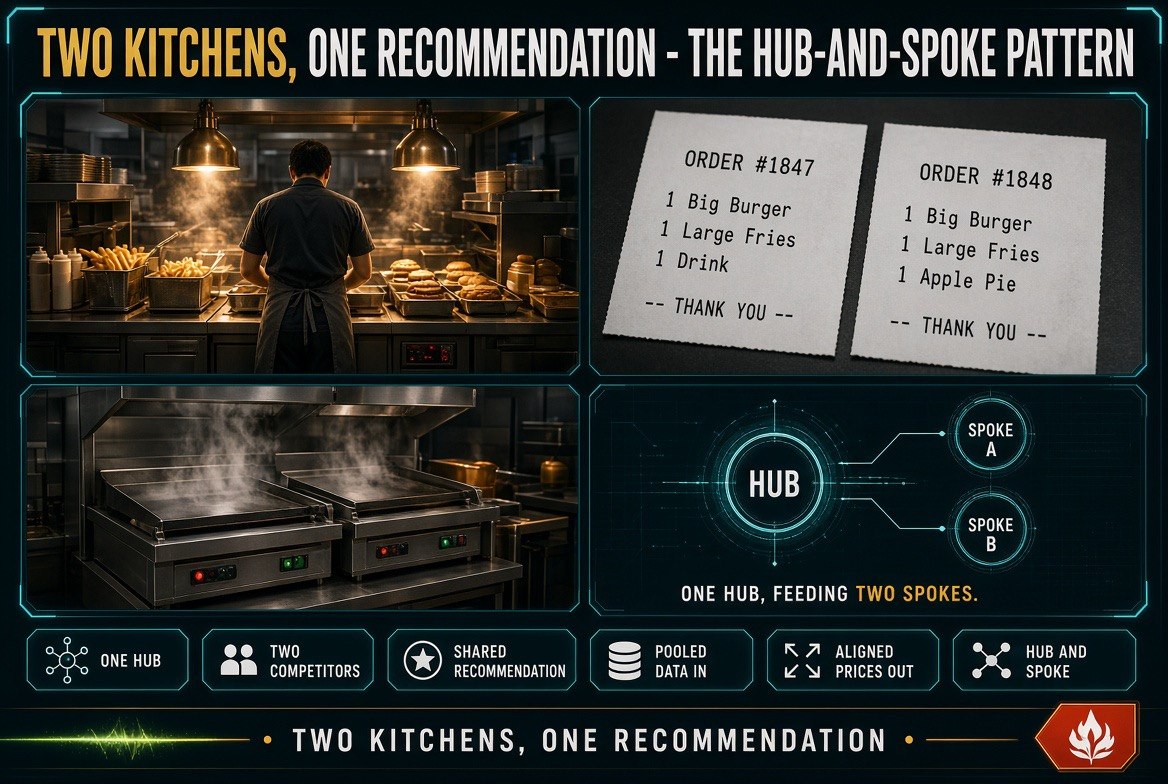
| You negotiate pricing with other independents using shared software output | High — the “hub-and-spoke” pattern regulators have targeted repeatedly |
What This Means for Your Independent Restaurant
You are not McDonald’s. You do not have 14,000 locations, a proprietary pricing engine, or an antitrust plaintiff three states away. But you buy pricing tools, and this case draws a line you can actually see.
The line is where the data comes from, not how clever the model is. Software that analyses your own POS history to tell you what your burger should cost is ordinary business. Software that tells you what price to charge based on what the operator down the street is charging, using data you could not otherwise see, is the version that attracts antitrust attention. The algorithmic sophistication is not the issue. The information flow is.
The franchise relationship is the exposed surface. This case exists because a central entity gave pricing recommendations to nominally independent businesses. If you are a franchisee, that is the structure you sit inside — and your exposure depends on whether following the recommendation is genuinely optional.
“Recommendation” is doing a lot of work. The lawsuit’s core factual dispute is whether McDonald’s recommendations were effectively mandatory. Every pricing vendor calls its output a recommendation. When you evaluate one, the question worth asking is what happens if you ignore it — contractual penalties, ranking demotion, loss of promotional support, or nothing at all.
Document your independence. If you use pricing software, keep evidence that you make the final call — overrides on the record, the reasoning behind deviations, and clear proof you were not penalised for charging what you decided. If this kind of case ever touches your segment, that record is your defence.
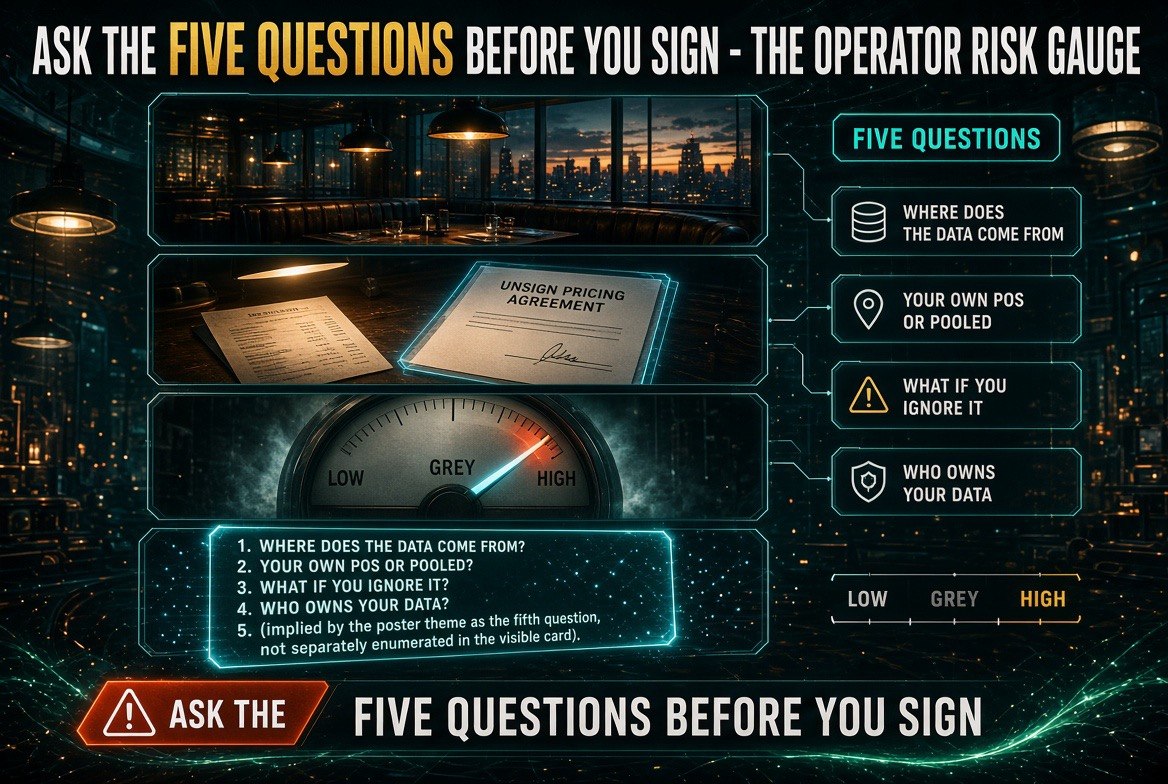
Five Questions to Ask Any Pricing Vendor
1. What data trains the recommendation? Your own transactions only, or data pooled across other operators? Get the answer in writing, and be suspicious of “industry benchmarks” that are not clearly sourced.
2. What exactly does the tool recommend — and to whom? Recommendations to you alone are one thing. Recommendations visible across a group of competing operators is the pattern regulators have been circling for years.
3. What happens if I ignore it? If there is no consequence, you have genuine discretion. If pricing below or above the recommendation costs you something, you should understand precisely what and why.
4. Is pricing output shared with anyone else? Including your franchisor, your distributor, an industry group, or other tenants in shared software. Shared output across competitors is the risk zone.
5. Who owns and retains the data you submit? If your transaction data enters a pool you cannot audit or exit, that is a structural commitment you are making — not just a software subscription.
The Wider Pattern: This Is Not One Company
McDonald’s is the highest-profile defendant in what is becoming a category of litigation. PYMNTS framed the filing as joining “widespread legal challenges to AI pricing algorithms.” The theory travels: whenever businesses that should be competing on price instead share a common algorithmic recommendation process, plaintiffs will argue the mechanism replaced competition.
For independent restaurants, the practical upshot is that pricing software has moved from an efficiency question to a legal-exposure question in a single news cycle. The tools are not going away — dynamic pricing can be a real margin lever, and AI menu engineering is genuinely useful. But the days of adopting a pricing platform without asking where its data comes from are ending.
One honest caveat on the McDonald’s case itself: everything here is an allegation. The case is at an early stage with no ruling on class certification or liability. McDonald’s denies the claims, and it may well prevail. The reason it matters to you anyway is not the outcome. It is that the theory is now on the public record, which means it is now a factor in how every operator should think about pricing software.
Ask the five questions before you sign, not after.
Frequently Asked Questions
What is the McDonald’s AI pricing lawsuit actually about?
It is a proposed federal antitrust class action alleging that McDonald’s used an AI-powered “pricing engine” trained on nonpublic transaction and pricing data from nearly 14,000 U.S. restaurants to coordinate menu prices across independent franchisees. The plaintiff calls it algorithmic price fixing and unlawful information sharing. McDonald’s denies the claim, stating that “AI does not set the price of a Big Mac or any other menu item” and that franchisees set their own prices individually.
When was the lawsuit filed, and where?
It was filed on October 2, 2026 in the U.S. District Court for the Northern District of Illinois, the federal court in Chicago. Reuters reported on the filing on October 5. The plaintiff is Michael Thomas, a McDonald’s customer from DeKalb, Illinois. The proposed class is a nationwide class of McDonald’s customers who purchased affected menu items.
Does this mean AI set the price of a Big Mac?
No, not as established fact. That is the allegation, and McDonald’s denies it directly. The complaint alleges the system generated “the optimal price” for items at each location and produced price recommendations for franchisees covering products like Big Macs, fries, meals, and discounted coffee. McDonald’s position is that franchisees set prices individually and are not compelled to follow recommendations. The case is at an early stage with no ruling on class certification or liability.
Is this a data privacy case or an antitrust case?
Antitrust. The claim is not about customer data privacy, surveillance, or personalised pricing to individual diners. It is about whether a shared pricing mechanism suppressed competition between locations. The theory is algorithmic price fixing through information sharing: that independent franchisees who would normally compete on price instead received coordinated recommendations generated from pooled nonpublic data.
I own an independent restaurant. Am I exposed to this?
Not because of McDonald’s, and nobody is alleging that. But the theory is worth understanding because it applies to any operator using pricing software. The line is where the data comes from, not how sophisticated the model is. Software that analyses your own POS history to set your own prices is ordinary business. Software that recommends prices based on nonpublic data pooled from competing operators is the version that attracts antitrust attention.
What should I ask a pricing tool vendor before signing?
Five questions: what data trains the recommendation (your own transactions only, or data pooled across other operators); what exactly the tool recommends and to whom; what happens if you ignore the recommendation; whether pricing output is shared with your franchisor, distributor, or other operators in the same software; and who owns and retains the data you submit. Get the answers in writing, and treat vague “industry benchmark” claims as unresolved.
What is the “hub-and-spoke” pattern regulators target?
It describes a central entity (the hub) coordinating pricing among otherwise independent competitors (the spokes) through shared software or shared data. The businesses never need to speak to each other directly, because the shared mechanism produces aligned pricing. That pattern is what the McDonald’s complaint describes, and it is the structure antitrust plaintiffs have been circling in algorithmic pricing cases across industries.
Is dynamic pricing by a single independent restaurant illegal?
No. A single restaurant adjusting its own prices based on its own demand, costs, and sales history is ordinary price optimisation and has been standard practice long before AI. The legal risk arises from coordination between separate businesses, or from using nonpublic competitive information pooled across operators. Raising your own prices because your own data says demand is high is not an antitrust problem.

About Barak Schurr
Barak Schurr is a serial entrepreneur who built and exited a major ticketing platform before turning his attention to AI and content. He runs three AI-focused research sites and writes about the tools, workflows, and strategies that let independent restaurant operators put AI to work — without hiring a department to run it.
Email: [email protected]
More AI Resources for Your Business