Get the AI Restaurant Quick-Start Guide — Free
The 5 AI tools independent US restaurant owners are using right now to cut labor costs and answer every call.
DoorDash Just Put an AI Ordering Agent in Your Customers’ Text Messages
⚡ Expert Summary: DoorDash launched a text-to-order AI agent that lets customers order by messaging, including requests like “order my usual.” Every order it generates is a DoorDash order — so the commission, the guest data, and the reorder relationship stay on the platform’s side of the table. Here is what actually changed, what it costs an independent operator, and the one move that protects your margin.
DoorDash announced this week that it is launching a text-to-order AI agent that lets customers place orders through Apple Messages. A guest can type “order my usual,” and the agent works out what that means, searches local restaurants, builds a cart, and can even send back photos of the dishes it recommends. Group orders, mixed dietary preferences, and different quantities are all handled inside one conversation.
Read that back as a restaurant owner and the surface appeal is obvious. Fewer taps to order means fewer abandoned carts. A conversational interface is far easier for a customer deciding between two nearby options at 8pm on a Friday.
The problem is where that conversation happens. Every order that goes through this agent is a DoorDash order — with DoorDash’s commission, DoorDash’s customer record, and DoorDash’s relationship with the person eating your food.
The Detail That Matters Most in the DoorDash Announcement
The agent is opening as a waitlist for US users. That timing matters: this is not a nationwide feature running today, it is a staged rollout, and independent operators almost always meet these tools through the marketplace before they meet them anywhere else.
There is a second piece of the same announcement worth clocking. DoorDash says it will begin testing delivery drones with select restaurants in Northern California. Read together with the text-to-order agent, the direction is clear: the platform is automating both ends of the transaction — how the order arrives, and how the food leaves.
None of that is sinister. It is a delivery company doing what delivery companies do: reducing friction so more orders flow through their pipe. The question for you is whether you are in the pipe or next to it.
| What the AI agent does for you | What it does to you |
|---|---|
| Lowers friction to order from your restaurant | Deepens reliance on a commission platform |
| Handles group orders and dietary requests | Customer relationship sits with DoorDash, not you |
| Reaches guests who never open a restaurant’s own site | Your reorder data and guest history are held elsewhere |
| Recommendation engine can surface you to nearby guests | Visibility is ranked by a platform you do not control |
Notice the pattern in that table. Every benefit on the left has a matching structural cost on the right, and the costs are the kind that compound quietly rather than show up on one week’s statement.
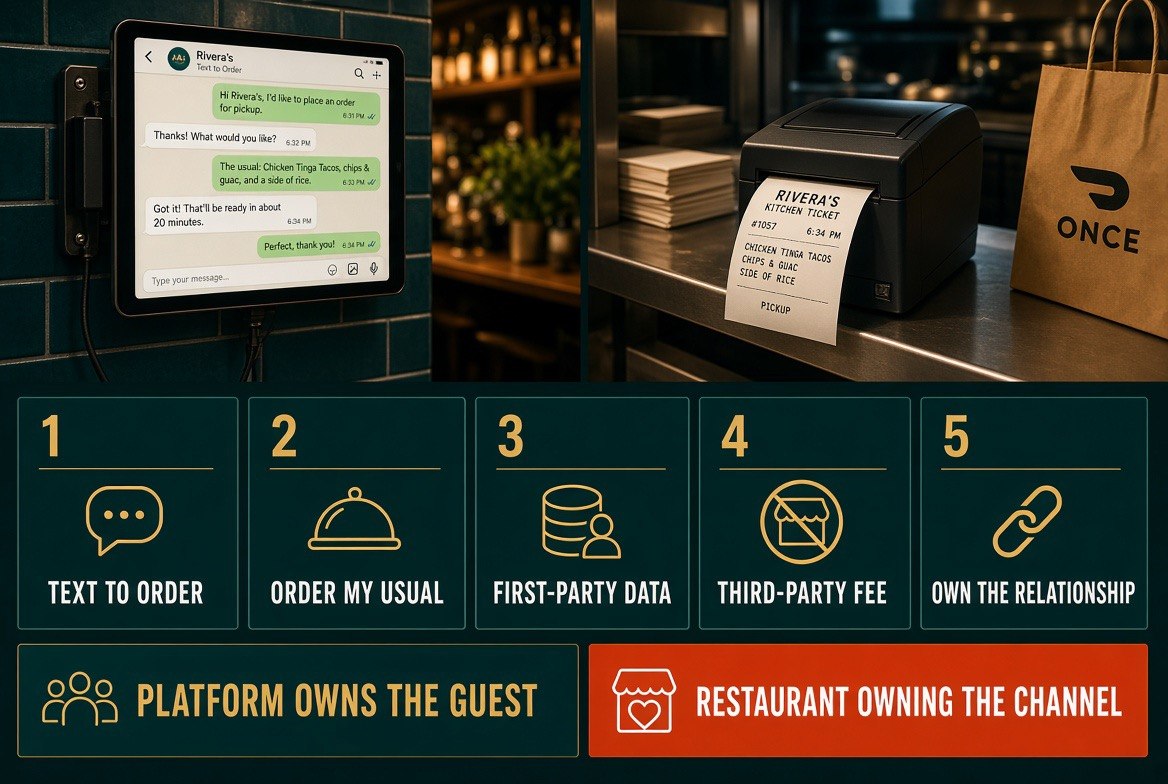
Where the AI ordering agent actually lands: a counter tablet holding the text thread, a ticket printing at the pass, and the first-party data trail a third-party platform never hands back.
Why “Order My Usual” Is the Real Story
Convenience features are usually framed as a win for restaurants because they lift order volume. Look closer at this specific feature and the framing weakens.
“Order my usual” is a habit engine. It is built to convert a repeat guest into an automatic one — which sounds good until you realise the habit runs through DoorDash’s app and DoorDash’s memory, not yours. The customer learns to text DoorDash, not your restaurant. Their favourite dish is stored in someone else’s database.
A regular who texts you directly is an asset you own. A regular who texts the platform is an asset the platform owns that happens to route to your kitchen. Those are very different positions to be in when commission rates are renegotiated, or when the platform starts favouring another restaurant in the same zip code for that customer’s next order.
This is not a new dynamic. It is the same dynamic that direct-ordering technology was built to solve. But it is worth restating, because an AI agent is a better version of it — more frictionless, more natural, and therefore stickier than a standard app reorder ever was.
What This Means for a Single-Location Restaurant
What follows is the practical read, without vendor spin from either direction.
Third-party delivery is not going away, and you should not pretend it is. For many independents, DoorDash and its competitors deliver orders that would never have arrived otherwise. The correct posture has never been to refuse the channel — it is to make sure the channel is not the only one you have.
The margin maths has not changed, only the entry point. A conversational agent lowers the customer’s effort, not your commission. If your delivery channel already costs a meaningful share of each order, an easier way to place those orders increases volume through the expensive channel, not the cheap one.
Your direct channel is now a defensive asset, not a nice-to-have. The owners best positioned over the next two years are the ones whose regulars have a reason to come to them first — a first-party ordering link, a loyalty programme, a text list they control. Those things were always worth doing. A frictionless platform agent is what makes them urgent.
| Factor | Order via DoorDash AI agent | Order via your own direct channel |
|---|---|---|
| Who owns the customer | The platform | You |
| Commission per order | Yes — platform fee applies | No platform commission |
| Access to guest data | Limited — platform holds the record | Full — order history is yours |
| Repeat-order mechanism | “Order my usual” inside their app | Your own loyalty or text list |
| Discovery for new guests | Strong — platform recommendation | Weak — you must drive it yourself |
The honest conclusion from that comparison is not “abandon third-party delivery.” It is that the two channels do different jobs. Delivery brings new guests at a cost. Direct ordering keeps guests at a lower cost. An agent that makes delivery effortless makes the second job more valuable, not less.
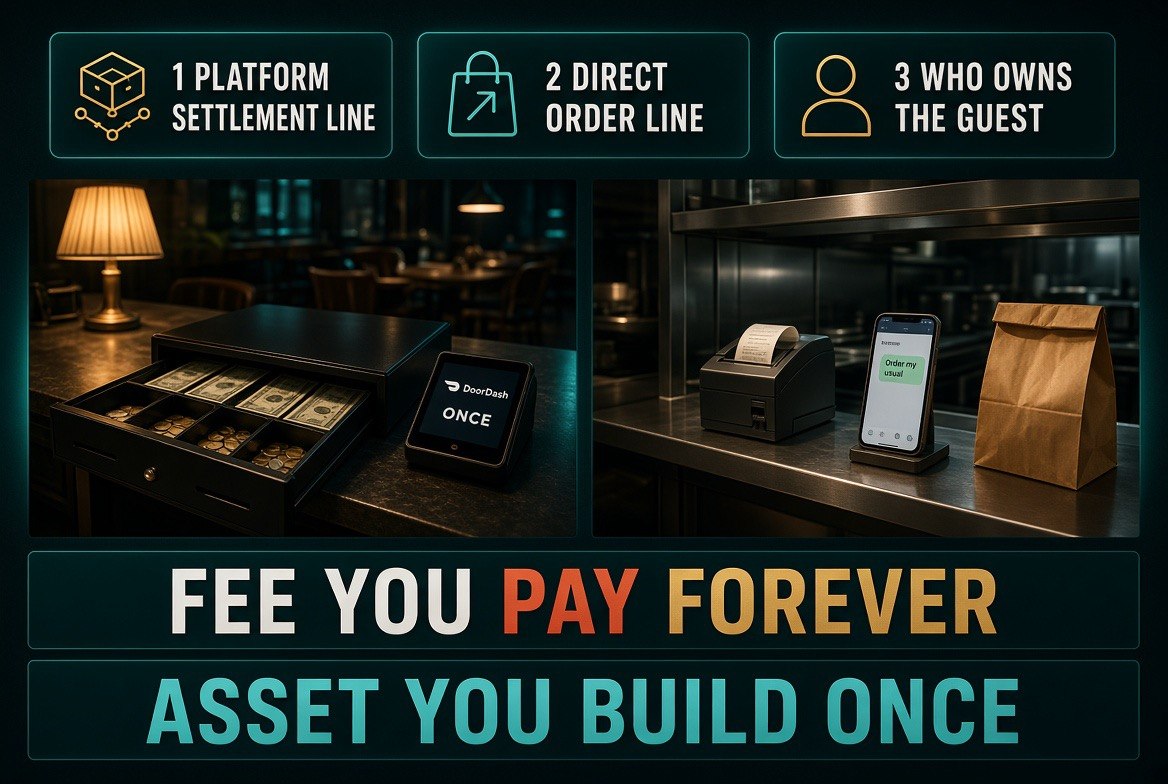
The comparison that decides the next renewal: a platform settlement line you pay forever, set against a direct-order ledger you build once and keep.
The Cost Question You Should Actually Ask
When a platform adds a convenience feature, the right question is not “will this bring more orders?” It almost certainly will, at the margin.
The right question is: what share of my total orders can I afford to have running through a channel where I do not own the customer?
Run the number on your own operation. Take your monthly delivery orders, multiply by your effective commission including fees, and look at the annual figure. Then look at what a direct-ordering channel would cost for the same volume. Most independents who actually do this exercise are surprised by the gap — and then surprised again when they realise how little of their marketing attention goes to the cheaper side of it.
An AI agent does not change that arithmetic. It makes it more important to get right, because it makes the expensive channel more effective at pulling volume toward itself.
Three Moves to Make This Quarter
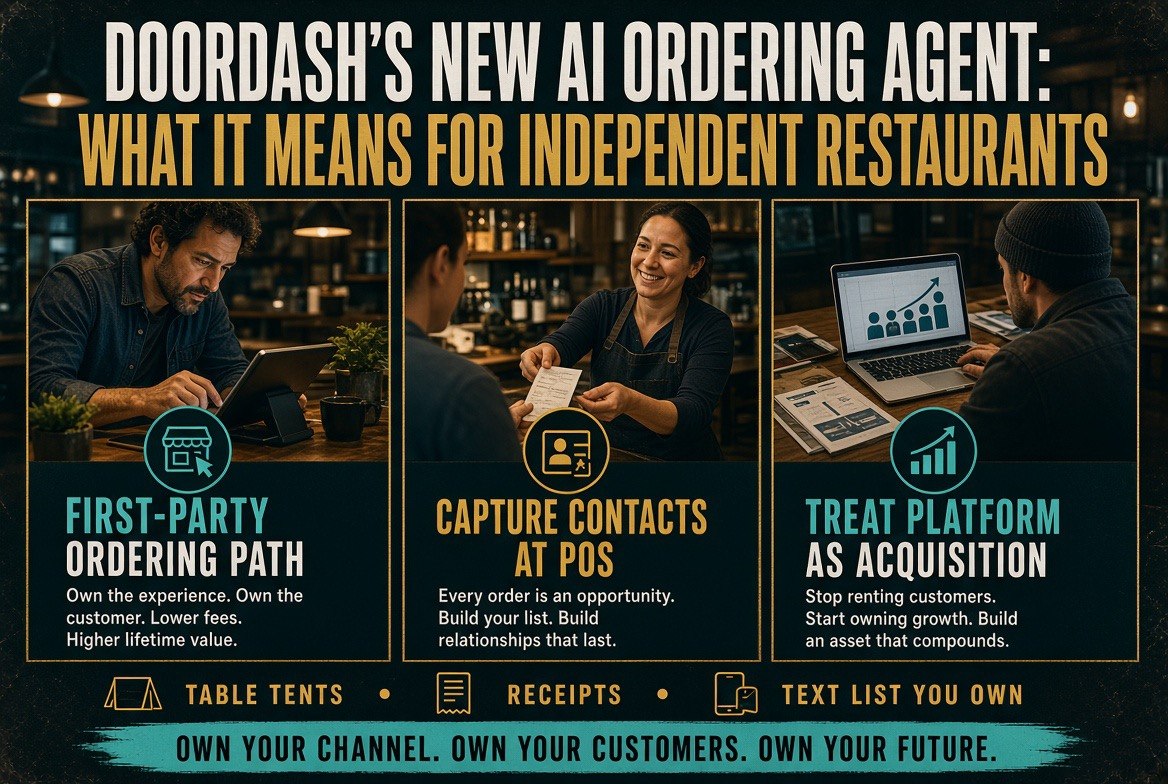
First, put a first-party ordering path in front of every guest you already have. Table tents, receipts, packaging inserts, your own social bios. The goal is a guest who knows how to order from you directly when they want to.
Second, capture contact details at the point of sale. A phone number or email from a dine-in guest is the cheapest customer acquisition you will ever do. Build the list before you need it.
Third, treat platform orders as acquisition, not as your customer base. Spend on them to reach new guests. Do not let them become the only way a regular can reach your kitchen.
None of that requires a budget. It requires deciding which relationship you are in the business of owning.
The Precedent Worth Watching
Agentic ordering is arriving across the whole delivery sector at once. Uber Eats and Grubhub are competing on the same ground, and every major platform is racing to become the default place a hungry person types their request. The winner of that race will hold an enormous amount of restaurant demand.
For an independent restaurant, the strategic position has not changed from the last decade of delivery. Integrate the channel, price for the commission, and never let a platform become your only route to the guest. The technology is new. The leverage problem is exactly the same one you have already been managing.
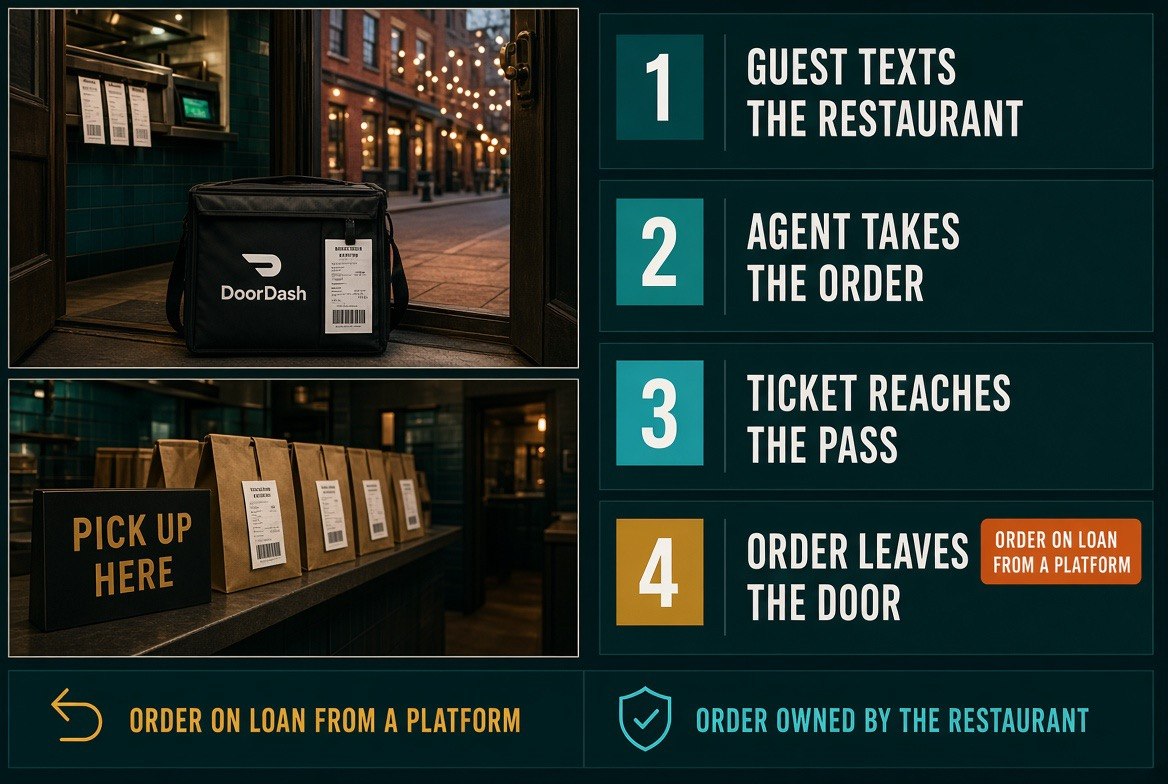
The end of the chain that decides everything: guest texts the restaurant, the agent takes the order, the ticket reaches the pass, and the order leaves the door. Whether that path is on loan from a platform or owned by the restaurant is the whole question.
What an AI Ordering Agent Changes About Guest Expectations
There is a second-order effect that gets less attention than the commission maths, and it will show up in your dining room before it shows up in your margins.
Once a guest learns they can type a request and get a cart built for them, that expectation does not stay inside the delivery app. It follows them through the door. Guests who arrive having been trained by a frictionless interface become less tolerant of friction everywhere else — a phone that rings out at 6pm, a booking system with six steps, a menu nobody can find online.
That cuts both ways for an independent. Your smaller size is an advantage in exactly one place: a human answers, remembers a face, and fixes a problem without a ticket number. The operators who win the next few years are the ones who put that human advantage in front of the guest at the moment the platform cannot — reserving a table, handling a dietary question, recognising a regular.
The practical version: if a platform is about to make ordering effortless, make the parts the platform cannot automate effortless too. Answer the phone. Make booking one tap. Keep the menu current. Those are the moments where a single-location restaurant beats an algorithm, and they are cheap to fix.
None of this requires new technology. It requires noticing that the technology has raised the bar for the things it does not touch.
Frequently Asked Questions
Does the DoorDash AI agent cost restaurants more?
The agent itself does not add a new fee, but every order it generates is a DoorDash order and carries the platform’s standard commission. Easy ordering means more volume through the commission channel.
Can customers use it to order directly from my restaurant?
No. The agent places orders through DoorDash. If you want first-party ordering, you need your own direct channel and a reason for guests to use it.
Is this available everywhere now?
DoorDash has opened a waitlist for US users, so this is a staged rollout rather than a nationwide feature available today.
Should I opt out of third-party delivery entirely?
For most independents, no. Delivery brings guests you would not otherwise reach. The aim is to keep it as an acquisition channel rather than your entire customer relationship.
What is the single highest-value thing an independent can do about this?
Build a direct ordering path and a contact list you own. It is the only part of the equation that a platform announcement cannot take away from you.

About Barak Schurr
Barak Schurr built and exited a major ticketing platform, ran global operations at Eventbrite, and now focuses on one question: which AI tools actually help independent restaurant owners run leaner and grow faster. He writes from the operator’s perspective — no vendor spin, no theory, just what’s real in 2026.
Email: [email protected]
More AI Resources for Your Business