Get the AI Restaurant Quick-Start Guide — Free
The 5 AI tools independent US restaurant owners are using right now to cut labor costs and answer every call.
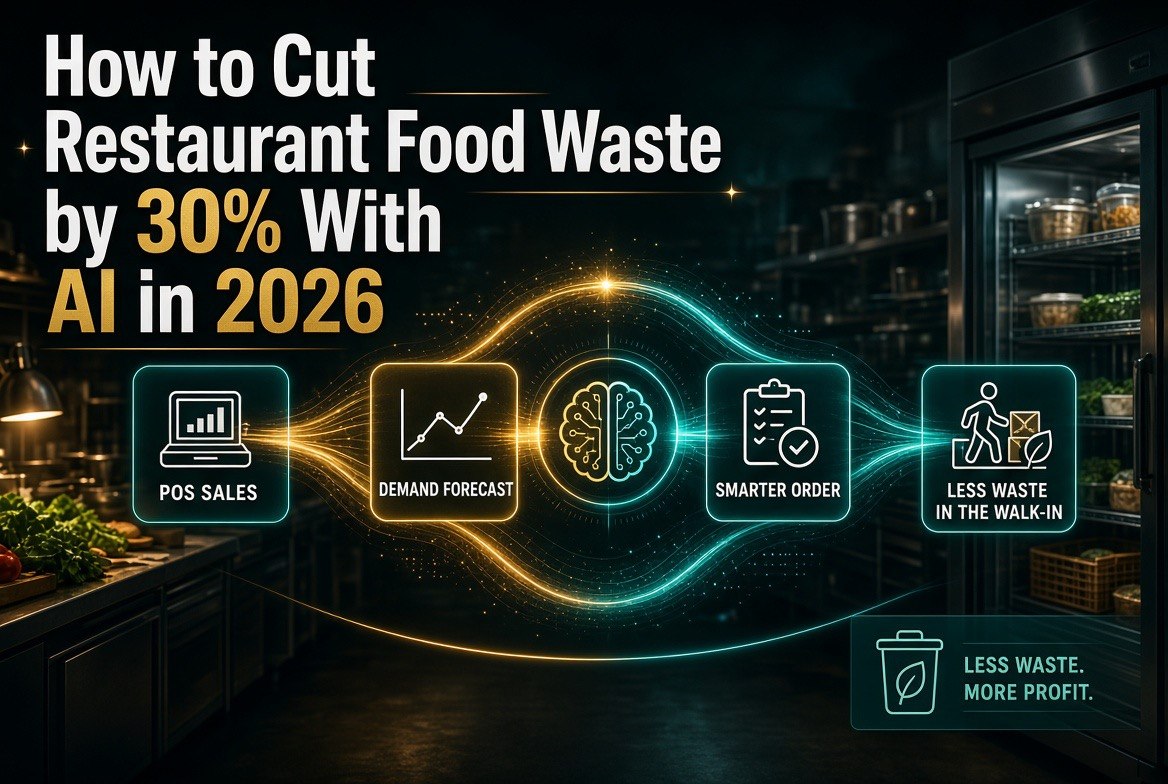
How to Cut Restaurant Food Waste by 30% With AI in 2026
⚡ Expert Summary: The average independent restaurant throws away 4% to 10% of the food it buys, and for a restaurant spending $30,000 a month on food, that is $1,200 to $3,000 walking straight into the bin every month. AI waste tools work by closing the gap between what you think you use and what you actually use — forecasting demand per menu item, tracking inventory as it moves, and flagging the specific items bleeding money. Operators running this properly cut waste 25-30% in the first ninety days. On that same $30,000 food spend, that is roughly $9,000 to $10,800 a year back on the P&L without changing the menu.
Here is the part nobody tells you about food waste: it is rarely one big mistake. It is thirty small ones. A case of tomatoes ordered for a Friday that turned out slow. A prep cook over-portioning the salmon because the last three tickets called for it. A dish that quietly stopped selling in March but still gets prepped in full every morning. None of those show up as a line item. All of them show up in your food cost percentage, and by the time your accountant sees it, the food is already in the dumpster.
This guide walks through exactly how independent restaurants use AI to cut food waste by 30% — what the tools actually do, where to start, what it costs, and how to run it on a real floor with a real team. No tech background required.
What Food Waste Actually Costs an Independent Restaurant
Start with your own number, because the industry average will not motivate your staff the way your own P&L does. Restaurants spend roughly 28% to 35% of revenue on food and beverage cost. Of that spend, somewhere between 4% and 10% ends up as waste — spoiled product, over-prep, over-portioning, trim loss, and unsold specials. Independent restaurants typically sit at the higher end because they lack the forecasting systems chains have.
Run the math on a mid-volume independent doing $100,000 a month:
- Food and beverage spend at 30% of revenue: $30,000 a month
- Waste at 8% of that spend: $2,400 a month
- Annual waste: $28,800
That is one employee’s salary burned every year. And the damage does not stop at the food cost line. Wasted food means wasted labour on prep, wasted energy in storage, wasted walk-in space, and — this one stings — wasted covers when you 86 a dish that customers came for. Waste is a margin problem, a labour problem, and a guest experience problem at the same time.
Why Traditional Approaches Fail for Independent Operators
Most independents have tried to solve this already. It usually looks like one of these:
The clipboard count. A manager walks the walk-in with a clipboard and writes down what looks low. It is done at the busiest moment of the day, it is inconsistent between managers, and it is always a day behind. By the time the order goes in, the number is already wrong.
The end-of-month food cost review. By the time your food cost percentage comes in at 33% instead of 30%, every dollar of waste is already gone. You can identify the problem but you cannot prevent it.
The chef’s instinct. Good chefs have genuine intuition about prep levels. It is also invisible, undocumented, and leaves with them when they take another job — taking your institutional knowledge out the door with them.
All three share the same flaw: they measure waste after it happens. AI waste tools work differently — they predict demand before service, track usage during service, and flag variance while you can still do something about it.
Where AI Actually Fits: The 4 Waste Points It Fixes
| Waste Point | What It Costs | What AI Does About It |
|---|---|---|
| Over-ordering | Spoiled product, cash tied up in the walk-in | Forecasts demand per item by day and daypart, generates order guides from projected covers |
| Over-prep | Prepped food that never sells, tossed at close | Builds prep lists from forecast, adjusts for weather, events, and local trends |
| Over-portioning | Silent margin leak on every plate, every shift | Flags variance between theoretical and actual usage per ingredient |
| Menu drift | Dead items still prepped daily, slow sellers held too long | Menu engineering scores every dish on margin and popularity, flags what to cut |
Notice that three of the four have nothing to do with spoiled food. The biggest waste categories in an independent restaurant are decisions made before service, not product that went bad. That is exactly the terrain AI tools are built for.
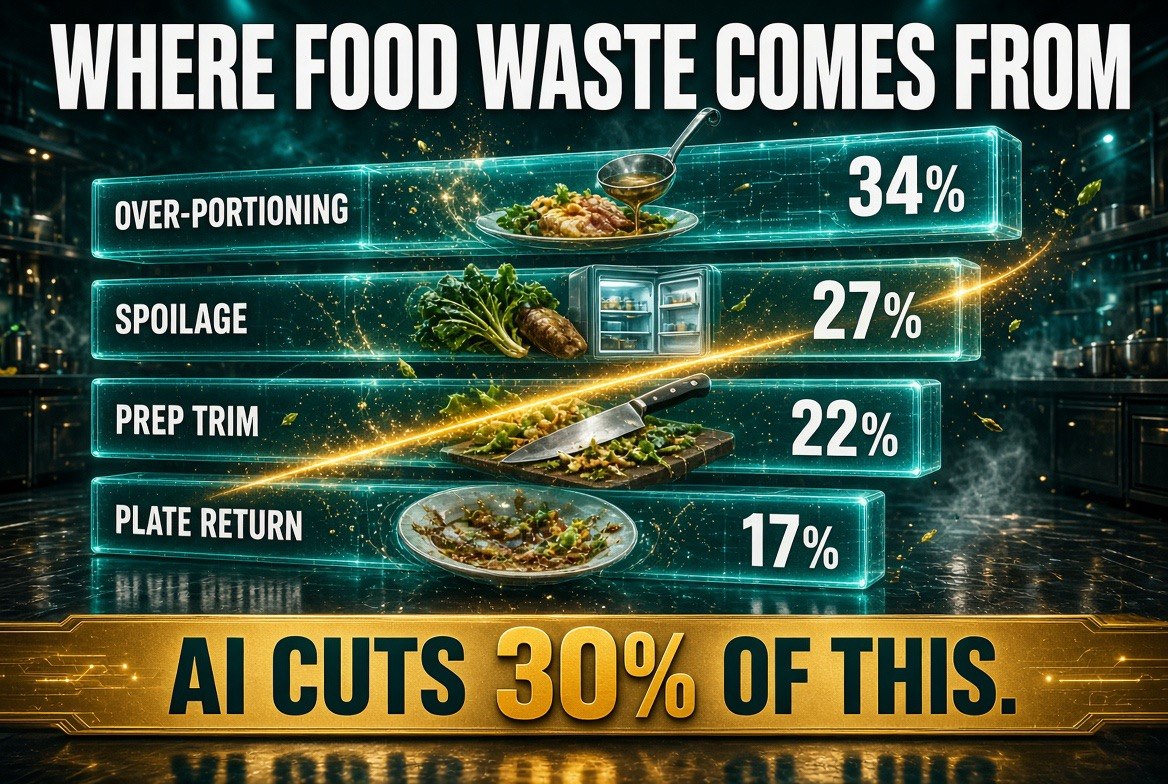
Over-portioning, spoilage, prep trim and plate return are the four places waste piles up. AI tracking attacks all four at once — which is how the 30% cut becomes realistic.
The Step-by-Step Playbook: Cutting Waste 30% in 90 Days
Step 1: Measure your real waste for two weeks (Days 1-14)
Before any AI tool can help, you need a baseline — and you would be surprised how few restaurants have one. For fourteen days, log three things: what you throw away at close, what you 86 during service, and what you comp or send back. Use a shared spreadsheet or a simple app on the prep station. Two weeks is enough to see the pattern.
Most operators doing this for the first time find one or two items responsible for a wildly disproportionate share of the loss. It is almost never the expensive proteins. It is usually a garnish, a sauce, or a side that gets prepped in bulk and used sparingly.
Step 2: Get your inventory and sales data into one place (Days 15-30)
AI waste tools need two feeds: what you sold, and what you used. If you are on a modern POS, your sales data is already structured. On the inventory side, this is where you either move to a digital counting tool or use one that reads your existing process.
This is the step where operators stall, so make it small. You do not need every ingredient mapped on day one. Pick your twenty highest-cost items and get those accurate. That is usually 70% to 80% of your food spend, and it is where the savings live.
Step 3: Turn on forecasting and kill the clipboard order (Days 31-60)
This is the highest-value change in the whole playbook. AI ordering tools forecast demand per item using your own sales history, adjusted for day of week, weather, local events, and seasonality. Instead of a manager guessing how much to order, the system produces a suggested order guide from projected covers.
Operators who make this switch typically see the biggest single drop in waste here, because over-ordering is the largest and most fixable category. It also shortens the time managers spend on ordering, which is labour you get back for free.
Step 4: Rebuild prep lists from the forecast (Days 31-60, in parallel)
Ordering is only half the equation. Prepped product that never sells is just as expensive as product that never got ordered. Once forecasting is live, use it to build daily prep lists — how many portions of each item to prep for tonight’s projected covers, not how many you prepped last Saturday.
This is the change your kitchen team will resist most, because it cuts against “we always prep that much.” Bring the numbers. When the prep cook sees the forecast was within 5% for four straight days, the argument ends.
Step 5: Run menu engineering on a fixed schedule (Days 61-90)
Every menu has four categories: stars (high margin, high popularity), plowhorses (low margin, high popularity), puzzles (high margin, low popularity), and dogs (low margin, low popularity). Most independents have never formally classified their dishes. AI menu tools do it from your POS data automatically and flag the dogs that are still consuming prep time and inventory.
Cutting two or three dogs from the menu typically removes a meaningful chunk of daily prep with almost no revenue impact, because those items were never selling anyway.
Step 6: Hold the gain with a weekly variance review (Ongoing)
The last step is what separates operators who keep their savings from those who slide back. Once a week, review theoretical versus actual usage on your top twenty items. A variance above about 3% on any item means something changed — a portion drift, a waste spike, a receiving error. Catch it in a week instead of a month and you stop the leak while it is small.
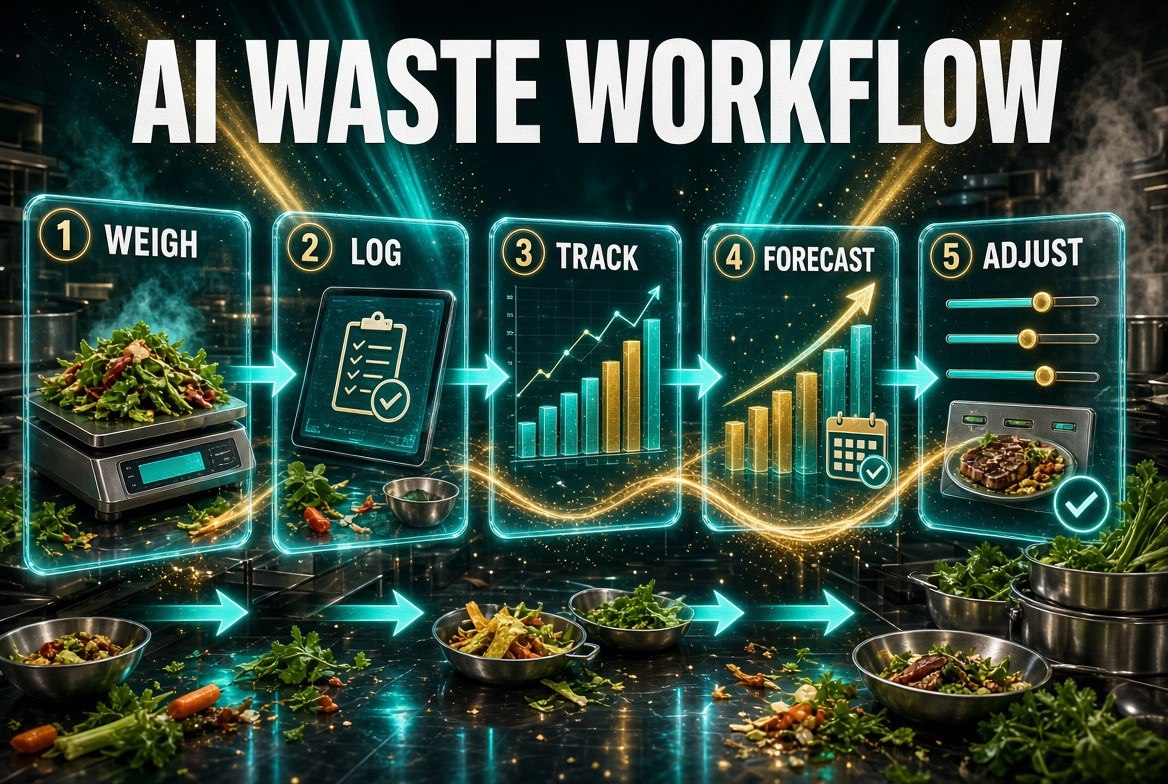
The five-step loop in practice: weigh what you throw out, log it, let the tool track the pattern, forecast demand from it, then adjust prep. Miss any step and the savings stall.
AI Food Waste Tools vs the Old Way: Side-by-Side
| Factor | Old Way (Clipboard + Monthly Review) | AI-Assisted Way (Forecast + Live Tracking) |
|---|---|---|
| When you learn about a problem | End of month, after the food is gone | Same day — flagged while you can act on it |
| Ordering basis | Manager’s judgment at the busiest moment of the day | Forecast from own sales history, weather, events |
| Portion control | Assumed correct unless someone complains | Variance tracked per ingredient against theoretical usage |
| Menu decisions | Gut feel, change twice a year at most | Scored continuously on margin and popularity |
| Time cost to the manager | 3-5 hours a week on counts and manual math | Under 1 hour a week once set up |
| Typical waste reduction | Flat, holds at current level | 25-30% in the first 90 days |
| Where the knowledge lives | In the head of your best manager or chef | In the system — survives staff turnover |
The last row is the one operators underestimate when they are evaluating cost. Staff turnover in restaurants runs high, and every time a manager leaves, the institutional knowledge about portioning, ordering quirks, and prep levels walks out with them. A system that holds that knowledge is worth more than the waste savings alone.
How to Choose a Tool Without Getting Burned
There is no shortage of options, and this is where independents get talked into subscriptions they never use. Four questions cut through it.
Does it read your existing POS data? If the tool cannot pull sales from whatever POS you already run, it will need manual entry — and manual entry dies in a busy restaurant. Integration with mainstream restaurant POS systems matters more than any feature list.
Does it do inventory and ordering, or only one? Forecasting without ordering leaves the clipboard in place. Ordering without inventory tracking misses portion drift. You want the loop closed.
What does the weekly time cost look like? Ask for the realistic number, not the demo number. If setup or weekly maintenance takes more than an hour once running, your team will abandon it during a busy period.
Can it prove the savings? Any tool worth paying for should show you theoretical versus actual variance. If it cannot quantify what it saved you, you are paying a subscription for a dashboard.
For a wider look at what independent operators are actually adopting rather than what vendors are pitching, our breakdown of the 5 most popular AI tools independent restaurants use in 2026 ranks tools by real adoption data instead of marketing spend.
The Labour Angle Nobody Talks About
Food waste and labour cost are the same conversation. Wasted food is wasted prep time — someone chopped it, portioned it, labelled it, and carried it to the walk-in. Over-ordering means staff counting and organizing product you did not need. Dead menu items mean a prep cook spending the first two hours of every shift on food that will not sell.
When operators run this playbook, the food cost savings are the headline, but the labour savings are often the surprise. Cutting two or three dead items and rebuilding prep lists from forecast typically removes 30 to 60 minutes of daily prep labour. Across a week, that is real money at a 28% to 35% labour cost percentage.
That is also why waste work tends to stick when other initiatives do not. Nobody argues against saving money on food, and the changes make the kitchen’s day easier rather than harder.
Common Mistakes That Kill the Savings
Mapping the whole menu before starting. Operators try to onboard every ingredient, burn three weeks on data entry, and quit. Start with your top twenty cost items.
Letting the forecast run without a human check. AI forecasting is good, not psychic. Pre-shift, a manager should glance at the forecast and override for anything the system cannot know — a private party booked this morning, a festival down the street, a supplier shorting you. Two minutes of judgment on top of a good forecast beats either alone.
Never telling the kitchen why. If the crew thinks this is surveillance, they will game the counts. If they understand that the savings protect their hours and their pay, they will help you find the leaks. Explain the number and share the win.
Stopping after the first win. Waste creeps back. The weekly variance review is not optional — it is the entire reason the savings hold past month three.
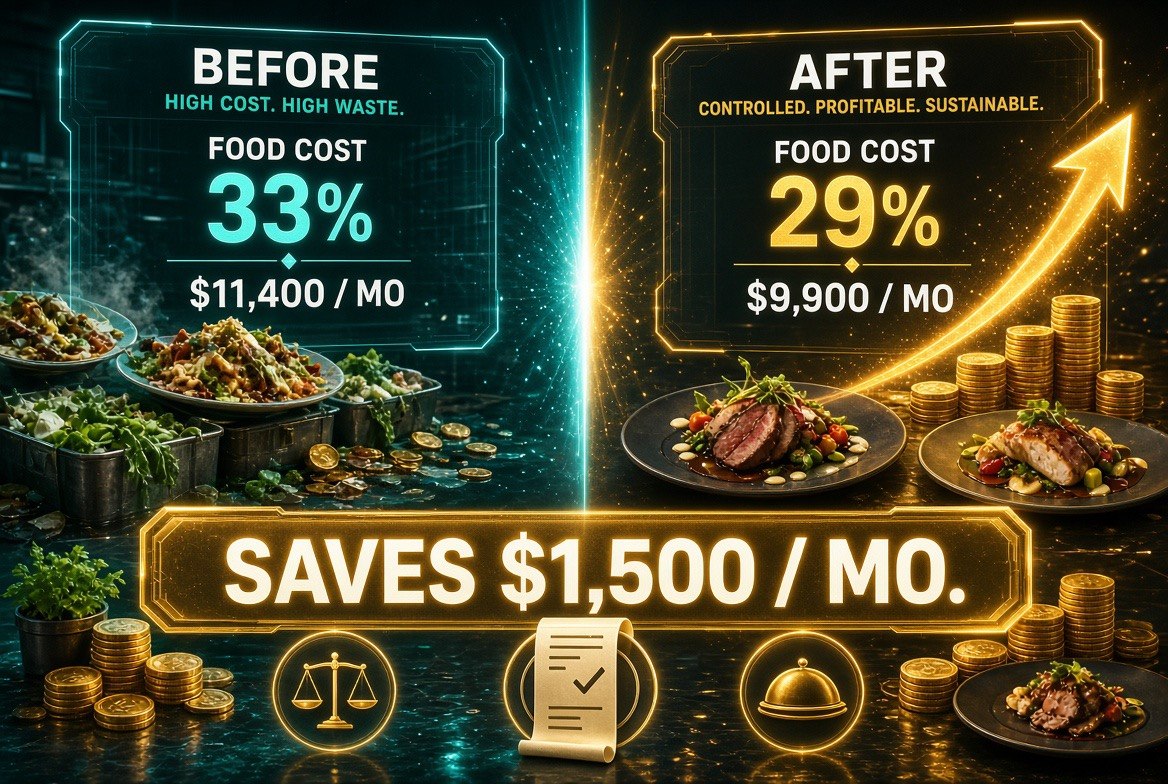
The end result on a 120-cover room: food cost dropping from 33% to 29% and roughly $1,500 a month staying in the business. That is the number to hold yourself to.
Frequently Asked Questions (FAQ)
How much can an independent restaurant realistically cut food waste by using AI?
Operators who implement forecasting, inventory tracking, and menu engineering properly typically cut waste by 25% to 30% within the first 90 days, with the largest early gains coming from fixing over-ordering. Sustaining that requires a weekly variance review, because waste levels creep back up if nobody is watching.
Do I need a modern POS to use AI food waste tools?
You need a POS that allows data export or has integration support. Most mainstream restaurant POS systems do. If you run an older or fully offline system, the tool will depend on manual entry, which is harder to sustain in a busy restaurant — worth confirming before you subscribe to anything.
How long does it take to see results?
Ordering improvements show up within the first full ordering cycle after forecasting goes live, usually two to four weeks in. Portioning and menu savings take longer because they require a menu cycle and staff adjustment — plan on 90 days for the full 25% to 30% reduction.
Is AI waste tracking too complex for a non-technical manager?
A good tool should be usable by a manager with no technical background. The workload is front-loaded: two weeks of baseline measurement and a focused setup on your top twenty cost items. After that, the routine is a count and a weekly variance review, both of which fit inside an hour a week.
What is the single highest-impact change I can make first?
Replace the clipboard order with a forecast-driven order guide. Over-ordering is the largest and most fixable waste category in most independent restaurants, and it is the change that pays back fastest — often within a month.
Does reducing food waste also reduce labour costs?
Yes, and operators consistently underestimate this. Less over-ordering means less counting and organizing, fewer dead menu items means less prep, and tighter prep lists mean fewer hours spent preparing food that never sells. Most restaurants find 30 to 60 minutes a day of prep labour disappears along with the waste.
Waste percentages and food cost ranges reflect standard industry operating benchmarks for independent US restaurants as of 2026. Your own baseline should come from the two-week measurement in Step 1, because the right target is the one your P&L shows.

About Barak Schurr
Barak Schurr built and exited a major ticketing platform, ran global operations at Eventbrite, and now focuses on one question: which AI tools actually help independent restaurant owners run leaner and grow faster. He writes from the operator’s perspective — no vendor spin, no theory, just what’s real in 2026.
Email: [email protected]
More AI Restaurant Resources