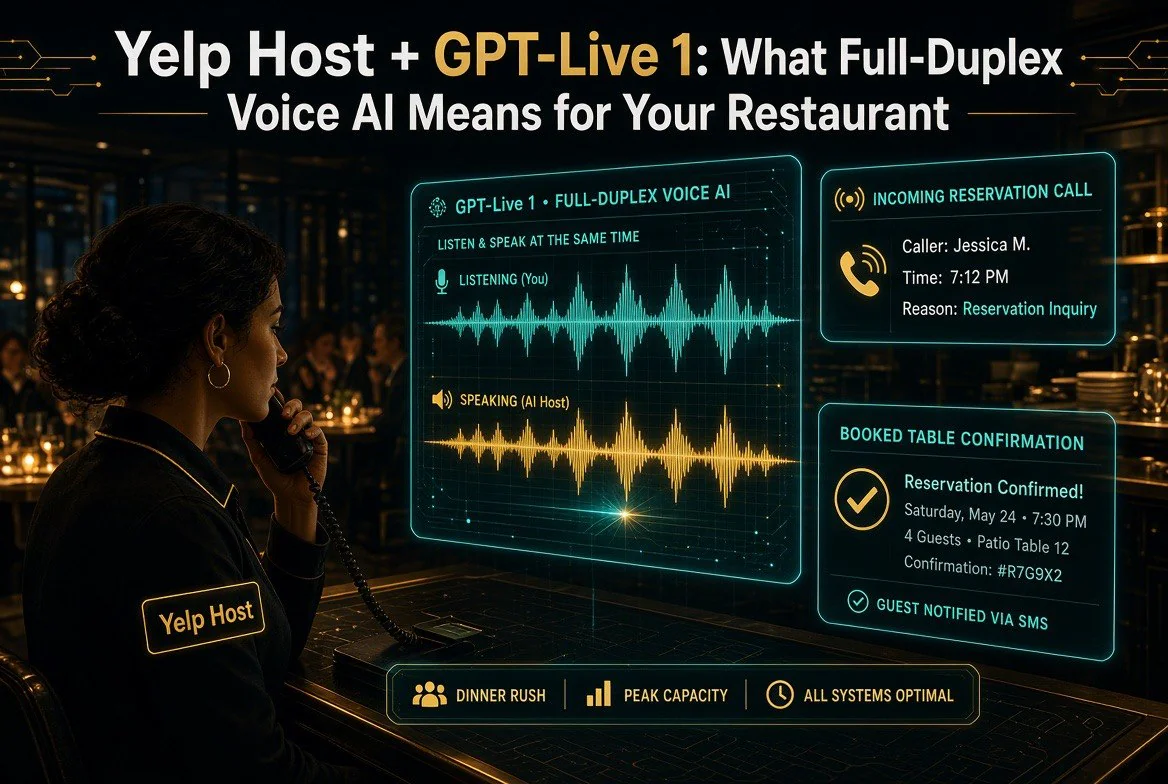
Yelp Host + GPT-Live 1: What Full-Duplex Voice AI Means for Your Restaurant
⚡ Expert Summary: On September 10, 2026, OpenAI released GPT-Live-1 — a full-duplex voice model that listens and speaks at the same time — and Yelp put it straight into Yelp Host for restaurants. Yelp Host has handled over 1 million calls since October 2025. The upgrade fixes the thing that made every earlier AI phone agent feel fake: it no longer waits for you to finish before it starts thinking. For an independent operator missing 25–60% of calls during a rush, that difference is dinner money — not a demo feature.
The phone rings during Friday dinner service. Your host is seating a party of six, your server is running food, and nobody can pick up. That call is a reservation for eight on Saturday, or a $240 catering inquiry, or a family deciding where to eat tonight. They hang up, and roughly 85% of people who hang up on a restaurant never call back — they call the place down the street.
Every restaurant owner reading this already knows that feeling. What changed on September 10 is the technology that answers that call. Yelp and Hatch became the first production deployments of OpenAI’s new GPT-Live-1 model, and the reason it matters is narrower and more practical than the press release makes it sound.
What Full-Duplex Actually Means (In Plain Restaurant Terms)
Every voice AI you’ve called before this one worked like a walkie-talkie. You talk. It waits. It decides you’re done. Then it responds. That pause — usually half a second to two seconds — is why those systems felt robotic even when the words were correct. It’s also why they fell apart when a caller changed their mind mid-sentence or a kitchen got loud.
Full-duplex is different. GPT-Live-1 listens while it speaks. It can process overlapping speech, natural pauses, interruptions, and mid-sentence topic changes without losing the thread of the conversation. It also reads tone — it can tell the difference between a caller who’s excited and one who’s already frustrated, and adjust accordingly.
Take five common restaurant phone scenarios and see the difference:
| Real Caller Moment | Older Turn-Based Voice AI | Yelp Host With GPT-Live-1 |
|---|---|---|
| Caller changes their mind mid-order | Finishes the wrong order, then needs a correction loop | Catches the change as it happens and updates without missing a beat |
| Caller interrupts to ask the specials | Talks over the caller; conversation resets | Handles the interruption, answers, then returns to the original request |
| Loud kitchen and full dining room | Mishears order items; requests repeats | Filters background noise and keeps the thread |
| Caller is already annoyed by hold music | Flat, identical tone regardless of mood | Detects frustration and shifts to a disarming, direct tone |
| Caller mixes two requests in one breath | Answers the first, drops the second | Holds both and resolves them in one call |
None of those are parlor tricks. Each one is a real caller behavior that causes a real lost order when the system handles it badly. The OpenAI release positions the voice layer at $0.05 per minute, with backend reasoning and tools priced separately — which for a restaurant handling a few hundred calls a month is a rounding error against one recovered catering order.
What Yelp Host Already Was — And What Changed
Important context: Yelp Host is not new. It launched in October 2025 and has processed more than 1 million calls for restaurants since then, handling reservations, waitlists, food orders, and menu questions by pulling from Yelp data plus your operational details — availability, seating, menu — and integrations with systems like POS and guest management platforms.
What GPT-Live-1 changes is the front end of that system, not the back end. Yelp’s own reporting on the upgrade describes improved call-handling rates and fewer transfers to humans, with callers speaking in fuller sentences because they’re no longer fighting a system that keeps cutting in. That last detail is the revealing one: when the AI stops interrupting people, people stop talking to it like a machine.
So the honest breakdown of what this actually is:
| Component | What It Does | Who Owns It |
|---|---|---|
| Voice layer (full-duplex conversation) | Listens and speaks simultaneously, handles interruptions, reads tone | GPT-Live-1 via OpenAI API |
| Restaurant knowledge | Menus, hours, availability, seating rules, specials | Yelp Host |
| Bookings and orders | Confirms reservations, captures takeout orders, updates waitlist | Yelp Host plus POS and guest management integrations |
| Service-business side (Hatch) | Qualifies leads, books jobs, follows up across voice, text, and email | Hatch, owned by Yelp since early 2026 |
| Call data and reporting | Shows what callers asked, what converted, where the system struggled | Yelp dashboard |
Read that back-to-front. The voice engine is rented from OpenAI at a metered rate. The restaurant intelligence — your menu, your rules, your availability, your booking flow — is Yelp’s. The data you learn from every call is the part that compounds, because it tells you what your customers keep asking for that nobody on your staff is hearing.
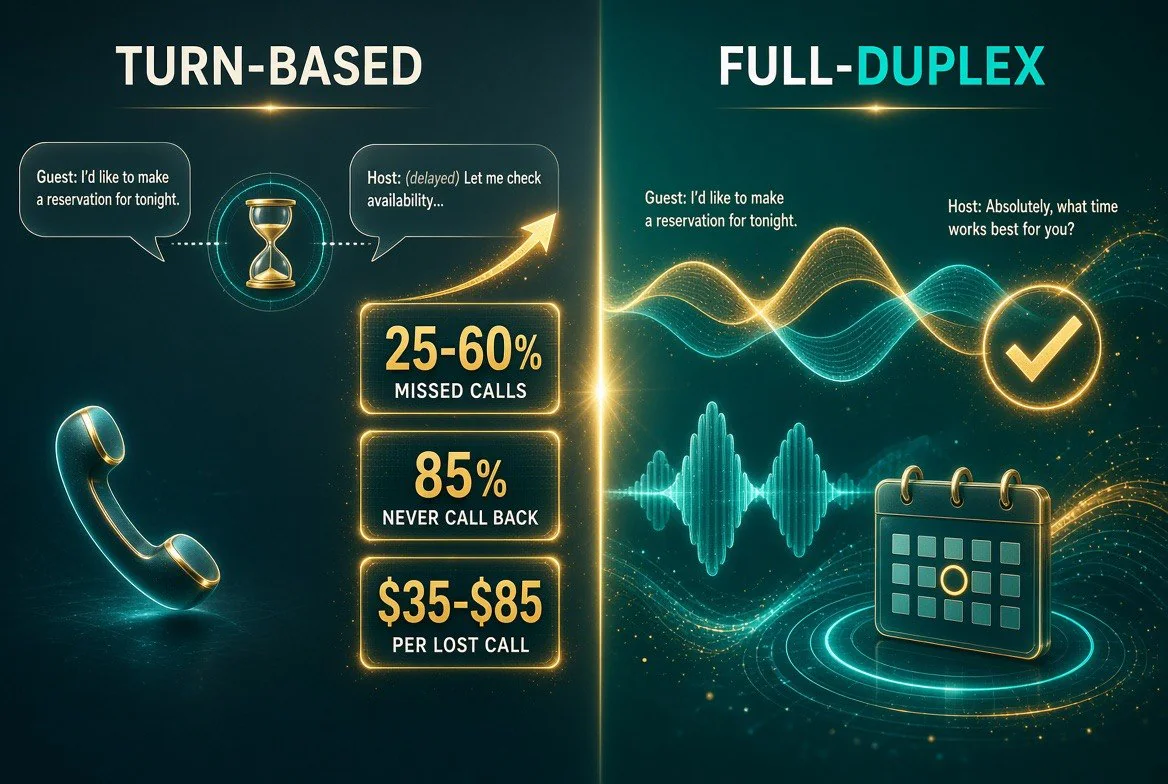
Turn-based versus full-duplex, side by side. A turn-based agent waits its turn and guests hear dead air. A full-duplex agent listens and speaks at the same time, so the call flows like a real conversation — which is the difference between a caller staying on the line and hanging up on a quarter to more than half of your calls.
The Math That Decides Whether This Is Worth It
Let’s put real numbers on the missed-call problem, because “AI answers your phone” means nothing without them.
| Number | What It Means |
|---|---|
| 25% to 60% of inbound calls missed | Peak hours are the worst: 30–60% during lunch and dinner rushes, 15–25% off-peak |
| 85% of unanswered callers don’t call back | Most hang up without leaving voicemail and call a competitor instead |
| 60% to 70% of calls are revenue-intent | Orders, reservations, catering — not questions about parking |
| $35 to $85 lost per missed revenue call | Average takeout ticket runs $38–$45; reservations and catering run far higher |
| ~150 missed calls per restaurant monthly | Typical US average used in 2026 industry analysis |
| $28,000 to $73,000 lost per location, per year | Higher end applies to busy independents and QSR-style volume |
| ~$20 billion lost annually across US restaurants | Conservative industry-wide estimate across 700,000+ locations |
Run your own version of the math. Take your missed calls per week, multiply by 0.65 for revenue intent, multiply by your average ticket, and multiply by 30. A restaurant missing just 30 calls a month at a $40 average ticket is looking at over $13,000 a year walking out the door — and that’s before you count repeat customers and the reviews from people whose calls went unanswered.
Against that, $0.05 per minute for the voice layer is not a cost worth debating. If Yelp Host recovers even three takeout orders a week that would have otherwise gone to voicemail, it pays for itself many times over. The question is never whether the math works. It’s whether the system actually answers correctly — which is exactly what this upgrade targets.
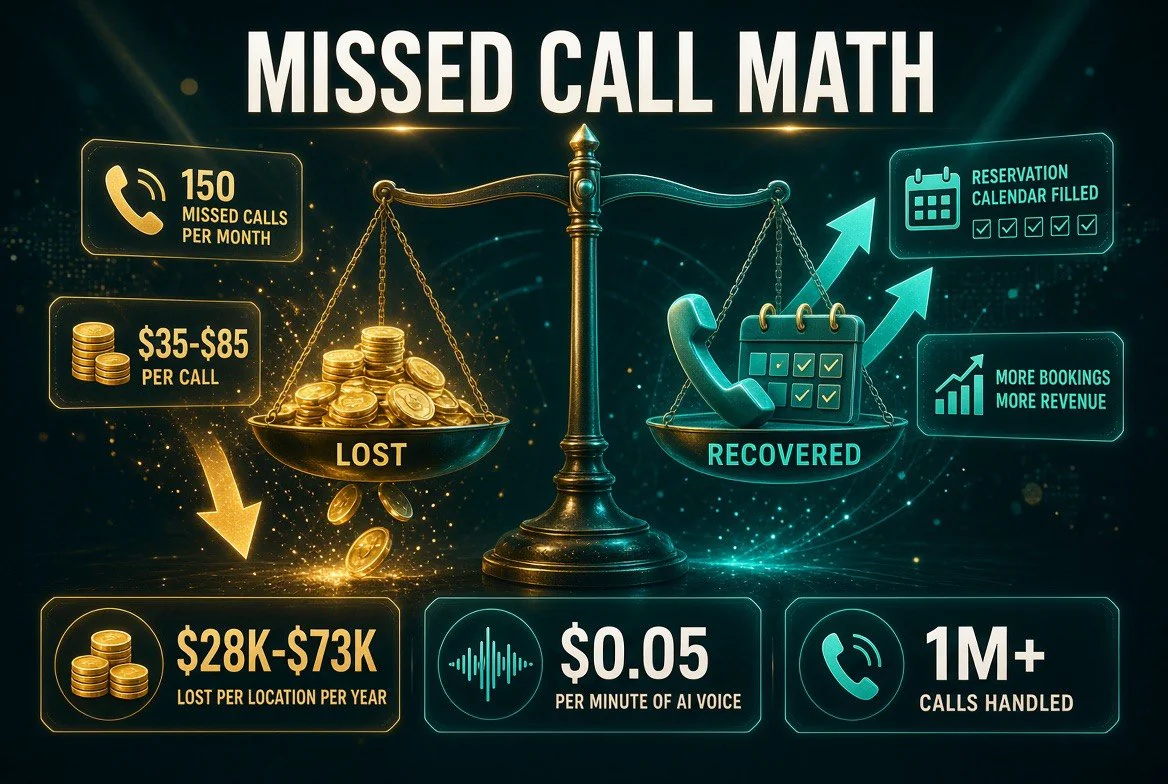
The math that decides the purchase. Roughly 150 missed calls a month at $35 to $85 each, with 85 percent of those callers never dialing again, compounds into tens of thousands of dollars lost per location every year. Against a voice layer that runs about $0.05 a minute, the recovered bookings are what tip the scale.
What Still Requires a Human
Don’t let the polish fool you into thinking you can fire your host and walk away.
Complex or large-party requests still need judgment. A regular calling about a 40-person buyout, a wedding inquiry, a mother asking about allergen handling for a child — these are calls where judgment, empathy, and the ability to make an exception matter. A well-built agent can capture the details and flag it. It should not be negotiating your private event pricing.
Escalation paths must be deliberate. When the agent doesn’t know something, who does it hand off to? If the answer is “a voicemail,” you’ve rebuilt the exact problem you were trying to solve. Configure the escalation to ring a real person — your manager’s phone, not a dead extension.
Your data has to be right. The agent pulls your menu, availability, hours, and seating rules. If your hours on Yelp say you close at 9 but you actually close at 10 on weekends, the agent will confidently tell callers the wrong thing. Garbage in, confident garbage out.
You still own the guest relationship. A caller handled by AI all the way through is a caller who never had a human moment with your restaurant. That’s fine for a Thursday takeout order. It’s not how you build regulars. Save the human handling for the moments that matter — the regulars, the celebrations, the complaints that need a real apology.
What to Do With This If You’re an Independent Operator
Get your Yelp listing accurate this week
Before any voice AI is worth anything, your hours, menu items, and pricing need to be current. This costs you nothing and improves everything else you do — search, discovery, reservations. Do it now regardless of whether you adopt voice AI.
Measure your own missed-call rate
Don’t guess from industry benchmarks. Pull your phone logs for the last two weeks. Count calls during service hours that rang more than four times or went unanswered. Multiply by your average ticket. That number is your actual case for action, and it’s the only one that will convince you.
Ask the vendor answer these three questions
One: what’s the escalation path when the agent can’t help — who takes the call, and how fast? Two: what happens to my call data, and do I get access to it? Three: which POS and reservation systems does it integrate with, and what breaks if I switch systems later?
Start with off-hours, not peak
If you’re testing any voice AI, run it during the windows you’re currently failing completely — after close, before open, Sunday mornings. Those are calls you’re missing 100% of right now. There’s no downside risk because there’s no current performance to degrade. Once you trust it there, bring it into the rush.
Watch the transfer rate like a hawk
The single metric that tells you whether the system is working is how often it hands calls to a human. If transfers drop over the first month, it’s learning your restaurant. If they stay flat, the system is bluffing its way through conversations and losing you orders in the process.
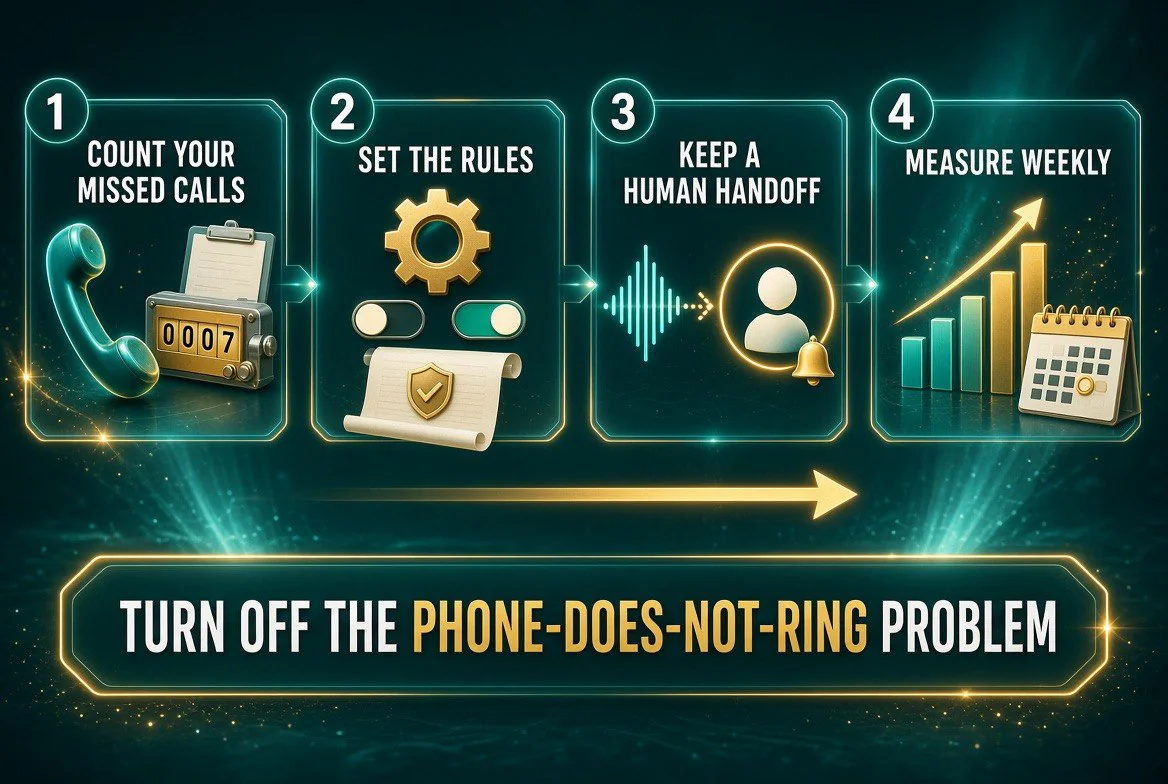
The operator playbook, in four steps: count your actual missed calls before you buy anything, set the rules for what the AI is allowed to handle, keep a clean human handoff for edge cases, then review the numbers weekly. Do this in order and the purchase decision makes itself.
The Pattern This Fits Into
Yelp isn’t the only company making this move, and that matters for how you plan. Hatch — which Yelp acquired in early 2026 — is deploying the same model for service businesses, qualifying leads and booking jobs across voice, text, and email. Meanwhile a whole field of independent voice agents has grown up around restaurants: reservation systems, phone ordering tools, and POS-connected answerers that all attack the same problem from different angles.
For an independent operator, the practical takeaway isn’t “pick Yelp.” It’s that voice AI crossed a threshold on September 10, 2026, and the threshold matters more than any single vendor. The technology stopped sounding like a system waiting for its turn. Once that happens, the bar for every restaurant phone conversation rises — because your competitor across the street is about to answer every call, at 9pm, on a Saturday, without a single person standing by the phone.
That’s the real pressure here. Not that AI can answer your phone, but that it’s about to answer theirs.
Frequently Asked Questions
What is GPT-Live-1 and why does it matter for restaurants?
GPT-Live-1 is OpenAI’s full-duplex voice model, released September 10, 2026. Full-duplex means it listens and speaks at the same time, so it can handle interruptions, background noise, and mid-sentence changes without breaking the conversation. For restaurants it matters because those are the exact conditions of a real phone call during service — and older voice AI failed at all of them.
Does Yelp Host cost extra now that it uses GPT-Live-1?
Yelp prices Yelp Host as part of its restaurant product offering. The underlying voice layer runs at $0.05 per minute on the OpenAI API, with backend reasoning priced separately. For most restaurants handling a few hundred calls a month, the underlying cost is small relative to the revenue recovered from answered calls.
Can Yelp Host take full takeout orders or just reservations?
It handles reservations, waitlist management, food orders, and menu questions. It draws on your menu, availability, hours, and seating rules, and connects to POS and guest management systems so orders and bookings land where your staff already work.
Will AI answering my phone make my restaurant feel impersonal?
For routine orders and standard reservations, most callers care about speed and accuracy, not whether a human answered. The risk is letting AI handle the moments that build regulars — large parties, celebrations, complaints. Configure escalation so a real person takes those calls.
How many calls do restaurants actually miss?
Industry data for 2026 shows 25% to 60% of inbound calls going unanswered, with the worst rates during lunch and dinner rushes. About 85% of callers who hang up never call back, and roughly 60% to 70% of inbound calls are order or reservation intent.
How much can a restaurant actually lose from missed calls?
Per-location estimates for 2026 range from about $28,000 to $73,000 a year, with the higher end applying to busy independents. Industry-wide, US restaurants lose an estimated $20 billion annually to unanswered calls.
Is full-duplex voice AI actually better, or is it marketing?
It’s a measurable difference. Turn-based systems force callers to wait, which causes talking over each other, repeated information, and abandoned calls. Yelp reports that with GPT-Live-1, call handling improved, fewer calls transfer to humans, and callers speak in fuller sentences. That last signal is the clearest evidence: people talk naturally when the system stops interrupting them.

About Barak Schurr
Barak Schurr built and exited a major ticketing platform, ran global operations at Eventbrite, and now focuses on one question: which AI tools actually help independent restaurant owners run leaner and grow faster. He writes from the operator’s perspective — no vendor spin, no theory, just what’s real in 2026.
Email: [email protected]
More AI Resources for Your Business